
Introduction to Global Food Safety Harmonization
In the high-stakes world of food manufacturing and international trade, regulatory compliance is the bedrock of market entry. For importers and formulators, a recurring question arises: Do food additives manufactured under Chinese National Standards (GB) meet the rigorous requirements of the US Food Chemicals Codex (FCC) and European Union (EU) regulations?
At FoodEmul, we formally confirm that our Polysorbate (Tween) and Sorbitan Ester (Span) series are manufactured to meet or exceed these international benchmarks. By aligning GB 25553-2010 with EU Regulation No 231/2012 and the US FDA’s Code of Federal Regulations (CFR), we ensure our products provide a “safe harbor” for global applications.
1. Technical Alignment: GB vs. EU (E431-E436 & E491-E495)
The European Union’s purity criteria for food additives are among the strictest in the world. Our product specifications are engineered to align perfectly with these standards, ensuring that an E-number designation on our Technical Data Sheet (TDS) is backed by chemical reality.
The Tween Series (Polysorbates)
For products such as Tween 60 (E435), the EU requires specific physicochemical indices to ensure emulsification efficiency and consumer safety. As shown in our documentation:
- Valor de saponificação: Our standard of 45–55 mgKOH/g mirrors the EU E435 requirement.
- Valor de hidroxila: Maintained between 81–96 mgKOH/g, ensuring the correct degree of oxyethylation.
- Oxyethylene Content: Strictly controlled between 65.0% – 69.5% for maximum consistency.
| Parâmetro | E 431 (Polyoxyethylene (40) stearate) | E 432 (Polysorbate 20) | E 433 (Polysorbate 80) | E 434 (Polysorbate 40) | E 435 (Polysorbate 60) | E 436 (Polysorbate 65) |
|---|---|---|---|---|---|---|
| Water content | ≤3% | ≤3% | ≤3% | ≤3% | ≤3% | ≤3% |
| Valor de acidez | ≤1 | ≤2 | ≤2 | ≤2 | ≤2 | ≤2 |
| Valor de saponificação | 25−35 | 40−50 | 45−55 | 41−52 | 45−55 | 88−98 |
| Valor de hidroxila | 27−40 | 96−108 | 65−80 | 90−107 | 81−96 | 40−60 |
| 1,4-Dioxano | ≤5 mg/kg | ≤5 mg/kg | ≤5 mg/kg | ≤5 mg/kg | ≤5 mg/kg | ≤5 mg/kg |
| Ethylene oxide | ≤0.2 mg/kg | ≤0.2 mg/kg | ≤0.2 mg/kg | ≤0.2 mg/kg | ≤0.2 mg/kg | ≤0.2 mg/kg |
| Ethylene glycols | ≤0.25% | ≤0.25% | ≤0.25% | ≤0.25% | ≤0.25% | ≤0.25% |
| Arsenic (As) | ≤3 mg/kg | ≤3 mg/kg | ≤3 mg/kg | ≤3 mg/kg | ≤3 mg/kg | ≤3 mg/kg |
| Chumbo (Pb) | ≤2 mg/kg | ≤2 mg/kg | ≤2 mg/kg | ≤2 mg/kg | ≤2 mg/kg | ≤2 mg/kg |
| Mercury (Hg) | ≤1 mg/kg | ≤1 mg/kg | ≤1 mg/kg | ≤1 mg/kg | ≤1 mg/kg | ≤1 mg/kg |
| Cadmium (Cd) | ≤1 mg/kg | ≤1 mg/kg | ≤1 mg/kg | ≤1 mg/kg | ≤1 mg/kg | ≤1 mg/kg |
The Span Series (Sorbitan Esters)
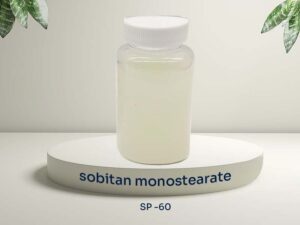
Similarly, for Sorbitan Monostearate (E491) and its counterparts (E492–E495), our specifications align with the EU’s mandates for acid value, melting range, and ester content. These parameters are critical for stabilizing water-in-oil emulsions in bakery and confectionery applications.
| Parâmetro | E 491 (Monostearate) | E 492 (Tristearate) | E 493 (Monolaurate) | E 494 (Monooleate) | E 495 (Monopalmitate) |
|---|---|---|---|---|---|
| Water content | ≤2% | ≤2% | ≤2% | ≤2% | ≤2% |
| Sulphated ash | ≤0.5% | ≤0.5% | ≤0.5% | ≤0.5% | ≤0.5% |
| Valor de acidez | ≤10 | ≤15 | ≤7 | ≤8 | ≤7.5 |
| Valor de saponificação | 147−157 | 176−188 | 155−170 | 145−160 | 140−150 |
| Valor de hidroxila | 235−260 | 66−80 | 330−358 | 193−210 | 270−305 |
| Arsenic (As) | ≤3 mg/kg | ≤3 mg/kg | ≤3 mg/kg | ≤3 mg/kg | ≤3 mg/kg |
| Chumbo (Pb) | ≤2 mg/kg | ≤2 mg/kg | ≤2 mg/kg | ≤2 mg/kg | ≤2 mg/kg |
| Mercury (Hg) | ≤1 mg/kg | ≤1 mg/kg | ≤1 mg/kg | ≤1 mg/kg | ≤1 mg/kg |
| Cadmium (Cd) | ≤1 mg/kg | ≤1 mg/kg | ≤1 mg/kg | ≤1 mg/kg | ≤1 mg/kg |
| Congealing range | 50−52 °C | 47−50 °C | —— | —— | 45−47 °C |
| Iodine value | —— | —— | —— | 80−100 | —— |
2. US FDA and FCC Compliance: The Gold Standard
In the United States, food additive safety is governed by the Code of Federal Regulations (CFR) Title 21. Specifically, 21 CFR Part 172 Subpart I outlines the permitted use of Multipurpose Additives, including Polysorbates and Sorbitan Esters.
O Food Chemicals Codex (FCC) provides the specific purity monographs recognized by the FDA. Our manufacturing process ensures that:
- Lead (Pb) & Arsenic (As): Levels are maintained at ≤ 2 mg/kg and ≤ 3 mg/kg respectively, meeting the safety thresholds required for the US market.
- Identity Testing: Our products pass the infrared absorption and solubility tests defined in the FCC monographs, confirming they are chemically identical to domestically produced US additives.
3. Universal Testing Methodologies: The Role of JECFA
A common misconception is that different regional standards imply different testing results. In reality, the analytical chemistry behind these standards is harmonized through the FAO JECFA Monographs, Volume 4.
JECFA (Joint FAO/WHO Expert Committee on Food Additives) publishes the “Combined Methods of Analysis,” which serves as the ultimate reference for both the EU and the FCC.
Comparison of Testing Protocols
| Parâmetro | GB/T Method | International Equivalent | Methodology |
| Saponification/Hydroxyl | GB 25553-2010 A.4-A.6 | USP/FCC / JECFA Vol 4 | Classical Volumetric Titration |
| Heavy Metals (Pb, As) | GB 25553-2010 A.10 | JECFA / AAS | Atomic Absorption Spectrometry |
| Teor de umidade | GB/T 6283 | Karl Fischer Method | Direct Electrometric Titration |
| 1,4-Dioxane / Ethylene Oxide | Internal GC-MS | JECFA Vol 4 | Cromatografia gasosa |
By utilizing the Karl Fischer method for water content and Atomic Absorption Spectrometry for heavy metals, FoodEmul ensures that a Certificate of Analysis (COA) issued in our lab will be verified and accepted by customs laboratories in Rotterdam, Los Angeles, or Shanghai.
4. Heavy Metal and Purity Control: Exceeding the Minimum
Safety is non-negotiable. Our internal quality control often sets “Safe Harbor” limits that are more stringent than the base requirements.
- Arsenic (As): While many standards allow up to 3 mg/kg, our batch results typically show levels significantly lower, providing an extra layer of security for infant formula or sensitive food applications.
- Mercury (Hg) & Cadmium (Cd): Following EU E431-E436 protocols, we ensure these toxic elements are kept below 1 mg/kg.
5. Documentation for Global Assurance
To facilitate a seamless import process, FoodEmul provides a comprehensive documentation suite with every shipment:
- Batch-Specific COA: Real-time test results (e.g., Lot P24112509) proving compliance with FCC/EU target ranges.
- Detailed TDS: Explicitly citing E-Numbers (E432, E433, E435, etc.) and FCC grades for formulation records.
- Regulatory Declarations: Certificates confirming Non-GMO, Halal, Kosher, and allergen-free status.
Conclusion: One Product, Global Reach
The technical data confirms a clear reality: the standards for Tween and Span series in China (GB), the US (FCC/FDA), and Europe (EU) are scientifically equivalent. By adhering to the testing methodologies defined in the JECFA Monographs, FoodEmul provides food-grade emulsifiers that are truly “plug-and-play” for international manufacturers.
Whether you are formulating for the European bakery market or the American sauce and dressing industry, our Tween 60, Polysorbate 80, and Sorbitan Monostearate offer the regulatory compliance and high-purity performance required for the modern global supply chain.