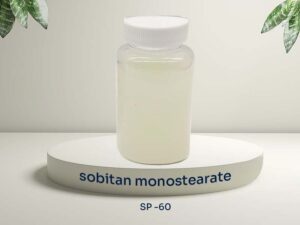

Introduction to Sorbitan Monostearate (Span 60) in Food Engineering
أحادي ستيرات السوربيتان, widely known in the industry as سبان 60, is a lipophilic (oil-loving) non-ionic surfactant used extensively as an emulsifier and stabilizer in the global food industry. Chemically, it is an ester of sorbitan and stearic acid, characterized by its ability to bridge the gap between oil and water phases, ensuring texture consistency and shelf-life stability.
In high-performance food manufacturing, Sorbitan Monostearate is rarely used in isolation. It is frequently paired with hydrophilic emulsifiers—most notably Polysorbate 60, 65, and 80—to create a balanced HLB (التوازن المحب للماء والمحب للدهون) system. This synergy is critical for achieving the sophisticated aeration required in bakery products and the stable fat suspension needed in dairy alternatives.
Technical Application Profiles of Sorbitan Monostearate
The functionality of Sorbitan Monostearate extends beyond simple emulsification. Its specific molecular structure allows it to function as a rehydration aid, a gloss enhancer, and an aeration catalyst.
1. Whipped Toppings and Aerated Edible Oils
In whipped edible oil toppings, the primary challenge is maintaining foam stability and preventing syneresis (water leakage). Sorbitan Monostearate aligns at the oil-water interface to strengthen the film surrounding air bubbles.
- Synergy: When combined with Polysorbate 60, it allows for a higher total emulsifier threshold, which significantly improves the “overrun” (volume increase) and the stiffness of the peaks in the topping.
2. Industrial Bakery: Cakes and Cake Mixes
In the bakery sector, Span 60 acts as a crumb softener and volume enhancer. It interacts with flour proteins and starches to prevent staling and improve the elasticity of the batter.
- Performance: It ensures that fats are finely dispersed throughout the batter, leading to a uniform pore structure (crumb) and preventing the collapse of the cake during the cooling phase.
3. Confectionery Coatings and Standardized Cacao Products
For nonstandardized confectionery coatings and chocolate-related products, Sorbitan Monostearate is essential for bloom inhibition. Fat bloom—the white, dusty appearance on chocolate—occurs when fats recrystallize on the surface. Span 60 stabilizes the fat crystals in their desired polymorphic form, maintaining a glossy finish and “snap.”
4. Dairy Substitutes: Coffee Whiteners and Creamers
Solid-state vegetable fat emulsions used in beverage coffee rely on Sorbitan Monostearate to remain stable in high-temperature, acidic environments (like hot coffee). It prevents the “feathering” effect, where the creamer separates or clumps upon contact with the liquid.
5. Yeast Production and Rehydration
Unique to its chemical profile, Sorbitan Monostearate serves as a rehydration aid for active dry yeast. During the drying process of yeast, the cell membranes can become brittle. Span 60 coats the yeast cells, protecting them during drying and facilitating a controlled, even uptake of water during rehydration, which maximizes leavening power.
6. Protective Coatings for Produce
In post-harvest technology, Sorbitan Monostearate is blended with white mineral oil or petroleum wax to create a breathable, protective barrier for raw fruits and vegetables. This coating reduces moisture loss and extends the “fresh-look” shelf life of the produce.
Regulatory Compliance and Usage Limits
To ensure consumer safety and food-grade integrity, the use of Sorbitan Monostearate is strictly governed by concentration limits. These limits are calculated based on the weight of the finished product or, in the case of bakery, the dry weight of the mix.
Technical Comparison of Maximum Usage Limits
The following table outlines the maximum allowable concentrations of Sorbitan Monostearate (SMS) and its combinations with Polysorbates (PS) according to standard food safety regulations:
| Application Category | Maximum SMS (Alone) | Combined Emulsifier Limits | Specific Constraints |
| Whipped Edible Oil Topping | 0.4% | Max 0.4% (w/ PS 60/65/80) | If w/ PS 60: SMS max 0.27%, PS 60 max 0.77% |
| Cakes & Cake Mixes | 0.61% | Max 0.66% (Total) | PS 65 max 0.32%; PS 60 max 0.46% (Dry weight) |
| Confectionery Coatings | 1.0% | Max 1.0% (Total) | If w/ PS 60: PS 60 limit is 0.5% |
| Cake Icings & Fillings | 0.7% | Max 1.0% (Total) | PS 65 max 0.32%; PS 60 max 0.46% |
| Coffee Creamer Substitutes | 0.4% | Max 0.4% (w/ PS 60/65) | Based on finished emulsion weight |
| Active Dry Yeast | 1.0% | غير متوفر | Acts strictly as a rehydration aid |
| Fruit/Veggie Coatings | Quantum Satis | Combined w/ PS 60 | Minimum quantity required for effect |
Critical Labeling and Safety Standards
For B2B procurement and industrial application, Sorbitan Monostearate must meet rigorous labeling requirements to ensure end-product compliance:
- Identity Verification: The ingredient must be clearly labeled as “Sorbitan Monostearate” on all primary packaging and technical data sheets (TDS).
- Concentration Transparency: Any intermediate premixes containing the additive must state the exact concentration or strength to allow manufacturers to calculate final dosage accurately.
- Usage Instructions: Labeling must provide adequate directions to ensure the final food product does not exceed the legal thresholds listed in the table above.
خاتمة
Sorbitan Monostearate is a versatile, industrial-grade emulsifier that provides essential structural benefits across the food processing spectrum. Whether used to stabilize a coffee creamer or to protect the potency of dry yeast, its application must be balanced with precise regulatory limits and a deep understanding of its synergistic relationship with polysorbates.
For manufacturers seeking to optimize texture and stability, adhering to these high-authority standards ensures both product excellence and regulatory peace of mind.