
Sorbitan Monostearate — Span 60, E491 — is the solid emulsifier you’ll find in more industrial food lines than any other member of the Span family. Its effectiveness comes down to two things: knowing which application to use it in, and staying within the regulatory dosage cap for that application. This guide covers both.
For the molecular chemistry, full specs, and physical properties, see our Chemical Properties & Specifications Guide.
What Is Span 60 (Sorbitan Monostearate)?
Sorbitan Monostearate (Span 60, E491, INCI: Sorbitan Stearate) is a nonionic, oil-soluble emulsifier made by esterifying sorbitol with stearic acid (C₁₈). It’s the most widely used Span series member thanks to its balance of lipophilicity (HLB 4.7) and thermal stability (melting point 52–57°C). Span 60 works primarily as a water-in-oil (W/O) emulsifier. It’s approved for food use under FDA 21 CFR 172.842 and as food additive E491 in the EU.
Chemical Properties Quick Reference
| Property | Value |
|---|---|
| Chemical Name | Sorbitan Monostearate |
| CAS Number | 1338-41-6 |
| E-Number | E491 |
| INCI Name | Sorbitan Stearate |
| Molecular Formula | C₂₄H₄₆O₆ |
| Molecular Weight | 430.62 g/mol |
| HLB Value | 4.7 |
| Melting Point | 52–57°C |
| Appearance | White to cream waxy solid/flakes |
| Solubility | Dispersible in hot water; soluble in hot ethanol, oils |
| FDA Status | GRAS, 21 CFR 172.842 |
Span 60 vs. Other Sorbitan Esters: Quick Comparison
Span 60 sits in the middle of the Span series in terms of lipophilicity. Here’s how it stacks up against its neighbors:
| Property | Span 20 | Span 40 | Span 60 | Span 65 | Span 80 |
|---|---|---|---|---|---|
| Fatty Acid | Lauric (C₁₂) | Palmitic (C₁₆) | Stearic (C₁₈) | Tristearate | Oleic (C₁₈:₁) |
| HLB | 8.6 | 6.7 | 4.7 | 2.1 | 4.3 |
| Melting Point | Liquid | 42–46°C | 52–57°C | 53–57°C | Liquid |
| E-Number | E493 | E495 | E491 | E492 | E494 |
For the full sorbitan ester lineup, see our Sorbitan Esters (Span Series) Complete Guide. For the tristearate variant, see our Span 60 vs. Span 65 Comparison.
Application Profiles
Whipped Toppings and Aerated Edible Oils
The main challenge in whipped toppings: keeping foam stable and stopping water from leaking out (syneresis). Span 60 lines up at the oil-water interface, strengthening the film around air bubbles.
- Synergy: Paired with Polysorbate 60, Span 60 lets you push total emulsifier higher — but when Polysorbate 60 is unavailable, start with our application-ranked Polysorbate 60 alternatives, improving overrun and peak stiffness.
- Dosage: Span 60 max 0.4% alone, or 0.27% Span 60 + 0.77% Polysorbate 60 combined.
Industrial Bakery: Cakes and Cake Mixes
Span 60 acts as a crumb softener and volume booster. It complexes with amylose in wheat starch, slowing staling, and keeps fat evenly spread through the batter.
- Performance: Even pore structure, resists collapse during cooling.
- Dosage: Span 60 max 0.61% alone, or combined total max 0.66% (dry weight). With Polysorbate 60: PS60 max 0.46%. With Polysorbate 65: PS65 max 0.32%.
Confectionery Coatings and Chocolate
Span 60 stabilizes fat crystals in their desired polymorphic form, preventing fat bloom — the dusty white surface from recrystallized cocoa butter.
- Performance: Holds gloss and snap through temperature swings.
- Dosage: Span 60 max 1.0% alone, or max 1.0% combined with Polysorbate 60 (PS60 max 0.5%).
Dairy Substitutes: Coffee Whiteners and Creamers
Solid-state vegetable fat emulsions need to stay stable in hot, acidic coffee. Span 60 prevents feathering — that moment when creamer separates or clumps on contact with hot liquid.
- Dosage: Span 60 max 0.4% (alone or combined with Polysorbate 60/65), based on finished emulsion weight.
Cake Icings and Fillings
Span 60 provides structure and stops oil separation in high-fat icings and cream fillings.
- Dosage: Span 60 max 0.7% alone, or combined total max 1.0%. Polysorbate 60 portion max 0.3%.
Other Nonstandardized Foods
For food products without a specific FDA standard of identity, Span 60 can be used at levels consistent with GMP (Good Manufacturing Practice) — the minimum amount needed to achieve the intended effect.
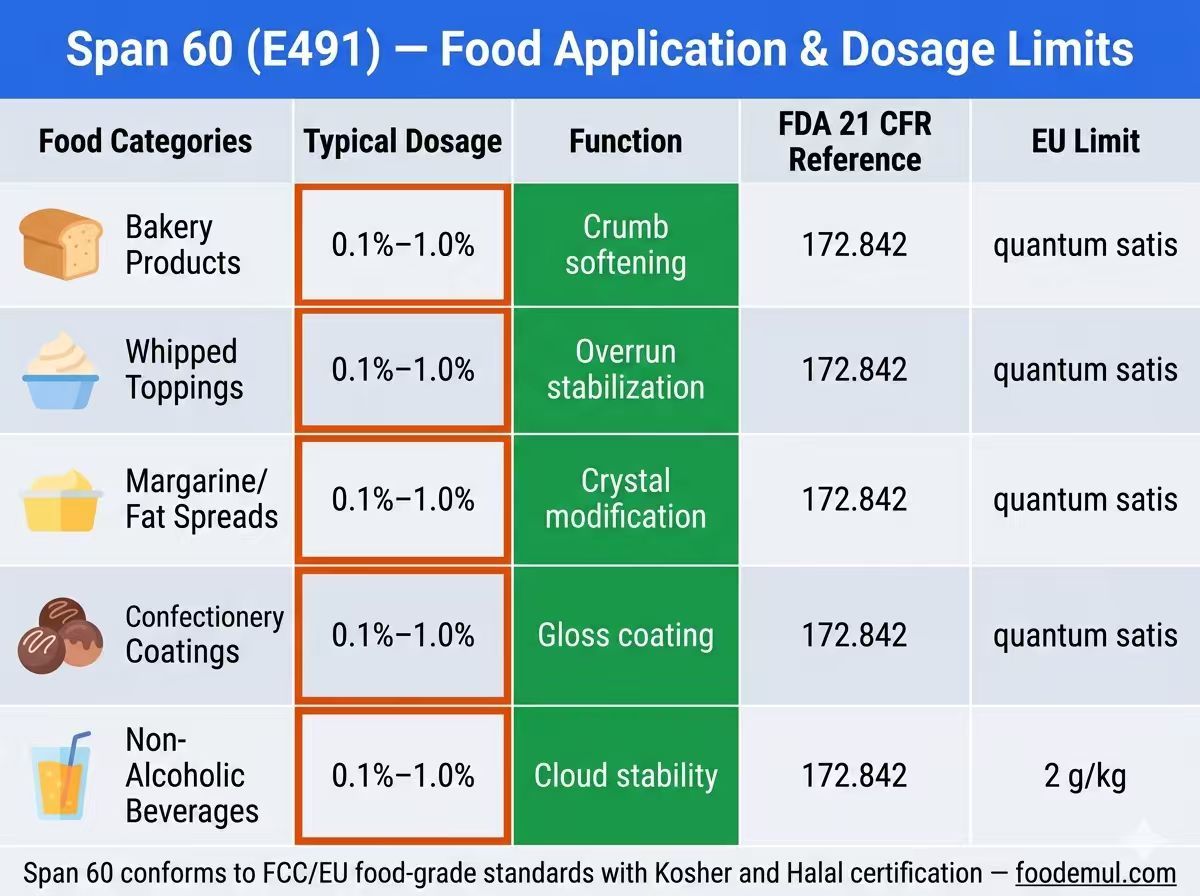
Regulatory Limits Summary
| Application | Span 60 Max (alone) | Combined Max | Polysorbate Partner | Polysorbate Max |
|---|---|---|---|---|
| Whipped toppings | 0.4% | 0.4% + PS60 | Polysorbate 60 | 0.77% |
| Cakes / cake mixes | 0.61% | 0.66% | PS60 or PS65 | PS60: 0.46% / PS65: 0.32% |
| Confectionery coatings | 1.0% | 1.0% | Polysorbate 60 | 0.5% |
| Coffee creamers | 0.4% | 0.4% | PS60 or PS65 | Per GMP |
| Cake icings / fillings | 0.7% | 1.0% | Polysorbate 60 | 0.3% |
| Nonstandardized foods | Per GMP — minimum needed for intended effect | |||
Global Regulatory Compliance
- USA (FDA): GRAS under 21 CFR 172.842. Application-specific limits as listed above. Label: “Sorbitan Monostearate” or “E491.”
- EU (EFSA): Approved as E491. ADI: 10 mg/kg body weight/day (as sorbitan esters total). Quantum satis in most categories; specific limits apply.
- Codex Alimentarius: INS 491. Listed in GSFA with category-specific maximum use levels.
- Japan: Approved as a food additive. Subject to MHLW specifications.
- Halal / Kosher: Certifiable — no animal-derived raw materials. Plant-based stearic acid and sorbitol. FoodEmul’s Span 60 carries Halal (MUI, Indonesia) and Kosher certification.
How to Use Span 60 — Practical Guidelines
Dispersion Method
- Span 60 is a waxy solid — it won’t disperse in cold water. Melt it into the fat/oil phase at 55–65°C before combining with the water phase.
- For O/W emulsions: add dissolved Span 60 to the hot fat phase, then slowly add the water phase under high-shear mixing.
- For W/O emulsions: dissolve Span 60 in the continuous fat phase, then disperse the water phase gradually.
Temperature Requirements
- Minimum processing temperature: 55°C (above melting point).
- Optimal: 60–65°C for complete dissolution and uniform dispersion.
- Stable up to 200°C — no degradation at standard food processing temperatures.
HLB Blending with Polysorbates
Span 60 (HLB 4.7) is almost never used at full dosage alone. The practical approach is to blend with a polysorbate to hit the target HLB for your specific product. Add the polysorbate at the calculated ratio to achieve the combined HLB your formula needs. For methodology, see our Span & polysorbate Formulators Guide.
Key Takeaways
- Span 60 (E491) is approved for food use globally — FDA GRAS, EU E491, Codex INS 491.
- Application-specific dosage limits exist — confectionery coatings allow up to 1.0%, whipped toppings cap at 0.4%.
- Span 60 almost always works best blended with a polysorbate (polysorbate 60, PS80) — the HLB ratio determines performance.
- FoodEmul’s Span 60 carries Halal (MUI, Indonesia) and Kosher certification. Contact us for certificates.
This guide references FDA 21 CFR 172.842, EU Regulation (EC) No 1333/2008, Codex GSFA, and published emulsifier science research (Hu et al., 2011). For your specific application and regulatory jurisdiction, consult your emulsifier supplier’s technical service team.