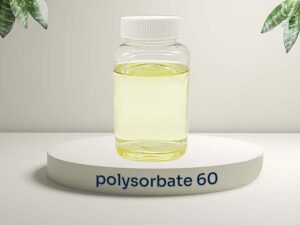

Le développement réussi d'un produit contenant du polysorbate 60 (Tween 60) ne se limite pas à son ajout à un mélange. Pour obtenir une émulsion stable et non séparable, les formulateurs doivent respecter des protocoles de température et de mélange précis.
Ce guide couvre les aspects techniques et pratiques des applications alimentaires, cosmétiques et industrielles.
1. Préparation : Détermination du dosage
Le niveau d’utilisation du polysorbate 60 varie considérablement en fonction de l’application et des réglementations locales (FDA/EFSA).
- Produits de boulangerie de qualité : 0,1% – 0,5% (basé sur le poids de la farine).
- Garnitures fouettées et émulsions à base d'huile : 0,2% – 0,4%.
- Lotions cosmétiques : 1% – 5% (en tant qu'émulsifiant primaire ou co-émulsifiant).
- Crèmes glacées et desserts glacés : 0,1% pour améliorer l'incorporation d'air et le séchage.
2. Règles de température et de solubilité
Le polysorbate 60 est un tensioactif non ionique qui devient plus actif à des températures spécifiques :
- Chauffage: Pour de meilleurs résultats, chauffez la phase aqueuse à 60°C – 70°C.
- Ajout de phase : Le polysorbate 60 est généralement ajouté au phase aqueuse en raison de son HLB élevé (14,9). Cependant, dans certains procédés cosmétiques “ tout-en-un ”, il peut être prémélangé à la phase huileuse avant l’émulsification.
- Évitez la surchauffe : Une exposition prolongée à des températures supérieures à 90 °C peut entraîner une oxydation et des odeurs désagréables.
3. Processus d'émulsification étape par étape
Pour créer une émulsion huile-dans-eau (H/E) stable à l'aide de polysorbate 60, suivez ces étapes :
- Préparation de la phase aqueuse : Dissoudre le polysorbate 60 dans de l'eau chaude (65 °C) en remuant doucement pour éviter une mousse excessive.
- Préparation de la phase huileuse : Chauffez vos huiles/graisses à la même température que la phase aqueuse.
- La phase de mélange : Ajouter lentement la phase huileuse à la phase aqueuse en utilisant un mélangeur à cisaillement élevé.
- Refroidissement: Continuez à remuer lentement pendant le refroidissement. Cela permet aux chaînes d'acide stéarique du Tween 60 de cristalliser correctement, assurant ainsi la texture crémeuse recherchée.
4. Combinaisons synergiques (Le système HLB)
Dans de nombreuses formulations professionnelles, le polysorbate 60 n'est pas utilisé seul. Il est souvent associé à des émulsifiants à faible HLB pour créer un “ système émulsifiant ” performant.”
- Tween 60 + stéarate de sorbitane (Span 60) : Il s'agit du duo B2B le plus courant. En mélangeant ces deux huiles, vous pouvez ajuster précisément le HLB pour qu'il corresponde parfaitement à votre type d'huile.
- Tween 60 + Mono- et diglycérides (GMS) : Largement utilisé dans les gels industriels pour gâteaux et les améliorants pour pain afin d'améliorer la douceur et l'aération de la mie.
5. Dépannage des problèmes courants
- Séparation des produits : Ce problème est généralement dû à un HLB inadapté ou à une vitesse de mélange insuffisante. Essayez d'ajouter une petite quantité de co-émulsifiant.
- Trouble dans les liquides clairs : Le polysorbate 60 peut rendre l'eau trouble si sa concentration est trop élevée. Si une eau limpide est souhaitée, il est conseillé d'utiliser du polysorbate 20.
- Mousse excessive : Réduire la vitesse d'agitation pendant la dissolution initiale dans l'eau.
6. Stockage et manutention
Pour maintenir la durée de conservation de votre formulation :
- Conserver le polysorbate 60 dans un endroit frais et sec, à l'abri de la lumière directe du soleil.
- Veillez à bien fermer le récipient pour éviter l'absorption d'humidité, qui peut affecter la précision de la concentration dans vos recettes.