
Polysorbate 60 at HLB 14.9, with a stearic acid backbone — this is the emulsifier behind most commercial cake gels, whipped toppings, and dairy emulsions. At FoodEmul, we manufacture it alongside Span 60 (HLB 4.7), and the 1:2 to 1:3 Span 60:Polysorbate 60 ratio is one of the most proven compound emulsifier systems in the industry. This guide covers how to use Polysorbate 60 — from HLB calculation to dosage ranges, co-emulsifier selection, and process integration.
Preparation: Determining the Dosage
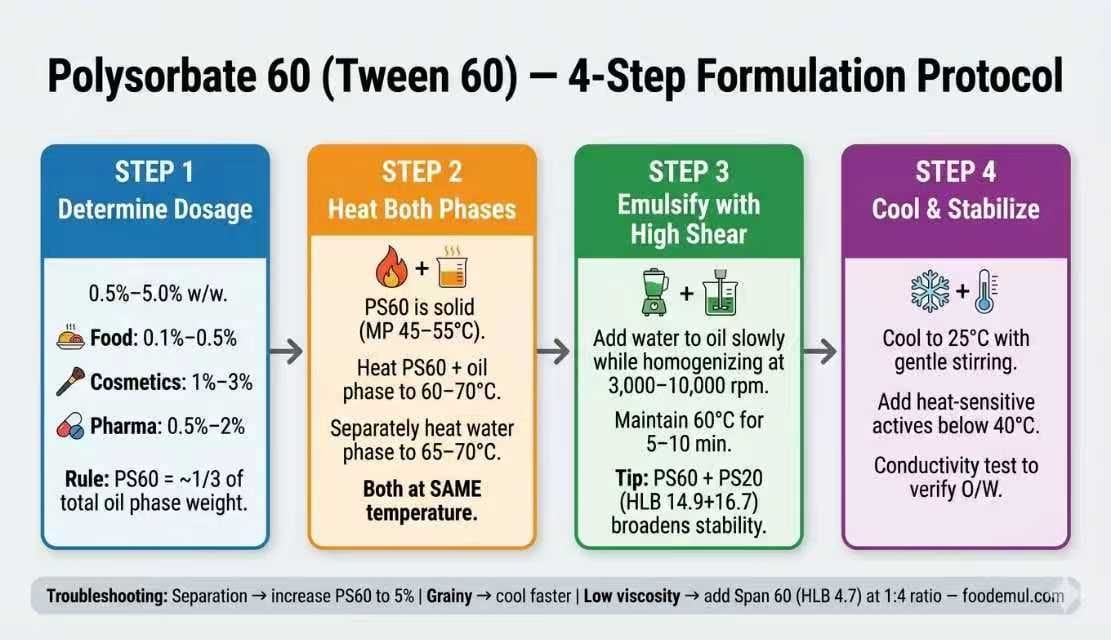
The usage level of Polysorbate 60 varies significantly depending on the application and local regulations (FDA/EFSA).
- Fine Bakery Wares: 0.1% – 0.5% (based on flour weight).
- Whipped Toppings & Oil-based Emulsions: 0.2% – 0.4%.
- Cosmetic Lotions: 1% – 5% (as a primary or co-emulsifier).
- Ice Cream & Frozen Desserts: 0.1% to improve air incorporation and dryness.
Temperature and Solubility Rules
Polysorbate 60 is a non-ionic surfactant that becomes more active at specific temperatures:
- Heating: For the best results, heat the water phase to 60°C – 70°C.
- Phase Addition: Polysorbate 60 is typically added to the water phase due to its high HLB (14.9). However, in specific “One-Pot” cosmetic processes, it can be pre-mixed with the oil phase before emulsification.
- Avoid Overheating: Prolonged exposure to temperatures above 90°C may lead to oxidation and off-odors.
Step-by-Step Emulsification Process
To create a stable Oil-in-Water (O/W) emulsion using Polysorbate 60, follow these steps:
- Water Phase Preparation: Dissolve Polysorbate 60 in warm water (65°C) while stirring gently to avoid excessive foaming.
- Oil Phase Preparation: Heat your oils/fats to the same temperature as the water phase.
- The Mixing Phase: Slowly add the oil phase into the water phase while using a high-shear mixer.
- Cooling: Continue slow stirring during the cooling process. This ensures the stearic acid chains in Polysorbate 60 crystallize correctly, providing the desired creamy texture.
Co-Emulsifier Pairing
Polysorbate 60 (HLB 14.9) is rarely used alone. The standard practice is pairing with Span 60 (HLB 4.7) at approximately a 3:1 ratio for a blended HLB of ~12. For the full HLB additive principle and pairing guidance, see the Pillar Guide .
Troubleshooting Common Issues
- Product Separation: Usually caused by an incorrect HLB match or insufficient mixing speed. Try adding a small amount of a co-emulsifier such as Span 60 (Sorbitan Monostearate, HLB 4.7) to fine-tune the overall HLB of your emulsifier system.
- Cloudiness in Clear Liquids: Polysorbate 60 may create a cloudy appearance if the concentration is too high. At room temperature it exists as a semi-solid gel; for clear liquid applications, consider switching to Polysorbate 20 (HLB 16.7, liquid at room temperature).
- Excessive Foaming: Reduce the stirring speed during the initial dissolution in water. Polysorbate 60 has a viscosity of approximately 0.60 Pa·s; gentle stirring below 100 rpm during hydration minimizes air incorporation.
Storage and Handling
To maintain the shelf life of your formulation:
- Store Polysorbate 60 in a cool, dry place, away from direct sunlight. The flash point is >149°C, but prolonged heat exposure accelerates oxidation.
- Ensure the container is tightly sealed to prevent moisture absorption, which can affect the concentration accuracy in your recipes.
- At temperatures below 25°C, Polysorbate 60 naturally thickens to a gel-like consistency. Gentle warming to 30-35°C restores pourability without affecting emulsification performance.
Before scaling to production, review the safety profile of Polysorbate 60 — including LD₅₀ data (>10 g/kg), FDA GRAS status, and 3-tier emulsifier safety classification.
Related: Polysorbate 60: A Versatile Emulsifier for Food, Cosmetics, and Pharmaceuticals
Need Polysorbate 60 for your formulation? We manufacture it alongside Span 60 and the full sorbitan ester range — reach out for technical support or samples.