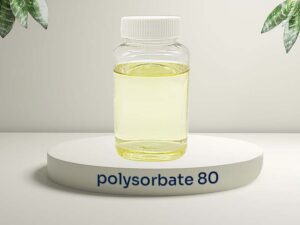
In the complex world of industrial formulation, few surfactants offer the versatility and stability of Полисорбат 80, also known commercially as Подросток 80. Whether you are an R&D manager developing a new silk-textured ice cream or a procurement officer ensuring religious compliance for global exports, understanding this ingredient is essential.
В foodemul.com, we prioritize transparency and technical precision. This guide serves as a definitive resource on the chemistry, applications, and safety profile of Polysorbate 80 (E433).
1. What is Polysorbate 80? (The Technical Profile)
Chemically defined as Полиоксиэтилен (20) сорбитан моноолеат, Polysorbate 80 is a non-ionic surfactant derived from polyethoxylated sorbitan and oleic acid.
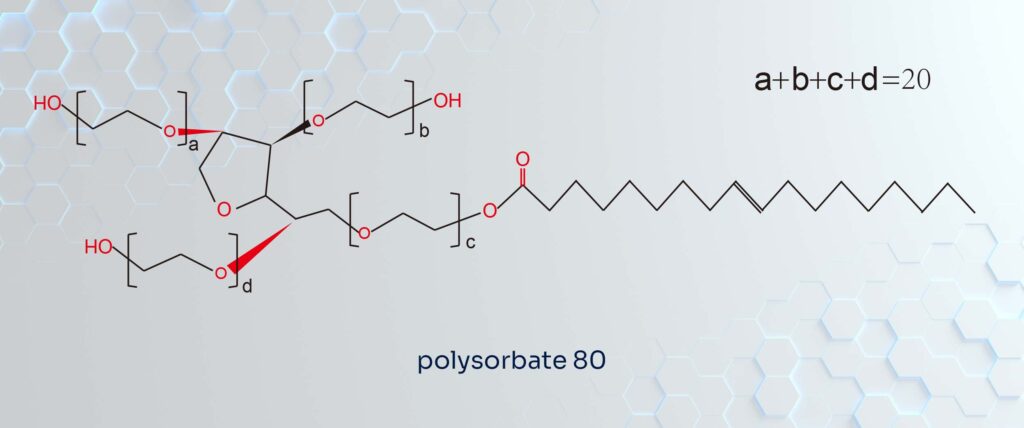
Key Specifications:
- Значение HLB: Approximately $15.0$. This high Hydrophilic-Lipophilic Balance indicates that the molecule is water-soluble and exceptionally effective at creating Oil-in-Water (O/W) emulsions.
- E-номер: E433 (Europe).
- Function: Emulsifier, solubilizer, and wetting agent.
Formulator’s Note: The “80” refers to the олеиновая кислота moiety. This distinguishes it from Polysorbate 20 (lauric acid) or Polysorbate 60 (stearic acid). Its efficacy relies heavily on the purity of the oleic acid source, which dictates the final surfactant’s color and odor.
2. Functional Roles in Food and Industry
Polysorbate 80 is ubiquitous because it solves thermodynamic instability issues that “clean” ingredients often cannot.
Мороженое и замороженные десерты
In ice cream, Polysorbate 80 actually acts to дестабилизировать the fat emulsion slightly during freezing. This allows fat globules to agglomerate and trap air bubbles, resulting in:
- Controlled Overrun: A creamy, smooth texture instead of a solid ice block.
- Стойкость к плавлению: Helping the product retain its shape as it warms.
Condiments, Pickles, and Brines
Many flavor compounds, such as dill oil or turmeric, are not water-soluble. Polysorbate 80 acts as a солюбилизатор, dispersing these oils evenly throughout the aqueous phase to ensure clarity and consistent flavor distribution.
Cosmetics & Pharmaceuticals
- Уход за кожей: It solubilizes essential oils and fragrances into water-based toners and serums without inducing cloudiness.
- Pharma: It is a critical excipient used to stabilize aqueous formulations of medications and vaccines.
3. Dietary & Lifestyle Compliance: Is It Safe for Everyone?
Modern consumers scrutinize labels for more than just health—they look for ethical and religious alignment.
Is Polysorbate 80 Vegan?
The “vegan status” depends entirely on the feedstock of the oleic acid. While historically derived from animal tallow, foodemul.com standards ensure that our Polysorbate 80 is 100% vegetable-origin (typically from olive, sunflower, or palm oil), making it vegan-friendly.
Is It Gluten-Free?
Yes. The precursors—sorbitol (from corn/tapioca), ethylene oxide, and oleic acid—contain no wheat, barley, or rye derivatives. It is inherently gluten-free.
Religious Certification (Halal & Kosher)
For global export, religious certification is non-negotiable.
| Requirement | Polysorbate 80 Status | foodemul.com Standard |
| Халяль | Must be free from animal tallow and alcohol processing. | Certified Vegetable-origin; Ethanol-free. |
| Кошерный | Must be derived from Kosher-certified fatty acids. | Certified Kosher Pareve (neutral). |
4. Safety Profile: Regulatory Status and Gut Health
Polysorbate 80 is designated as Generally Recognized As Safe (GRAS) by the U.S. FDA and is approved in the EU (E433). The Acceptable Daily Intake (ADI) is set at 0–25 мг/кг массы тела.
Modern Research: The Microbiome
Recent animal-model studies have suggested that high consumption of dietary emulsifiers may impact the gut mucus barrier. The hypothesis suggests that increased intestinal permeability could trigger low-grade inflammation.
The Reality for Formulators: Regulatory bodies like the EFSA and FDA continuously review this data. At the low concentrations typically used in food (often $<1\%$), Polysorbate 80 remains widely regarded as safe for the general population.
5. Technical Comparison: Polysorbate 80 vs. 60
Choosing the right “Tween” depends on your oil phase and physical requirements.
| Особенность | Полисорбат 80 (Твин 80) | Полисорбат 60 (Твин 60) |
| Источник жирных кислот | Олеиновая кислота (ненасыщенная) | Стеариновая кислота (насыщенная) |
| Физическое состояние | Вязкая желтая жидкость | Восковая паста / Твердое вещество |
| Значение HLB | 15.0 | 14.9 |
| Основное применение | Ice cream, liquid solubilization | Cakes, icings, aeration |
6. Identification and Alternatives
To confirm a product is free of this emulsifier, scan the ingredient deck for synonyms: Polysorbate 80, Tween 80, Polyoxyethylene (20) sorbitan monooleate, or E433.
Natural “Clean Label” Alternatives
While Polysorbate 80 is highly efficient, “clean label” projects may require alternatives:
- Lecithin (Soy/Sunflower): Natural, but has a much lower HLB.
- Acacia Gum: Provides stabilization but lacks the high-power solubilizing strength of Tweens.
- Egg Yolks: Often used in “super-premium” ice creams as a traditional emulsifier.
Final Thoughts for Formulators
Navigating the technical and regulatory landscape of surfactants requires reliable data. When sourced from high-quality manufacturers, Polysorbate 80 is a safe, effective, and versatile tool that meets the rigorous demands of the global market.
Looking for high-purity surfactants?
Explore the foodemul.com product catalog for technical data sheets (TDS), safety data sheets (SDS), or bulk quotation requests.