
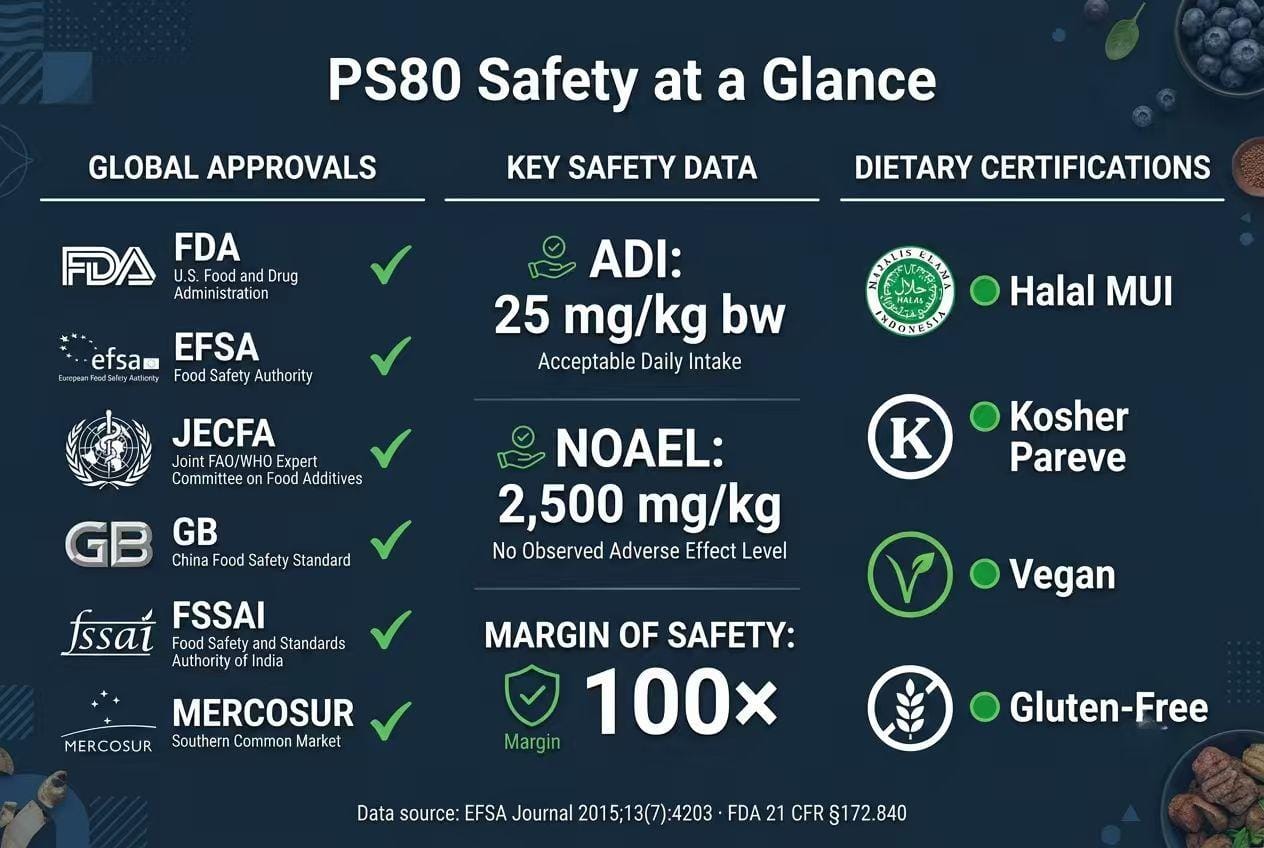
Polysorbate 80 is approved in every major food market. It has a safety margin of 100× the acceptable daily intake. And it carries Halal and Kosher certification without special processing. When procurement asks “can we ship this to the EU, China, and the Middle East?” — the answer is yes, same spec sheet, no reformulation.
This guide covers the regulatory approvals, toxicology data, and compliance documentation that R&D and procurement teams actually need. For chemistry and applications, see our What Is Polysorbate 80? Complete Technical Guide. For a deeper dive into solubilization ratios and essential oil compatibility, see our guide on Polysorbate 80 and Polysorbate 20 as Flavor and Fragrance Solubilizers.
Quick Reference Specifications
Polysorbate 80 is widely used in skincare as a gentle emulsifier and fragrance carrier. For a complete view of all three polysorbates in personal care — including PS20 for solubilization and PS60 for cream emulsification — see our formulator’s guide to polysorbates in skincare and haircare.
Polysorbate 80 is a non-ionic surfactant — one of the most widely used in food and pharma. To understand what “non-ionic” means, how it compares to ionic surfactants, and where it fits in the HLB scale, see our guide to non-ionic surfactant chemistry and selection.
| Parameter | Specification (Food Grade, FCC/JECFA) |
|---|---|
| CAS Number | 9005-65-6 |
| E-Number / INS | E433 / INS 433 |
| HLB Value | 15.0 |
| Oxyethylene Content | 65.0–69.5% |
| Acid Value | ≤ 2.0 mg KOH/g |
| Saponification Value | 45–55 mg KOH/g |
| Hydroxyl Value | 65–80 mg KOH/g |
| Water Content | ≤ 3.0% |
| Heavy Metals (as Pb) | ≤ 10 mg/kg |
| Arsenic | ≤ 3 mg/kg |
For a complete Certificate of Analysis, contact our team. All FoodEmul PS80 is Kosher (MUI, Indonesia) and Halal certified.
Global Regulatory Approvals
PS80 is one of the most broadly approved synthetic emulsifiers worldwide. Here’s its status across six major jurisdictions:
| Agency | Status | ADI (mg/kg bw/day) | Key Document |
|---|---|---|---|
| FDA (USA) | 21 CFR §172.840; GRAS | No limit set | Direct food additive, multipurpose |
| EFSA (EU) | E433; re-evaluated 2015 | 25 mg/kg bw | EFSA Journal 2015;13(7):4203 |
| JECFA (WHO/FAO) | INS 433 | 0–25 mg/kg bw | Group ADI for polysorbates (20, 60, 65, 80) |
| GB 2760 (China) | Approved, CNS 10.025 | — | GB 2760-2024; permitted in 30+ food categories |
| FSSAI (India) | INS 433; permitted | GMP | FSS Regulations 2011, Table 2 of Appendix A |
| MERCOSUR | INS 433; harmonized | — | GMC Res. 11/06; aligned with Codex |
What this means: One spec sheet covers the US, EU, China, India, and South America. PS80 faces no regional regulatory dead ends. The only watch-out: JECFA’s group ADI means if your formulation already uses PS60, the combined polysorbate intake must stay under 25 mg/kg.
Safety Profile: What the Toxicology Data Says
EFSA 2015 Re-evaluation
The European Food Safety Authority’s 2015 re-assessment is the most thorough polysorbate review to date. Key findings:
- NOAEL: 2,500 mg/kg bw/day — from a two-year chronic toxicity study in rats. That’s 100× the ADI, giving a substantial safety margin.
- Absorption & metabolism: PS80 is largely broken down in the GI tract. The polyoxyethylene portion passes through largely unabsorbed.
- No carcinogenicity, genotoxicity, or reproductive toxicity at relevant exposure levels.
FDA Stance
FDA classifies PS80 as GRAS (Generally Recognized As Safe) under 21 CFR 172.840. No numerical ADI is set — the application-specific limits in the CFR serve as the practical ceiling. For the full list of 15 FDA-approved applications and their limits, see our PS80 Food Application Limits.
Handling, Storage, and Shelf Life
| Parameter | Recommendation |
|---|---|
| Storage temperature | 10–30°C; protect from freezing and direct sunlight |
| Shelf life | 24 months from date of manufacture in unopened original packaging |
| Pour point | ~7°C — pumpable at room temperature; warm to 15°C if cold-stored |
| Material compatibility | Stainless steel (316L), HDPE, PTFE-lined vessels. Avoid copper and brass — trace metal ions accelerate oxidation |
| Moisture sensitivity | Hygroscopic — keep containers sealed. Water uptake above 3% accelerates ester hydrolysis |
Quality Control: 3 Tests That Matter
| Test | What It Detects | Why It Matters |
|---|---|---|
| Acid Value | Free fatty acid level — hydrolysis indicator | Elevated acid value = partial ester breakdown = potential off-flavors in delicate products like vanilla ice cream or clear beverages |
| Hydroxyl Value | Residual hydroxyl groups — ethoxylation extent | Confirms correct EO chain length (~20 units); wrong hydroxyl value = wrong HLB = wrong emulsification behavior |
| Water Content (Karl Fischer) | Moisture level | Water above 3% accelerates ester hydrolysis and supports microbial growth; the most common degradation pathway in storage |
Procurement tip: the Acid Value is your single most informative quick check on a CoA. If it’s trending up across batches from the same supplier, hydrolysis is happening — either in storage or during manufacturing.
Halal, Kosher, and Certifications
| Certification | Status | Notes |
|---|---|---|
| Halal | ✅ Certified (MUI, Indonesia) | Plant-derived raw materials; no animal or alcohol components |
| Kosher | ✅ Certified — Pareve | No meat or dairy derivatives |
| Non-GMO | Available on request | Non-GMO sorbitol and fatty acid sources |
| Vegan | ✅ Suitable | No animal-derived raw materials |
For the full certification package details, see our Halal & Kosher Compliance Guide.
Key Takeaways
- PS80 is approved in all major markets — FDA GRAS, EU E433, China GB 2760, India FSSAI, MERCOSUR. No regulatory dead ends.
- Safety margin: NOAEL of 2,500 mg/kg bw/day is 100× the EFSA ADI. No carcinogenicity, genotoxicity, or reproductive toxicity at relevant levels.
- Best quick quality check: Acid Value on the CoA. Trending upward = hydrolysis. Trending steady = stable product.
- Store at 10–30°C, keep containers sealed. PS80 is hygroscopic — water uptake triggers the most common degradation pathway.
- FoodEmul PS80 ships with Halal (MUI), Kosher (Pareve), CoA, TDS, and SDS. Contact us for certificates or a sample.
This guide references EFSA Journal 2015;13(7):4203, FDA 21 CFR 172.840, JECFA Monographs, GB 2760-2024, and relevant Codex and FSSAI standards. For your specific regulatory jurisdiction, consult your compliance officer.