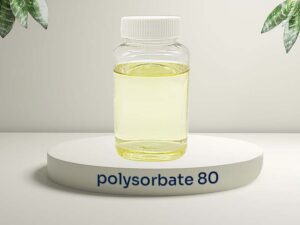

Introduction: The Role of Polysorbate 80 in Modern Food Engineering
Polysorbate 80, chemically defined as polyoxyethylene (20) sorbitan monooleate, is a sophisticated non-ionic surfactant and emulsifier. In the B2B food additive sector, it is recognized by its European code E433. This compound is a mixture of polyoxyethylene ethers of mixed partial oleic acid esters of sorbitol anhydrides.
Due to its high Hydrophilic-Lipophilic Balance (HLB) value of 15.0, it is the industry standard for creating stable oil-in-water emulsions, ensuring ingredient dispersion, and controlling foam in complex food matrices.
Manufacturing and Technical Standards
To meet Industrial-grade et Food-grade standards, Polysorbate 80 must be manufactured through the controlled reaction of oleic acid with sorbitol to yield a specific acid number, followed by precise ethoxylation.
Certified Technical Specifications:
- Saponification Number: 45–55
- Acid Number: 0–2 (Maximum 7.5 during intermediate stages)
- Hydroxyl Number: 65–80
- Oxyethylene Content: 65%–69.5%
- Maximum Water Content: 0.5%
Detailed Application Scenarios in Food Processing
1. Frozen Dairy and Non-Standardized Desserts
Polysorbate 80 is critical in the production of ice cream, frozen custard, ice milk, and fruit sherbet. It functions by partially displacing milk proteins from the fat globule surface. This promotes “controlled churning” during freezing, resulting in a smoother texture and preventing the dessert from melting too rapidly.
2. Specialized Condiments: Pickles and Barbecue Sauce
In the production of pickles and pickle products, Polysorbate 80 acts as a solubilizing and dispersing agent for spice oils. Similarly, in barbecue sauces, it serves as a surfactant and wetting agent for both natural and artificial colors, ensuring a vibrant, uniform appearance without separation during shelf life.
3. Baking and Confectionery: Shortenings and Whipped Toppings
Polysorbate 80 is an essential emulsifier in shortenings and edible oils. It is often used in a synergistic blend with Polysorbate 60 to improve the aeration of batters. For whipped edible oil toppings, it provides the structural integrity required to maintain foam stability and prevent the collapse of the topping.
4. Dairy Processing: Cottage Cheese and Gelatin
In the preparation of the creaming mixture for cottage cheese, Polysorbate 80 acts as a defoaming agent, ensuring the final product has the desired consistency without air pockets. In gelatin desserts and mixes, it serves as a dispersing agent to ensure the powder hydrates quickly and uniformly in water.
5. Nutrient Delivery: Vitamin-Mineral Preparations
As a high-HLB surfactant, Polysorbate 80 is indispensable for solubilizing fat-soluble vitamins (A, D, E, and K) in aqueous vitamin-mineral preparations. It is specifically regulated based on the presence of calcium caseinate, as the interaction between the emulsifier and the protein affects the delivery system’s stability.
6. Industrial Processing Adjuvants
Polysorbate 80 serves several behind-the-scenes roles in food manufacturing:
- Yeast Production: Used in yeast-defoamer formulations to control gas release during fermentation.
- Sodium Chloride Production: Acts as a surfactant in the production of coarse crystal sodium chloride, influencing the crystal growth and shape.
- Poultry Processing: Added to scald water for poultry defeathering as a wetting agent, allowing water to penetrate feathers more effectively for a cleaner removal process.
- Canned Vegetables: Acts as a solubilizer for dill oil in canned spiced green beans, ensuring the flavor is evenly distributed in the brine.
7. Agricultural Use: Herbicide and Plant-Growth Regulators
Beyond direct food addition, Polysorbate 80 is used by growers as an adjuvant for herbicide and plant-growth regulator dilutions. It enhances the “wetting” capability of the spray on crop leaves, ensuring the active agricultural chemicals are absorbed efficiently.
Regulatory Compliance and Usage Limits
Food chemical engineers must strictly adhere to the maximum permitted levels to ensure product safety and regulatory compliance.
The technical data below comes from the FDA-authorized source, eCFR 172.840 Polysorbate 80.
Technical Data: Polysorbate 80 Permitted Limits
| Application Scenario | Functional Role | FDA Compliance Limit |
| Frozen Desserts (Ice Cream, Sherbet, etc.) | Émulsifiant | Max 0.1% (alone or with Polysorbate 65) |
| Pickles & Pickle Products | Solubilizing Agent | Max 500 ppm |
| Shortenings & Edible Oils | Émulsifiant | Max 1.0% by weight |
| Whipped Edible Oil Toppings | Émulsifiant | Max 0.4% (alone or combined) |
| Yeast Defoamer Formulations | Defoaming Agent | Max 4% in defoamer; 4 ppm in final yeast |
| Cottage Cheese (Creaming Mixture) | Defoaming Agent | Max 0.008% of finished product |
| Gelatin Desserts & Mixes | Dispersing Agent | Max 0.082% (dry-weight basis) |
| Barbecue Sauce | Surfactant/Wetting Agent | Max 0.005% by weight |
| Coarse Crystal Sodium Chloride | tensioactif | Max 10 ppm |
| Poultry Scald Water | Agent mouillant | Max 0.0175% in water |
| Canned Spiced Green Beans | Solubilizing Agent | Max 30 ppm (for Dill Oil) |
| Special Dietary Foods | Émulsifiant | Max 360 mg per day |
| Vitamin-Mineral Preps (No Caseinate) | Solubilizer | Max 300 mg per daily dose |
| Vitamin-Mineral Preps (With Caseinate) | Solubilizer | Max 175 mg to 475 mg per daily dose |
| Herbicide/Plant-Growth Regulators | Adjuvant | Exempt from tolerance (applied to crops) |
Strategic Formulation Advice for B2B Buyers
When sourcing Polysorbate 80, it is vital to distinguish between general industrial surfactants and food-grade E433.
- Synergy: In bakery and topping applications, Polysorbate 80 is rarely used alone. Combining it with Monostéarate de sorbitane ou Polysorbate 60 often yields a more stable emulsion than any single agent.
- Labeling Requirements: All intermediate premixes must clearly state the concentration of Polysorbate 80 to allow end-manufacturers to calculate final concentrations accurately and remain within legal limits.
- Stockage: Due to the oleic acid component, Polysorbate 80 should be stored in a cool, dry place to prevent oxidation, which can lead to off-flavors in delicate products like ice cream or whipped toppings.
By following these engineering principles and regulatory constraints, manufacturers can leverage Polysorbate 80 to achieve superior texture, clarity, and stability in a wide array of food products.