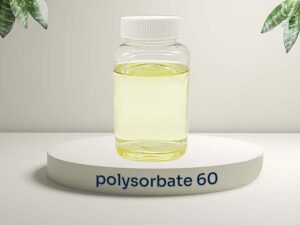

Polysorbate 60 (Tween 60) is an essential non-ionic surfactant and high-HLB emulsifier (HLB ~14.9) widely used to stabilize oil-in-water emulsions. By reducing interfacial tension, it ensures texture consistency, aeration, and shelf-life stability across a vast range of food categories.
Polysorbate 60: Technical Definition and Overview
Chemically known as polyoxyethylene (20) sorbitan monostearate, Polysorbate 60 is synthesized through the ethoxylation of sorbitan monostearate. Its dual-nature—a lipophilic stearic acid tail and a hydrophilic polyoxyethylene head—allows it to bridge oil and water phases effectively. In industrial food production, it is often preferred for its stability under varying pH and temperature conditions, especially when compared to natural emulsifiers.
Bakery and Yeast-Leavened Product Performance
In the bakery sector, Polysorbate 60 serves as a powerful dough conditioner.
- Dough Strengthening: It interacts with gluten proteins to improve gas retention, leading to increased loaf volume and a more uniform crumb structure.
- Anti-Staling: By forming complexes with amylose, it retards starch retrogradation, significantly extending the “freshness” window of bread and buns.
- Смеси для выпечки тортов: It ensures rapid dispersion of shortenings, resulting in cakes with higher volume and a moist, tender mouthfeel.
Dairy, Ice Cream, and Coffee Whitener Stability
Polysorbate 60 is a “workhorse” for dairy and vegetable fat-water systems.
- Мороженое: It controls the agglomeration of fat globules during freezing, which promotes a smooth texture, prevents large ice crystal formation, and provides excellent melt-resistance.
- Сливки для кофе: In both liquid and powder forms, it prevents “feathering” (oil separation or protein precipitation) when the creamer is added to acidic, hot coffee. It ensures a stable emulsion that provides a clean, white appearance.
Shortenings, Toppings, and Edible Oil Functionality
For lipid-heavy systems, Polysorbate 60 is critical for aeration and plasticity.
- Взбитые сливки: It stabilizes the air-cell interface in vegetable-based creams, allowing for high “overrun” (volume expansion) and firm peaks that do not weep.
- Жиры: When added to shortenings, it improves the “creaming” ability, allowing more air to be whipped into the fat. This is essential for professional baking and frying oils, where it also helps prevent oil exudation (bleeding) in the finished product.
Confectionery Coatings, Syrups, and Opacity Effects
Polysorbate 60 enhances the visual and sensory appeal of sweets.
- Gloss and Snap: In confectionery coatings, it ensures a smooth, shiny finish and prevents “fat bloom”—the unappealing white crystallization of cocoa butter or fats.
- Opacity Agent: It is uniquely used in sugar-type coatings to impart greater opacity, ensuring a vibrant, solid color appearance.
- Chocolate Syrups: It ensures cocoa solids and oils remain in a stable suspension, preventing sediment or fat separation at the top of the bottle.
Dressings, Gelatin Desserts, and Specialty Uses
Beyond core categories, Polysorbate 60 solves specific formulation challenges.
- Заправки для салатов: It maintains a stable O/W emulsion in non-standardized dressings, preventing the “shake before use” necessity for high-viscosity sauces.
- Gelatin Desserts: It acts as a dispersing agent for flavors, colors, and artificial sweeteners, ensuring they are evenly distributed throughout the gelatin matrix.
- Fruit Coatings: It is often used as a carrier or wetting agent in protective wax coatings for raw fruits and vegetables to maintain moisture and freshness.
Technical Specifications and Synergistic Combinations
The efficiency of Polysorbate 60 is frequently boosted by pairing it with low-HLB emulsifiers like Сорбитан моностеарат (Span 60). This “Tween-Span” synergy allows formulators to achieve a precise HLB balance tailored to their specific oil phase, whether it’s a veterinary laboratory preparation or a high-fat bakery shortening.
Summary of Polysorbate 60 Application Scenarios
In summary, Polysorbate 60 is a multi-functional additive that transcends simple emulsification. It acts as a texture modifier in bakery and frozen desserts, an aeration stabilizer in whipped toppings and shortenings, a dispersing agent in beverages and powders, and a visual enhancer in confectionery coatings. Its ability to manage the complex interactions between fats, water, and air makes it indispensable for achieving professional-grade food quality, structural integrity, and extended shelf life in the global food market.
Polysorbate 60 Usage Limits & Scenarios Summary Table
| Food Application | Potential Co-Emulsifiers | FDA Limit (Finished Product Weight) |
|---|---|---|
| Whipped Edible Oil Topping | Span 60, Tween 65, Tween 80 | Total ≤ 0.4%; Blend: Tween 60 ≤ 0.77%, Span 60 ≤ 0.27% |
| Cakes and Cake Mixes | Tween 65, Span 60 | Alone ≤ 0.46% (dry weight); Total combination ≤ 0.66% |
| Confectionery Coatings | Размах 60 | Alone ≤ 0.5%; Total combination ≤ 1.0% |
| Cake Icings and Fillings | Tween 65, Span 60 | Alone ≤ 0.46%; Total combination ≤ 1.0% |
| Shortenings and Edible Oils | Подросток 80 | Total combination ≤ 1.0% |
| Coffee Whiteners / Dairy Subs | Tween 65, Span 60 | Total combination ≤ 0.4% |
| Dressings (Non-standardized) | Alone | ≤ 0.3% |
| Дрожжевая пекарня | Alone | ≤ 0.5% (based on flour weight) |
| Мороженое и замороженные десерты | Tween 65, Tween 80 | Total combination ≤ 0.1% |
| Sugar Coating Opacity | Alone | ≤ 0.2% |
| Chocolate Flavored Syrups | Alone | ≤ 0.05% |
| Artificially Sweetened Gelatin | Alone (as dispersant) | ≤ 0.5% (dry weight) |
| Fruit & Veggie Coatings | Span 60 (with wax/oil) | Minimum quantity required for effect |
| Nonalcoholic Drink Mixes | Alone (foaming agent) | ≤ 4.5% of the mix weight |
The table above is edited by the referring to the eCFR regulation issued by the FDA § 172.836 Polysorbate 60.