
If you’re formulating, auditing, or preparing export documents — this is your Polysorbate 60 (E435 / polysorbate 60) reference. It covers how PS60 is used across FDA-regulated food categories, with the exact permitted limit for each one. No commentary, just the numbers and the mechanisms behind them.
For chemical properties, molecular structure, HLB, cosmetics + pharma applications, and formulation synergy with Span 60, see our Comprehensive Polysorbate 60 Guide. This article focuses strictly on food-category usage and FDA limits. For the complementary Span 60 reference, see the Span 60 Food Application Limits.
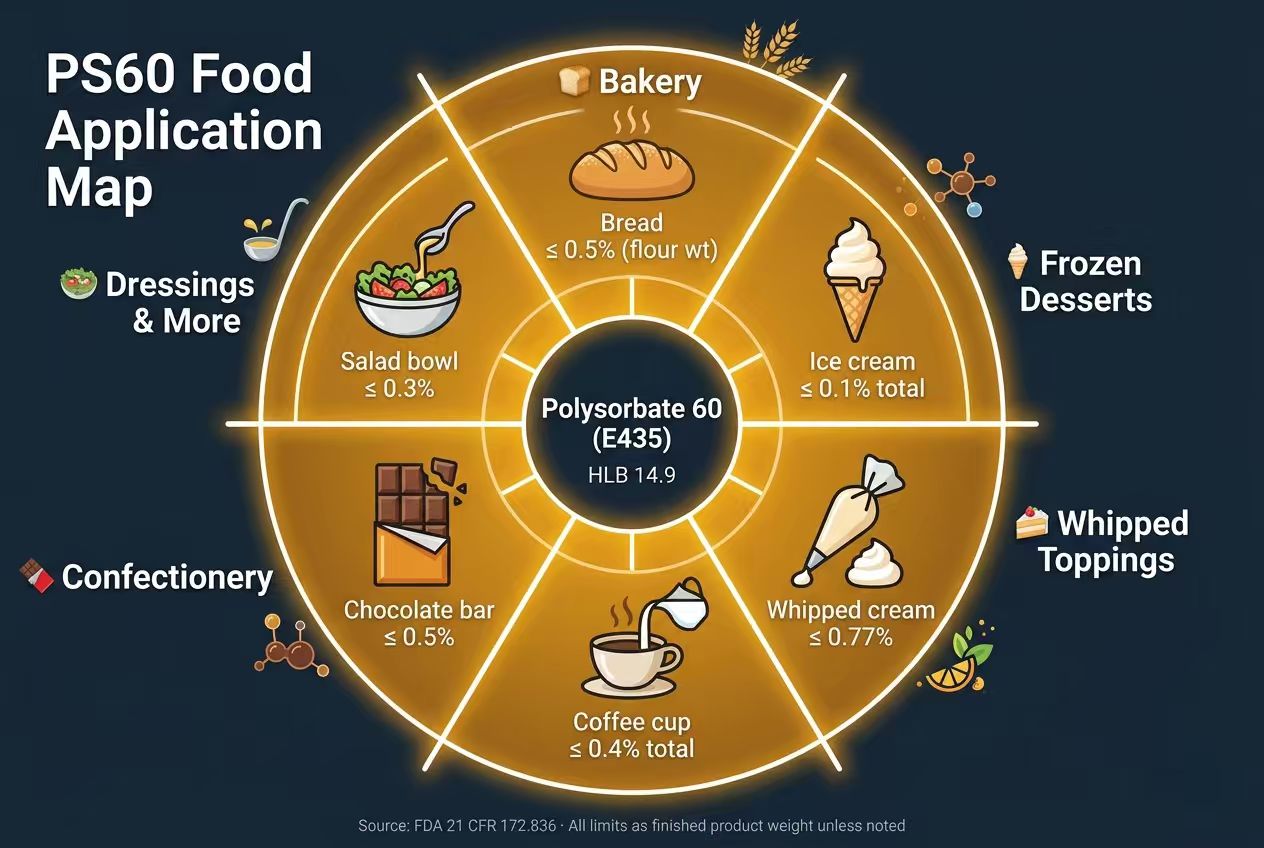
Bakery and Yeast-Leavened Products
PS60 is the workhorse dough conditioner for industrial bakeries. At 0.3–0.5% (flour weight), it does two things at once:
- Gluten reinforcement. The stearic acid chain (C18:0) aligns with gluten proteins during mixing, strengthening the protein network. This improves gas retention and oven spring — giving you 10–15% more loaf volume than un-emulsified dough.
- Anti-staling. During baking, PS60 complexes with amylose from starch granules, forming an insoluble inclusion complex that blocks amylose retrogradation — the main cause of bread firming. Result: 2–3 extra days of soft, fresh-baked texture.
Processing note: Add PS60 to the fat phase (shortening or oil) at 55–60°C before mixing into dough. This ensures full dissolution and even distribution. Adding powder directly to flour can give you inconsistent loaf quality.
| Application | Limit | Basis |
|---|---|---|
| Yeast-leavened bakery (bread, buns) | ≤ 0.5% | Flour weight |
| Cakes and cake mixes | ≤ 0.46% alone; ≤ 0.66% total with other polysorbates | Dry weight |
Frozen Desserts
In ice cream, PS60 works backwards from most emulsifiers — it destabilizes instead of stabilizing. During freezing in the scraped-surface heat exchanger, PS60 pushes milk proteins off the fat globule surface, allowing controlled fat globule clumping. This partial coalescence builds a 3D fat network that:
- Traps air cells for smooth, creamy mouthfeel
- Gives melt-down resistance (ice cream holds its shape as it warms)
- Blocks large ice crystal growth during temperature swings
PS60 is often blended with PS65 or PS80 to tune the fat destabilization profile. PS80’s unsaturated oleic acid (C18:1) makes a softer fat network; PS60’s saturated stearic acid (C18:0) makes a firmer one. Pick based on the body and melt you want.
| Application | Limit |
|---|---|
| Ice cream / frozen desserts | ≤ 0.1% total (alone or combined with PS65, PS80) |
Whipped Toppings and Shortenings
In lipid-heavy systems, PS60 stabilizes the air-cell interface in whipped vegetable-oil toppings. PS60’s HLB of 14.9 means it concentrates at the air-water interface — stearic acid tail anchored in fat, polyoxyethylene head in water — forming a viscoelastic film that resists drainage.
This gives you high overrun (200–300%) with firm, stable peaks that don’t weep or collapse over shelf life. The standard industrial blend: PS60 (≤ 0.77%) + Span 60 (≤ 0.27%), combined total ≤ 0.4%. Span 60’s low HLB (4.7) reinforces the fat side of the interfacial film.
In shortenings and edible oils, PS60 improves creaming ability — the capacity to trap air when fat and sugar are beaten together — and prevents oil bleeding in laminated doughs and filled products.
| Application | PS60 Limit | Total with Co-Emulsifiers |
|---|---|---|
| Whipped edible oil toppings | ≤ 0.77% | ≤ 0.4% total (with Span 60, PS65, PS80) |
| Shortenings / edible oils | — | ≤ 1.0% total combination |
Coffee Whiteners and Dairy Substitutes
Coffee whiteners face one of the toughest emulsion challenges in food: a vegetable-oil-in-water emulsion must sit stable at neutral pH for months, then survive instant exposure to hot (85–95°C), acidic (pH 4.5–5.5) coffee without breaking.
PS60 prevents feathering — the visible oil separation or protein clumping that looks like white specks on your coffee. Two mechanisms:
- Thermal shock resistance. PS60’s polyoxyethylene chains extend far into the water phase, building a thick steric barrier around each oil droplet. This barrier prevents coalescence even through a 60°C temperature jump.
- pH stability. Unlike protein-based emulsifiers that denature in acidic conditions, PS60’s nonionic chemistry maintains interfacial activity across the pH range.
| Application | PS60 Limit |
|---|---|
| Coffee whiteners / dairy substitutes | ≤ 0.4% of finished emulsion |
Confectionery Coatings
In chocolate and compound coatings, PS60 reduces viscosity for better flow during enrobing and molding. Paired with Span 60, it balances coating thickness and fat crystal stability.
| Application | PS60 Limit | Total |
|---|---|---|
| Confectionery coatings | ≤ 0.5% | ≤ 1.0% combined with Span 60 |
Other Food Applications
| Application | PS60 Limit | Notes |
|---|---|---|
| Gelatins, puddings, fillings | ≤ 0.4% | Alone or combined with other polysorbates |
| Beverage bases | Per GMP | Minimum needed for emulsification |
| Flavor emulsions | Per GMP | Typically 10–100 ppm in finished beverage |
| Nonstandardized foods | Per GMP | Minimum needed for intended effect |
Regulatory Reference
- FDA: 21 CFR 172.836 — Polysorbate 60. Application-specific limits as listed above.
- EU: E435. ADI: 10 mg/kg body weight/day (as polysorbates total). Quantum satis in most food categories.
- Codex: INS 435. Listed in GSFA with category-specific maximum use levels.
- Japan / Korea: Approved as food additive.
- Halal / Kosher: Certifiable — no animal-derived components. FoodEmul’s PS60 carries Halal (MUI, Indonesia) and Kosher certification.
Key Takeaways
- PS60 is approved across 14 FDA food categories with specific, category-level dosage limits.
- The highest single-application limit is 0.77% (whipped toppings). The strictest is 0.1% (frozen desserts).
- PS60 almost always works best blended with Span 60 — the ratio determines performance.
- FoodEmul’s PS60 carries Halal (MUI, Indonesia) and Kosher certification.
This guide references FDA 21 CFR 172.836, EU Regulation (EC) No 1333/2008, Codex GSFA, and published research (Hu et al., 2011). For application-specific advice, consult your emulsifier supplier’s technical service team.