

Polysorbate 80 is safe and effective — but only within its regulatory limits. Exceed the ADI (Acceptable Daily Intake) or misapply the dosage in a specific food category, and you are looking at compliance risk, not just a formulation problem. At FoodEmul, we help formulators stay within E433 limits across food, cosmetic, and pharmaceutical applications. This guide covers the numbers: ADI by region, category-specific maximums, and practical dosing ranges that work.
Quick Reference Dosage Table
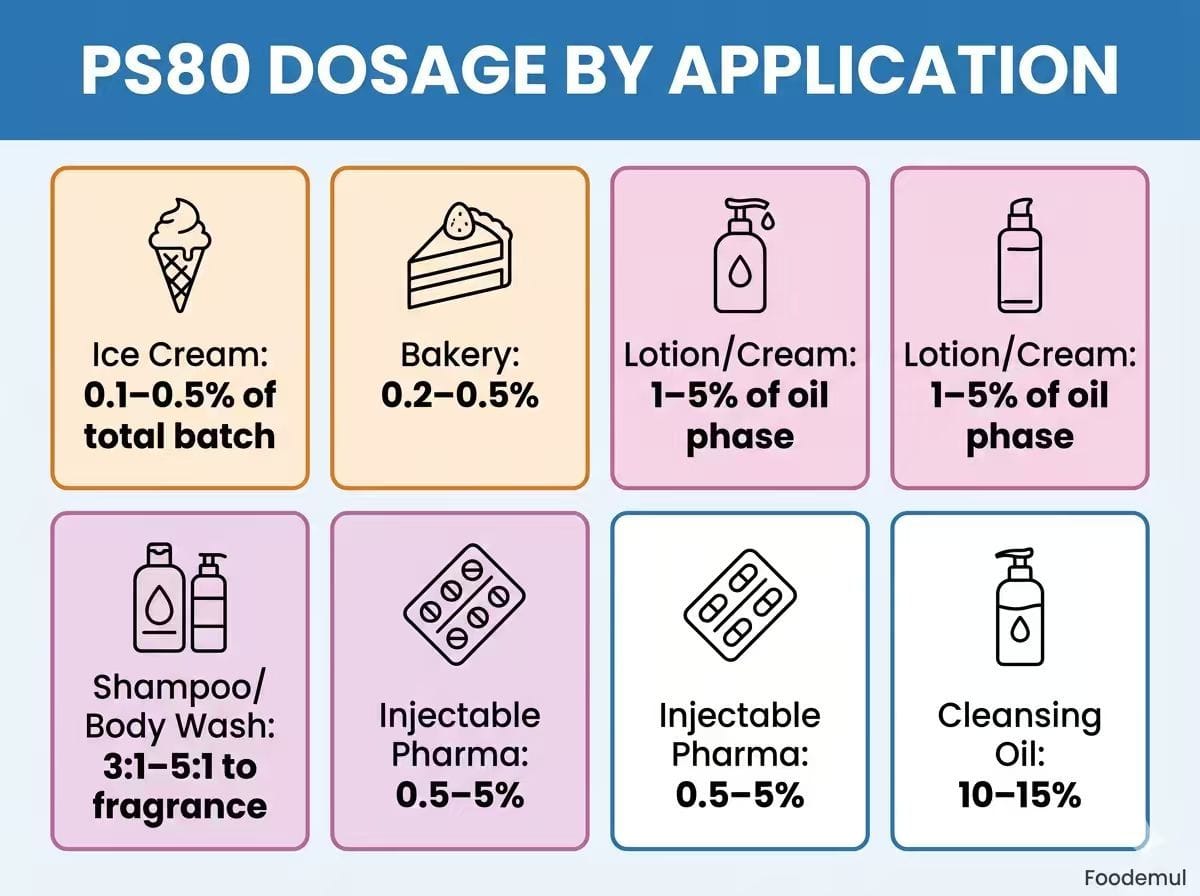
The table below provides industry-standard starting concentrations alongside the regulatory maximums for each major jurisdiction. Start at the low end and titrate up based on sensory evaluation and stability testing.
| Food Category | Typical Starting Dose | FDA 21 CFR 172.840 | EU E433 | GB 2760 (China) | Primary Function |
|---|---|---|---|---|---|
| Ice Cream & Frozen Desserts | 0.1% – 0.2% | Up to 0.1% (alone) | 1,000 mg/kg | 1.0 g/kg | Controls overrun, prevents ice crystals |
| Salad Dressings & Sauces | 0.1% – 0.3% | GMP | 1,000 mg/kg | 1.0 g/kg | Stable O/W emulsion, prevents separation |
| Bakery Products (cakes, bread) | 0.1% – 0.5% | 0.46% (total emulsifier) | 3,000 mg/kg | 2.0 g/kg | Improved crumb, volume, shelf life |
| Beverages & Flavored Drinks | 0.02% – 0.05% | GMP | 100 mg/L | 0.5 g/kg | Flavor oil solubilization, cloud stability |
| Confectionery Coatings | 0.1% – 0.3% | 0.1% (alone) | 1,000 mg/kg | 1.0 g/kg | Fat bloom prevention, gloss retention |
| Whipped Toppings & Shortenings | 0.2% – 0.4% | GMP | 3,000 mg/kg | 2.0 g/kg | Foam stabilization, texture |
| Processed Cheese & Dairy Analogs | 0.05% – 0.2% | GMP | 1,000 mg/kg | 1.0 g/kg | Smooth melt, prevents oiling-off |
| Pickles & Acidified Vegetables | 0.02% – 0.05% | GMP | 500 mg/kg | 0.5 g/kg | Brine stability, defoaming |
Dosage by Food Category — Detailed Guidelines
Ice Cream and Frozen Desserts
Polysorbate 80 is the go-to emulsifier for ice cream because it controls fat destabilization during freezing. At 0.1–0.2%, it displaces proteins from the fat globule surface, allowing controlled partial coalescence — the mechanism that gives ice cream its dry, creamy mouthfeel and slow melt. Unlike monoglycerides, Polysorbate 80 acts faster during the dynamic whipping-freezing process, making it ideal for continuous freezers.
Pro tip: Blending Polysorbate 80 with Span 60 at a 40:60 ratio reduces total emulsifier usage by 20–40% while improving overrun and anti-melt properties, as demonstrated in Chapter 6 of Food Emulsifiers (Science Press). The synergistic HLB sweet spot for ice cream is 8–10.
Salad Dressings and Emulsified Sauces
For O/W dressings with 30–50% oil phase, start at 0.1–0.3% of total batch weight. Polysorbate 80’s HLB of 15.0 makes it strongly hydrophilic — perfect for creating fine, stable oil droplets in a continuous water phase. Critical step: pre-blend Polysorbate 80 into the oil phase before combining with aqueous ingredients. This ensures the emulsifier is positioned at the oil-water interface before homogenization.
Bakery Products
In cakes and bread, Polysorbate 80 at 0.1–0.5% (flour weight basis) works differently than in liquid systems. Research in Food Emulsifiers (Chapter 6) shows that Polysorbate 80 strengthens gluten networks and increases dough resistance to extension. Importantly, the dose-response is non-linear — adding more Polysorbate 80 beyond the optimal range does not proportionally improve results. Start at 0.2% and increase in 0.1% increments while evaluating crumb structure and loaf volume.
Beverages (Clear and Cloudy)
For flavor oil solubilization in clear drinks, dosage is driven by oil load, not total batch weight. A typical citrus-flavored beverage with 0.1% flavor oil needs 0.02–0.05% Polysorbate 80. Going higher risks haze and “soapy” off-notes. See Section 4 for the full solubilization ratio method.
How to Calculate Polysorbate 80 Dosage — The Oil Phase Method
The most common formulator mistake? Calculating dosage as a percentage of total batch weight instead of oil phase weight. Polysorbate 80 works at the oil-water interface — its required amount is directly proportional to the oil you’re emulsifying.
Step-by-Step Calculation
- Determine oil phase weight. If your formula contains 15 kg oil in a 100 kg batch, the oil phase is 15 kg.
- Apply the rule of thumb. Polysorbate 80 dosage = 1–10% of oil phase weight, depending on emulsion type:
- Coarse emulsions (dressings, sauces): 1–3% of oil weight
- Fine emulsions (beverages, ice cream): 5–8% of oil weight
- Microemulsions (clear systems): 8–10% of oil weight
- Calculate. For 15 kg oil in a salad dressing (coarse O/W): 15 kg × 2% = 0.30 kg Polysorbate 80 (0.3% of total 100 kg batch).
- Verify against regulatory limits. 0.3% = 3,000 mg/kg — within FDA GMP and EU 1,000–3,000 mg/kg limits for dressings.
HLB-Based Fine-Tuning
For formulators who need precision: use the required HLB of your oil phase. Common food oils have required HLB values of 6–10 for O/W emulsions. Polysorbate 80 (HLB 15.0) can be blended with a low-HLB emulsifier like Span 80 (HLB 4.3) to target the exact required HLB:
| Target HLB | Polysorbate 80 (HLB 15.0) | Span 80 (HLB 4.3) | Example Application |
|---|---|---|---|
| 10 | 53% | 47% | General O/W emulsions, sauces |
| 9 | 44% | 56% | Ice cream, whipped toppings |
| 8 | 35% | 65% | Cakes, shortenings |
The “Golden Ratios” for Solubilization
When solubilizing flavor oils or fat-soluble vitamins into clear water-based systems, the ratio to oil matters more than percentage of total batch. These starting ratios have been validated across dozens of commercial beverage formulations:
- Essential Oils (citrus, mint): 1:1 to 1:3 (Polysorbate 80 : oil). For 1 g of lemon oil, use 1–3 g Polysorbate 80.
- Fat-Soluble Vitamins (A, D, E, K): 1:2 to 1:5, depending on carrier oil. Vitamin E acetate requires less (∼1:1); vitamin A palmitate needs more (∼1:3).
- Flavor Compounds (vanillin, esters): 1:1 to 1:2. These are partially water-soluble, reducing the emulsifier load.
- Medium-Chain Triglycerides (MCT oil): 1:4 to 1:6. MCTs are harder to microemulsify; increase Polysorbate 80 proportionally.
Technique matters as much as ratio. Pre-dissolve Polysorbate 80 in the oil phase with gentle warming (40–50°C), then add water slowly with high-shear mixing. The order of addition — oil into water vs. water into oil — can mean the difference between a crystal-clear microemulsion and a hazy failure.
Regulatory Limits by Region
Polysorbate 80 is approved as a food additive in all major markets, but the limits differ significantly. Never assume a formulation compliant in one region is automatically compliant in another.
| Region | Regulation | Code | General Limit | ADI |
|---|---|---|---|---|
| United States | FDA 21 CFR 172.840 | Polysorbate 80 | GMP or specific limits per application | — |
| European Union | Regulation (EC) No 1333/2008 | E433 | 100–3,000 mg/kg (category-dependent) | 25 mg/kg bw/day (re-evaluated 2015) |
| China | GB 2760-2011 | Polyoxyethylene (20) Sorbitan Monooleate | 0.5–2.0 g/kg depending on food category; same scope as Polysorbate 20 | — |
| JECFA (FAO/WHO) | JECFA Monograph (1984, 2014) | INS 433 | Application-specific: e.g., 0.05% for pickles | 0–25 mg/kg bw |
| Codex Alimentarius | GSFA (General Standard for Food Additives) | INS 433 | 500–5,000 mg/kg (category-dependent) | — |
Key quality specifications (GB 25554-2010 / FCC): Food-grade Polysorbate 80 must meet: oxyethylene content 65.0–69.5%, acid value ≤ 2.0 mg KOH/g, saponification value 40–55 mg KOH/g, hydroxyl value 65–80 mg KOH/g, moisture ≤ 3.0%, residue on ignition ≤ 0.25%, arsenic ≤ 3 mg/kg, lead ≤ 2 mg/kg (GB) / 10 mg/kg (FCC).
Factors That Affect Optimal Dosage
The same formula can require different Polysorbate 80 levels depending on five key variables. Adjust your starting dose accordingly:
- pH. Polysorbate 80 is stable across pH 3–11, but highly acidic systems (pH < 3.5) may require 10–20% more emulsifier due to partial hydrolysis over shelf life. For low-pH beverages, test stability at 3 months.
- Processing temperature. Pasteurization (72°C, 15s) and UHT (135–140°C, 2–4s) can affect emulsion stability. Always re-validate dosage after thermal processing — what works at bench scale may not survive the production line.
- Co-emulsifiers. As shown in Section 3, blending Polysorbate 80 with a low-HLB emulsifier can reduce total emulsifier load by 20–40%. The textbook Food Emulsifiers documents that Span 60 + polyglycerol ester blends in ice cream cut emulsifier use while improving overrun.
- Oil phase composition. Long-chain triglycerides (LCTs) require more emulsifier than MCTs. Unsaturated oils (soybean, canola) emulsify more easily than saturated fats (coconut, palm kernel).
- Salt and sugar content. High salt (>2%) competes for interfacial water, potentially reducing Polysorbate 80 effectiveness. High sugar (>15%) increases continuous phase viscosity, which can improve emulsion stability and allow slightly lower Polysorbate 80 dosage.
Step-by-Step Formulation Protocol
Follow this sequence for consistent results at production scale:
- Weigh Polysorbate 80 accurately. At typical 0.1–0.5% usage, a 100 kg batch needs only 100–500 g. Use a precision scale (±1 g). Over-weighing is the #1 cause of off-flavors.
- Pre-blend into oil phase. Add Polysorbate 80 to the oil/fat portion of your formula. Warm to 40–50°C if the oil is solid at room temperature. Stir until fully dissolved — Polysorbate 80 is a viscous liquid at 25°C and disperses readily in warm oil.
- Combine phases under shear. Add the oil-Polysorbate 80 blend to the water phase slowly while mixing. Use a high-shear mixer or homogenizer (3,000–10,000 rpm for lab; inline homogenizer for production).
- Homogenize. For fine emulsions, pass through a two-stage homogenizer (150/30 bar for dairy; 200/50 bar for beverages). Monitor droplet size — target D[4,3] < 5 μm for creamy emulsions, < 1 μm for beverages.
- Verify stability. Run accelerated stability tests: 3 freeze-thaw cycles (−18°C ↔ 25°C) and 7-day storage at 45°C. No phase separation, creaming, or significant viscosity change = formulation is stable.
Troubleshooting Common Issues
| Symptom | Probable Cause | Corrective Action |
|---|---|---|
| Haze / cloudiness in clear drinks | Droplet size > 100 nm; insufficient Polysorbate 80-to-oil ratio | Increase Polysorbate 80 ratio to 2:1 or 3:1. Use high-shear mixing. Pre-blend oil + Polysorbate 80 before water addition. |
| “Soapy” or bitter off-taste | Dosage too high; residual free fatty acids from low-grade Polysorbate 80 | Reduce dosage. Source food-grade Polysorbate 80 meeting GB 25554-2010 / FCC specifications (acid value ≤ 2.0). Consider blending with Span 80 to reduce Polysorbate 80 load. |
| Phase separation in dressing after 2–4 weeks | Insufficient emulsifier for oil load; homogenization pressure too low | Recalculate: is Polysorbate 80 at 2–5% of oil phase weight? Increase homogenization to 200/50 bar. Add 0.05% xanthan gum as stabilizer. |
| Ice cream: coarse texture, rapid melt | Polysorbate 80 under-dosed or fat content too low for emulsifier level | Increase to 0.15–0.2%. Verify fat content ≥ 8%. Consider Polysorbate 80 + Span 60 blend (40:60) with target HLB 8–10. |
| Separation in acidic beverage (pH 3.0) | Partial Polysorbate 80 hydrolysis at low pH over time | Increase Polysorbate 80 by 10–20% to compensate for shelf-life degradation. Add 0.1% gum arabic as co-stabilizer. Run 3-month pH 3.0 stability trial. |
| Oiling-off in processed cheese | Insufficient emulsifier; processing temperature too high | Increase to 0.2% of total weight. Ensure processing temperature is 75–85°C (not higher). Add 0.1% trisodium citrate as emulsifying salt synergist. |
Polysorbate 80 Dosage in Cosmetics & Personal Care
While this guide focuses on food formulations, Polysorbate 80 is widely used in lotions, creams, shampoos, and body washes. Dosage differs significantly from food applications:
- Lotions and creams (O/W emulsions): 1–5% of oil phase weight. For a typical lotion with 10–25% oil phase, this translates to 0.1–1.25% of total batch. At 2–3% Polysorbate 80-to-oil, most medium-viscosity emulsions are stable for 12+ months.
- Shampoos and body washes (solubilization): A 3:1 to 5:1 ratio of Polysorbate 80 to fragrance/essential oil. For 1% fragrance in a shampoo, use 3–5% Polysorbate 80.
- Makeup removers and cleansing oils: 10–15% Polysorbate 80 in oil-based cleansers ensures complete rinse-off without residue.
- Regulatory note: Cosmetic-grade Polysorbate 80 is not subject to food additive limits. CIR (Cosmetic Ingredient Review) has determined Polysorbate 80 safe at concentrations up to 25% in rinse-off and 10% in leave-on products (CIR Final Report, 2015).
For formulation techniques beyond dosage, see our Polysorbate 80 Formulation Guide.
Related Reading
- Deeper formulation guide: Polysorbate 80 Formulation Guide — HLB and Emulsifier Synergy
- Comparison with other polysorbates: Polysorbate 60 vs 80 — Key Differences and How to Choose
- Product specifications & ordering: Food-Grade Polysorbate 80 (E433)
- Safety & regulatory deep dive: Polysorbate 80 Safety, Uses & Global Compliance
Need Polysorbate 80 with full compliance documentation? We manufacture to food-grade specifications with Kosher and MUI Halal certification — reach out for technical data or samples.
