
14 Core Functions of Food Emulsifiers: The Science behind Interfacial Tension
Discover how our surfactant technology reduces interfacial tension, stabilizes multi-phase systems, and optimizes food texture across industries
“All food emulsifiers are fundamentally surface-active agents (surfactants). They possess a dual nature: a hydrophilic (water-loving) head and a lipophilic (oil-loving) tail. By aligning themselves at the interfaces (Oil-Water, Water-Air, or Solid-Liquid), they dramatically reduce interfacial tension and form a protective film that prevents phase separation. Below is how this physicochemical property translates into 14 powerful functions in food processing.”
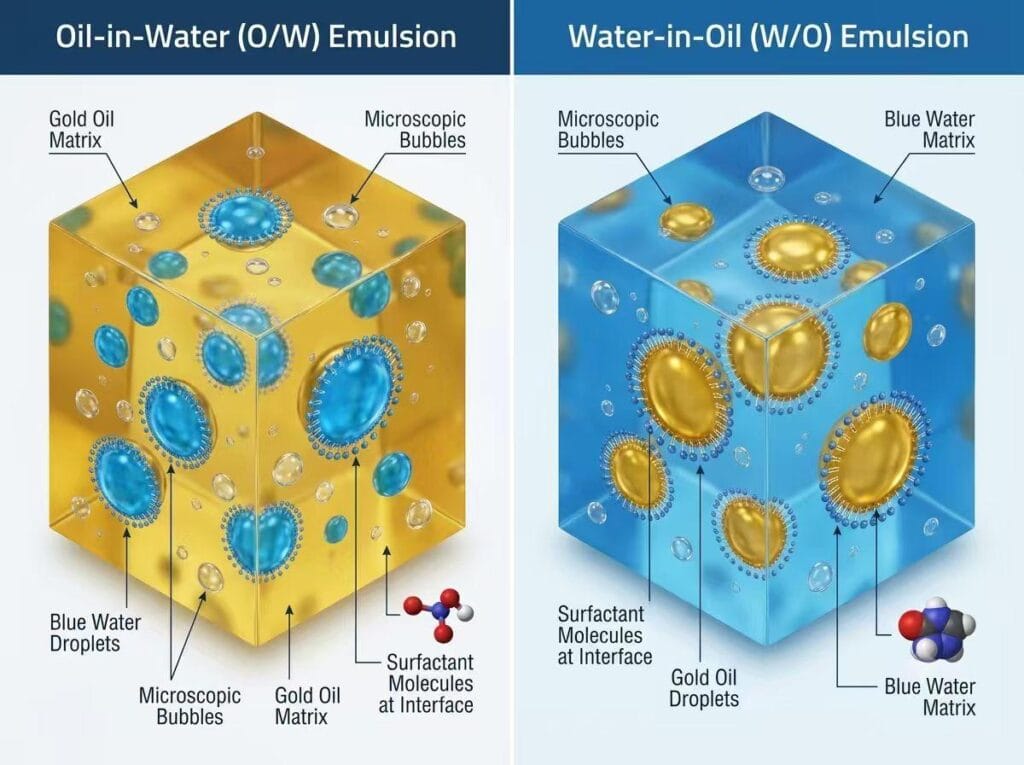
01. Fundamental Emulsification
Food emulsifiers stop oil and water from separating by dropping the interfacial tension between them.
These surfactants have a hydrophilic head and a lipophilic tail that line up at the molecular boundary. They create a strong, protective film around droplets so they cannot clump together.
Manufacturers use a low-HLB ingredient to lock water inside margarine and chocolate. For dairy drinks and dressings, a high-HLB surfactant keeps fat globules between 0.1 and 1.0µm to prevent creaming.
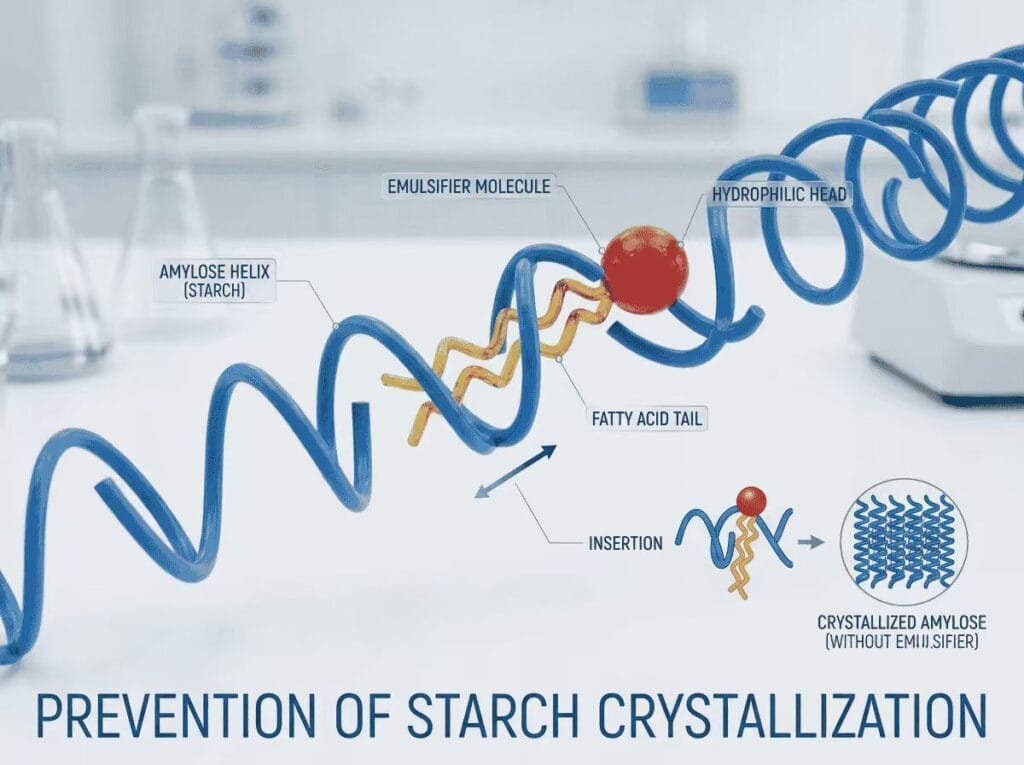
02. Starch Complexing (Anti-Staling)
Emulsifiers stop starch from hardening by locking into its molecular structure to trap moisture.
The hydrophobic tail of the surfactant inserts itself directly into the linear helical cavity of amylose. This bond blocks the recrystallization process that causes retrogradation and staling.
Bakers use these agents in bread and cakes to keep the crumb structure soft over extended storage periods. They also apply them to instant noodles and mashed potatoes to reduce surface stickiness and prevent clumping.
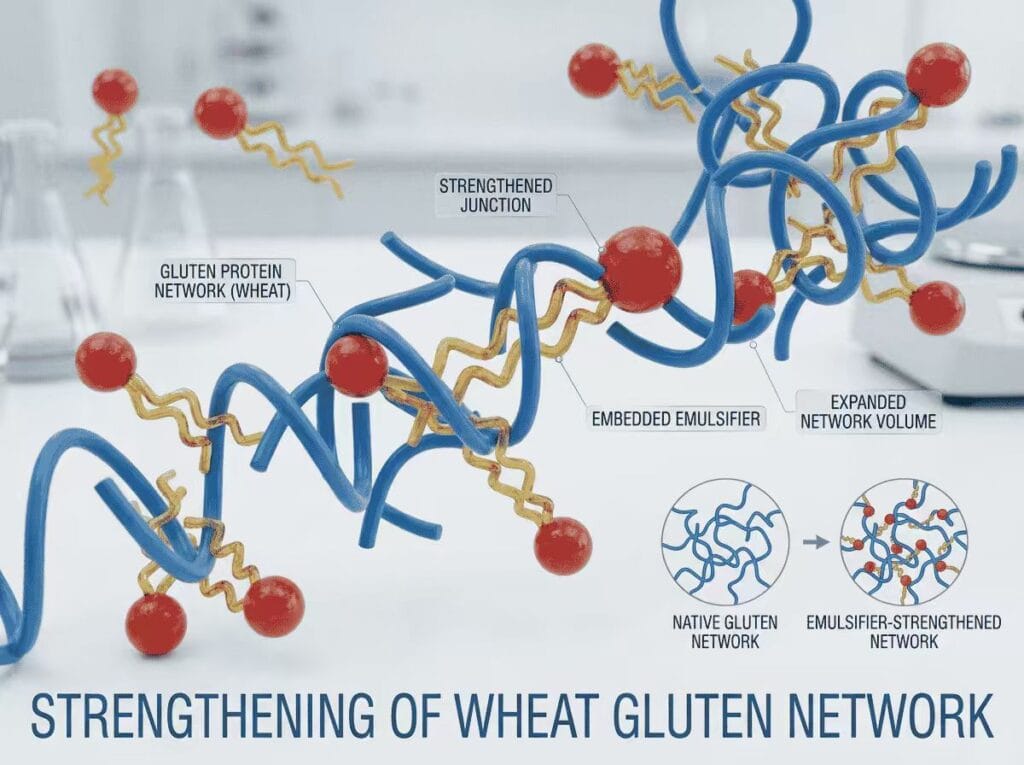
03. Protein Network Modification
Food emulsifiers strengthen food proteins by binding to them and altering their molecular structure.
The ionic head groups of these surfactants connect with proteins through electrostatic binding and hydrophobic insertion. This cross-linking reinforces the gluten network, which boosts gas retention and dough viscoelasticity.
Industrial bakers add them to yeast dough and bread to maximize loaf volume and create a uniform crumb grain. Manufacturers also use them in noodle and pasta production to reduce cooking loss and ensure a firm texture.
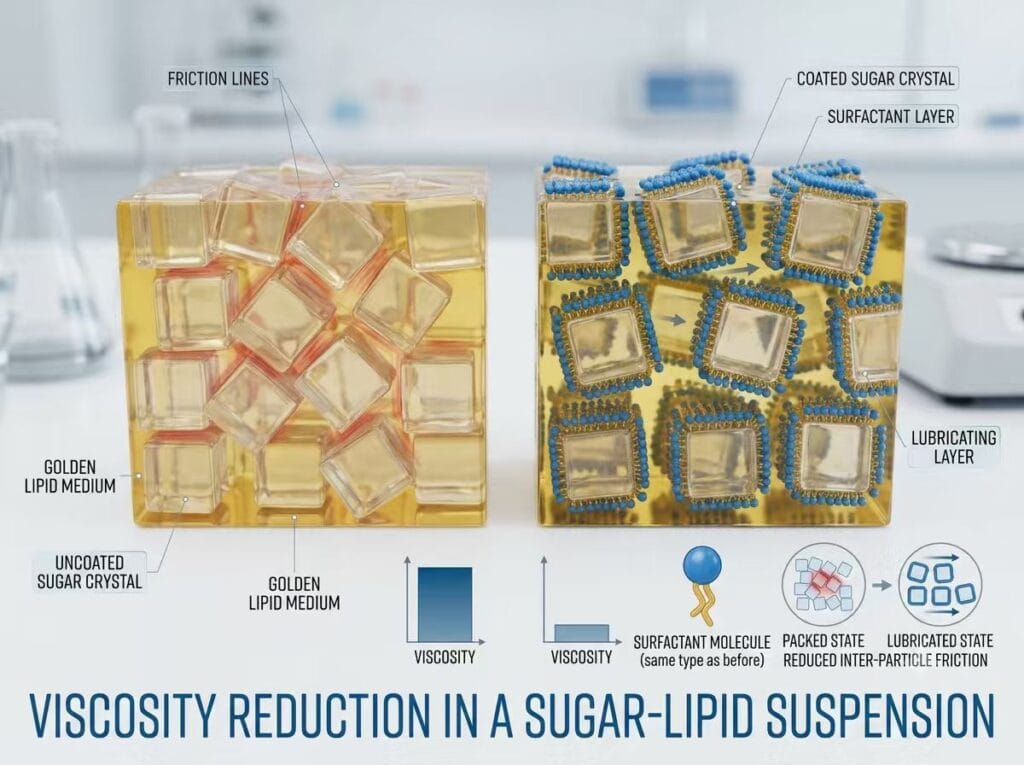
04. Viscosity & Rheology Modification
Surfactant ingredients lower friction in concentrated suspensions by coating the polar surfaces of solid particles.
These agents adsorb onto sugar crystals to form a hydrophobic organic layer. This coating reduces particle-to-particle friction and changes the rheological behavior of the lipid matrix, which lowers plastic viscosity.
Manufacturers use this function in molten chocolate to optimize fluidity during conching and tempering while saving on cocoa butter. It is also used in industrial confectionery enrobing to control the coating thickness on biscuits, wafers, and candy bars.
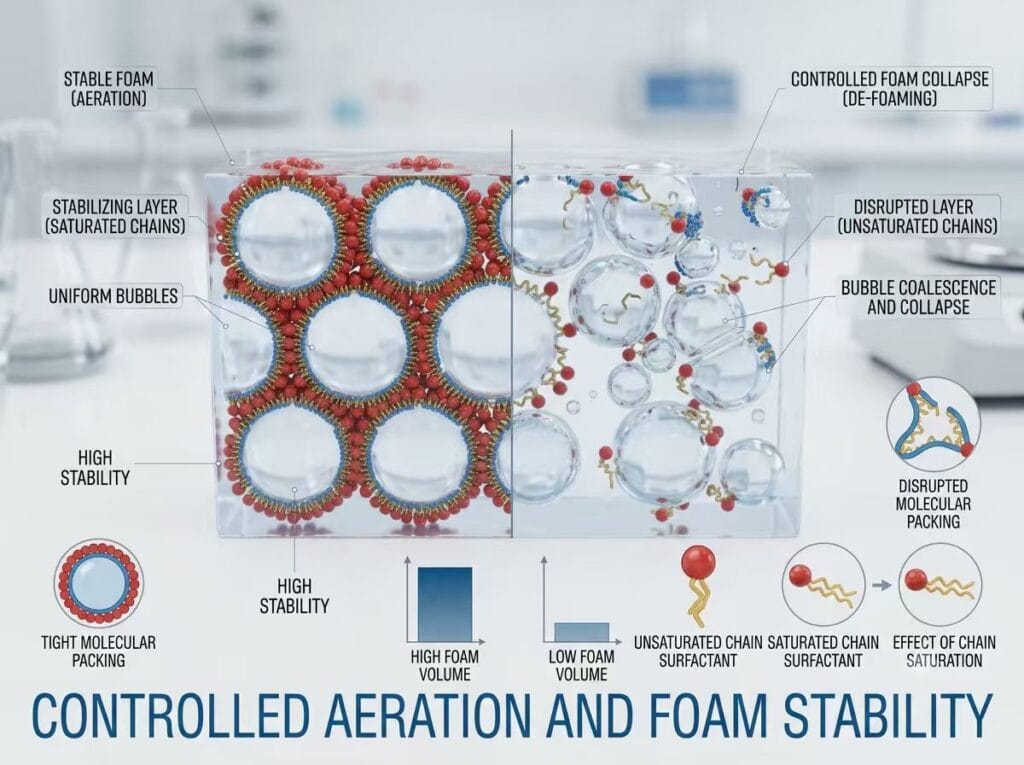
05. Foaming, Aeration & Defoaming Control
Surfactants control gas-liquid dispersions by migrating to the air-water interface to alter surface tension.
Saturated fatty acid chains form a stable, viscoelastic film that prevents bubble coalescence and liquid drainage. In contrast, unsaturated fatty acid chains disrupt the system balance to cause rapid bubble collapse.
Food producers add saturated types to industrial cake mixes and whipping creams for rapid aeration and uniform air cells. They use unsaturated types as defoamers in commercial dairy processing and liquid egg processing to suppress foam during high-speed agitation.
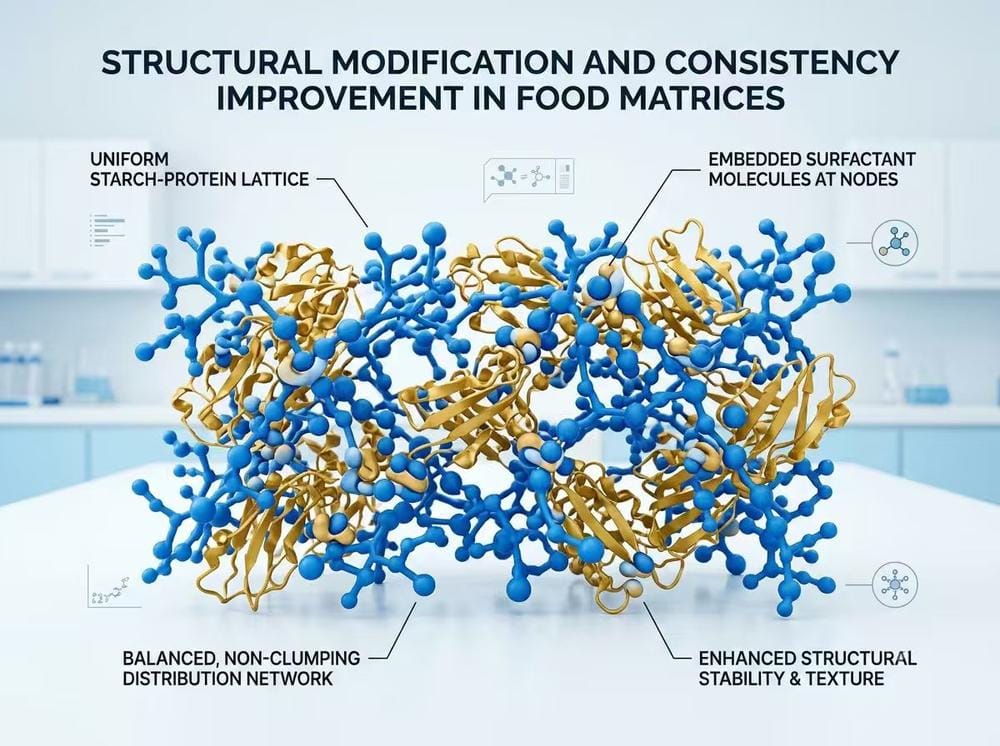
06. Texture & Consistency Modification
Food surfactants work as multi-functional structural modifiers by interacting with both starches and protein matrices at the same time.
These agents form stable, structured complexes with starches and cross-link with proteins to prevent the retrogradation and aggregation of macro-molecular networks. This action stops ingredient segregation and modifies the rheological density.
Manufacturers use this function in macaroni and pasta production to prevent starch leaching during cooking and improve chewiness. It is also applied to dehydrated potato flakes and extruded snacks to regulate starch swelling and optimize industrial extrudability.
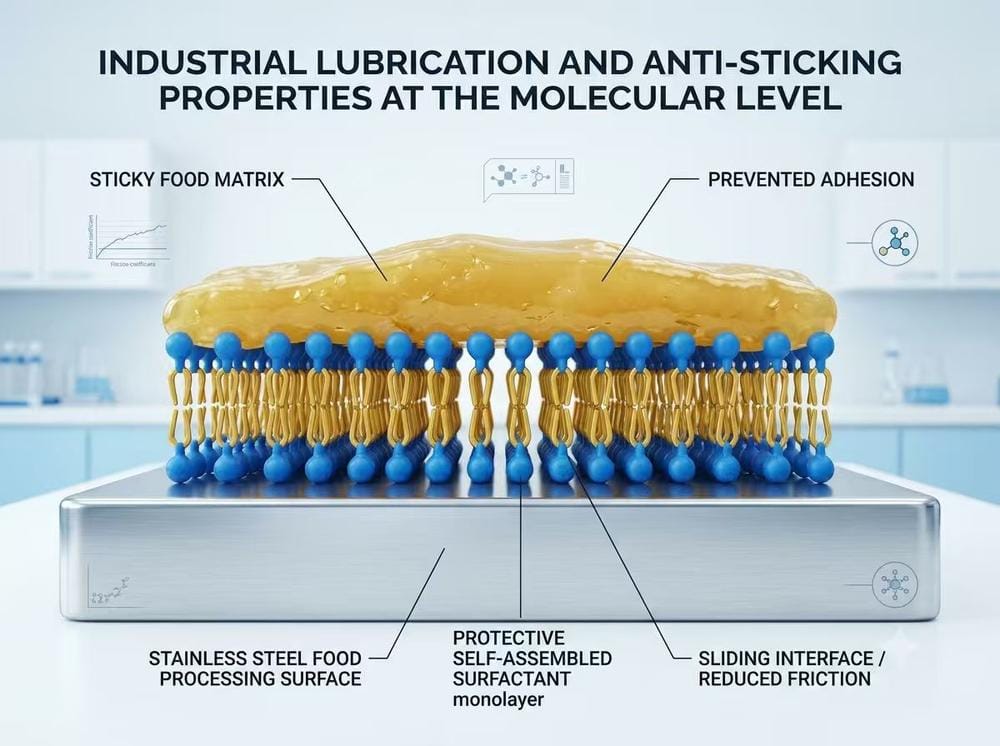
07. Lubrication & Anti-Sticking
Surfactants act as industrial lubricants by creating a slippery, non-reactive film between food matrices and metal machinery.
The molecules quickly migrate to boundary interfaces, placing their lipid-affinity chains toward the food and aligning against processing equipment surfaces. This monomolecular layer lowers surface friction to stop sticky residues from adhering to molds, cutters, or belts.
Processors use this function in high-speed bakery and candy extrusion to ensure clean product release from divider blades and confectionery molds. It is also used in starchy food and pasta processing to keep individual items from clumping together during automated packaging.
08. Crystal Modification & Growth Control
Surfactants act as crystal templates in lipid-rich systems to control polymorphic crystallization, crystal shape, and growth rate.
By aligning with fat molecules, these emulsifiers maintain lipids in their optimum crystallization state. This structural template prevents uncontrolled crystal growth and stabilizes the fat matrix against phase changes.
Manufacturers use this function in margarine and shortening production to optimize fat crystal structures for better baking performance. It is also applied to confectionery, sugar, and salt products to regulate crystal shape and prevent textural roughness during storage.
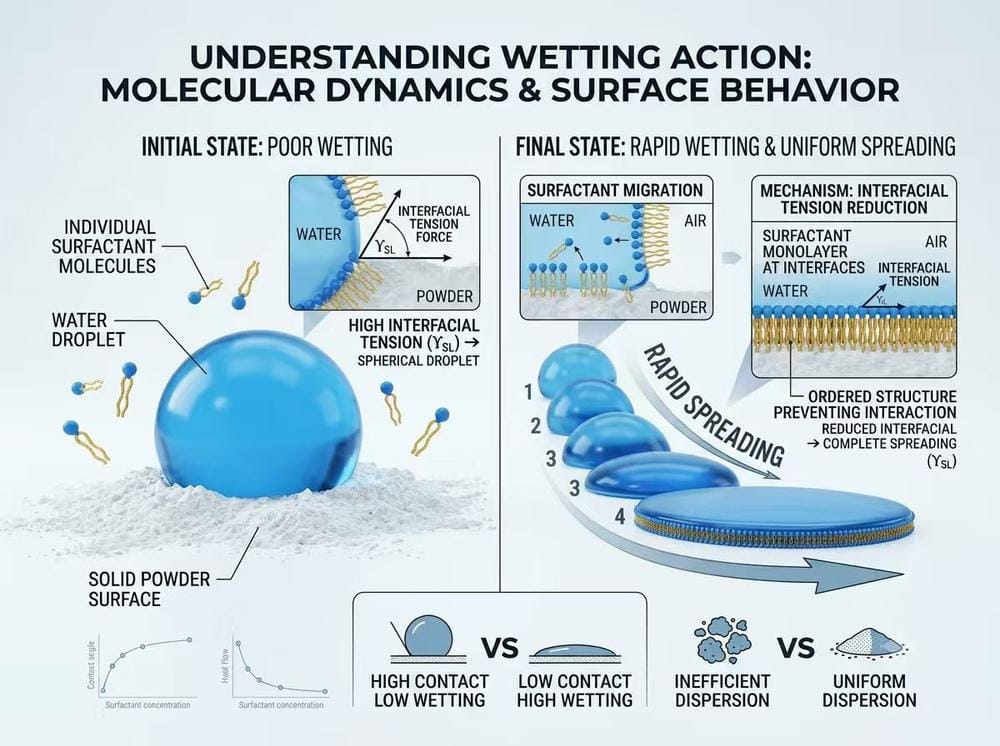
09. Wetting & Interfacial Tension Reduction
Emulsifiers function as excellent wetting agents by forcing liquids to spread quickly and evenly across solid surfaces.
They lower the interfacial tension between the liquid and solid boundaries. This action allows water to penetrate capillaries and coat dry powder particles immediately rather than pooling on top.
Food manufacturers use this property in instant foods, spray-dried desserts, and cocoa powders to speed up rehydration. It also prevents clumping in powdered beverages and coffee by ensuring lump-free dissolution.
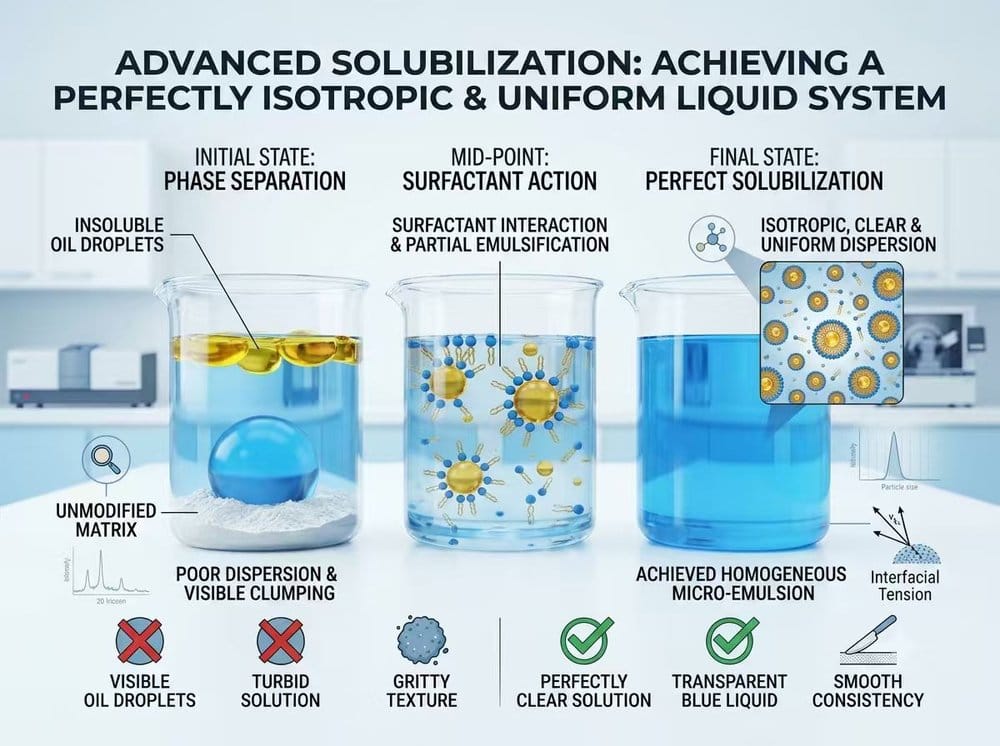
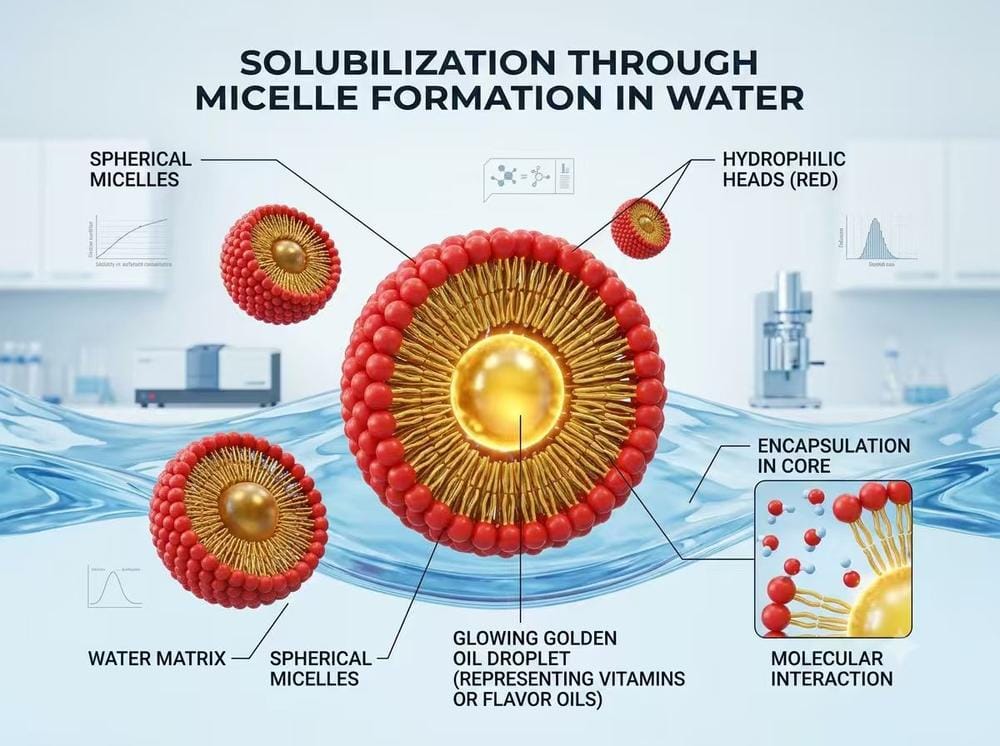
10. Solubilization & Clear Dispersion
Emulsifiers increase dispersion capacity by lowering molecular interfacial barriers until two insoluble liquids form a completely transparent, isotropic solution.
They reduce surface tension to a near-zero level, allowing hydrophobic liquids to stay suspended inside a continuous water phase. This clear solubilization process completely prevents turbidity, phase partitioning, and sedimentation.
Flavor houses use this function in liquid flavorings and fragrance extracts to dissolve volatile essential oils into clear drinks without turning them cloudy. It is also applied to food colorants to keep fat-soluble pigments suspended uniformly throughout water-based products.
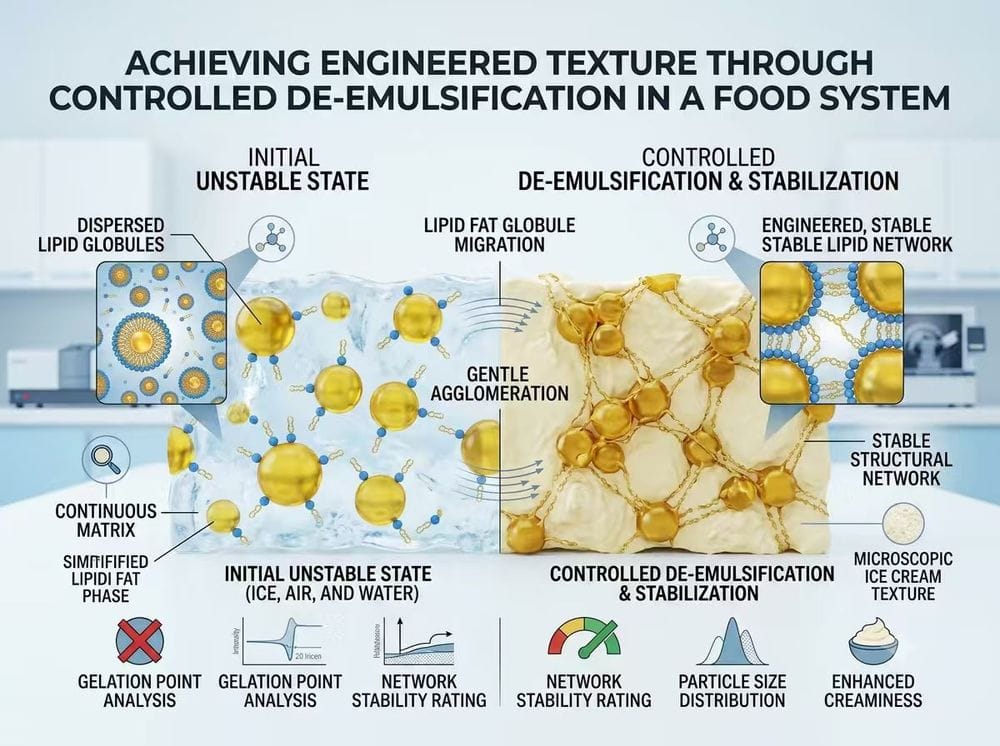
11. Demulsification & Controlled De-emulsification
Emulsifiers can drive controlled demulsification by systematically disrupting the interfacial equilibrium of an existing emulsion system.
By deploying opposing types of surfactants or altering the critical balance at the boundary, processors force the destabilization of selected phases. This targeted collapse allows specific particles to aggregate into functional, stable macro-structures instead of separating completely.
Manufacturers use this controlled destabilization in premium ice cream manufacturing to let fat globules partially agglomerate, which locks in air cells and increases meltdown resistance. It is also applied in industrial food processing to disrupt unwanted operational foam, forcing rapid liquid drainage to keep production lines moving.
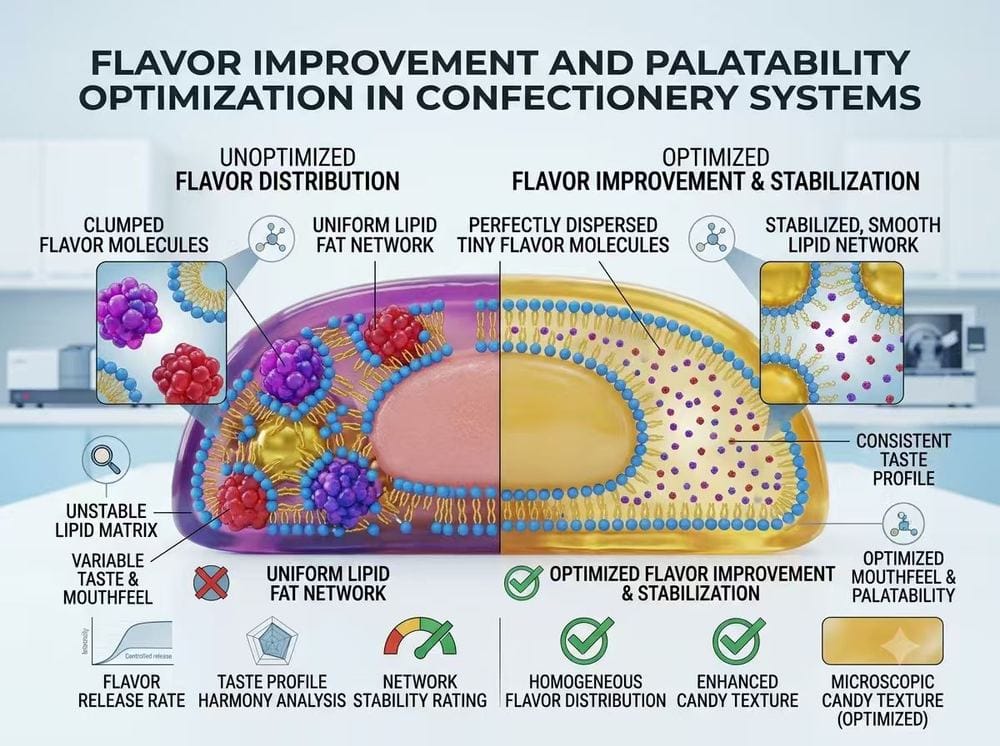
12. Flavor & Palatability Improvement
Emulsifiers improve flavor release in lipid-heavy systems by creating a finely structured, completely uniform matrix.
These surfactants homogenize the lipid system at a microscopic level, preventing phase separation from trapping or unevenly dispersing flavor molecules. This stabilization guarantees a controlled, gradual release of flavor compounds during consumption while optimizing the oral melt profile.
Manufacturers use this function in chewing gum and bubble gum bases to lock flavor oils into the matrix and extend the taste profile. It is also applied to confectionery coatings, sugar confections, and chocolate to eliminate waxiness and enhance the smooth mouthfeel.
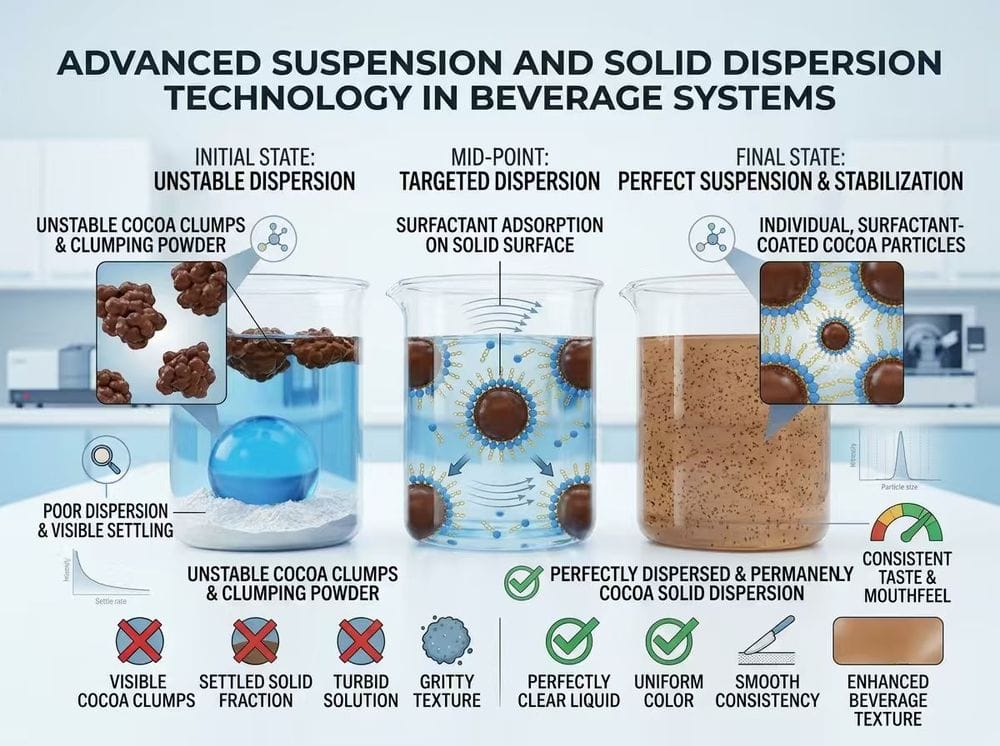
13. Suspension & Solid Dispersion
Emulsifiers act as suspending agents by lowering interfacial energy to keep fine, insoluble solid particles dispersed within a liquid medium.
They facilitate the wetting and mechanical redispersion of solid particles, stopping them from sticking together. When combined with thickeners, they create a stable matrix that completely blocks gravitational sedimentation and tight particle packing.
Dairy processors use this function in chocolate milk and cocoa beverages to keep heavy cocoa solids suspended and prevent hard bottom sedimentation. It is also applied to nut milks and plant-based drinks to maintain cloud stability and eliminate layer separation.
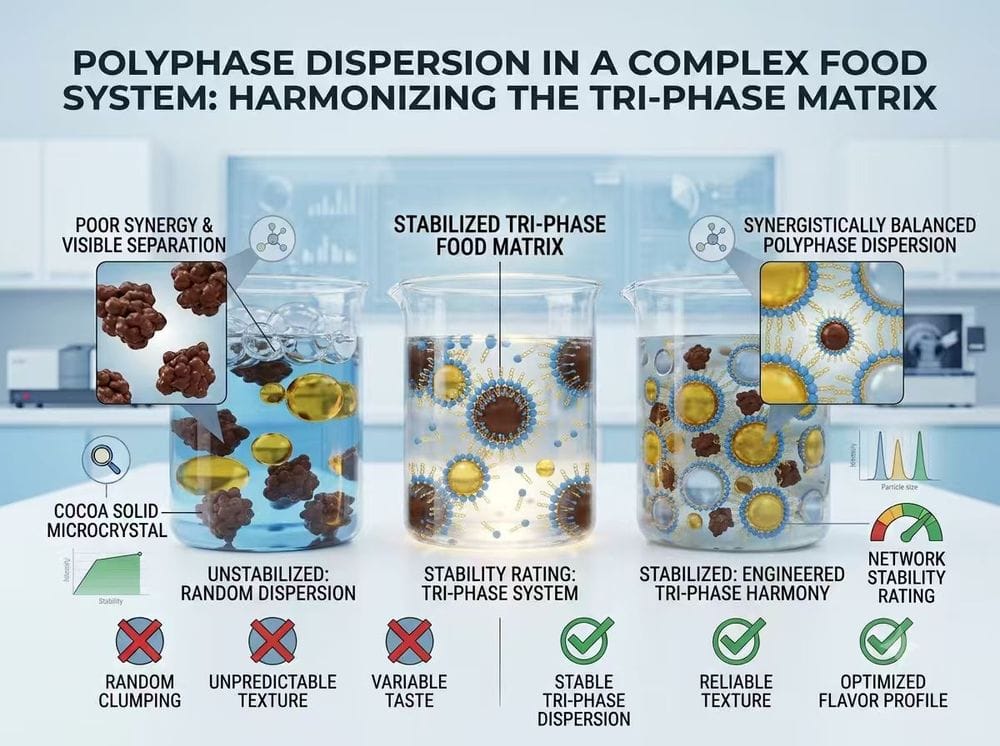
14. Polyphase Dispersion Action
Emulsifiers stabilize complex systems by lowering interfacial energy so that multiple incompatible states of matter can co-exist.
They form a resilient interfacial barrier between distinct solid, liquid, and gaseous phases, drastically reducing systemic tension. This prevents the different phases from separating or collapsing, locking them into a uniform matrix.
Manufacturers use this multi-phase function in ice cream and frozen confections to simultaneously disperse liquid fats, solid ice crystals, and air bubbles for a smooth melting profile. It is also applied to coffee whiteners and non-dairy creamers to ensure quick dispersion without oil separation.
01. Fundamental Emulsification
Food emulsifiers stop oil and water from separating by dropping the interfacial tension between them.
These surfactants have a hydrophilic head and a lipophilic tail that line up at the molecular boundary. They create a strong, protective film around droplets so they cannot clump together.
Manufacturers use a low-HLB ingredient to lock water inside margarine and chocolate. For dairy drinks and dressings, a high-HLB surfactant keeps fat globules between 0.1 and 1.0µm to prevent creaming.
02. Starch Complexing (Anti-Staling)
Emulsifiers stop starch from hardening by locking into its molecular structure to trap moisture.
The hydrophobic tail of the surfactant inserts itself directly into the linear helical cavity of amylose. This bond blocks the recrystallization process that causes retrogradation and staling.
Bakers use these agents in bread and cakes to keep the crumb structure soft over extended storage periods. They also apply them to instant noodles and mashed potatoes to reduce surface stickiness and prevent clumping.
03. Protein Network Modification
Food emulsifiers strengthen food proteins by binding to them and altering their molecular structure.
The ionic head groups of these surfactants connect with proteins through electrostatic binding and hydrophobic insertion. This cross-linking reinforces the gluten network, which boosts gas retention and dough viscoelasticity.
Industrial bakers add them to yeast dough and bread to maximize loaf volume and create a uniform crumb grain. Manufacturers also use them in noodle and pasta production to reduce cooking loss and ensure a firm texture.
05. Foaming, Aeration & Defoaming Control
Surfactants control gas-liquid dispersions by migrating to the air-water interface to alter surface tension.
Saturated fatty acid chains form a stable, viscoelastic film that prevents bubble coalescence and liquid drainage. In contrast, unsaturated fatty acid chains disrupt the system balance to cause rapid bubble collapse.
Food producers add saturated types to industrial cake mixes and whipping creams for rapid aeration and uniform air cells. They use unsaturated types as defoamers in commercial dairy processing and liquid egg processing to suppress foam during high-speed agitation.
06. Texture & Consistency Modification
Food surfactants work as multi-functional structural modifiers by interacting with both starches and protein matrices at the same time.
These agents form stable, structured complexes with starches and cross-link with proteins to prevent the retrogradation and aggregation of macro-molecular networks. This action stops ingredient segregation and modifies the rheological density.
Manufacturers use this function in macaroni and pasta production to prevent starch leaching during cooking and improve chewiness. It is also applied to dehydrated potato flakes and extruded snacks to regulate starch swelling and optimize industrial extrudability.
01. Fundamental Emulsification
Food emulsifiers stop oil and water from separating by dropping the interfacial tension between them.
These surfactants have a hydrophilic head and a lipophilic tail that line up at the molecular boundary. They create a strong, protective film around droplets so they cannot clump together.
Manufacturers use a low-HLB ingredient to lock water inside margarine and chocolate. For dairy drinks and dressings, a high-HLB surfactant keeps fat globules between 0.1 and 1.0µm to prevent creaming.
13. Suspension & Solid Dispersion
Emulsifiers act as suspending agents by lowering interfacial energy to keep fine, insoluble solid particles dispersed within a liquid medium.
They facilitate the wetting and mechanical redispersion of solid particles, stopping them from sticking together. When combined with thickeners, they create a stable matrix that completely blocks gravitational sedimentation and tight particle packing.
Dairy processors use this function in chocolate milk and cocoa beverages to keep heavy cocoa solids suspended and prevent hard bottom sedimentation. It is also applied to nut milks and plant-based drinks to maintain cloud stability and eliminate layer separation.
10. Solubilization & Clear Dispersion
Emulsifiers increase dispersion capacity by lowering molecular interfacial barriers until two insoluble liquids form a completely transparent, isotropic solution.
They reduce surface tension to a near-zero level, allowing hydrophobic liquids to stay suspended inside a continuous water phase. This clear solubilization process completely prevents turbidity, phase partitioning, and sedimentation.
Flavor houses use this function in liquid flavorings and fragrance extracts to dissolve volatile essential oils into clear drinks without turning them cloudy. It is also applied to food colorants to keep fat-soluble pigments suspended uniformly throughout water-based products.
11. Demulsification & Controlled De-emulsification
Emulsifiers can drive controlled demulsification by systematically disrupting the interfacial equilibrium of an existing emulsion system.
By deploying opposing types of surfactants or altering the critical balance at the boundary, processors force the destabilization of selected phases. This targeted collapse allows specific particles to aggregate into functional, stable macro-structures instead of separating completely.
Manufacturers use this controlled destabilization in premium ice cream manufacturing to let fat globules partially agglomerate, which locks in air cells and increases meltdown resistance. It is also applied in industrial food processing to disrupt unwanted operational foam, forcing rapid liquid drainage to keep production lines moving.
14. Polyphase Dispersion Action
Emulsifiers stabilize complex systems by lowering interfacial energy so that multiple incompatible states of matter can co-exist.
They form a resilient interfacial barrier between distinct solid, liquid, and gaseous phases, drastically reducing systemic tension. This prevents the different phases from separating or collapsing, locking them into a uniform matrix.
Manufacturers use this multi-phase function in ice cream and frozen confections to simultaneously disperse liquid fats, solid ice crystals, and air bubbles for a smooth melting profile. It is also applied to coffee whiteners and non-dairy creamers to ensure quick dispersion without oil separation.
04. Viscosity & Rheology Modification
Surfactant ingredients lower friction in concentrated suspensions by coating the polar surfaces of solid particles.
These agents adsorb onto sugar crystals to form a hydrophobic organic layer. This coating reduces particle-to-particle friction and changes the rheological behavior of the lipid matrix, which lowers plastic viscosity.
Manufacturers use this function in molten chocolate to optimize fluidity during conching and tempering while saving on cocoa butter. It is also used in industrial confectionery enrobing to control the coating thickness on biscuits, wafers, and candy bars.
07. Lubrication & Anti-Sticking
Surfactants act as industrial lubricants by creating a slippery, non-reactive film between food matrices and metal machinery.
The molecules quickly migrate to boundary interfaces, placing their lipid-affinity chains toward the food and aligning against processing equipment surfaces. This monomolecular layer lowers surface friction to stop sticky residues from adhering to molds, cutters, or belts.
Processors use this function in high-speed bakery and candy extrusion to ensure clean product release from divider blades and confectionery molds. It is also used in starchy food and pasta processing to keep individual items from clumping together during automated packaging.
08. Crystal Modification & Growth Control
Surfactants act as crystal templates in lipid-rich systems to control polymorphic crystallization, crystal shape, and growth rate.
By aligning with fat molecules, these emulsifiers maintain lipids in their optimum crystallization state. This structural template prevents uncontrolled crystal growth and stabilizes the fat matrix against phase changes.
Manufacturers use this function in margarine and shortening production to optimize fat crystal structures for better baking performance. It is also applied to confectionery, sugar, and salt products to regulate crystal shape and prevent textural roughness during storage.
01. Fundamental Emulsification
Food emulsifiers stop oil and water from separating by dropping the interfacial tension between them.
These surfactants have a hydrophilic head and a lipophilic tail that line up at the molecular boundary. They create a strong, protective film around droplets so they cannot clump together.
Manufacturers use a low-HLB ingredient to lock water inside margarine and chocolate. For dairy drinks and dressings, a high-HLB surfactant keeps fat globules between 0.1 and 1.0µm to prevent creaming.
12. Flavor & Palatability Improvement
Emulsifiers improve flavor release in lipid-heavy systems by creating a finely structured, completely uniform matrix.
These surfactants homogenize the lipid system at a microscopic level, preventing phase separation from trapping or unevenly dispersing flavor molecules. This stabilization guarantees a controlled, gradual release of flavor compounds during consumption while optimizing the oral melt profile.
Manufacturers use this function in chewing gum and bubble gum bases to lock flavor oils into the matrix and extend the taste profile. It is also applied to confectionery coatings, sugar confections, and chocolate to eliminate waxiness and enhance the smooth mouthfeel.
09. Wetting & Interfacial Tension Reduction
Emulsifiers function as excellent wetting agents by forcing liquids to spread quickly and evenly across solid surfaces.
They lower the interfacial tension between the liquid and solid boundaries. This action allows water to penetrate capillaries and coat dry powder particles immediately rather than pooling on top.
Food manufacturers use this property in instant foods, spray-dried desserts, and cocoa powders to speed up rehydration. It also prevents clumping in powdered beverages and coffee by ensuring lump-free dissolution.
02. Starch Complexing (Anti-Staling)
Emulsifiers stop starch from hardening by locking into its molecular structure to trap moisture.
The hydrophobic tail of the surfactant inserts itself directly into the linear helical cavity of amylose. This bond blocks the recrystallization process that causes retrogradation and staling.
Bakers use these agents in bread and cakes to keep the crumb structure soft over extended storage periods. They also apply them to instant noodles and mashed potatoes to reduce surface stickiness and prevent clumping.
07. Lubrication & Anti-Sticking
Surfactants act as industrial lubricants by creating a slippery, non-reactive film between food matrices and metal machinery.
The molecules quickly migrate to boundary interfaces, placing their lipid-affinity chains toward the food and aligning against processing equipment surfaces. This monomolecular layer lowers surface friction to stop sticky residues from adhering to molds, cutters, or belts.
Processors use this function in high-speed bakery and candy extrusion to ensure clean product release from divider blades and confectionery molds. It is also used in starchy food and pasta processing to keep individual items from clumping together during automated packaging.
06. Texture & Consistency Modification
Food surfactants work as multi-functional structural modifiers by interacting with both starches and protein matrices at the same time.
These agents form stable, structured complexes with starches and cross-link with proteins to prevent the retrogradation and aggregation of macro-molecular networks. This action stops ingredient segregation and modifies the rheological density.
Manufacturers use this function in macaroni and pasta production to prevent starch leaching during cooking and improve chewiness. It is also applied to dehydrated potato flakes and extruded snacks to regulate starch swelling and optimize industrial extrudability.
