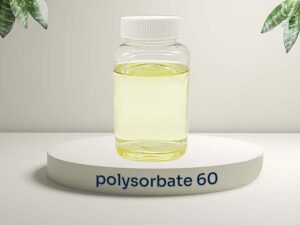

Finding a substitute for Polysorbate 60 (Tween 60) is a common challenge for formulators today. Whether you are aiming for a “Clean Label” status, dealing with supply chain shortages, or looking to reduce costs, choosing the right alternative depends entirely on your specific application.
Polysorbate 60 is unique due to its high HLB (14.9) and stearic acid base. Below are the top 5 alternatives categorized by their best-use cases.
1. For “Clean Label” Food Products: Lecithin
If you want to remove E-numbers (like E435) from your ingredient list, Lecithin (derived from Soy, Sunflower, or Egg) is the most popular natural alternative.
- Best For: Chocolate, baked goods, and instant powders.
- Pro Tip: Lecithin has a much lower HLB (around 4-7) than Polysorbate 60. You may need to use a “Fluid Lecithin” or combine it with other natural stabilizers like Guar Gum to achieve the same emulsion stability.
2. For High Aeration & Whipped Toppings: Span 60 + Hydrocolloids
Polysorbate 60 is famous for its ability to hold air in whipped creams. A single substitute often fails here, so a “system” is required.
- The Blend: Use Sorbitan Monostearate (Span 60) combined with Xanthan Gum or Methylcellulose.
- Why it works: Span 60 provides the fat-binding properties, while hydrocolloids provide the viscosity needed to trap air bubbles.
Ultimate Guide to Polysorbate 60
New to Tween 60? Explore our comprehensive pillar guide covering properties, technical specifications, and global industry applications of E435.
Read Full Pillar Guide →3. For Bakery & Dough Conditioning: DATEM or CITREM
In industrial baking, Polysorbate 60 is used to soften the crumb.
- Alternative 1 (DATEM): Diacetyl Tartaric Acid Esters of Mono-and Diglycerides. It is a very strong emulsifier for bread volume.
- Alternative 2 (CITREM): Citric Acid Esters of Mono-and Diglycerides. This is often seen as a more “natural-friendly” ester for fats and oils.
4. For Cosmetics & Lotions: Cetearyl Glucoside
In skincare, many brands are moving away from PEGs (Polyethylene Glycols) found in Polysorbates.
- Best For: Natural face creams and body lotions.
- Benefits: It offers a much “greener” profile and creates a lamellar structure in emulsions, which helps with skin hydration, unlike the purely micellar structure of Polysorbate 60.
5. For High-Shear Industrial Needs: PEG-100 Stearate
If you aren’t restricted by “natural” labels and just need a powerful synthetic performer:
- Best For: Heavy-duty industrial emulsions and pharmaceutical ointments.
- Note: PEG-100 Stearate has a similar HLB and stearic acid backbone, making it almost a “drop-in” replacement in many non-food formulas.
Comparison Summary Table
| Substitute | Key Benefit | Best Application |
|---|---|---|
| Lecithin | Natural / Clean Label | General Food Emulsions |
| Span 60 + Gum | Excellent Aeration | Whipped Toppings |
| DATEM | Volume & Texture | Industrial Baking |
| Cetearyl Glucoside | Skin-Friendly | Natural Cosmetics |
Conclusion: Things to Consider Before Switching
Before switching to a substitute, ensure you understand the Core Properties of Polysorbate 60 to match your new emulsifier’s performance. Every substitute will slightly change the sensory profile, shelf life, or viscosity of your final product. We recommend small-batch testing before full-scale production.