

Span 60 (sorbitan monostearate, HLB 4.7) and Span 65 (sorbitan tristearate, HLB 2.1) both carry stearic acid — but Span 65 has three stearic chains to Span 60’s one, and that structural difference changes everything: HLB drops from 4.7 to 2.1, melt point rises, and the emulsifier shifts from a general-purpose W/O anchor to an ultra-low-HLB specialist for chocolate and high-fat systems. At FoodEmul, we manufacture both. This guide compares them on every formulation-relevant metric.
What are Sorbitan Esters? The Chemistry of Span Surfactants
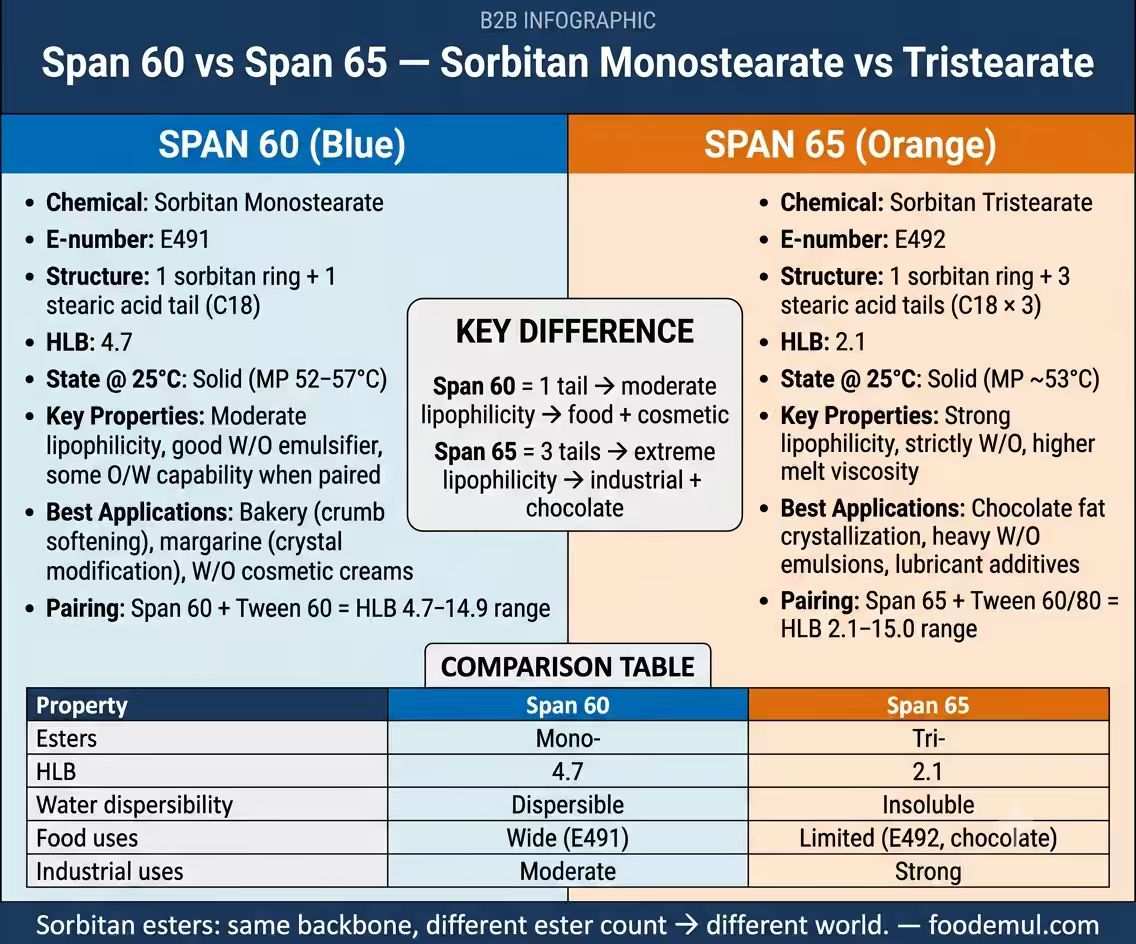
To understand the nuances of Sorbitan Monostearate vs. Tristearate, formulation engineers must first look at the foundational chemistry of the Span series. Sorbitan esters are non-ionic surfactants derived from natural sources, specifically the reaction between sorbitol (a sugar alcohol) and fatty acids.
The synthesis begins with the dehydration of sorbitol to form sorbitan, a cyclic ether mixture (primarily 1,4-sorbitan). This core is then subjected to the esterification of sorbitan with stearic acid. The stoichiometry of this reaction—specifically the ratio of fatty acid to the sorbitan backbone—determines whether the resulting molecule becomes a monoester or a triester. This process yields the lipophilic “Span” surfactants, which act as the backbone for water-in-oil (W/O) emulsions across the food, cosmetic, and industrial sectors.
While the entire Span family shares a common origin, the distinction between Span 60 (Monostearate) and Span 65 (Tristearate) represents a critical divergence in functionality, driven entirely by molecular geometry and the density of the fatty acid chains.
Structural Differences: One Tail vs. Three
The primary differentiator in the Sorbitan Monostearate vs. Tristearate comparison is the number of esterified groups attached to the sorbitan ring. This structural variance fundamentally alters the surfactant’s physical properties and its interaction with oil and water phases.
Sorbitan Monostearate (Span 60)
Sorbitan monostearate, commercially known as Span 60, consists of a sorbitan head group esterified with a single stearic acid tail. This “single-tail” configuration leaves more hydroxyl (-OH) groups on the sorbitan ring exposed and available for hydrogen bonding with water. Consequently, while still lipophilic, Span 60 possesses a degree of polarity that allows it to function effectively at the oil-water interface, acting as a bridge in emulsion systems.
Sorbitan Tristearate (Span 65)
In contrast, sorbitan tristearate (Span 65) is formed when three steric acid molecules attach to the sorbitan backbone. This triple hydrophobic tail in surfactants significantly increases the molecule’s molecular weight and creates a dense, non-polar barrier. The steric hindrance and increased lipophilicity created by the three sorbitan esters fatty acid chain groups make Span 65 far less soluble in water and highly compatible with fats and oils.
From a purity and composition standpoint, the “Tristearate” designation implies a higher degree of esterification, resulting in a molecule that behaves more like a wax or a fat crystal modifier than a traditional oil-water emulsifier.
📚 Need the Big Picture?
You are reading a detailed chapter on a specific topic. To understand the complete chemistry, manufacturing process, and full application range of the Span Series, check out our central guide.
Read the Ultimate Guide to Sorbitan Esters →
HLB Values and Hydrophobicity: Why it Matters
The Hydrophilic-Lipophilic Balance (HLB) system is the standard metric for predicting surfactant behavior. The structural differences described above result in a distinct “HLB Gap” between the two esters.
The HLB Gap
Span 60 typically carries an HLB value of approximately 4.7. This places it firmly in the category of W/O emulsifiers, but it is high enough to disperse somewhat in warm water. It is excellent for stabilizing emulsions where the water phase needs to be finely dispersed within an oil phase.
Span 65, due to its triple fatty acid chain, has a much lower HLB value of approximately 2.1. This extremely low value indicates strong lipophilicity (oil-loving nature). It does not function well as a primary emulsifier for creating emulsions but excels in systems requiring high oil solubility or crystal modification.
Solubility Profiles
- Water: Span 60 is dispersible in warm water; Span 65 is insoluble in water.
- Oils: Span 65 is soluble in mineral oils and vegetable oils even at lower temperatures compared to Span 60, which may require heating to dissolve fully in the oil phase due to its higher melting point and polarity.
- Organic Solvents: Both are soluble in ethanol and other organic solvents, though Span 65 shows higher solubility in non-polar solvents.
Key Applications in the Food Industry
In food science, the choice between sorbitan monostearate and tristearate is rarely interchangeable; they serve distinct rheological and stabilizing functions.
Sorbitan Monostearate in Baking
Span 60 is the gold standard for yeast-raised baked goods. Its HLB of 4.7 allows it to interact with gluten proteins and starch granules. It strengthens the dough, improves gas retention during fermentation, and enhances the rehydration of instant active dry yeast. The result is a loaf with increased volume, a finer crumb structure, and extended shelf life (anti-staling).
Sorbitan Tristearate in Confectionery
Span 65 is the “Anti-Bloom” hero in the chocolate industry. Chocolate fat bloom occurs when cocoa butter creates unstable polymorph crystals that migrate to the surface, causing a white haze. Sorbitan tristearate acts as a crystal modifier; it co-crystallizes with the cocoa butter to stabilize the desired crystal form (Form V). This prevents bloom and maintains the glossy snap of high-quality chocolate.
Margarine and Spreads
In high-fat emulsions like margarine, both esters can be used, but for different reasons. Span 60 helps stabilize the water droplets within the fat matrix to prevent weeping (syneresis). Span 65 acts to modify the crystallization of the fat phase itself, ensuring the spread maintains a smooth texture without developing sandiness (grainy crystals) over time.
Industrial and Cosmetic Uses
Beyond food, the specific sorbitan esters fatty acid chain configurations dictate their utility in chemical formulations.
Personal Care
In cosmetics, Span 60 is widely used in creams and lotions as a primary emulsifier for rich, heavy textures (W/O systems). It provides a distinct sensory profile that feels protective on the skin. Span 65 is less common as a primary emulsifier but is used in waxy formulations, lipsticks, and balms where structural integrity and high oil binding are required.
Textile and Plastics
In the plastics industry, these surfactants serve as internal lubricants and anti-static agents. The long hydrophobic tails allow them to migrate to the surface of the polymer, reducing friction and preventing charge buildup. Span 60 is also frequently used as an anti-fogging agent in food packaging films.
Synergy with Polysorbates
Neither Span 60 nor Span 65 works in isolation. They are frequently paired with their ethoxylated counterparts—Polysorbate 60 (Polysorbate 60) and Polysorbate 65 (Polysorbate 65). By mixing a low HLB Span with a high HLB Polysorbate, formulators can dial in the exact HLB required for their specific oil phase, creating highly stable emulsion systems that resist separation.
Comparison Table: Sorbitan Monostearate vs. Tristearate
The following table summarizes the technical specifications critical for procurement and formulation:
| Property | Sorbitan Monostearate (Span 60) | Sorbitan Tristearate (Span 65) |
|---|---|---|
| Common Name | Span 60 | Span 65 |
| CAS Number | 1338-41-6 | 26658-19-5 |
| HLB Value | 4.7 (Lipophilic) | 2.1 (Highly Lipophilic) |
| Melting Point | 50°C – 55°C | 53°C – 57°C |
| E-Number (Food) | E491 | E492 |
| Primary Function | Emulsification, Dough Conditioning | Crystal Modification, Anti-Bloom |
| Fatty Acid Chains | 1 (Monostearate) | 3 (Tristearate) |
Safety, Regulatory Status, and Side Effects
Both surfactants possess an excellent safety profile and are widely accepted by global regulatory bodies. They are biodegradable and non-toxic when used within established limits.
Regulatory Highlight:
Both Sorbitan Monostearate (E491) and Sorbitan Tristearate (E492) are recognized as GRAS (Generally Recognized As Safe) by the US FDA. In the European Union, they are approved food additives subject to specific purity criteria outlined in Commission Regulation (EU) No 231/2012.
While side effects are rare, excessive consumption of sorbitan esters (far exceeding standard dietary intake) can lead to mild gastrointestinal disturbances due to their surfactant nature. However, at the dosage levels used in food (typically 0.5% to 1.0%), they are metabolically safe.
Conclusion: Which One Should You Use?
Choosing between Sorbitan Monostearate vs. Tristearate ultimately depends on the problem you are trying to solve within your formulation.
If your goal is emulsification, aeration, or texture improvement in bread and cakes, Span 60 (Sorbitan Monostearate) is the superior choice due to its balanced HLB and ability to interact with water and starch. However, if your challenge lies in lipid management, controlling fat crystallization, or preventing bloom in chocolate and confectionery, Span 65 (Sorbitan Tristearate) is the requisite additive.
By understanding the impact of the hydrophobic tail in surfactants and the specific esterification of sorbitan, engineers can leverage these versatile esters to optimize stability and sensory attributes in their final products.
For a deeper look into how these solid esters are manufactured and purified, read our Technical Manufacturing Guide.
System overview: For the complete Span and Polysorbate product line, HLB pairing principles, and industry application matrix, see our Span & Polysorbate Formulators Guide.
Span 60 deep dive: For the complete Span 60 technical guide including chemical properties, manufacturing pathways, and specification tables, see our Sorbitan Monostearate E491 Guide.
Need Span 60 or Span 65? We manufacture both alongside Polysorbate 80 and the full range — Kosher and MUI Halal certified — reach out for specifications or samples.
