

Sorbitan esters are manufactured through a two-step process — sorbitol dehydration followed by fatty acid esterification — and the manufacturing conditions directly affect the final product’s performance. At FoodEmul, we control every step from raw material sourcing to final packaging. This guide covers the technical side: how sorbitan esters are made, what the safety data says, and what quality parameters matter for food-grade material.
Technical Specifications
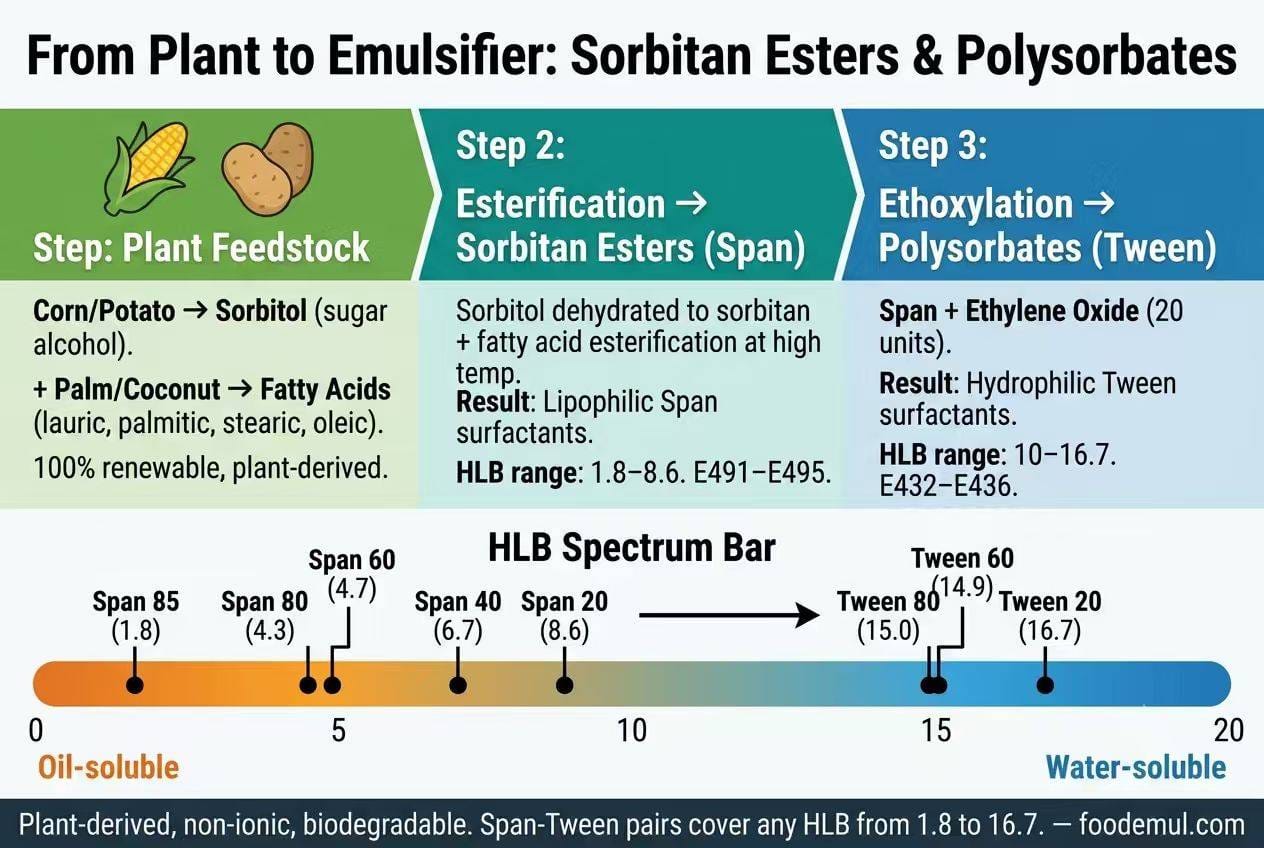
Sorbitan Esters are non-ionic surfactants formed by the esterification of sorbitol (and its anhydrides) with fatty acids. They are lipophilic, making them excellent water-in-oil (W/O) emulsifiers. When ethoxylated, they become Polysorbates (polysorbate) — the hydrophilic counterparts used in Span-Polysorbate blends.
| Product | CAS Number | E-Number | Fatty Acid | HLB | Physical Form (25°C) | Saponification Value (mg KOH/g) | Acid Value (mg KOH/g, max) |
|---|---|---|---|---|---|---|---|
| Span 20 | 1338-39-2 | E493 | Lauric (C12) | 8.6 | Amber Oily Liquid | 155–170 | 7 |
| Span 40 | 26266-57-9 | E495 | Palmitic (C16) | 6.7 | Cream Paste | 140–155 | 7 |
| Span 60 | 1338-41-6 | E491 | Stearic (C18) | 4.7 | Tan Beads/Flakes | 147–157 | 7 |
| Span 65 — Sorbitan Tristearate (E492) product specifications | 26266-58-0 | E492 | Stearic (C18×3) | 2.1 | Tan Beads/Flakes | 176–188 | 7 |
| Span 80 | 1338-43-8 | E494 | Oleic (C18:1) | 4.3 | Amber Viscous Liquid | 145–160 | 7 |
| Span 85 | 26266-58-0 | — | Oleic (C18:1×3) | 1.8 | Amber Oily Liquid | 165–185 | 15 |
Understanding Ester Types: Mono-, Di-, Tri-, and Polyesters
The ratio of monoesters to di-/tri-/polyesters determines the functional properties of each Span variant:
- Sorbitan Monoesters (Span 20, 40, 60, 80): One fatty acid chain per sorbitan molecule. These are the standard food-grade and cosmetic-grade sorbitan esters with HLB values of 4.3–8.6. The single fatty acid chain provides optimal W/O emulsification.
- Sorbitan Triesters (Span 65, 85): Three fatty acid chains per sorbitan molecule. These are more lipophilic (HLB 1.8–2.1), making them suitable for fat-continuous systems like chocolate and margarine where minimal water interaction is desired.
- Sorbitan Polyesters / Polyethoxylated Sorbitan Esters: When sorbitan esters are further reacted with ethylene oxide, they become polysorbates (Polysorbate series) — the hydrophilic counterparts used in Span-Polysorbate O/W emulsifier blends. These are covered in our Polysorbate (Polysorbate) Comprehensive Guide.
Manufacturing note: The monoester content is controlled by the sorbitol-to-fatty-acid ratio during esterification. Higher monoester content requires precise temperature and vacuum control — a key differentiator between food-grade and industrial-grade sorbitan esters.
For sourcing: Sorbitan Monopalmitate (Span 40) and Sorbitan Trioleate (Span 85) extend the Span range at the higher-HLB and ultra-low-HLB extremes respectively.
The Manufacturing Process & Quality Control
High-purity Sorbitan Esters — required for sensitive applications like pharmaceuticals and food — depend on precise process control at every stage.
Step 1: Raw Material Selection
- Sorbitol: Derived from corn or wheat starch; pharmaceutical-grade sorbitol preferred for injectable-grade esters.
- Fatty Acids: Vegetable-sourced (coconut, palm, or olive oil fractions). Kosher and Halal certification must be verified at the raw material stage, not just on the finished product.
Step 2: Synthesis Reaction
Two mechanisms occur simultaneously:
- Dehydration: Sorbitol is dehydrated to form sorbitan (a cyclic ether). Temperature and vacuum control at this stage determine the ratio of mono-, di-, and tri-esters in the final product.
- Esterification: Sorbitan reacts with the fatty acid at 180°C – 250°C under vacuum. Catalysts accelerate the reaction; continuous removal of water by-product drives equilibrium toward ester formation.
Step 3: Refining and Purification
The crude ester exits the reactor with trace impurities. Food and cosmetic grades require:
- Decolorization: Activated carbon treatment to achieve the expected pale yellow to amber color.
- Deodorization: Steam stripping to remove volatile odor components.
- Filtration: Removal of catalyst residues to meet food-grade clarity standards.
Grade Comparison: Food, Pharmaceutical, USP, and Industrial
Not all sorbitan esters are created equal. The intended application determines the required purity grade:
| Grade | Key Requirement | Typical Applications | Testing Standard |
|---|---|---|---|
| Food Grade | Meets FCC/GB 25552 specifications; free of harmful solvent residues | Baked goods, dairy, confectionery, beverages | Acid value, saponification value, heavy metals (Pb≤2, As≤3 mg/kg) |
| Pharmaceutical Grade / USP | Highest purity; meets USP-NF monographs; full traceability | Oral solid dosage, topical creams, parenteral excipients | Additional tests: microbial limits, endotoxins, residual solvents |
| Cosmetic Grade | Low odor, consistent color; CIR safety-approved | Creams, lotions, makeup, hair care | Gardner color ≤3, peroxide value, absence of skin irritants |
| Kosher / Halal Certified | Documented vegetable-source raw materials; certified production line | Any food/cosmetic application requiring religious certification | Third-party certification (OU, MUI, IFANCA); raw material audit trail |
| Industrial Grade | Cost-optimized; wider specification tolerance | Metalworking fluids, textile processing, oilfield chemicals | Relaxed acid value and color specs; no food-grade documentation required |
Quality Control Parameters
Every batch at FoodEmul is tested against these three critical values:
- Acid Value (AV): Measures residual free fatty acids. Low AV = reaction went near completion. High AV indicates incomplete esterification or product degradation.
- Saponification Value (SV): Verifies average molecular weight and total ester content. A batch falling outside the SV range suggests wrong fatty acid ratio or contamination.
- Hydroxyl Value (HV): Confirms the ratio of unreacted hydroxyl groups. Critical for HLB consistency — if HV drifts, the emulsifying behavior of that batch will be different from the standard.
Reading a Certificate of Analysis (COA)
When you receive a batch, cross-check these values against the specification table in Section 1:
| Parameter | What It Tells You | Red Flag |
|---|---|---|
| Acid Value | Reaction completeness; product freshness | AV above spec = degraded or poorly synthesized material |
| Saponification Value | Correct fatty acid type and ratio | SV out of range = wrong fatty acid or ester distribution |
| Hydroxyl Value | HLB consistency batch-to-batch | HV drift >5% = emulsifying performance will differ from previous orders |
| Color (Gardner) | Purity; oxidation state | Darker than spec = oxidation or insufficient decolorization |
| Moisture (% Karl Fischer) | Residual water | >0.5% = risk of hydrolysis during storage |
Always request a COA with each shipment. A supplier that cannot provide batch-level COA data cannot guarantee batch-to-batch consistency.
Regulatory Compliance: E491–E495 Across Markets
Sorbitan Esters are approved as food additives globally, but permitted usage levels and categories vary by jurisdiction.
| Ester | EU (EC 1333/2008) | FDA (21 CFR) | GB (China GB 2760) | JECFA ADI (mg/kg bw) |
|---|---|---|---|---|
| Span 20 (E493) | 0.5–10 g/kg (varies by food category) | GRAS, 21 CFR 172.842 | Permitted, category-dependent | 0–25 |
| Span 40 (E495) | Permitted in specific categories | GRAS, 21 CFR 172.842 | Permitted, category-dependent | 0–25 |
| Span 60 (E491) | Permitted in baked goods, desserts, etc. | GRAS, 21 CFR 172.842 | Permitted in multiple categories | 0–25 |
| Span 65 (E492) | Permitted in specific categories | GRAS, 21 CFR 172.842 | Permitted, category-dependent | 0–25 |
| Span 80 (E494) | Permitted in baked goods, emulsions | GRAS, 21 CFR 172.842 | Permitted in multiple categories | 0–25 |
Always check your target market’s latest food additive regulations for category-specific maximum use levels. The values above are general ADI ranges; specific food categories have individual limits.
Safety Data Sheets (SDS) & Handling Protocols
While Sorbitan Esters are Generally Recognized as Safe (GRAS) and low-toxicity, industrial handling requires defined protocols.
Hazard Identification (GHS Classification)
Most Span grades are not classified as hazardous substances. However:
- Concentrated contact: May cause mild, transient eye or skin irritation upon prolonged exposure.
- Inhalation: Mists or dusts (particularly from solid beads like Span 60/65) may cause respiratory tract irritation.
- Thermal decomposition: Heating above 250°C may release irritating fumes; ensure ventilation if processing at elevated temperatures.
Personal Protective Equipment (PPE)
- Chemical-resistant gloves (nitrile or neoprene)
- Safety goggles
- For Span 60/65 bead handling: dust mask if ventilation is inadequate
Storage & Stability
- Store in a cool, dry, well-ventilated area.
- Keep containers tightly closed when not in use — moisture absorption degrades product.
- Span 80/85 (Oleates): Unsaturated fatty acid chain is susceptible to oxidation. Store under nitrogen blanket if possible; avoid exposure to air and direct light. Shelf life: 24 months from manufacture date when stored correctly.
Emergency Response (First Aid)
- Eye Contact: Flush with water for at least 15 minutes. Remove contact lenses if present.
- Skin Contact: Wash with soap and water.
- Ingestion: Rinse mouth. Do not induce vomiting unless directed by medical personnel.
Conclusion
Technical performance starts with manufacturing rigor. From raw material certification through batch-level QC testing, every step determines whether a Span 60 bead or Span 80 liquid performs identically from order to order.
At FoodEmul.com, we provide:
– Full batch-level COA with every shipment (AV, SV, HV, color, moisture)
– Kosher and Halal certification documentation
– Technical data sheets (TDS) and safety data sheets (SDS) on request
– Regulatory support for EU, FDA, and GB compliance
Contact us to request TDS, SDS, COA samples, or to discuss your specific quality requirements.
Need sorbitan esters with full manufacturing documentation? We manufacture Span 60, Span 80, and the full E491-E495 range — Kosher and MUI Halal certified — reach out for technical data or samples.
