
Chemical Structure and Composition
For formulation engineers and R&D managers seeking a comprehensive polysorbate 20 TDS overoview, understanding the fundamental chemistry of this surfactant is the first step toward successful application. Polysorbate 20, commercially known as Tween 20, is a non-ionic surfactant belonging to the polysorbate family.
Molecular Makeup of Polysorbate 20
Thepolysorbate 20 chemical structure is derived from the ethoxylation of sorbitan monolaurate. The molecule consists of a hydrophilic head group comprising polyoxyethylene (PEG) chains and a lipophilic tail derived from lauric acid (C12 fatty acid). Specifically, it is formed by the reaction of sorbitan fatty acid ester with approximately 20 moles of ethylene oxide.
This amphiphilic structure allows Polysorbate 20 to function effectively as a wetting agent, stabilizer, and solubilizer in aqueous systems. Unlike its counterparts (such as Polysorbate 60 or 80), the lauric acid tail provides a specific balance suited for lighter formulations and high-clarity applications.
To satisfy R&D engineers, visualizing the amphiphilic nature of the molecule is key. This clarifies why the HLB is so high (16.7).
- Hydrophilic Head: Comprised of ~20 moles of ethylene oxide. This large polar head is what makes it highly water-soluble.
- Lipophilic Tail: Derived from Lauric Acid (C12). The shorter chain length (compared to Polysorbate 80’s C18 tail) is why Tween 20 is better for solubilizing essential oils rather than heavy vegetable oils.
Key Physical and Chemical Properties (TDS Data)
When evaluating raw materials for supply chain integration, precise technical data is paramount. Below is a detailed breakdown of polysorbate 20 properties and standard specifications found in a Technical Data Sheet (TDS).
Polysorbate 20 HLB Value and Emulsification
The hlb polysorbate 20 value is approximately 16.7. This high Hydrophile-Lipophile Balance indicates that the molecule is strongly hydrophilic. Consequently, it is primarily used as an Oil-in-Water (O/W) emulsifier and a solubilizer for essential oils, fragrances, and vitamins in water-based systems.
Solubility Profile: Water and Organic Solvents
Formulators rely on polysorbate 20 solubility data to determine compatibility. It exhibits the following solubility characteristics:
- Water: Soluble (clear to slightly hazy solution).
- Ethanol/Isopropanol: Soluble.
- Methanol: Soluble.
- Mineral Oil: Insoluble.
- Vegetable Oils: Generally insoluble (dispersible).
Critical Micelle Concentration (CMC) & Melting Point
The critical micelle concentration polysorbate 20 is a vital metric for determining the minimum amount of surfactant required to form micelles. The CMC is approximately 0.06 mM (approx. 0.007% w/v) at 25°C. This low CMC makes it highly efficient for solubilizing hydrophobic compounds without excessive surfactant usage.
Regarding thermal properties, the polysorbate 20 melting point is not a singular sharp point due to its complex mixture, but it generally remains a liquid at room temperature, with a pour point typically below -10°C, ensuring ease of handling in cold manufacturing environments.
Standard Polysorbate 20 Specifications
At foodemul.com, we adhere to strict quality controls. The following table outlines standard polysorbate 20 specifications typically required for procurement and quality assurance:
| Parameter | Specification Range | Test Method |
|---|---|---|
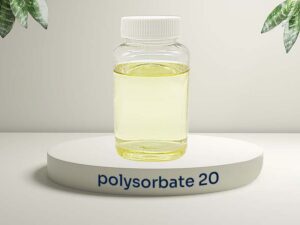
| Appearance | Yellow to amber oily liquid | Visual |
| Acid Value (mg KOH/g) | Max 2.0 | AOCS Te 1a-64 |
| Saponification Value (mg KOH/g) | 40 – 50 | AOCS Tl 1a-64 |
| Hydroxyl Value (mg KOH/g) | 96 – 108 | AOCS Cd 13-60 |
| Moisture (Water Content) | Max 3.0% | Karl Fischer |
| Dioxane (ppm) | Max 10 (or strictly regulated limits) | Gas Chromatography |
Pro-Tip for Formulators: Always verify the hydroxyl value batch-to-batch, as slight variations can impact the viscosity of the final emulsion. Foodemul.com ensures tight specification ranges to maintain formulation stability.
Quick Comparison Between polysorbate 20 and polysorbate 80
| Feature | Polysorbate 20 (Tween 20) | Polysorbate 80 (Tween 80) |
| Fatty Acid | Lauric Acid (C12) | Oleic Acid (C18) |
| HLB Value | 16.7 (More Hydrophilic) | 15.0 |
| Best Use | Fragrance/EO Solubilization | Emulsifying heavy oils/fats |
| Appearance | Yellow oily liquid | Amber viscous liquid |
Functional Applications and Behavior
Surfactant Behavior: Does Polysorbate 20 Foam?
A common query in R&D is: does polysorbate 20 foam? Yes, it does possess foaming properties, although it is generally considered a low-to-moderate foamer compared to anionic surfactants like SLS. Its foam is relatively stable but light.
Because of this, it is frequently used in:
- Personal Care: As a mild cleansing agent in baby shampoos and facial washes where low irritation is critical.
- Industrial Applications: As a wetting agent where moderate foam is acceptable or controlled with defoamers.
- Food Systems: As a dispersing agent where foaming is not the primary function, but surface tension reduction is required.
Safety, Specifications, and Regulatory Compliance
Ensuring regulatory compliance is central to the value proposition at foodemul.com. We provide full transparency regarding polysorbate 20 safety and origin.
Toxicology Profile: Is Polysorbate 20 Safe?
Is polysorbate 20 safe for consumption and topical application? Yes. It is widely regarded as safe when used within established concentration limits.
- Food Industry: It is approved as a food additive (E432 in the EU / 21 CFR 172.846 in the USA). It acts as an emulsifier in dressings, baked goods, and flavor drops.
- Cosmetics: The Cosmetic Ingredient Review (CIR) Expert Panel has concluded it is safe for use in cosmetic formulations. It is non-irritating to the skin and eyes at typical use concentrations.
Dietary & Ethical Compliance: Is Polysorbate 20 Vegan?
For brands targeting the plant-based market, the question is polysorbate 20 vegan is critical. Polysorbate 20 is produced by reacting sorbitol (sugar alcohol) and lauric acid with ethylene oxide.
While lauric acid can be derived from animal fats, foodemul.com strictly sources vegetable-derived lauric acid (typically from coconut or palm kernel oil) and plant-based sorbitol. Therefore, our Polysorbate 20 is suitable for vegan and vegetarian formulations. We recommend always requesting a “Statement of Origin” to satisfy RSPO and vegan certification requirements.
Regulatory Note: While Polysorbate 20 is safe, formulators must be aware of 1,4-dioxane impurities, a byproduct of ethoxylation. Foodemul.com utilizes advanced vacuum stripping technologies to ensure impurity levels are well below strict regulatory thresholds (e.g., EU and California Prop 65 limits).
In summary, this polysorbate 20 TDS overoview highlights the surfactant’s versatility as a high-HLB solubilizer and emulsifier. By leveraging high-purity grades from reliable partners like foodemul.com, formulators can ensure stability, safety, and compliance in their final products.
FAQ
Q: My Polysorbate 20 solution is cloudy. Is it contaminated?
- Expert Insight: Not necessarily. Check the temperature. While Polysorbate 20 has a high cloud point, high electrolyte (salt) concentrations in your water phase can lower this significantly, causing “salting out.” Ensure you are using deionized water for maximum clarity.
Q: How do I avoid “clumping” or “fish-eyes” during mixing?
- Expert Insight: Even though it is a liquid, adding Polysorbate 20 too quickly to a cold aqueous phase can create localized high-viscosity zones. Pro-tip: Pre-blend Polysorbate 20 with your oil-based fragrances or vitamins before adding the mixture to the water phase for seamless solubilization.
Q: Can I use Polysorbate 20 in high-heat processes?
Expert Insight: It is generally stable; however, prolonged exposure to temperatures above 60°C in the presence of oxygen can lead to autoxidation. If your process requires high heat, consider adding a food-grade antioxidant like Tocopherol (Vitamin E).