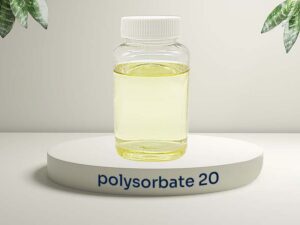

Every emulsifier has a spec sheet. This article covers what matters on the Polysorbate 20 TDS — HLB, acid value, saponification number, hydroxyl value — and what those numbers actually mean for your formulation. At FoodEmul, we manufacture the full Polysorbate range alongside sorbitan esters (Span).
Chemical Structure and Composition
Polysorbate 20 is a workhorse in personal care. Our skincare and haircare formulation guide covers PS20 in micellar waters, toners, and sulfate-free shampoos — with typical use rates and the CIR safety assessment.
Polysorbate 20, commercially known as Polysorbate 20, is a non-ionic surfactant formed by the ethoxylation of sorbitan monolaurate with approximately 20 moles of ethylene oxide. The resulting molecule has a polyoxyethylene head group (~20 EO units) that provides high water solubility and a lauric acid tail (C12, saturated) that anchors into light oils and fragrances.
Molecular Makeup
- Hydrophilic head: Three polyoxyethylene chains totaling ~20 EO units. Each EO unit (-CH₂CH₂O-) acts as a hydrogen-bond acceptor, creating a dense hydration shell that makes PS20 the most water-soluble polysorbate (HLB 16.7).
- Lipophilic tail: Lauric acid (C12, saturated). The shortest fatty acid chain in the polysorbate family — 6 carbons shorter than PS60’s stearic acid (C18) and 6 carbons shorter than Polysorbate 80’s oleic acid (C18:1). This short chain is why PS20 excels at solubilizing light fragrances and essential oils but struggles with heavy vegetable oils.
This amphiphilic structure allows Polysorbate 20 to function as a wetting agent, solubilizer, and O/W emulsifier. Unlike Polysorbate 60 (semi-solid at room temperature), PS20 remains a free-flowing liquid down to −10°C — ideal for cold-process manufacturing.
Key Physical and Chemical Properties
When evaluating raw materials for supply chain integration, precise technical data is paramount. Below is a detailed breakdown of polysorbate 20 properties and standard specifications.
HLB Value and Emulsification
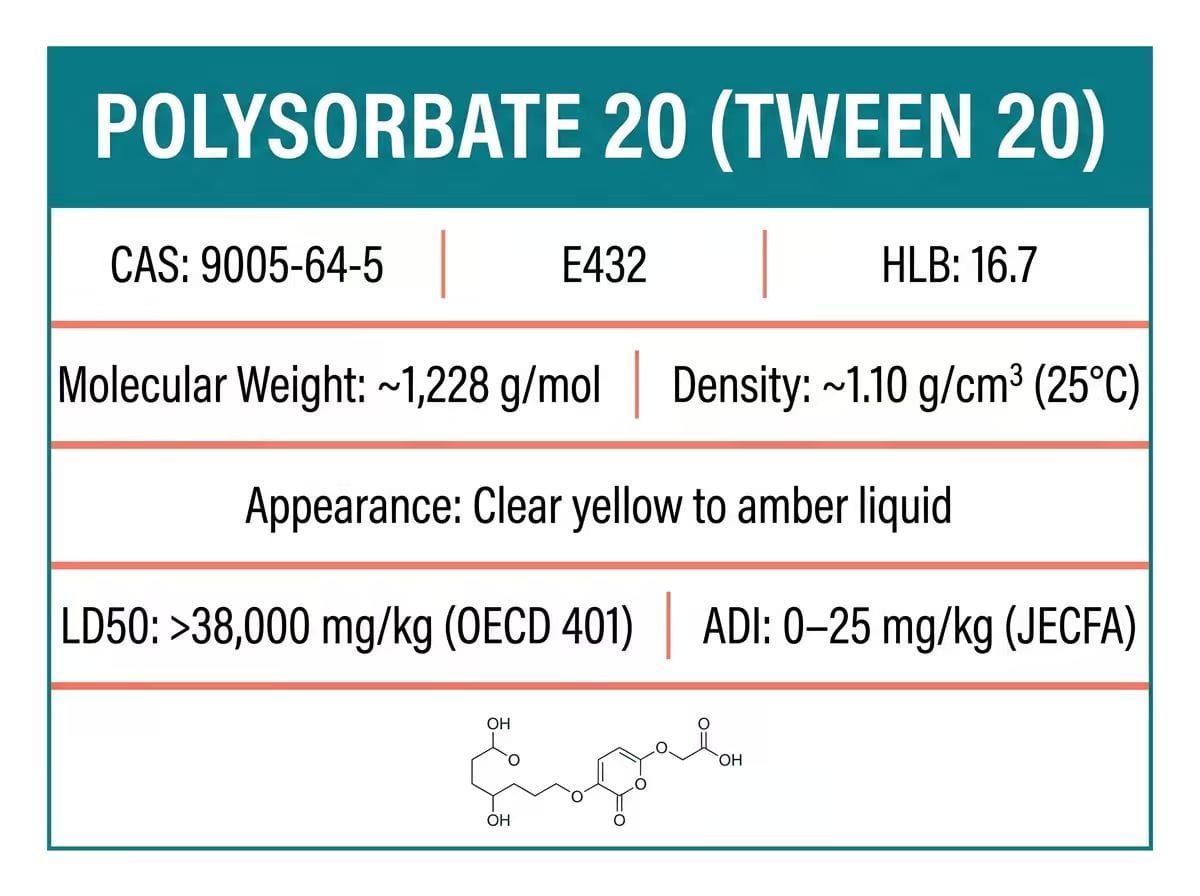
The HLB of Polysorbate 20 is 16.7 — the highest in the polysorbate family. This strongly hydrophilic character makes it the premier choice for solubilizing essential oils, fragrances, and fat-soluble vitamins (A, D, E, K) into clear, water-based systems. At 1–5% usage, it produces crystal-clear solutions that remain stable through temperature cycling.
Solubility Profile
| Solvent | Solubility | Notes |
|---|---|---|
| Water | Fully soluble | Clear to slightly hazy solution; cloud point > 80°C |
| Ethanol | Soluble | Fully miscible at all concentrations |
| Isopropanol | Soluble | — |
| Methanol | Soluble | — |
| Propylene glycol | Soluble | Common co-solvent in cosmetic formulations |
| Vegetable oils | Insoluble to dispersible | Limited solubility due to short C12 tail |
| Mineral oil | Insoluble | Use Polysorbate 80 or Span 80 for mineral oil systems |
Critical Micelle Concentration (CMC) and Surface Activity
The CMC of Polysorbate 20 is approximately 0.06 mM (~0.007% w/v) at 25°C. This exceptionally low CMC makes PS20 highly efficient — only trace amounts are needed to form micelles and begin solubilizing hydrophobic compounds. For comparison, Polysorbate 80 has a CMC of ~0.012 mM — PS20 requires roughly 5× more surfactant to reach the CMC, but its shorter C12 tail produces smaller micelles that scatter less light, yielding clearer solutions.
Thermal Properties
PS20 does not have a sharp melting point due to its polydisperse nature (a distribution of EO chain lengths). It remains a liquid at room temperature with a pour point below −10°C, ensuring pumpability in cold storage and refrigerated manufacturing environments. Prolonged heating above 60°C in the presence of oxygen can initiate autoxidation — add tocopherol (Vitamin E) at 0.01–0.05% for thermal protection.
Standard Specifications
| Parameter | Specification | Test Method |
|---|---|---|
| Appearance | Yellow to amber oily liquid | Visual |
| Acid Value | ≤ 2.0 mg KOH/g | AOCS Te 1a-64 |
| Saponification Value | 40–50 mg KOH/g | AOCS Tl 1a-64 |
| Hydroxyl Value | 96–108 mg KOH/g | AOCS Cd 13-60 |
| Water Content | ≤ 3.0% | Karl Fischer (USP 921) |
| 1,4-Dioxane | ≤ 10 ppm | GC Headspace |
| Ethylene Oxide | ≤ 1 ppm | GC Headspace |
| Heavy Metals (as Pb) | ≤ 10 ppm | FCC Appendix VII |
QC Tip: The hydroxyl value is the most batch-sensitive parameter. Variations of ±5 mg KOH/g can shift the effective HLB by 0.3–0.5 units — enough to cause phase separation in finely tuned emulsions. Foodemul.com maintains tight specification ranges across all production lots.
Quick Comparison: Polysorbate 20 vs. 80
| Feature | Polysorbate 20 (Polysorbate 20) | Polysorbate 80 (Polysorbate 80) |
|---|---|---|
| Fatty Acid | Lauric acid (C12, saturated) | Oleic acid (C18:1, unsaturated) |
| HLB Value | 16.7 (most hydrophilic) | 15.0 |
| CMC | ~0.06 mM | ~0.012 mM |
| Physical Form @25°C | Clear to yellow liquid | Amber viscous liquid |
| Best For | Fragrance/essential oil solubilization in clear toners, serums, and aqueous systems | Heavy oil emulsification in ice cream, salad dressings, and pharma formulations |
| Not For | Heavy vegetable oils, mineral oil systems | Ultra-clear aqueous products (slight haze) |
| Tech Specs | This page | Polysorbate 80 Technical Specifications |
For a comprehensive side-by-side analysis covering structure, applications, and selection criteria, see our PS20 vs. Polysorbate 80 Complete Comparison. For the four-way polysorbate overview, see the Polysorbate Emulsifiers Complete Guide.
Functional Applications and Behavior
Surfactant Behavior: Foaming Properties
PS20 produces low-to-moderate foam — significantly less than anionic surfactants like SLS or SLES. Its foam is relatively light and stable, making it suitable for:
- Personal care: Mild cleansing in baby shampoos and facial washes where low irritation and moderate foam are desired.
- Industrial: Wetting agent applications where surface tension reduction is the primary goal and foam is managed with defoamers.
- Food: Dispersing agent in dry mixes where foaming is incidental but surface tension control is critical for hydration.
Key Application Areas
- Cosmetics: Solubilizes fragrances and essential oils into toners, serums, and micellar waters at 1–5%. The resulting solutions remain crystal clear — a key advantage over Polysorbate 80 in transparency-critical formulations.
- Pharmaceuticals: Stabilizes emulsions and solubilizes poorly water-soluble APIs. Used in oral suspensions and topical preparations.
- Food: Wetting agent and flavor dispersant. FDA 21 CFR 172.846 permits use as an emulsifier in specific food categories.
Safety, Specifications, and Regulatory Compliance
Toxicology Profile
PS20 is widely regarded as safe within established limits: The acute oral LD50 in rats is >38,000 mg/kg body weight (OECD 401), placing it in the lowest toxicity category. No genotoxicity or carcinogenicity has been observed in standard OECD assays. The ADI (Acceptable Daily Intake) established by JECFA is 0–25 mg/kg bw/day for all polysorbates combined (E432–E436).
- Food: Approved as E432 (EU) and under FDA 21 CFR 172.846. Used as an emulsifier in dressings, baked goods, and flavor preparations.
- Cosmetics: CIR Expert Panel concluded safe for cosmetic use. Non-irritating to skin and eyes at typical concentrations (1–5%).
- Acute toxicity: LD₅₀ > 10 g/kg (rat, oral) — practically non-toxic.
Dietary Compliance
Is Polysorbate 20 vegan? Yes — when sourced from vegetable-derived lauric acid. Foodemul.com uses coconut or palm kernel oil-based lauric acid and plant-based sorbitol. Our PS20 carries Halal and Kosher certification. Request a Statement of Origin for vegan compliance documentation.
Impurity Control
1,4-Dioxane and ethylene oxide are potential byproducts of the ethoxylation process. Foodemul.com uses vacuum stripping to maintain both impurities below regulatory thresholds (EU and California Prop 65). Every batch ships with a Certificate of Analysis confirming these values.
FAQ
Q: My Polysorbate 20 solution is cloudy. Is it contaminated?
Not necessarily. High electrolyte (salt) concentrations in the water phase can lower the cloud point, causing “salting out.” Use deionized water for maximum clarity. Also, check the temperature — while PS20 has a high cloud point (>80°C in pure water), dissolved salts can reduce this significantly.
Q: How do I avoid clumping or fish-eyes during mixing?
Pre-blend PS20 with your oil-based ingredients (fragrances, vitamins) before adding to the water phase. This ensures the surfactant is already associated with the oil, enabling seamless solubilization. Adding neat PS20 directly to cold water can create localized high-viscosity zones that resist dispersion.
Q: Can I use Polysorbate 20 in high-heat processes?
It is stable for short durations up to 60°C. For prolonged heating or autoclaving, add a food-grade antioxidant like Tocopherol (Vitamin E) at 0.01–0.05% to prevent autoxidation of the PEG chains and lauric acid tail.
Related Technical Resources
- Usage ratios & solubilization protocols: PS20 Usage Ratio Guide
- Formulation guide: PS20 Formulator’s Guide
- PS20 vs Polysorbate 80 comparison: PS20 vs. Polysorbate 80 Complete Comparison
- Polysorbate family overview: Polysorbate Emulsifiers Complete Guide
- Product page (TDS, SDS, quotation): Polysorbate 20 Product Page
Contact FoodEmul.com for batch-specific Certificate of Analysis, Technical Data Sheet (PDF), or bulk quotation.
Need Polysorbate 20 with full technical documentation? We manufacture the full range with Kosher and MUI Halal certification — reach out for specifications or samples.