Category: Industry Overview
Insights on food emulsifiers—applications, functions, and benefits to improve stability, texture, and quality across industries.
The Industry Overview category provides the foundational knowledge that every food scientist, cosmetic formulator, and procurement professional needs before diving into product-specific guides. These articles cover the first principles of emulsifier science, the journey from raw material to finished ingredient, and the physical properties that govern surfactant performance in real-world manufacturing.
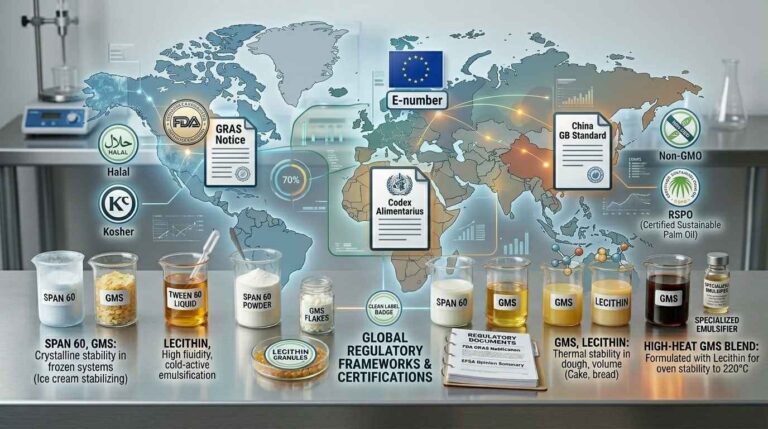
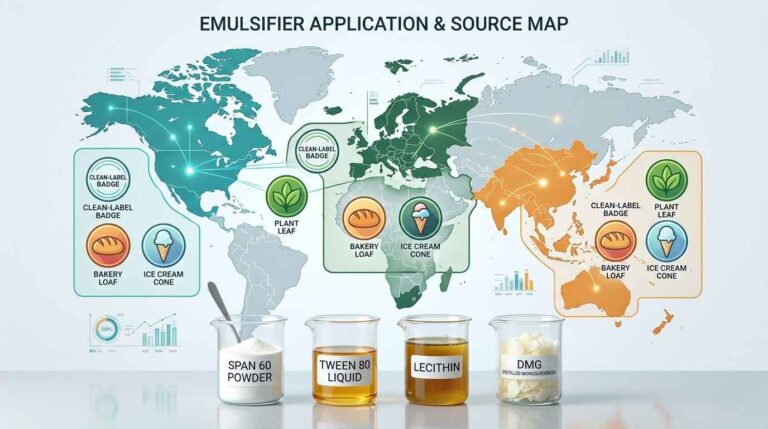
The cornerstone article—’Understanding Food Emulsifiers: Functions and Applications in the Food Industry’—explains what emulsifiers are, how they reduce interfacial tension, and why they are essential for preventing phase separation, retarding starch retrogradation in bread, controlling ice crystal growth in frozen desserts, and preventing fat bloom in chocolate. It introduces the E-number system and maps common emulsifiers (E322 lecithin through E492 sorbitan tristearate) to their functions. ‘Sorbitan Esters and Polysorbates: A Comprehensive Guide to Plant-Based Emulsifiers’ broadens the scope to both Span and polysorbate families, covering natural origins, HLB theory, and cross-industry applications.
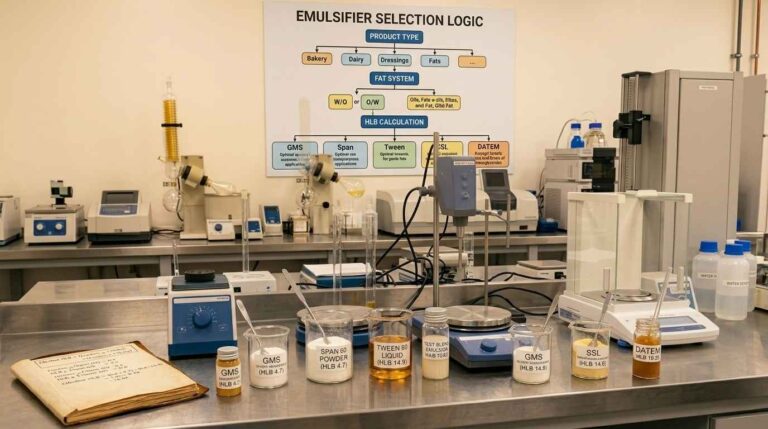
For those who need to understand what goes into these ingredients, ‘From Plant to Plate: Raw Materials of Food-Grade Span and polysorbate’ traces the supply chain from corn, coconut, and palm to purified sorbitol and fatty acids. The Span & polysorbate Surfactants formulation guide provides a practical entry point to HLB blending, while the Pour Point & Melting Point guide covers the temperature-dependent physical behavior that dictates handling, storage, and processing conditions in industrial settings.