

Sorbitan esters and polysorbates share the same fatty acid backbone — Span 60 and Polysorbate 60 both start from stearic acid — but that is where the similarity ends. Sorbitan esters (Span) anchor the oil phase at low HLB. Polysorbates drive the water phase at high HLB. At FoodEmul, we manufacture the full range of both families, and the pairing is what makes the system work. This guide covers the chemistry, applications, and selection criteria for sorbitan esters and polysorbates side by side.
Introduction to Natural Emulsifiers
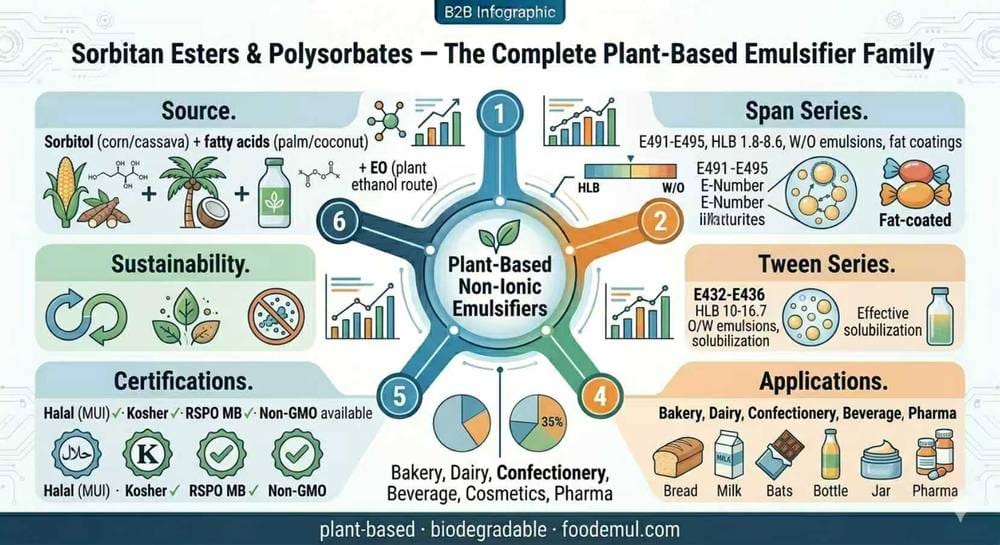
One of the most persistent challenges in product formulation is the immiscibility of oil and water — leading to separation, reduced shelf life, and poor texture. Emulsifiers are the key to overcoming this hurdle.
Among the most effective and environmentally friendly options are Sorbitan Esters and Polysorbates. Derived from renewable plant-based sources, these non-ionic surfactants have revolutionized industries by enabling stable emulsions in food, cosmetics, pharmaceuticals, and beyond.
At FoodEmul.com, we specialize in high-quality Sorbitan Esters and Polysorbates that are functional, safe, and sustainable. This guide covers their origins, properties, and applications.
What Are Sorbitan Esters and Polysorbates?
Natural and Renewable Origins
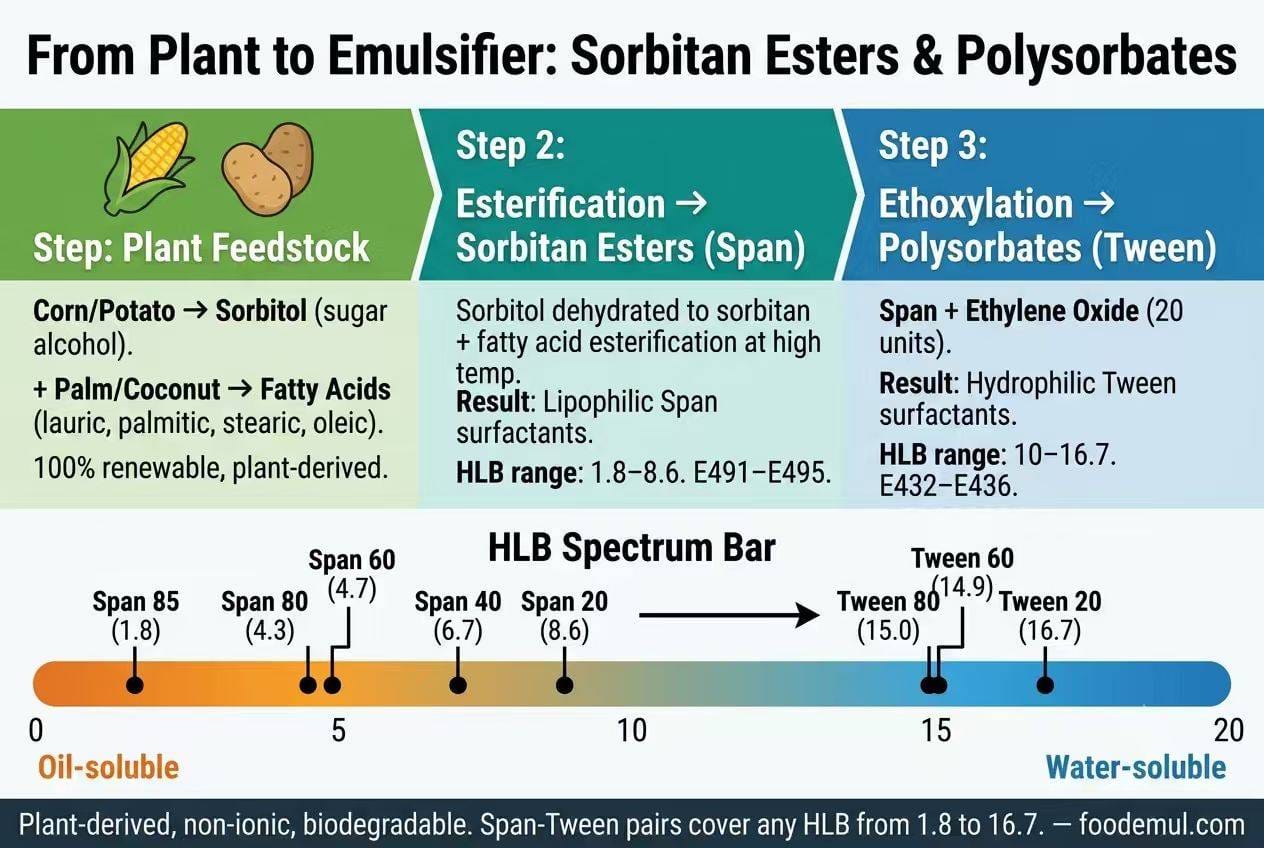
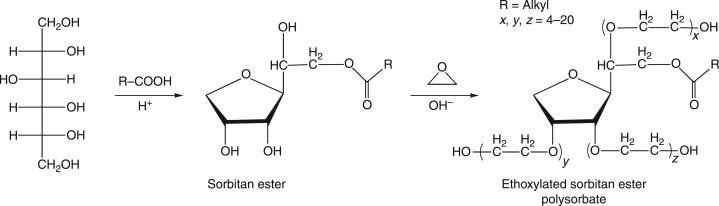
Sorbitan Esters are synthesized through the esterification of sorbitol — a sugar alcohol derived from crops like corn and potatoes — with fatty acids such as lauric, palmitic, stearic, or oleic acid. The process involves dehydration at high temperatures to form sorbitan, which is then esterified to produce lipophilic surfactants.
These compounds are entirely based on renewable raw materials, making them an eco-conscious choice for manufacturers aiming to reduce their environmental footprint.
Polysorbates are created by ethoxylating Sorbitan Esters — adding ethylene oxide to enhance hydrophilicity. This modification transforms them into versatile emulsifiers for oil-in-water systems, while maintaining their plant-based origins. Both families align with global trends toward sustainability and green chemistry.
The Sorbitan Ester Family: Meet the Spans
The Sorbitan Ester family — commonly called Spans — includes a range of esters each tailored for specific applications:
- Sorbitan Monolaurate (Span 20): Derived from lauric acid, typically a liquid. Ideal for emulsifying oil and water in cosmetic formulations.
- Sorbitan Monostearate (Span 60): Made from stearic acid, appears as waxy flakes. Widely used in food products like margarine for its stabilizing properties.
- Sorbitan Monopalmitate (Span 40): From palmitic acid, used in personal care emulsions.
- Sorbitan Trioleate (Span 85): A liquid ester for industrial and cosmetic formulations.
- Sorbitan Tristearate (Span 65): A solid ester used as a lubricant and anti-static agent in textiles.
The numbering system (20, 40, 60, 80) directly corresponds to the fatty acid: 20 for monolaurate, 40 for monopalmitate, 60 for monostearate, and 80 for monooleate. This variety allows formulators to select the optimal ester based on HLB value, solubility, and desired emulsion type.
| Product Name | Abbreviation | Physical Form | Primary Function | Main Applications | Industries Served | Key Benefits |
|---|---|---|---|---|---|---|
| Sorbitan Mono Laurate | SML | Liquid | Emulsifier | Creams, lotions, sunscreens | Cosmetics, Pharmaceuticals | Mild surfactant; suitable for sensitive skin; enhances emulsion stability |
| Sorbitan Mono Stearate | SMS | Waxy flakes | Food-grade emulsifier (W/O) | Margarine, ice cream, bakery | Food, Cosmetics | Stabilizes water-in-oil emulsions; prevents separation |
| Sorbitan Tri Stearate | STS | Waxy flakes | Lubricant | Fiber processing, coatings | Textiles, Industrial, Coatings | Reduces friction; prevents static build-up |
| Sorbitan Mono Oleate | SMO | Liquid | Stabilizer & lubricity additive | Lotions, creams, shampoos | Cosmetics, Personal Care | Enhances smoothness; disperses active ingredients |
| Sorbitan Tri Oleate | STO | Liquid | Emulsifier for balanced pH | Creams, lotions, pharma | Cosmetics, Pharmaceuticals, Industrial | Stable over wide pH range; mild to skin |
Polysorbates: The Ethoxylated Partners
Polysorbates are ethoxylated derivatives of Sorbitan Esters. Reacting Spans with ethylene oxide introduces polyoxyethylene chains, significantly increasing hydrophilicity. This results in HLB values from 10.0 to 16.7, making them excellent for oil-in-water emulsions and solubilization.
Common types include Polysorbate 20 (from monolaurate), Polysorbate 40 (from monopalmitate), Polysorbate 60 (from monostearate), Polysorbate 80 (from monooleate), and Polysorbate 85 (from trioleate, HLB 11.0).
These surfactants are often paired with Sorbitan Esters to achieve a balanced HLB. For example, blending Sorbitan Stearate with Polysorbate 60 produces stable, smooth cosmetic creams. Their wetting, dispersing, and stabilizing properties make Polysorbates invaluable in pharmaceuticals — including vaccines and injectables.
Curious about the origin of these ingredients?
Understanding functionality is only half the story. Discover how our 100% vegetable-based sources — from corn to coconut — are processed into high-performance food-grade emulsifiers.
The Science of Emulsification: Understanding HLB
What is the HLB Value?
The Hydrophilic-Lipophilic Balance (HLB) quantifies the balance between the water-attracting and oil-attracting portions of a surfactant molecule. Ranging from 1 to 20, the HLB value dictates how a surfactant behaves:
- Below 6: Water-in-oil (W/O) emulsifiers
- 7–9: Wetting agents
- Above 8: Oil-in-water (O/W) emulsifiers
Sorbitan Esters have low HLB values (1.6–8.6) due to their lipophilic nature, making them ideal for W/O systems. Polysorbates have high HLB values (10.0–16.7), driven by ethoxylated groups that enhance water solubility and O/W emulsion formation.
Understanding HLB guides the selection of emulsifiers to achieve the desired viscosity, stability, and texture in the final product.
Combining HLB for Perfect Formulations
One of the key advantages of Sorbitan Esters and Polysorbates is their compatibility for precise HLB tuning. By mixing a low-HLB Span with a high-HLB Polysorbate, manufacturers can target a specific HLB value.
For instance, combining Sorbitan Monostearate (HLB 4.7) with Polysorbate 60 (HLB 14.9) yields an HLB around 9.8 — ideal for O/W emulsions in lotions or food products.
This synergy enables tailored properties: from thick, creamy W/O formulations in cosmetics to light, fluid O/W systems in beverages. In ice cream, such blends prevent ice crystal formation and improve mouthfeel. In pharmaceutical creams, they ensure even drug distribution. The ability to customize HLB reduces the need for multiple ingredients, streamlining formulations and cutting costs.
Key Applications Across Industries
Food and Beverage Industry
In the food sector, Sorbitan Esters and Polysorbates serve as essential food-grade emulsifiers, approved by global regulatory bodies. Sorbitan Monostearate is widely used in margarine and spreads to stabilize W/O emulsions, preventing oil separation and ensuring smooth consistency.
In ice cream, these emulsifiers control overrun and texture by promoting air incorporation and reducing ice crystal size. Polysorbate 80 is employed in sauces, dressings, and baked goods to maintain homogeneity and extend shelf life.
They also prevent sugar crystallization in confectionery and aid flavor solubilization in beverages. The plant-based origin appeals to health-conscious consumers, while their non-toxic nature ensures compliance with food safety standards.
Cosmetic and Personal Care
The cosmetic industry relies heavily on Sorbitan Esters and Polysorbates for emulsifying, stabilizing, and texturizing. Sorbitan Esters like Sorbitan Monooleate create stable W/O emulsions in creams and lotions that provide a rich, non-greasy skin feel.
In sunscreens, they help disperse UV filters evenly for consistent protection. Polysorbates, with their high HLB, excel in O/W formulations for shampoos and conditioners — solubilizing fragrances and active ingredients while improving foam and rinseability.
Their mildness makes them suitable for sensitive skin formulations. Together, these surfactants ensure smooth application and long-lasting stability — critical factors in competitive markets where consumer satisfaction drives brand loyalty.
Pharmaceutical Applications
In pharmaceuticals, Sorbitan Esters and Polysorbates formulate stable emulsions, creams, and ointments with even distribution of active ingredients. Sorbitan Monolaurate enhances skin penetration of topical drugs, while Polysorbate 80 stabilizes proteins and prevents aggregation in injectables and vaccines.
Their safety profile, backed by extensive toxicological studies, makes them suitable for sensitive applications including pediatric and geriatric products. Regulatory approvals from the FDA and EMA underscore their reliability, with established ADI values ensuring safe consumption.
The ability to tailor HLB through Span-Polysorbate blends allows customized formulations that meet specific therapeutic needs — from anti-inflammatory creams to life-saving vaccines.
Industrial and Technical Uses
Beyond consumer goods, Sorbitan Esters and Polysorbates find applications across industrial sectors. Sorbitan Tristearate serves as a lubricant in textile manufacturing, reducing friction between fibers during spinning and weaving.
In plastics, they act as anti-fogging agents in films, preventing condensation. The agrochemical industry employs them as dispersants in pesticides and herbicides, ensuring even coverage and enhanced efficacy.
They are also used in metalworking fluids as corrosion inhibitors and in polymerization processes as emulsifiers. Their non-ionic nature makes them less sensitive to pH and electrolyte changes, ensuring consistent performance in harsh industrial environments.
Safety and Regulatory Compliance
Sorbitan Esters and Polysorbates are generally recognized as safe (GRAS) by international bodies including the WHO and FDA. Extensive studies show them to be non-toxic, non-irritating, and non-sensitizing.
The ADI (Acceptable Daily Intake) for common Sorbitan Esters is 0–25 mg/kg body weight per day, reflecting their low risk profile. During digestion, they are hydrolyzed into sorbitan and fatty acids, which are metabolized or excreted harmlessly.
Their plant-based origin further enhances their appeal, catering to vegan and natural product trends. In cosmetics, they are listed in positive regulatory databases; in pharmaceuticals, they meet stringent purity standards. This robust safety framework allows manufacturers to use these emulsifiers with confidence.
Choosing the Right Emulsifier
Selecting the appropriate Sorbitan Ester or Polysorbate depends on HLB value, application, and desired emulsion type. At FoodEmul.com, we offer a comprehensive range — including Sorbitan Monolaurate, Monostearate, Trioleate, and multiple Polysorbates — all sourced from renewable plants.
Our products are customizable to meet specific client needs across food, cosmetics, pharmaceuticals, and industrial uses. With expertise in HLB systems, we assist formulators in blending emulsifiers to achieve stable emulsions, improved texture, and extended shelf life.
Explore our offerings to find the perfect emulsifier solution for your next formulation challenge.
Master reference: For the complete Span-Polysorbate system map with HLB spectrum, solubility comparison, and application matrix, see our Span & Polysorbate Formulators Guide.
Related Guides
- Span & Polysorbate system overview: Span & Polysorbate Formulators Guide
- Polysorbate family comparison: Polysorbate Emulsifiers Complete Guide
- Sorbitan esters deep dive: Sorbitan Esters Food Grade Guide
Need sorbitan esters or polysorbates? We manufacture Span 60, Polysorbate 80, and the full range — reach out for specifications or to request a sample.
