Category: Natural Substitutes
Insights on food emulsifiers—applications, functions, and benefits to improve stability, texture, and quality across industries.
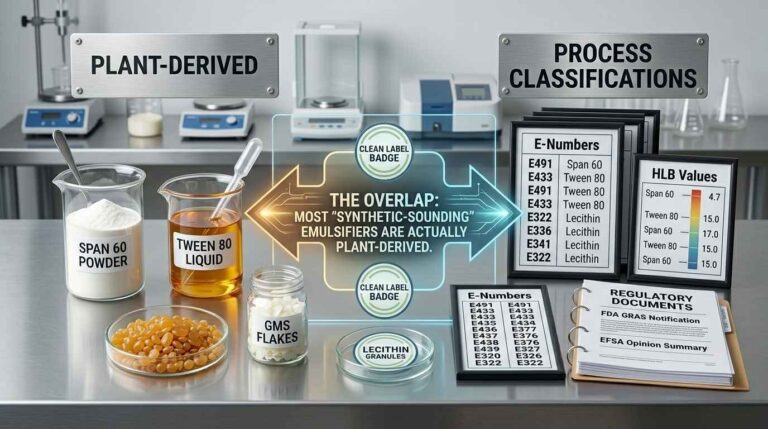
As clean-label demand reshapes the food and personal care industries, formulators increasingly need alternatives to synthetic-sounding ingredients without sacrificing emulsion stability. The Natural Substitutes category provides science-backed guidance on replacing polysorbate emulsifiers with plant-based, minimally processed, or bio-based alternatives—evaluating real performance trade-offs rather than marketing claims.
The Polysorbate 80 Substitutes guide is a practical decision framework for formulators. It categorizes alternatives by functional need: lecithin for general emulsification in clean-label chocolates and baked goods, Quillaja extract and sucrose esters for beverage solubilization, gum arabic for flavor encapsulation, and protein-polysaccharide complexes for advanced emulsion stabilization. Each substitute is evaluated against PS80 on HLB equivalence, temperature stability, pH tolerance, cost impact, and regulatory status (organic, non-GMO, allergen labeling). The guide emphasizes that no single drop-in replacement exists—successful substitution requires a systems approach combining emulsifiers with hydrocolloids, process adjustments, and realistic shelf-life expectations.
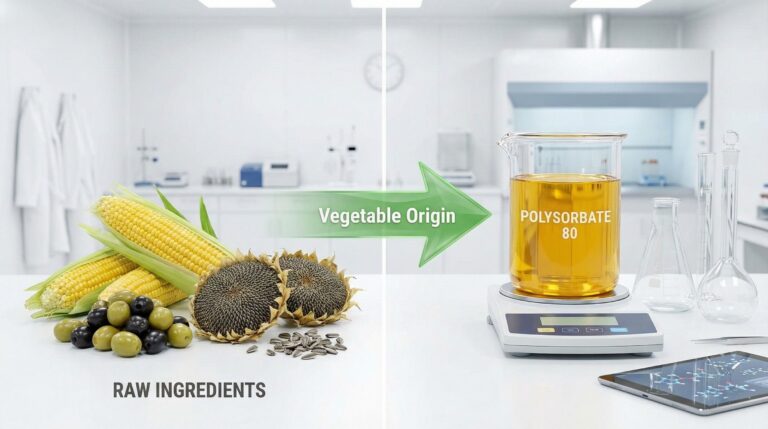
The Bio-based Sorbitan Esters & Green Chemistry article looks forward, examining how next-generation manufacturing processes—enzymatic esterification, solvent-free synthesis, and non-GMO feedstock certification—are making the Span series itself a cleaner-label proposition. Together, these articles equip R&D teams to make informed reformulation decisions that balance consumer perception, functional performance, and cost.