Category: Regulatory & Safety
Insights on food emulsifiers—applications, functions, and benefits to improve stability, texture, and quality across industries.
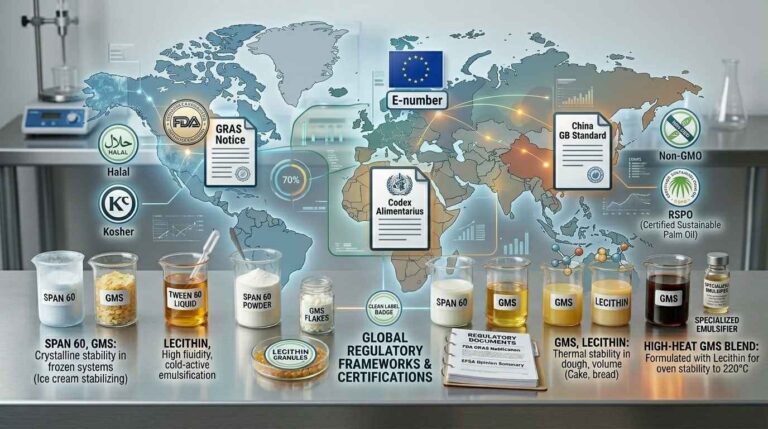
Regulatory compliance and safety assurance are non-negotiable in the food, cosmetics, and pharmaceutical industries. This category consolidates essential knowledge on the global regulatory landscape governing Sorbitan Esters, Polysorbates, and related non-ionic emulsifiers—empowering manufacturers and importers to navigate FDA, EFSA, REACH, and religious dietary certification requirements with confidence.
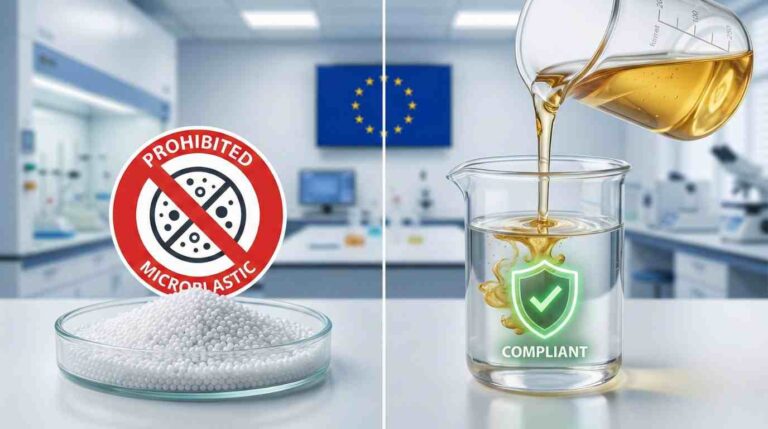
The Global Regulatory Harmonization guide maps the compliance requirements across three major jurisdictions: FCC (Food Chemicals Codex) for the United States, EU Regulation (EC) No 1333/2008 for Europe, and GB standards for China—covering purity specifications, permitted food categories, and maximum usage limits for the entire Span (E491–E495) and polysorbate (E432–E436) series. The REACH Compliance Guide addresses a rising industry concern: whether polysorbates qualify as microplastics under ECHA definitions. It presents the biodegradation pathway (ester hydrolysis → sorbitol + fatty acids), OECD 301 ready biodegradability data, and the regulatory argument for exemption.
Two dedicated certification guides cover religious dietary compliance in depth. The PS80 Kosher Verification Guide identifies the three critical control points (oleic acid source, sorbitan backbone, shared equipment), explains Passover (KFP) sourcing challenges, and provides a supplier audit checklist. The broader Kosher & Halal Certification Guide extends this framework across the entire Span and polysorbate product lines, covering recognized agencies (OU, OK, Kof-K, Star-K), documentation requirements, and common compliance pitfalls in global supply chains.