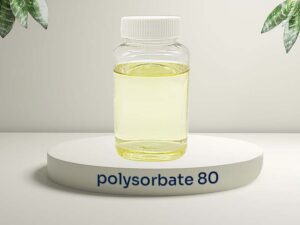

If your product ships to Israel, the Middle East, or kosher-certified markets in North America and Europe, Polysorbate 80 certification is not optional — it is a gatekeeping requirement. At FoodEmul, we hold MUI Halal (Indonesia) and Kosher certifications for our full Polysorbate and sorbitan ester range. This guide explains what kosher certification actually means for Polysorbate 80, how to verify it, and what questions buyers should ask suppliers.
Why Polysorbate 80 is High-Risk for Kosher Status
Unlike simple ingredients like salt or sugar, Polysorbate 80 is a complex ester. Its kosher status depends on three potential failure points:
- The Oleic Acid Source (The #1 Risk): Oleic acid is the hydrophobic tail of the molecule. It can be derived from animal tallow (beef/pork fat) or vegetable oils (olive, canola, sunflower). Physically, they look identical, but animal-derived oleic acid renders the entire batch non-kosher.
- The Sorbitan Backbone: Sorbitan is dehydrated sorbitol. While usually plant-based (corn, wheat, tapioca), the specific starch source dictates “Kosher for Passover” status (see below).
- Processing & Equipment (Shared Lines): Ethoxylation reactors are expensive. Manufacturers often use the same vessels to produce non-kosher industrial surfactants. Without a rigorous “Kosherization” (boil-out/cleaning) verified by a rabbi, even plant-based Polysorbate 80 can be rendered non-kosher due to equipment cross-contamination.
Expert Insight: “Vegan” does not imply “Kosher.” A product can be vegan (no animal ingredients) but still fail kosher certification because it was processed on equipment that previously ran animal fats, or because the certification paperwork is missing.
Critical Control Points (CCPs) for Procurement
| CCP | What to Verify | Why it Matters |
|---|---|---|
| Raw Material Origin | Written confirmation of Vegetable-Grade Oleic Acid. | Excludes beef tallow/lard sources. |
| Catalysts & Aids | Kosher status of polymerization catalysts. | Some chemical aids may be non-kosher; the final certification must cover these. |
| Production Line | Dedicated Kosher line OR Validated Kosherization log. | Prevents cross-contact with non-kosher esters. |
| Bulk Transport (Logistics) | Kosher Wash Tags for ISO tanks/Road tankers. | Crucial for bulk buyers: If the tanker truck previously hauled non-kosher lard, your kosher Polysorbate 80 loses its status upon loading. |
Certification Essentials: Reading the Documents
Do not rely on a generic statement. You need the actual certificate.
- Recognized Agencies: Look for the “Big Four” symbols: OU (Orthodox Union), OK, Kof-K, and Star-K. Regional agencies (e.g., London Beth Din, KLBD) are also widely accepted, but always verify with your final customer’s rabbi if in doubt.
- Specificity is Key:
Plant-Specific: The certificate must address the specific manufacturing facility. A certificate for a Headquarters office does not cover the factory unless explicitly stated.
Product-Specific: “Polysorbate 80” or your supplier’s specific trade name (e.g., “FoodEmul T-80”) must be listed.
- Lot-Specific Letters: For sensitive applications (like infant formula or pharmaceuticals), request a Lot-Specific Kosher Letter rather than a blanket annual certificate.
The “Kosher for Passover” (KFP) Challenge
Passover (Pesach) introduces strict prohibitions against Chametz (leavened grains like wheat, barley) and Kitniyot (legumes, corn, rice, soy – depending on tradition).
- The Sorbitol Issue: Most Polysorbate 80 is made from sorbitol derived from corn (maize).
Ashkenazi Jews traditionally avoid corn (Kitniyot) during Passover.
Therefore: Standard Kosher Polysorbate 80 (OU) is usually NOT Kosher for Passover.
- Sourcing for Passover: You must specifically request “Kosher for Passover” Polysorbate 80. This typically requires:
Sorbitol from a non-kitniyot source (e.g., tapioca or specific sugar cane streams), OR special rabbinical supervision allowing corn derivatives for certain sub-groups (often labeled “Kosher for Passover for Kitniyot eaters”).
Action: If your final product is for Passover, standard Polysorbate 80 will likely disqualify it. Verify this early (6 months in advance). For technical specifications and sourcing of vegetable-origin polysorbates, see our Polysorbate 80 product page and the Polysorbate 80 Technical Guide.
Working with Suppliers: The Audit Checklist
When auditing a Polysorbate 80 supplier (like FoodEmul), check the following:
- Traceability: Can they trace a specific drum of Polysorbate 80 back to the specific batch of oleic acid?
- Change Management: Do they have a policy to notify you if they switch oleic acid vendors? (e.g. switching from Olive to Sunflower is fine, but switching suppliers might introduce risk).
- Repacking Protocol: If you buy from a distributor who repacks from bulk to drums, the repacking facility must also be kosher certified. A kosher product repacked in a non-kosher warehouse loses its status.
Labeling Do’s and Don’ts
- DO use the exact symbol provided by the certifying agency (e.g., the OU circle) on your packaging only if you have a valid contract.
- DO NOT use a generic “K” unless authorized; it often holds less market value than specific agency logos.
- DO NOT assume “Pareve” status without checking. Polysorbate 80 is almost always Pareve (neutral), but if processed on lines shared with stearates derived from dairy (rare but possible), it could be status-compromised.
FAQ
Q: Can I mix Kosher Polysorbate 80 with non-kosher ingredients?
A: You can, but the final product will be non-kosher. You must remove the kosher symbol from the final product label.
Q: Is “Vegetarian” Polysorbate 80 the same as “Kosher”?
A: No. Vegetarian guarantees no meat flesh. Kosher guarantees the source, the equipment, and the supervision. A vegetarian product made on a line that processed non-kosher wine or grape derivatives (for example) would be vegetarian but not kosher.
Q: Does the certificate expire?
A: Yes, typically every 12 months. Set a reminder in your ERP system 60 days before expiry to request the new one.
For a complete overview of Polysorbate 80 safety, applications, and regulatory compliance, visit the Polysorbate 80 Safety & Uses Guide.
Related: See related guide
Need kosher-certified Polysorbate 80? We hold active Kosher and MUI Halal certifications — reach out for certificates or samples.