Explore the future of green chemistry with bio-based sorbitan esters. Learn about sustainable production, renewable feedstocks, and eco-friendly applications.
Sorbitan esters are not going anywhere — but how they are made is changing. Bio-based feedstocks, enzymatic synthesis, and lower-carbon production pathways are reshaping the supply chain for Span emulsifiers. At FoodEmul, we track these developments because they affect everything from raw material sourcing to customer sustainability commitments. This guide covers the green chemistry trends shaping the future of sorbitan esters: what is commercially available, what is in development, and what matters for formulators.
The Evolution of Green Chemistry Surfactants
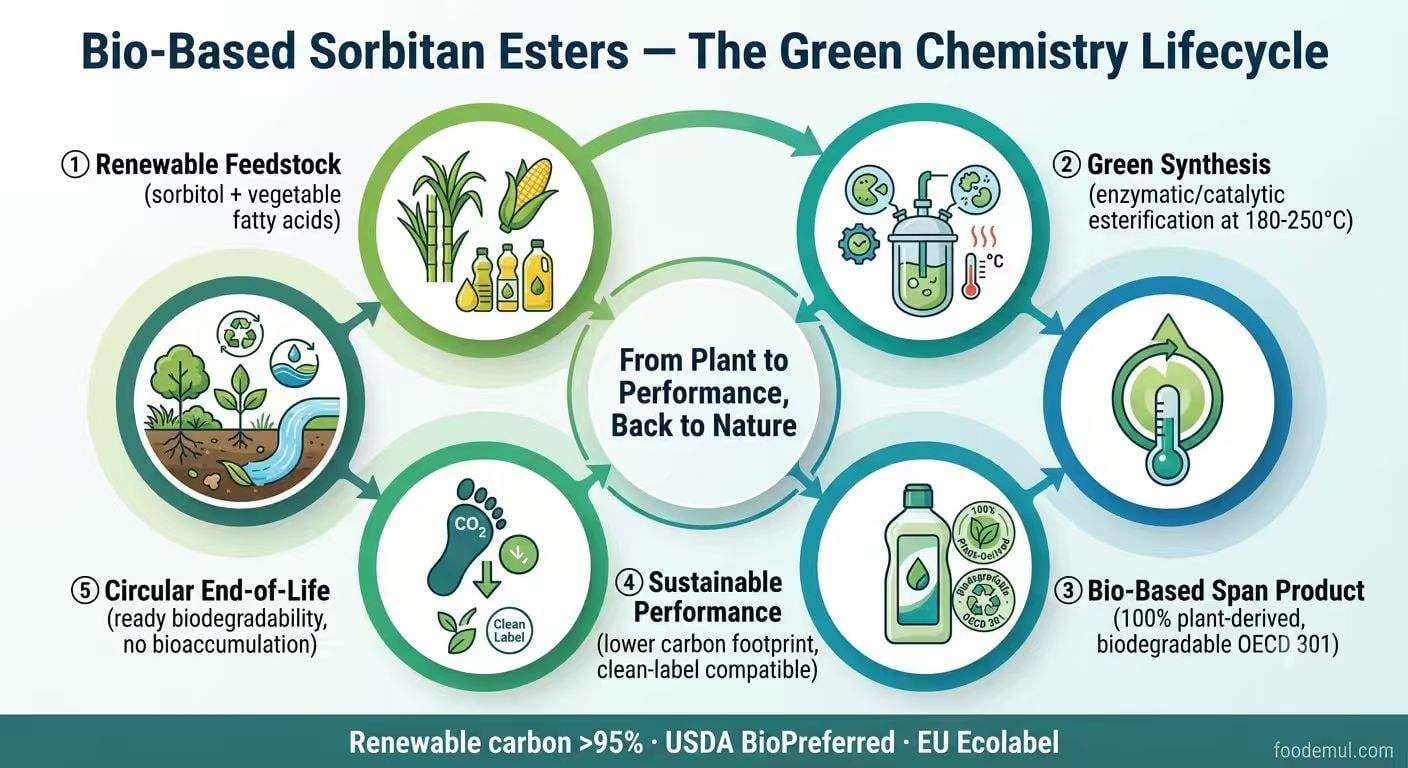
Bio-Based Sorbitan Esters — The Green Chemistry Lifecycle from renewable feedstock to circular end-of-life
The integration of green chemistry surfactants into commercial manufacturing is no longer just a “nice-to-have” sustainability goal; it is a market necessity. Traditional surfactants often rely on non-renewable resources and can pose challenges regarding biodegradability. However, the new generation of sorbitan esters (Spans) is designed to minimize environmental impact from the molecular level up. By focusing on non-toxic, biodegradable, and biocompatible structures, these surfactants provide a safer profile for both the consumer and the ecosystem without compromising the emulsifying power required for complex industrial applications. Bio-based Sorbitan Monopalmitate (Span 40) — with its palmitic acid chain and HLB of 6.7 — exemplifies this trend, finding use in functional food coatings and pharmaceutical emulsions where renewable sourcing matters.
Property
Product
HLB Value
Physical Form
Melting Point
Span 20
8.6
Amber Oily Liquid
~ -10°C
Span 40
6.7
Cream-colored Paste
45 – 49°C
Span 60
4.7
Tan Beads/Flakes
52 – 57°C
Span 80
4.3
Amber Viscous Liquid
~ -12°C
Advancements in Sustainable Sorbitan Ester Production
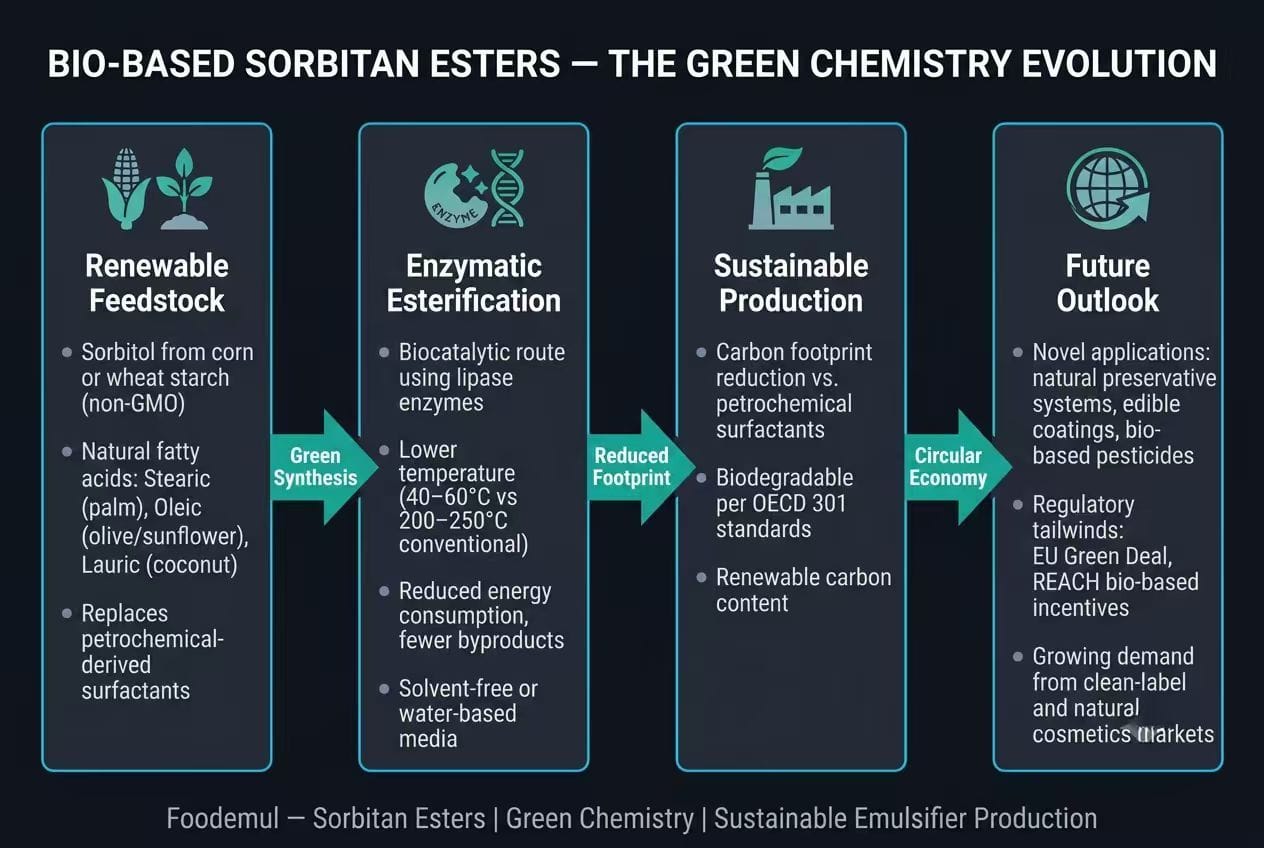
Efficiency is the hallmark of modern manufacturing. Sustainable sorbitan ester production now utilizes advanced catalytic processes and enzymatic synthesis to lower energy consumption. Unlike traditional esterification, which often requires high temperatures and harsh catalysts, these innovative methods operate under milder conditions. This not only reduces the carbon footprint of the production facility but also minimizes the formation of unwanted byproducts, resulting in a higher-purity end product that is safer for sensitive applications like pharmaceuticals and personal care.
Utilizing Renewable Feedstock for Sorbitan Esters
One of the most significant breakthroughs in the industry is the sourcing of renewable feedstock for sorbitan esters. Instead of relying on petrochemical derivatives, manufacturers are turning to plant-based sorbitol derived from corn or wheat, and fatty acids sourced from coconut, palm, or rapeseed oils. This shift creates a closed-loop biological cycle. By using biomass that can be replanted and harvested annually, the industry ensures a stable, long-term supply chain that is decoupled from the volatility of oil prices.
📚 Need the Big Picture?
You are reading a detailed chapter on a specific topic. To understand the complete chemistry, manufacturing process, and full application range of the Span Series, check out our central guide.
Bio-Based Sorbitan Esters — The Green Chemistry Evolution: Renewable Feedstock → Enzymatic Esterification → Sustainable Production → Future Outlook.
Research Trends in Emulsifiers and Modern Formulations
The scientific community is currently diving deep into research trends in emulsifiers to optimize the Hydrophilic-Lipophilic Balance (HLB) of bio-derived Spans. Recent studies are focused on how these bio-based molecules interact at the oil-water interface compared to their synthetic counterparts. Engineers are finding that bio-based esters often offer superior skin compatibility in topicals and more controlled release profiles in drug delivery systems. This research is paving the way for “smart” emulsions that can respond to temperature or pH changes, providing functionality that was previously difficult to achieve with standard surfactants.
Exploring Novel Applications of Span
As the performance of these green molecules improves, we are seeing novel applications of span emerge across diverse sectors. Beyond the traditional strongholds of food and beverage stabilization, bio-based sorbitan esters are now being utilized in:
Eco-friendly Agrochemicals: Improving the “wetting” ability of biopesticides on leaf surfaces.
Advanced Cosmetics: Serving as the primary emulsifier in “clean beauty” products that demand 100% natural certification.
Biolubricants: Enhancing the stability of biodegradable industrial lubricants used in environmentally sensitive marine or forestry equipment.
The Future Outlook
The trajectory of the surfactant industry is clear: the future is bio-based. As regulatory pressures on microplastics and non-biodegradable chemicals increase, the demand for high-purity, plant-derived esters will only grow. By continuing to innovate within the framework of green chemistry, the Span series will continue to provide the structural integrity required for modern products while protecting the planet for future generations.
Looking for sustainably sourced sorbitan esters? We manufacture Span 60, Span 80, and the full range from plant-based feedstocks — reach out for documentation or samples.