

Polysorbate 80 is the most versatile O/W emulsifier in the food industry — but clean-label pressure is real. Retailers and consumers are asking for alternatives, and formulators need to know what actually works versus what sounds good on paper. At FoodEmul, we manufacture Polysorbate 80 alongside sorbitan esters, so we understand both sides of this conversation. This guide compares natural substitutes — lecithin, saponins, gum arabic, and others — against Polysorbate 80 on the metrics that matter: HLB, dosage, stability, and cost.
The Benchmark: Why is Polysorbate 80 so Hard to Replace?
Is Polysorbate 80 Natural? The Origin Debate
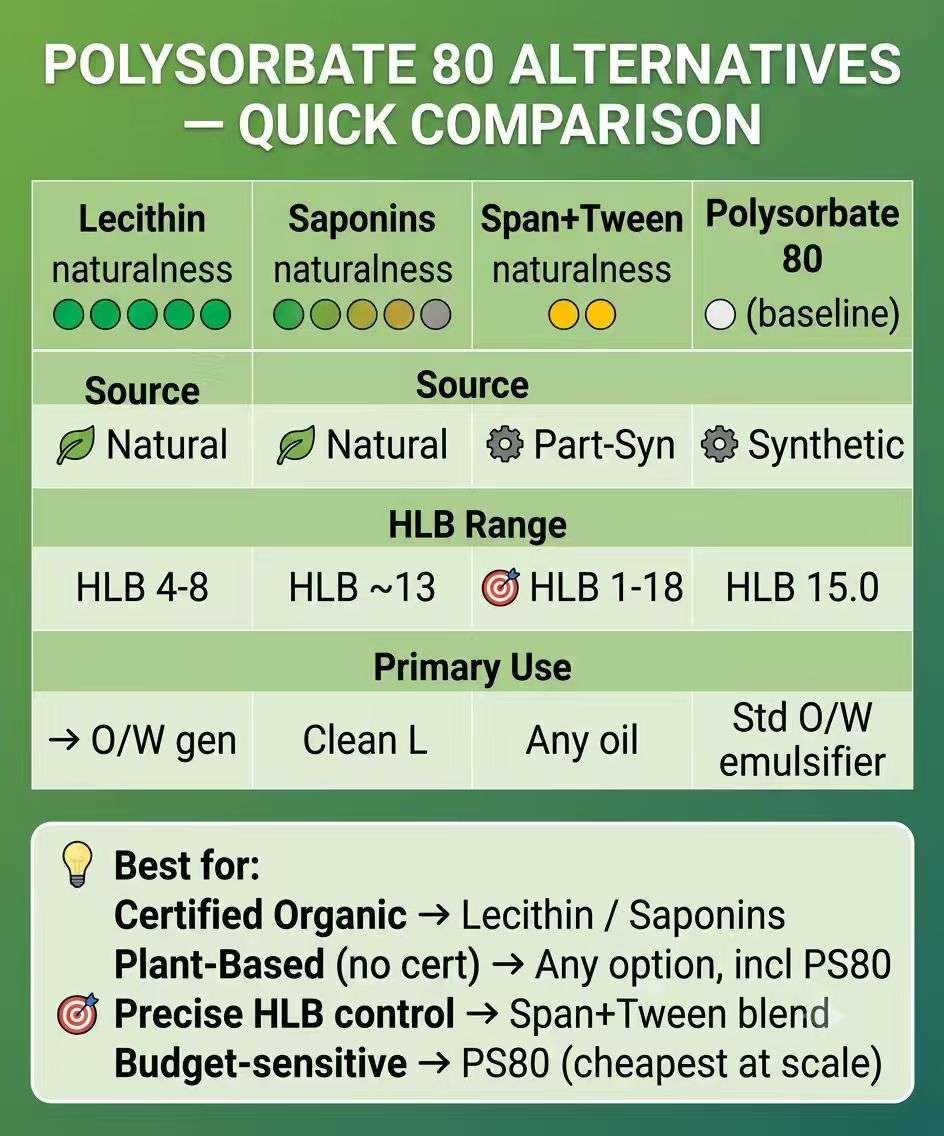
Before searching for a substitute, it is worth asking: is Polysorbate 80 itself natural? The answer is more nuanced than a simple yes or no — and understanding it may change whether you need a substitute at all.
The source materials are plant-based. Polysorbate 80 starts with sorbitol (derived from corn, cassava, or other starch crops) and oleic acid (a fatty acid extracted from vegetable oils such as olive, sunflower, or palm). Both raw materials come from renewable botanical sources. This is why Polysorbate 80 is often labeled “plant-derived” by ingredient suppliers.
Here is the distinction that matters for labeling: under FDA and EU regulations, Polysorbate 80 is classified as a synthetic food additive because the ethoxylation step chemically modifies the starting materials. It cannot be labeled as “natural,” “organic,” or “clean label” — regardless of whether the raw materials were non-GMO or plant-sourced (CFR 21 § 101.22).
For formulators seeking a plant-derived but fully functional alternative, our Span series (E491–E495) offers lipophilic emulsifiers that share the same sorbitol/fatty acid origin without ethoxylation — making them the closest structural relatives to polysorbates in natural positioning.
The process introduces a synthetic step. During manufacturing, sorbitan monooleate (Span 80) is reacted with approximately 20 moles of ethylene oxide to attach polyoxyethylene chains — the chemical modification that transforms the lipophilic Span 80 into the water-soluble Polysorbate 80 (HLB ~15.0). Ethylene oxide is a petrochemical derivative, and this ethoxylation step is what pushes Polysorbate 80 into the “synthetic” category under most clean-label and natural certification frameworks.
The regulatory reality: Under FDA 21 CFR 172.840, Polysorbate 80 is classified as a synthetic food additive (GRAS). The EU lists it as E433, a permitted synthetic emulsifier. China’s GB 2760 standard similarly treats it as a chemically modified additive. None of the major organic or natural certification bodies (USDA Organic, COSMOS, NATRUE) permit polysorbates in certified products.
Practical takeaway for formulators: If your brand requires certified natural or organic labeling, you need a true substitute — and the lecithins and saponins discussed in this guide are your best options. But if your goal is simply “plant-based” or “vegan” (without organic certification), Polysorbate 80 already meets those criteria — its raw materials are 100% botanical. For more on plant-based emulsifier strategies across the full Span and Polysorbate family, see our Plant-Based Emulsifier Strategies guide.
To understand why substitutes fail, we must look at the numbers. Polysorbate 80 is an Oil-in-Water (O/W) solubilizer with an HLB (Hydrophile-Lipophile Balance) value of 15.0.
- High Efficiency: You typically only need 0.1% – 0.5% to stabilize a heavy emulsion.
- Clarity: It creates tiny micelles, allowing for clear beverages and smooth, dry ice cream.
- The Problem with Naturals: Most natural emulsifiers have low HLB values (3–7) or weak interfacial tension. They simply aren’t strong enough to hold oil and water together on their own.
Analyzing the “Natural” Alternatives (And Their Hidden Costs)
If you are determined to replace Polysorbate 80, here are the common options. However, be aware of the trade-offs in stability and cost.
Sunflower/Soy Lecithin
- Source: Soybean or Sunflower oil extraction.
- The Reality: Lecithin is excellent for chocolate, but it has a low HLB of ~4–7.
- The Downside: It loves oil more than water. If you try to use it in a beverage or ice cream mix, it often results in a greasy mouthfeel or eventual separation. It cannot replace the high-HLB “lifting power” of Polysorbate 80.
Gum Arabic (Acacia)
- Source: Sap from the Acacia tree.
- The Reality: It works by physically coating oil droplets (mechanical stabilization) rather than chemical bonding.
- The Downside: Dosage. To match the effect of 1 part Polysorbate 80, you often need 10 to 20 parts of Gum Arabic. This drastically changes the texture, viscosity, and cost of your formulation.
Quillaja Extract (Saponins)
- Source: Soapbark tree.
- The Reality: One of the few natural options with a high HLB.
- The Downside: Cost. It is significantly more expensive than Polysorbate 80 and can have a bitter aftertaste if not highly purified.
The “Plant-Based” Solution: Why You Don’t Need to Switch
Lecithin vs. Polysorbate 80 — Can You Substitute?
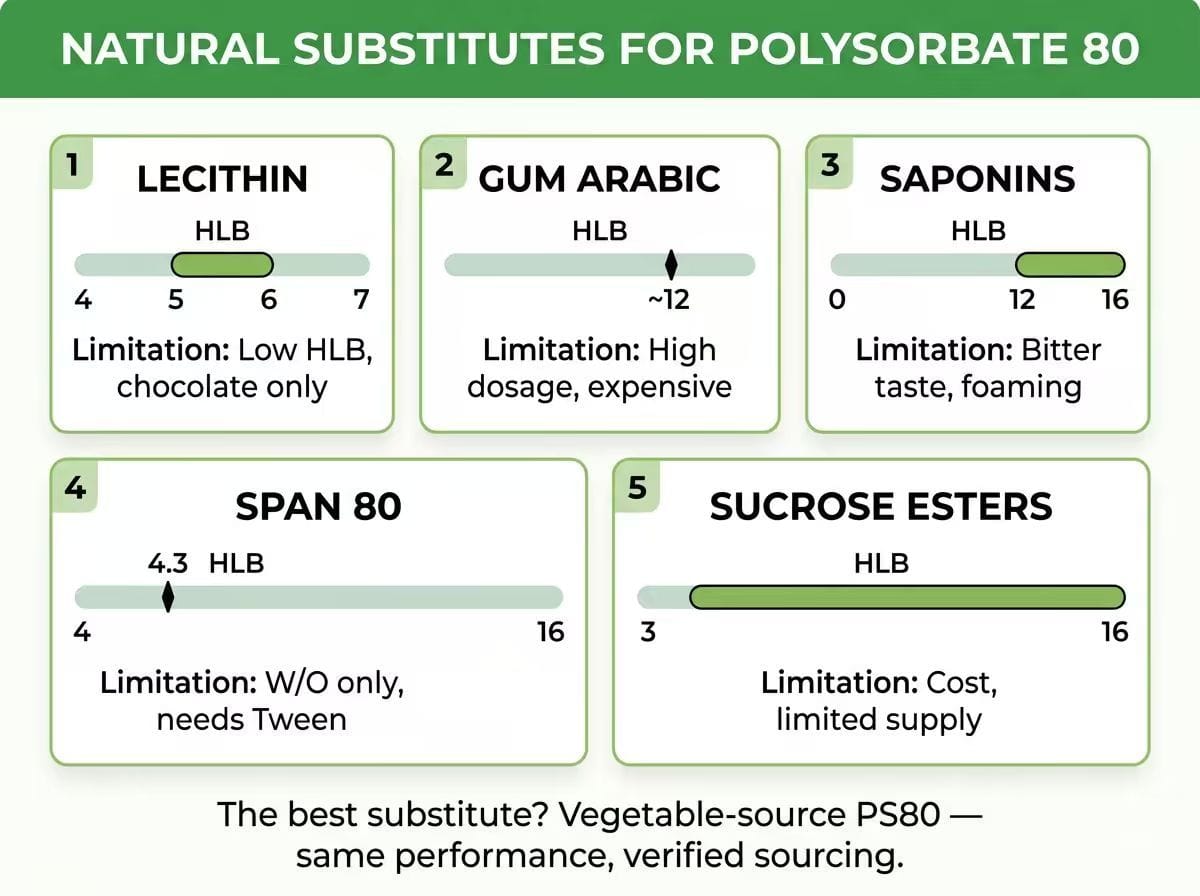
Lecithin (E322, from soy or sunflower) is the most common “natural” alternative proposed for Polysorbate 80. While both are emulsifiers, they operate differently: lecithin is a phospholipid mixture with HLB 4–9 (W/O-leaning), while Polysorbate 80 is a synthetic polyoxyethylene ester with HLB 15.0 (strongly O/W). In O/W emulsions like dressings, sauces, or ice cream, lecithin alone cannot achieve the same droplet size reduction without a high-HLB co-emulsifier — often defeating the “single natural ingredient” goal. For W/O applications like margarine or chocolate, lecithin performs well and is the preferred choice.
Sorbitan Monooleate (Span 80) vs. Polysorbate 80
Span 80 (E494, HLB 4.3) and Polysorbate 80 are chemically related — Polysorbate 80 is ethoxylated Span 80. Span 80 is a W/O emulsifier; Polysorbate 80 is O/W. They are not substitutes for each other, but they work together: Span 80 anchors the oil phase while Polysorbate 80 stabilizes the water phase in combined HLB systems. See our Span 80 Technical Guide for formulation ratios.
Many brands seek a substitute because they fear Polysorbate 80 is “animal-derived” or “unsafe.” This is a misconception regarding modern manufacturing.
Natural Substitute Comparison at a Glance
| Alternative | Type | HLB | Best For | Limitation |
|---|---|---|---|---|
| Lecithin (E322) | Natural phospholipid | 4–9 | Bakery, chocolate, margarine | W/O only; weak O/W stability without co-emulsifier |
| Gum Arabic (E414) | Natural gum | ~12 | Beverage emulsions, flavor encapsulation | High usage rate (10–20% of oil phase vs 0.5–5% for Polysorbate 80) |
| Saponins (Quillaja, E999) | Plant extract | 13–16 | Beverages, foaming applications | Costly; limited supply; bitter aftertaste at high doses |
| Sorbitan Esters (Span, E491–E495) | Semi-synthetic | 2–9 | W/O emulsions, coatings, dispersions | Low HLB only; requires Polysorbate co-emulsifier for O/W |
| Sucrose Esters (E473) | Semi-synthetic | 1–16 | Broad HLB range; dairy, bakery | Higher cost; less available than Polysorbate 80 globally |
Note on PS20 substitutes: If you are looking for alternatives to Polysorbate 20 specifically (not Polysorbate 80), see our PS20 vs Polysorbate 80 comparison guide — the substitution logic differs significantly due to the shorter lauric acid chain (C12 vs C18:1).
You can achieve a high-performance, ethical formulation by specifying Vegetable-Based Polysorbate 80.
What is Vegetable-Based Polysorbate 80? Instead of using animal tallow (beef fat), we source our Oleic Acid from Olive, Palm, or Sunflower oil, and our Sorbitol from Corn or Tapioca.
- Chemically Identical: It has the same high HLB (15.0) and stabilizing power.
- Dietary Compliance: It is fully Vegan, Kosher Pareve, and Halal.
- Safety: It removes the risk of animal-borne impurities while maintaining the strict purity standards required for food (E433) and pharma.
For 90% of formulations, the goal isn’t to remove the emulsifier—it is to ensure the emulsifier is ethical and plant-sourced.
Expert Formulation Tip: The Span + Polysorbate System
If you are struggling with stability but want to minimize chemical usage, the answer isn’t a natural gum—it’s HLB Optimization.
By combining Polysorbate 80 (Polysorbate 80) with Sorbitan Monooleate (Span 80), you can fine-tune the HLB to exactly match your oil phase.
- Span 80 (HLB 4.3): Lipophilic (Oil-loving).
- Polysorbate 80 (HLB 15.0): Hydrophilic (Water-loving).
Why use both? Mixing them creates a stronger, more complex film around the oil droplet than using either alone. This often allows you to reduce the total amount of emulsifier needed in your recipe, resulting in a cleaner taste and lower cost.
Conclusion
Natural substitutes like Lecithin and Gum Arabic have their place, but they often compromise texture, clarity, and shelf-life when tasked with replacing the heavy-lifting power of Polysorbate 80.
Before you reformulate your entire product line, consider the source. A certified Vegetable-Based Polysorbate 80 solves the dietary and ethical concerns of today’s consumers without sacrificing the stability your product needs.
Need certified Vegetable-Based Polysorbate 80 or Sorbitan Esters? At FoodEmul, we specialize in high-purity surfactants for the food industry. Contact our technical team for HLB calculation support and samples.
Need help navigating the clean-label transition? We manufacture Polysorbate 80, Span 60, and the full range with Kosher and MUI Halal certification — reach out for technical guidance or samples.
