

Bread dough is not cake batter. It’s a viscoelastic solid that has to trap fermentation gas, survive mixing and sheeting, and set into a stable crumb during baking — then stay soft for days. DATEM and SSL do the heavy lifting in bread. But polysorbate 60 and Span 60 fill two specific gaps those primary emulsifiers leave open: interface modification and fat-phase anchoring.
If you’re evaluating Span/polysorbate for bread, this guide tells you exactly where they earn their cost — and where they don’t.
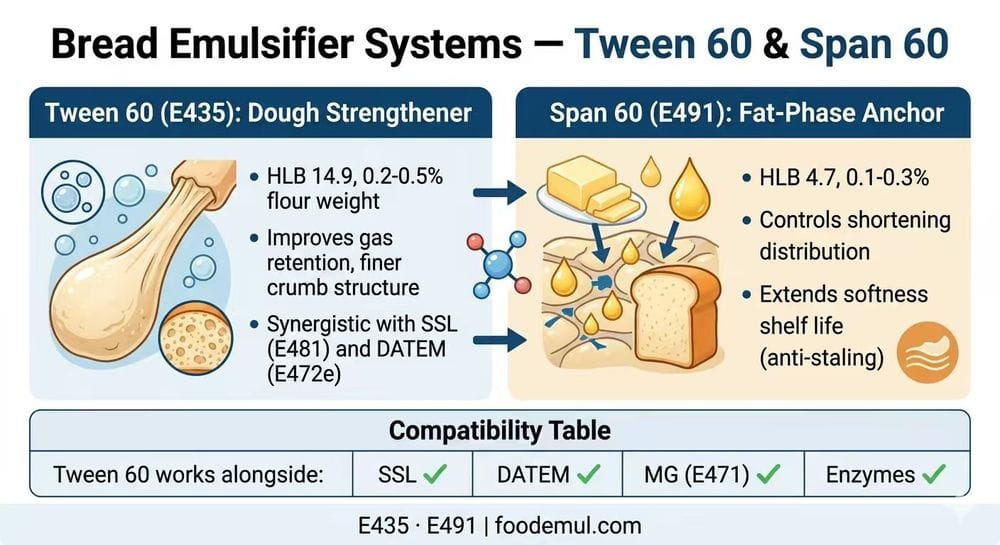
Why Bread Needs Emulsifiers
Two jobs define bread emulsifiers (Hu et al., 2011):
| Function | What It Does | Where polysorbate 60 and Span 60 Fit |
|---|---|---|
| Dough strengthening | Reinforces gluten, improves gas retention, increases loaf volume | polysorbate 60 solubilizes lipophilic compounds that block gluten formation, improving dough elasticity |
| Crumb softening / anti-staling | Slows starch retrogradation, retains moisture | Span 60 stabilizes the fat phase, slowing moisture migration and supporting crumb structure |
Bread uses more types of emulsifiers than cake or ice cream. DATEM (E472e) and SSL (E481) are the lead dough strengtheners. DMG/GMS (E471) is the main anti-staling agent. polysorbate 60 and Span 60 fill niches those primary emulsifiers don’t fully cover.
polysorbate 60: The Interface-Modifying Dough Strengthener
How polysorbate 60 Works in Dough
polysorbate 60 (Polysorbate 60, E435, HLB 14.9) strengthens bread dough through a mechanism different from DATEM or SSL. It doesn’t cross-link gluten proteins directly. Instead, it changes the dough’s interfacial chemistry:
Flour contains natural lipids — polar and non-polar — that can block gluten protein hydration and network formation during mixing. Left alone, these create weak spots in the gluten matrix where gas escapes.
polysorbate 60 grabs these interfering lipids into its micelles, clearing the way for gluten proteins to hydrate fully and form a continuous, elastic network. The textbook confirms this: polysorbate 60 measurably increases dough tensile strength and stretching energy even at low levels (Hu et al., 2011).
Measurable Effects
At 0.1–0.3% of flour weight, polysorbate 60:
- Increases dough tensile strength — the force to stretch dough to failure goes up
- Increases stretching energy — total work input rises, indicating stronger gluten
- Improves gas retention — stronger dough films hold more CO₂ during proofing, giving larger loaf volume
Unlike DATEM, polysorbate 60’s effect plateaus — it doesn’t keep getting stronger at higher doses. That makes it most cost-effective as a targeted supplement, not a primary dough strengthener.
Where polysorbate 60 Adds the Most Value
| Application | Why polysorbate 60 Helps |
|---|---|
| High-hydration doughs (≥65% water) | More water dissolves more lipophilic compounds from flour; polysorbate 60 manages them |
| Whole wheat / multigrain | Bran has high levels of lipids that block gluten; polysorbate 60 clears the interface |
| Frozen dough | Ice crystal damage weakens gluten during freezing; polysorbate 60 reinforces before freeze stress |
| High-fiber bread | Added fiber competes for water; polysorbate 60 helps gluten compete for hydration |
Span 60: The Fat-Phase Anchor in Bread
Span 60 (Sorbitan Monostearate, E491, HLB 4.7) plays a supporting role in bread — less prominent than polysorbate 60, but important in specific dough types:
- Enriched doughs (brioche, panettone, sweet rolls): High fat content (10–25% of flour weight) needs fat-phase stabilization. Span 60 at 0.1–0.2% keeps fat evenly dispersed through the dough, preventing oil pooling during proofing.
- Frozen dough: Span 60 co-crystallizes with dough fat, building a more elastic fat crystal network that withstands ice crystal damage during freeze-thaw cycles.
- Laminated doughs (croissant, Danish): Span 60 in the roll-in fat maintains layer integrity through repeated folding — same mechanism as in laminated cracker and pastry margarine.
HLB: Why Bread Is Different from Cake
| Property | Cake | Bread |
|---|---|---|
| Target HLB | 14–16 (O/W emulsion) | Not HLB-driven |
| Primary mechanism | Air-water interface stabilization | Gluten-lipid interface modification |
| Key emulsifier | GMS + PGMS | DATEM + SSL |
| Span/polysorbate role | Core structural | Targeted supplement |
Bread is not an emulsifier-driven system in the way cake is. The HLB concept is less relevant — what matters is how polysorbate 60 interacts with flour lipids at the gluten interface, and how Span 60 stabilizes fat in specific dough types.
Compound Emulsifier Systems
In commercial bread, Span and polysorbate are rarely used alone. They’re blended into compound systems:
| Bread Type | Primary Emulsifier | Span/polysorbate Addition | Dosage |
|---|---|---|---|
| White pan bread | DATEM 0.3% + SSL 0.2% | polysorbate 60 0.1% | 0.1–0.3% Span/polysorbate |
| Whole wheat | SSL 0.3% + DATEM 0.2% | polysorbate 60 0.15–0.2% | 0.15–0.3% |
| Frozen dough | SSL 0.3% + DMG 0.2% | polysorbate 60 0.1% + Span 60 0.1% | 0.2% |
| Enriched (brioche) | GMS 0.5% + DATEM 0.2% | Span 60 0.1–0.2% | 0.1–0.3% |
| Artisan/sourdough | None or minimal | Not recommended | — |
Dosage Quick Reference
| Bread Type | polysorbate 60 (% flour) | Span 60 (% flour) | Addition Point |
|---|---|---|---|
| White pan bread | 0.1–0.2% | — | Dissolve in dough water |
| Whole wheat | 0.15–0.3% | — | Dissolve in dough water |
| Frozen dough | 0.1% | 0.1% | polysorbate in water; Span in fat |
| Enriched (brioche) | 0.05–0.1% | 0.1–0.2% | polysorbate in water; Span in fat |
| Artisan | — | — | Not recommended |
Process Integration
- polysorbate 60: Dissolve in the dough water portion at 25–35°C. polysorbate 60 is a paste at room temperature — pre-warming to 30–35°C makes it pourable. Add to the mixer with the water phase.
- Span 60: Melt into the fat phase (shortening, butter, oil) at 55–65°C. Span 60 needs to be fully liquid to disperse evenly. Add the fat phase to the dough after the water phase and initial gluten development.
- Mixing: Total mixing time does not change with Span/polysorbate addition. Follow your standard mix time — overmixing damages the gluten network that polysorbate 60 is helping to build.
- Proofing: Standard proofing conditions apply. polysorbate 60’s improved gas retention may allow slightly shorter proofing time — monitor dough height, not the clock.
Troubleshooting
| Problem | Likely Cause | Solution |
|---|---|---|
| Low loaf volume | Insufficient dough strength; poor gas retention | Increase polysorbate 60 to 0.2–0.3%; check DATEM/SSL dosage |
| Dense crumb in whole wheat | Bran lipids blocking gluten; insufficient polysorbate 60 | Increase polysorbate 60 to 0.2–0.3%; add vital wheat gluten |
| Collapsed frozen dough | Ice crystal damage; weak gluten after thaw | Add polysorbate 60 0.1% + Span 60 0.1%; increase SSL |
| Oily surface on enriched dough | Fat pooling; insufficient Span 60 | Add Span 60 at 0.1–0.2%; verify fat incorporation during mixing |
| Rapid staling | Starch retrogradation; moisture migration | Add DMG/GMS first; Span 60 as supplement at 0.1% |
The Bottom Line
polysorbate 60 and Span 60 play targeted supporting roles in bread — not as primary emulsifiers, but as precision tools for specific dough problems:
- polysorbate 60 is an interface-modifying dough strengthener — it clears flour lipids that block gluten formation, improving gas retention and loaf volume. Most valuable in whole wheat, high-hydration, and frozen doughs.
- Span 60 is a fat-phase anchor — it stabilizes fat in enriched doughs and protects frozen dough through freeze-thaw cycles. Most valuable in brioche, panettone, and frozen dough.
- Neither replaces DATEM, SSL, or DMG — bread already has an effective primary emulsifier toolkit. Span/polysorbate are supplements for the gaps those primary emulsifiers leave open.
For polysorbate 60 specs and FDA limits, see the Polysorbate 60 Food Application Guide. For Span 60 specs, see the Span 60 Food Application Limits. For HLB methodology, refer to our Span & polysorbate Formulators Guide.
This guide draws on published research, formulation practice, and the food emulsifier science reference by Hu et al. (2011). For specific bread formulation advice, consult your emulsifier supplier’s technical service team.