
Cake gel — also called SP emulsifier or cake foaming agent — is a compound blend built around two emulsifiers: Span 60 and polysorbate 60. One generates the foam. The other stops it from collapsing. Get the ratio right and you can replace some or all of the eggs in your formula while getting better, more consistent volume. Get it wrong and the cake falls flat — literally.
This guide covers the Span/polysorbate pair at the core of cake gel, the ratios for different cake types, and the process parameters that make the difference between a sponge that springs and one that sinks.
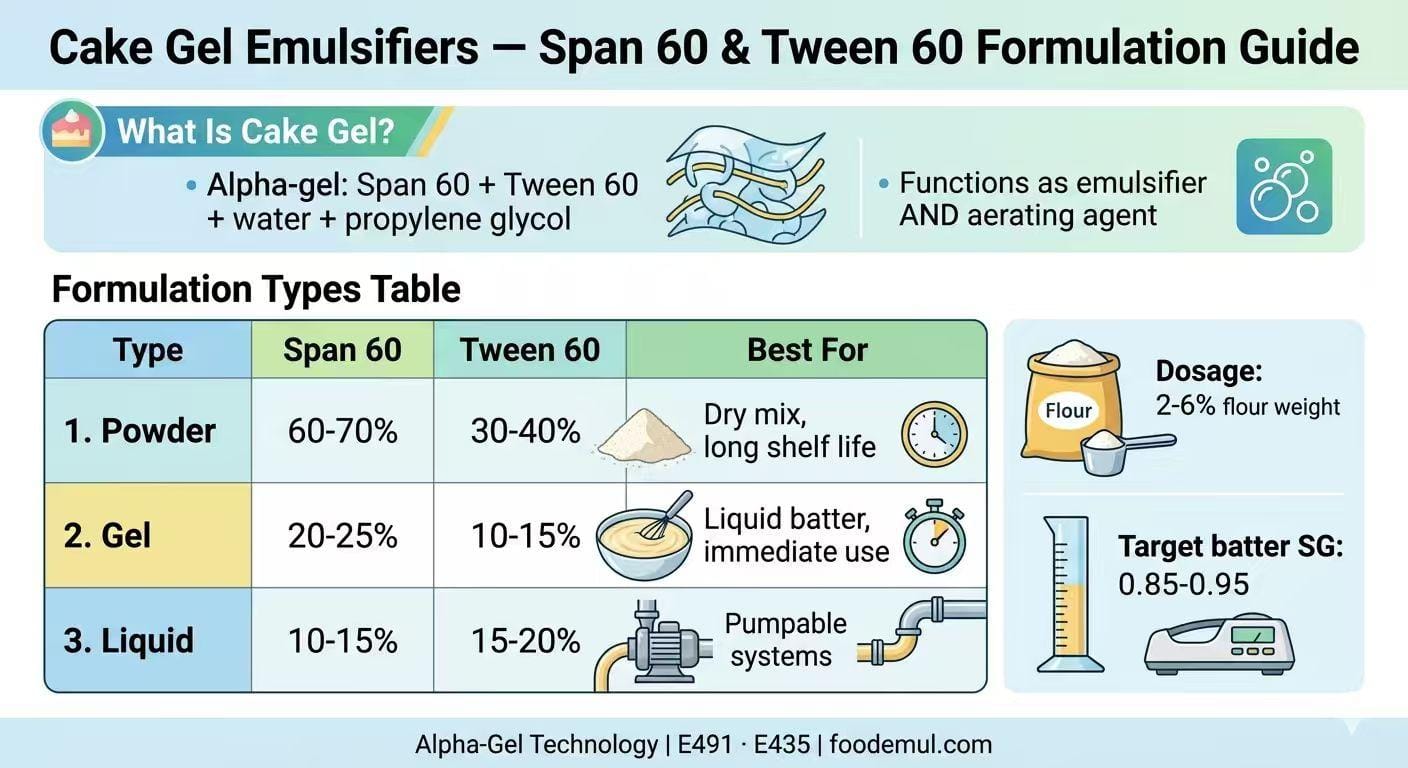
What Is Cake Gel?
Cake gel — SP emulsifier, cake emulsifier, cake foaming agent — is a compound baking blend for aerated cake production. It comes as a paste or powder, 20–40% active emulsifiers, with the rest being water, sorbitol, propylene glycol, or starch carrier (Hu et al., 2011).
At its core, a cake gel is an HLB-balanced system built around two complementary emulsifiers:
| Role | HLB Range | Primary Emulsifier | What It Does |
|---|---|---|---|
| Foam generation | High HLB (12–15) | polysorbate 60 (Polysorbate 60, E435) | Rapid air uptake, whipping speed, O/W emulsification |
| Foam stabilization | Low HLB (3–5) | Span 60 (Sorbitan Monostearate, E491) | Air cell film strength, fat crystal stabilization, heat resistance |
The Span 60 + polysorbate 60 pair is the most studied and reliable emulsifier combination in cake systems. They share the same fatty acid chain (stearic acid, C18:0), which matches bakery shortening profiles, and together cover the full HLB range needed for cake batter aeration.
Practical starting formula: Span 60 : polysorbate 60 : GMS = 1 : 2 : 3 (by weight), hydrated in propylene glycol at 20–30% total solids. Effective HLB ~9–10 — ideal for sponge cake.
Supporting emulsifiers in the blend:
| Emulsifier | Role in Cake Gel |
|---|---|
| GMS / DMG (E471) | Anti-staling via starch complexation; fat dispersion |
| PGMS (E477) | Extra foaming power in high-sugar batters |
| SSL (E481) | Crumb resilience in gluten-containing cakes |
| Lecithin (E322) | Clean-label option for fat dispersion |
These are supporting players. The foam generation and stability — the two functions that define cake gel performance — come from Span and polysorbate.
Why Cakes Need Emulsifiers: The Span/polysorbate Mechanism
The Problem with Eggs Alone
Traditional sponge cake runs on whipped whole eggs. Egg proteins unfold during whipping and form a foam network — but it’s fragile:
- Foam collapses under load. The second you fold in flour, sugar, or fat, the foam starts dying.
- Temperature-sensitive. A warm production floor can cut foam life to minutes.
- Batch variation. Egg protein content changes with season, feed, and hen age.
How Span/polysorbate Fix It
polysorbate 60’s high HLB (14.9) drives rapid air incorporation during whipping — it reduces surface tension at the air-water interface, letting bubbles form faster and smaller. Span 60’s low HLB (4.7) then moves in: it co-crystallizes with fat at the bubble surface, building a structured film around each air cell that resists collapse during baking.
Together, Span 60 + polysorbate 60 replaces the two functions eggs provide — foaming (egg white) and emulsification (egg yolk) — with a more consistent, more controllable system.
Span/polysorbate Ratios by Cake Type
| Cake Type | Span 60 : polysorbate 60 | Total Emulsifier | Key Characteristic |
|---|---|---|---|
| Sponge cake | 1 : 2 to 1 : 3 | 3–6% of batter | Maximum volume, lightest texture |
| Pound cake | 1 : 1 to 2 : 3 | 2–4% | Balance of volume and richness |
| Chiffon cake | 1 : 2 | 3–5% | Oil-based; needs more Span for fat anchoring |
| High-ratio cake | 1 : 2 to 1 : 3 | 2–4% | High sugar; polysorbate 60 compensates for sugar’s foam-suppressing effect |
| Layer cake | 1 : 1 to 2 : 3 | 2–3% | Moderate volume, even crumb for stacking |
| Egg-free / vegan | 1 : 2 | 4–8% | Higher dosage — replacing all egg function |
Key principle: More Span 60 = stronger foam, more heat resistance, but slower whipping. More polysorbate 60 = faster whipping, higher initial volume, but more collapse risk during baking.
Powder vs. Gel vs. Liquid: Which Form?
| Form | Active Content | Best For | Trade-off |
|---|---|---|---|
| Powder | 80–100% | Dry mix / premix operations | Needs hydration time; slower dispersion |
| Paste / gel | 20–40% | Most bakeries; pumpable, easy to dose | Shorter shelf life; needs ambient storage control |
| Liquid | 10–20% | High-volume automated lines | Lowest active content; highest shipping cost per kg active |
Dosage Quick Reference
| Cake Type | Cake Gel (% of batter) | Active Span+polysorbate (% of batter) | Egg Reduction Possible |
|---|---|---|---|
| Sponge cake (full egg) | 3–6% | 0.6–2.4% | 20–50% egg reduction |
| Pound cake | 2–4% | 0.4–1.6% | 10–30% |
| Chiffon cake | 3–5% | 0.6–2.0% | 20–40% |
| High-ratio cake | 2–4% | 0.4–1.6% | 10–25% |
| Egg-free / vegan cake | 4–8% | 0.8–3.2% | 100% (no eggs needed) |
Process Integration
- Hydration: If using powdered cake gel, pre-hydrate in a portion of the recipe water at 25–35°C for 15–30 minutes. Paste/gel forms can be added directly.
- All-in method (with cake gel): Add all ingredients including cake gel to the mixer. Mix at low speed 1 minute, then high speed 5–8 minutes. The cake gel enables the all-in method — no separate egg whipping step needed.
- Specific gravity target: 0.35–0.45 for sponge cake, 0.65–0.75 for pound cake. Lower = more air, lighter texture. Cake gel typically hits target specific gravity 30–50% faster than egg-only mixing.
- Baking: Standard temperatures apply (160–180°C for sponge, 170–190°C for pound). Cake gel improves oven spring — expect 5–10% more height than egg-only formulas.
- Cooling: Cool in pan 10–15 minutes, then de-pan. Cake gel cakes have better structural integrity — less collapse during de-panning.
Troubleshooting
| Problem | Likely Cause | Solution |
|---|---|---|
| Cake collapses during baking | Insufficient Span 60; weak foam structure | Increase Span 60 proportion; target 1:2 Span:polysorbate minimum |
| Slow whipping / low volume | Insufficient polysorbate 60; poor air incorporation | Increase polysorbate 60 proportion; verify mixer speed |
| Tunnels / large holes | Over-whipping; foam too coarse | Reduce mixing time; check specific gravity target |
| Dry, crumbly texture | Excess emulsifier; over-stabilization | Reduce total cake gel dosage by 20–30% |
| Rapid staling | Insufficient GMS/DMG in blend | Add GMS at 1–2% of batter; Span/polysorbate alone don’t anti-stale |
| Uneven crumb color | Poor emulsifier dispersion | Ensure cake gel fully hydrated; increase low-speed mix time |
The Bottom Line
Span 60 and polysorbate 60 are the functional core of cake gel — polysorbate 60 generates the foam, Span 60 stabilizes it. Together they replace the two jobs eggs do (foaming and emulsifying) with a more consistent, controllable system:
- Span 60 : polysorbate 60 = 1 : 2 is the starting ratio for most cake types. Adjust toward 1:3 for lighter sponge, toward 1:1 for richer pound cake.
- Cake gel at 3–6% of batter weight for sponge cake — this is the sweet spot for maximum volume with good structure. Egg-free formulas need 4–8%.
- Cake gel enables the all-in method — no separate egg whipping. All ingredients go in together, mix, bake. This is the biggest production advantage.
For Span 60 specs, see the Span 60 Food Application Limits. For polysorbate 60 limits, see the Polysorbate 60 Food Application Guide. For HLB methodology, refer to our Span & polysorbate Formulators Guide.
This guide draws on published research, formulation practice, and the food emulsifier science reference by Hu et al. (2011). For specific cake formulation advice, consult your emulsifier supplier’s technical service team.