

What Is a Surfactant? The Chemistry Behind Surface Active Agents
While this 101 guide covers surfactant fundamentals, our polysorbates in skincare and haircare guide goes deep into practical formulation — which polysorbate for micellar waters, creams, shampoos, and what concentrations to use.
“Surfactant” is a contraction of surface active agent. Any compound that lowers the surface tension (or interfacial tension) between two liquids, a liquid and a solid, or a liquid and a gas qualifies. In plain terms: surfactants are what let oil and water mix.
Every surfactant molecule has the same two-part architecture: a hydrophilic head that loves water, and a lipophilic tail (hydrophobic) that loves oil. This dual personality is what makes surfactants useful — the head grabs water, the tail grabs oil, and the molecule parks itself at the interface between the two phases. That positioning reduces the energy barrier keeping them apart.
The role of a surfactant in a formulation depends on what you’re trying to accomplish. The same molecule can act as an emulsifier (stabilizing oil droplets in water), a wetting agent (helping a liquid spread across a surface), a detergent (lifting dirt off fabric), a foaming agent, or a solubilizer (dissolving an otherwise insoluble substance into a clear solution). The function is determined by the molecule’s structure — specifically the balance between the head and tail — not by any special category it belongs to.
I’ve seen formulators get tripped up by this. They’ll look for an “emulsifier” when what they actually need is a surfactant with an HLB around 4-6 for a W/O emulsion, or 10-15 for O/W. The name on the label matters less than the numbers.
Ionic vs. Non-Ionic Surfactants — The Charge Difference Explained
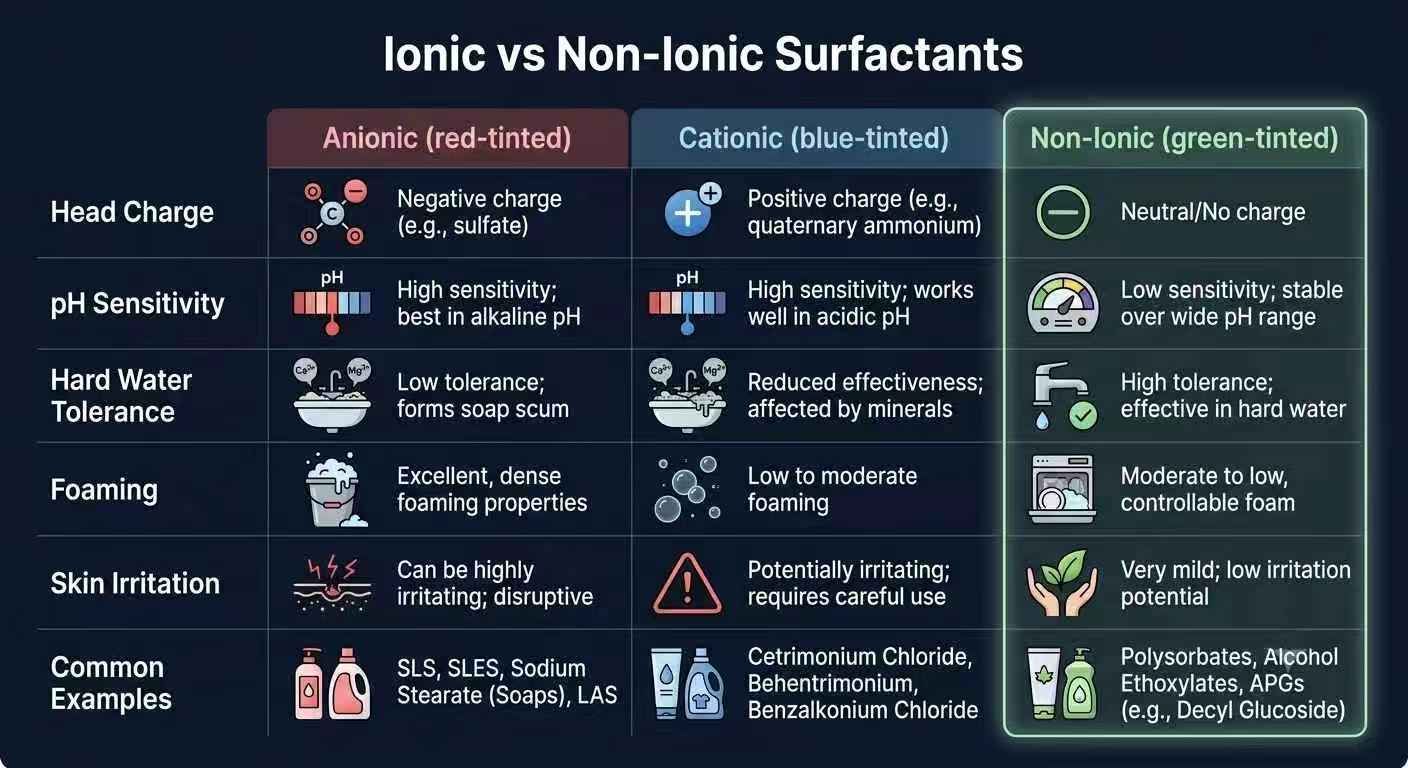
Surfactants are classified by what their head group does in water. That maps directly to how they behave in a formula.
| Type | Head Group Charge | Example | Typical Use |
|---|---|---|---|
| Anionic | Negative (-) | Sodium lauryl sulfate (SLS) | Detergents, shampoos, high foam |
| Cationic | Positive (+) | Cetrimonium chloride | Hair conditioners, fabric softeners, antimicrobials |
| Non-Ionic | No charge (0) | Polysorbate 80, Span 60 | Food emulsions, cosmetics, pharma, solubilization |
| Amphoteric | Both (+ and -) | Cocamidopropyl betaine | Mild cleansers, baby shampoos |
In food emulsifier science, the charge classification is the primary organizational framework. The standard textbook on the subject — Food Emulsifiers (Hu et al., China Light Industry Press) — opens its classification section with this exact split: emulsifiers are first divided into ionic and non-ionic types. Ionic emulsifiers further break down into anionic (negative), cationic (positive), and amphoteric (both charges) sub-types. Non-ionic emulsifiers, by contrast, carry no electrical charge at all — their hydrophilic portion is a neutral polar group like a polyethylene oxide chain or a polyol hydroxyl cluster.
The charge difference has real consequences. Ionic surfactants are sensitive to pH and electrolyte concentration — add enough salt and an anionic surfactant can crash out of solution. Non-ionic surfactants don’t have this problem. They perform the same job regardless of water hardness, pH swings, or the presence of other charged species in the formula. That stability is one of the main reasons non-ionics dominate food applications.
What Does “Nonionic” Mean? (And Why It Matters for Formulators)
“Nonionic” means exactly what it sounds like — no ions. When you drop a non-ionic surfactant into water, it disperses and does its job without splitting into charged fragments. There’s no Na⁺ counter-ion floating around, no quaternary ammonium group looking for something to bind to. The molecule stays intact and neutral.
This is fundamentally different from how ionic surfactants behave. Sodium lauryl sulfate dissociates into a negatively charged lauryl sulfate ion and a sodium cation the moment it hits water. That dissociation drives foam, governs micelle formation, and makes the whole system sensitive to the ionic environment. Non-ionics skip all of that.
The textbook definition draws the line clearly: if the hydrophilic group carries no electrical charge, the emulsifier is non-ionic. Glycerol monostearate, sorbitan esters (Span series), and polysorbates (polysorbate series) all fall into this category. Their hydrophilicity comes from oxygen atoms in ether linkages, ester bonds, and hydroxyl groups — polar enough to interact with water, but never ionized.
What this means in practical formulation terms: non-ionic surfactants give you a wider working window. You can use them in acidic beverages (pH 3), neutral dairy systems (pH 6.5), and alkaline cleaning products (pH 11) without worrying about charge collapse. You can combine them with ionic surfactants to fine-tune performance without compatibility issues. And you can predict their behavior using a single number — the HLB value.
How Non-Ionic Surfactants Work — The HLB System and CMC Theory
The Griffin HLB system (Hydrophilic-Lipophilic Balance) is the formulator’s compass. Every non-ionic surfactant gets an HLB number between roughly 1 and 20, with lower numbers meaning more oil-soluble and higher numbers meaning more water-soluble. The scale was developed specifically for non-ionic ethoxylated surfactants, and it maps directly to what the molecule can do:
| HLB Range | Behavior | Application |
|---|---|---|
| 1 – 3 | Anti-foaming | Defoamers in food processing |
| 3 – 6 | W/O emulsifier | Margarine, butter spreads, fillings |
| 7 – 9 | Wetting agent | Powder dispersion, coating |
| 8 – 13 | O/W emulsifier | Beverages, sauces, dressings |
| 13 – 15 | Detergent | Cleaning, degreasing |
| 15 – 18 | Solubilizer | Essential oil solubilization, clear beverages |
Here are the measured HLB values for the most common food-grade non-ionic surfactants, as documented in the standard reference Food Emulsifiers table of HLB values:
| Surfactant | E-Number | Charge | HLB |
|---|---|---|---|
| Sorbitan Monolaurate (Span 20) | E493 | Non-ionic | 8.6 |
| Sorbitan Monopalmitate (Span 40) | E495 | Non-ionic | 6.7 |
| Sorbitan Monostearate (Span 60) | E491 | Non-ionic | 4.7 |
| Sorbitan Tristearate (Span 65) | E492 | Non-ionic | 2.1 |
| Sorbitan Monooleate (Span 80) | E494 | Non-ionic | 4.3 |
| Polysorbate 20 (polysorbate 20) | E432 | Non-ionic | 16.7 |
| Polysorbate 60 (polysorbate 60) | E435 | Non-ionic | 14.9 |
| Polysorbate 80 (polysorbate 80) | E433 | Non-ionic | 15.0 |
A practical rule of thumb I use: one drop of polysorbate 20 (HLB 16.7) typically solubilizes about 1 drop of essential oil. If the mixture stays cloudy, add another drop. If it stays cloudy after 3:1 polysorbate-to-oil, try switching to polysorbate 80 (HLB 15.0) or add a co-surfactant like Span 20 (HLB 8.6) to bring the effective HLB into the oil’s required range. Every oil has its own “required HLB” — citrus oils tend to need 12-14, while heavier oils like patchouli need 14-16.
There’s also a rigorous way to calculate HLB if you need precision. The Davies method breaks each surfactant molecule down into structural groups, assigns each group a numerical contribution, then plugs them into a formula: HLB = Σ(hydrophilic group numbers) − Σ(lipophilic group numbers) + 7. This is the method used when you’re dealing with novel surfactants not covered by the Griffin empirical scale.
Beyond HLB, the other concept worth understanding is the Critical Micelle Concentration (CMC). At very low concentrations, surfactant molecules float around as individual monomers. As you add more, they eventually reach a threshold where the interface is saturated and the excess molecules spontaneously assemble into micelles — spherical structures with hydrophobic tails clustered inward and hydrophilic heads facing the water. The textbook notes, as confirmed by experimental measurements, that CMC and HLB share a logarithmic relationship — the lower the CMC, the more surface-active the surfactant is at low concentrations.
The mesophase behavior of non-ionic surfactants in water is also worth knowing if you’re formulating semi-solid products. Single glycerides and sorbitan esters form lamellar liquid crystal structures at processing temperatures, which contribute to the texture and stability of margarines, spreads, and bakery shortenings. Span 60, for example, forms a lamellar mesophase at 55°C — a fact that explains why it works so well in fat-based confectionery fillings.

Common Non-Ionic Surfactant Examples by Chemical Class
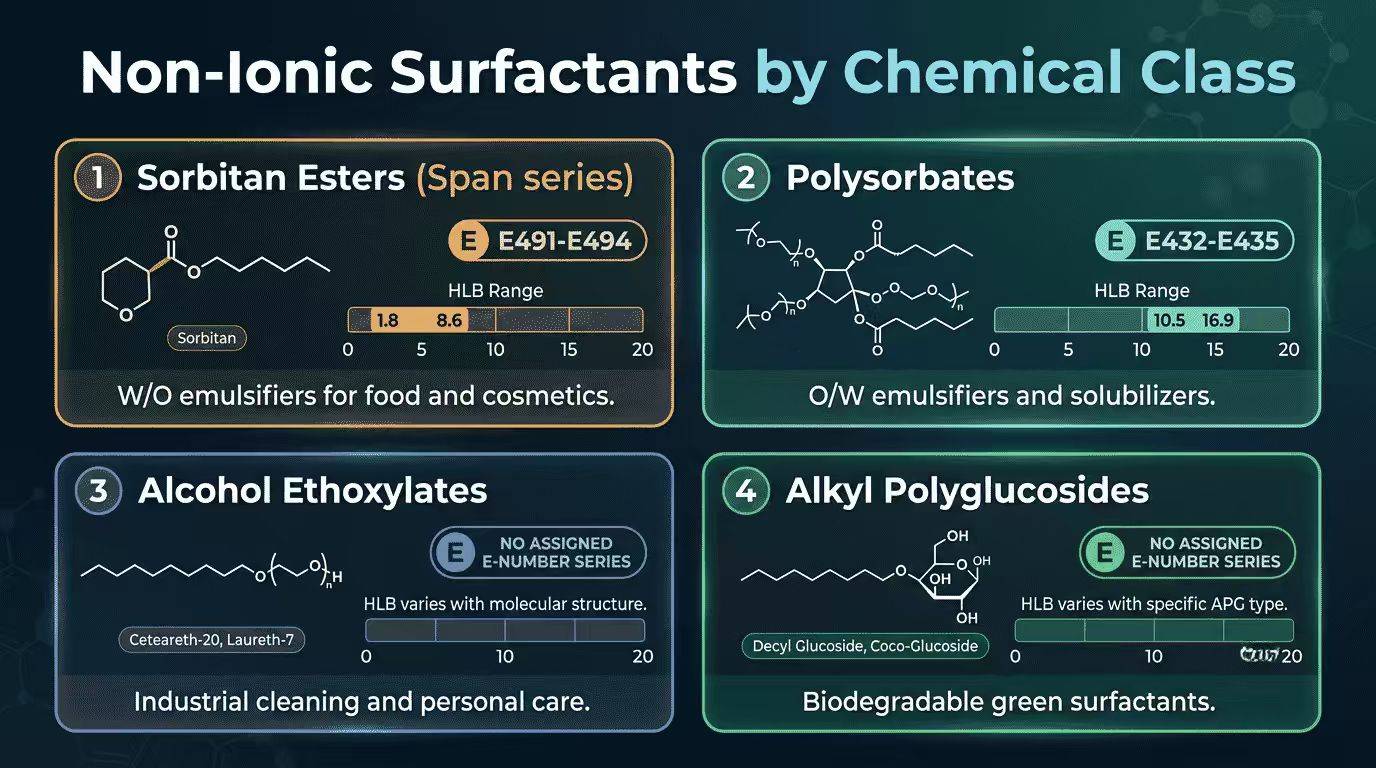
I’ve organized these by chemical family instead of by application, because the family tells you more about what a surfactant can do than any single use case. For a deeper dive into the Span side, see our complete sorbitan esters guide., because the family tells you more about what the molecule can do.
Sorbitan Esters (Span Series) — E491 through E495. These are made by reacting sorbitol with fatty acids, then dehydrating to close the sorbitan ring. They’re lipophilic (HLB 2-9) and work as W/O emulsifiers, crystal modifiers, and anti-bloom agents in chocolate and confectionery. Span 60 (E491, sorbitan monostearate, HLB 4.7) is the workhorse for fat-based fillings. Span 80 (E494, sorbitan monooleate, HLB 4.3) handles oil-phase dispersion in margarine. Span 20 (E493, sorbitan monolaurate, HLB 8.6) bridges into O/W territory and works as a yeast protectant in baking.
Polysorbates (polysorbate Series) — E432 through E436. These are Span molecules with polyethylene oxide chains grafted onto the sorbitan ring, which dramatically increases water solubility and pushes HLB into the 10-17 range. polysorbate 20 (E432, polysorbate 20, HLB 16.7) is the go-to solubilizer for essential oils and flavor compounds — if you’ve ever made a clear peppermint beverage or a water-soluble CBD tincture, you’ve used it. polysorbate 80 (E433, polysorbate 80, HLB 15.0) handles heavier oils and is the standard emulsifier in ice cream for controlling fat destabilization during freezing. polysorbate 60 (E435, polysorbate 60, HLB 14.9) sits in between and works well with saturated fat systems like cakes and whipped toppings.
Polyglycerol Esters (PGE) — E475. Made by polymerizing glycerol then esterifying with fatty acids. The polymerization degree lets you tune HLB across a wide range. PGEs are increasingly popular in “clean label” adjacent products because they can be positioned as vegetable-derived, though they’re still synthetic by any technical definition.
Sucrose Esters — E473. Made from sugar and fatty acids. HLB ranges from 1 to 16 depending on the degree of esterification. They’re fully biodegradable and have excellent aerating properties — you’ll find them in whipped toppings, cake batters, and some dairy alternatives.
Alcohol Ethoxylates — These are workhorses in industrial and cleaning applications but generally not food-grade. C12-C15 alcohol + 3-9 moles EO gives you a low-foaming wetting agent. The same backbone with 20-40 moles EO becomes a high-HLB solubilizer. You’ll see these in laundry detergents, hard surface cleaners, and agrochemical spray adjuvants.
Alkyl Polyglucosides (APG) — C8-C16 fatty alcohol + glucose. Completely derived from renewable feedstocks (corn starch + coconut/palm oil), fully biodegradable, and mild enough for baby products. APGs are the closest thing to a “natural” non-ionic surfactant, though formulators should know they can be tricky to thicken and don’t foam as richly as sulfates.
Non-Ionic Surfactants in Food Applications — The Food-Grade Advantage
Most surfactant guides cover cleaning and industrial chemistry. Food-grade non-ionic surfactants are a different animal — they operate under strict regulatory frameworks, and not every non-ionic surfactant is safe to eat.
In China, food-grade polysorbates and sorbitan esters are regulated under GB 2760 (the national standard for food additive usage), with product quality governed by separate standards: Polysorbate 20 under GB 29221, Polysorbate 60 under GB 25553, and Polysorbate 80 under GB 25554. In the US, polysorbates fall under FDA 21 CFR 172.840 (polysorbate 60), 172.838 (polysorbate 65), and 172.840 (polysorbate 80), while the EU regulates them under Regulation (EC) No 1333/2008 with E-numbers E432-E436.
Here’s where the major non-ionic surfactants actually show up in food:
Ice Cream: Polysorbate 80 at 0.02-0.04% of the mix weight. It partially displaces protein from the fat globule membrane during aging, which controls fat destabilization during freezing. Too much and the ice cream gets buttery; too little and it’s icy. This is one of those applications where experience beats the spec sheet — I’ve seen formulators dial in the dose by running freeze-thaw cycles and checking meltdown rate, not by reading the HLB table.
Confectionery Coatings: Span 60 (sorbitan monostearate) at 0.3-0.5%. It modifies fat crystal behavior — specifically, it promotes the stable β’ polymorph over the undesirable β form, which prevents the waxy, grainy surface defect known as fat bloom. Combined with a small amount of polysorbate 60, you get a dual-emulsifier system that handles both the fat phase and any incidental moisture.
Beverages: polysorbate 20 at 0.01-0.05% as a solubilizer for flavor oils and fat-soluble vitamins. The key metric here is clarity — if the beverage goes cloudy after 48 hours at 4°C, the solubilization ratio needs adjustment. Most citrus oils require an HLB of 12-14, which polysorbate 20 (16.7) exceeds, so you can actually cut it with a small amount of Span 20 (8.6) to hit the exact HLB window while saving cost.
Bakery: Span 60 and polysorbate 60 in combination at 0.2-0.5% of flour weight. The Span strengthens the gluten network (dough strengthening), while the polysorbate improves crumb softness and volume. Sucrose esters are increasingly competing in this space due to their superior aeration properties and clean-label positioning.
Margarine & Shortening: Span 80 (HLB 4.3) or Span 60 (HLB 4.7) at 0.2-0.5%. These stabilize the water-in-oil emulsion and control crystallization during cooling. The Span molecule’s sorbitan ring provides the steric bulk that prevents water droplets from coalescing in a 80% fat continuous phase.
Non-Ionic Surfactants Beyond Food — Cosmetics, Pharma, and Industrial
Non-ionic surfactants are more dominant outside food than inside it.
Cosmetics: polysorbate 20 and polysorbate 80 are the standard solubilizers for fragrance oils in water-based toners and micellar waters. Cetearyl glucoside and other APG-based emulsifiers have largely replaced PEG-based systems in “natural” cosmetic lines. Span 80 and polysorbate 80 combinations create stable cold-process emulsions — no heating required, which saves energy and protects heat-sensitive ingredients like retinol and vitamin C.
Pharmaceuticals: Polysorbate 80 is in injectable formulations (including some COVID vaccines) as a stabilizer that prevents protein aggregation. Polysorbate 20 appears in oral liquid formulations and eye drops. Both are pharmacopoeia-grade, which means tighter specs on peroxide value, acid value, and ethylene oxide residuals than food-grade equivalents.
Agrochemicals: Non-ionic surfactants dominate the spray adjuvant market because they’re compatible with most pesticide active ingredients, don’t react with hard water minerals, and improve wetting and penetration on waxy leaf surfaces. Alcohol ethoxylates and alkylphenol ethoxylates (in regions where still permitted) are the standard choices.
Industrial Cleaning: Alcohol ethoxylates and alkyl polyglucosides form the backbone of low-foam CIP (clean-in-place) detergents for food processing equipment. Non-ionics are chosen here specifically because they don’t leave ionic residues that could interfere with the next production batch or corrode stainless steel.
Why Formulators Choose Non-Ionic Over Ionic — A Decision Framework
After working with both types for years, here’s my mental checklist for when non-ionic is the answer:
1. pH flexibility. Non-ionics work across the full pH range. Ionic surfactants lose functionality outside their effective window — carboxylate soaps precipitate below pH 5, amine-based cationics deprotonate above pH 9. If your formula has a challenging pH profile, go non-ionic.
2. Electrolyte tolerance. Non-ionics shrug off salt, calcium, and magnesium. If you’re formulating with hard water, brine, or a formula loaded with mineral salts, non-ionics won’t cloud out or lose activity the way anionics will.
3. Low foam. Most non-ionics (especially the Span series and short-chain alcohol ethoxylates) are naturally low-foaming. In applications like spray-drying, CIP cleaning, or recirculating systems where foam is a process-killer, this is a decisive advantage.
4. Synergy potential. Non-ionics play well with others. You can pair Span 60 (HLB 4.7) with polysorbate 60 (HLB 14.9) to hit any intermediate HLB exactly by adjusting the ratio. The HLB values of non-ionic mixtures are additive, which means blending is predictable. Ionic-nonionic combinations are also possible — a small amount of anionic SDS with a non-ionic polysorbate often gives better emulsification than either alone.
5. Low irritancy. Non-ionics are generally milder on skin and mucous membranes than anionics. Polysorbates have been used in injectable pharmaceuticals for decades. No ionic surfactant has that safety record for parenteral routes.
6. Regulatory acceptance in food. The vast majority of approved food emulsifiers are non-ionic — glycerol esters, sorbitan esters, polysorbates, sucrose esters, polyglycerol esters, and lecithin (which is amphoteric but often grouped with non-ionics in formulation contexts). If you’re developing anything edible, you’re almost certainly working with non-ionic surfactants by default.
Frequently Asked Questions About Non-Ionic Surfactants
Q: Is polysorbate 80 ionic or non-ionic?
Non-ionic. Polysorbate 80 (polysorbate 80, E433) has no charged groups — its water solubility comes from polyethylene oxide chains, not ionization. It works the same in acidic, neutral, and alkaline conditions.
Q: What’s the difference between Span and polysorbate?
Both are sorbitan-based, but Span is the unmodified sorbitan ester (lipophilic, HLB 2-9) while polysorbate is the ethoxylated version (hydrophilic, HLB 10-17). Span 60 + ethylene oxide = polysorbate 60. Same fat-soluble backbone, different head group.
Q: Can I mix ionic and non-ionic surfactants?
Yes, and you often should. Non-ionic surfactants stabilize the micelles formed by ionic surfactants, reduce their sensitivity to hard water, and can lower the overall CMC of the blend. This is standard practice in shampoo formulation and industrial emulsification.
Q: What is the most common non-ionic surfactant in food?
By volume, mono- and diglycerides of fatty acids (E471). By versatility, the Span/polysorbate family — they cover the full HLB spectrum and appear in everything from ice cream to chewing gum to vitamin emulsions.
Q: Are non-ionic surfactants natural?
Most are semi-synthetic — derived from natural feedstocks (palm oil, coconut oil, sorbitol from corn) but chemically modified. Sorbitan esters and polysorbates require esterification and (for polysorbate) ethoxylation. Alkyl polyglucosides come closest to “natural” — they’re made from glucose and fatty alcohol with no ethoxylation step. If clean-label is a requirement, APGs and sucrose esters are your best bets within the non-ionic category.
