

Estimated reading time: 8 minutes
Hi, I’m Joe. Here at FoodEmul, we’ve been supplying Span and polysorbate emulsifiers to food manufacturers for years, so we know how these ingredients actually perform on a production line — not just on a spec sheet.
This article came from a simple question: where does Span 60 actually make sense in confectionery? Lecithin and PGPR dominate chocolate, and for good reason. But Span 60 has a few specific jobs that nothing else does quite as well. I wanted to lay those out clearly — including the limitations, because the worst thing you can do is use the wrong emulsifier and wonder why it didn’t work.
By the end of this guide, you’ll know exactly where Span 60 earns its place in your confectionery line, what dosage to use, and — just as important — where it doesn’t belong.
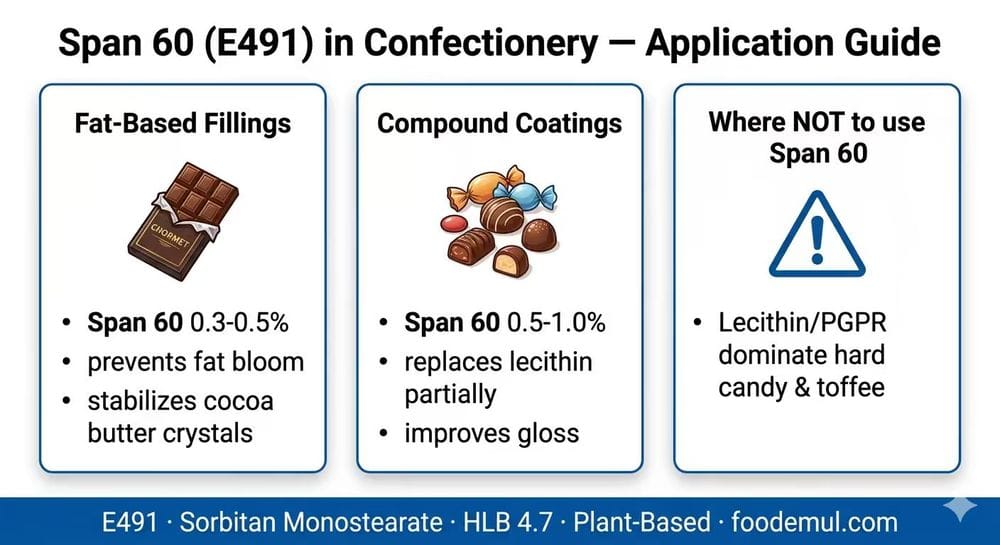
Lecithin and PGPR Run Confectionery. Span 60 Plays a Different Game.
Chocolate is the one food category where Span and polysorbate emulsifiers have the smallest role. The heavy lifters are:
- Lecithin (E322): Cuts plastic viscosity in chocolate so you can mold and enrobe at workable fat levels. Standard use: 0.3–0.5%.
- PGPR (E476): Lowers yield stress — the force needed to get chocolate moving. At 0.2–0.5%, PGPR makes thin-shell molding possible and lets you use less cocoa butter.
- AMP (E442): Ammonium phosphatide, a synthetic lecithin alternative used in premium chocolate.
Span 60 and polysorbate 60 don’t compete with these for primary functions. What they do instead is narrower and more specific: fat crystal control in cocoa-butter-based systems, stabilizing fat-based fillings, and improving compound coating performance.
Span 60 (E491) in Chocolate — Support, Not Star
What It Does
Span 60’s low HLB (4.7) and stearic acid chain (C18:0) give it one specific job in chocolate: cocoa butter crystal stabilization.
Well-tempered chocolate holds cocoa butter in Form V (β) crystals — the structure behind snap, gloss, and clean mold release. Form V is stable but not permanent. Over time, it can shift to Form VI (β₁), producing fat bloom: that whitish film that makes chocolate look old.
Span 60 at 0.1–0.3% of chocolate mass co-crystallizes with cocoa butter and slows the Form V → Form VI shift. It doesn’t stop bloom forever — nothing does — but it stretches the bloom-free shelf life by slowing the crystal change.
What It Doesn’t Do
Span 60 does not:
- Cut chocolate viscosity (that’s lecithin)
- Lower yield stress (that’s PGPR)
- Let you drop cocoa butter content
- Replace proper tempering
It’s a shelf-life tool, not a processing tool.
The Span 60 Value Proposition for Chocolate
| Function | Lecithin (E322) | PGPR (E476) | Span 60 (E491) |
|---|---|---|---|
| Viscosity reduction | Primary | Secondary | None |
| Yield stress reduction | Minimal | Primary | None |
| Crystal stabilization | None | None | Primary |
| Bloom resistance | Minimal | None | Contributing |
| Fat dispersion | Secondary | None | Contributing |
Span 60 doesn’t replace lecithin or PGPR — you add it when viscosity and yield stress are already dialed in and your next target is bloom-free shelf life or better tempering tolerance.
For full Span 60 specs, see our Sorbitan Monostearate (E491) Technical Guide.
Fat-Based Fillings — Where Span 60 Takes the Lead
Truffle Centers, Praline Fillings, and Nut Pastes
Fat-based confectionery fillings — ganache, truffle centers, hazelnut paste, peanut butter fillings — are water-in-oil or high-fat continuous systems. Span 60’s low HLB lines up perfectly here:
- Fat phase stabilization: These fillings can run 30–50% fat. Span 60 at 0.1–0.3% keeps the fat phase stable, preventing oil separation during shelf life and through temperature swings.
- Fat migration barrier: When you enrobe a fat-based filling in chocolate, the softer filling oils try to migrate into the chocolate shell, causing bloom and softening. Span 60 in the filling slows that migration.
- Texture consistency: Span 60 co-crystallizes with the filling fat, giving you a firmer, more consistent texture that holds up at room temperature.
Caramel and Toffee
Caramel is a fat-in-sugar system — the continuous phase is amorphous sugar, with fat droplets spread throughout. The problem: fat droplets merge during cooking (120–130°C) and on cooling, leaving an oily surface and uneven texture.
Span 60 at 0.1–0.2% stabilizes those fat droplets during cooking. You get smoother, more uniform caramel with less surface oil. polysorbate 60 doesn’t belong in caramel — the high heat and low water don’t suit a high-HLB emulsifier.
Compound Coatings — Span 60’s Strongest Confectionery Role
Compound coatings — vegetable fat + sugar + cocoa powder, no cocoa butter — are where Span 60 gives you the most value per gram:
- No cocoa butter, no natural crystal former. Cocoa butter’s triglyceride structure (mostly POP, POS, SOS) provides natural crystallization and contraction. Compound coatings use palm kernel oil or palm mid-fraction, which behave differently. Span 60 supplements the crystal-forming ability of these vegetable fats.
- Crystal type control. Compound coating fats crystallize in the β’ form — Span 60 pushes this desired crystal form, producing better snap and gloss.
- Mold release. Span 60 at 0.2–0.5% improves release from enrobing machinery and molds, cutting waste and improving surface finish.
Recommendation: Span 60 at 0.2–0.5% of compound coating, added to the fat phase at 55–60°C before mixing with dry ingredients. Pair with lecithin for viscosity control. polysorbate 60 is not used in compound coatings.
Sugar-Based Confectionery — Very Limited Role
Hard candies, lollipops, gummies, jellies, and marshmallows are sugar-continuous or water-continuous systems with almost no fat phase. Span 60 and polysorbate 60 don’t do much here:
- Hard candy: No fat phase — no emulsifier needed.
- Gummies/jellies: Gelatin or pectin does the structuring; emulsifiers add nothing.
- Marshmallows: Span 60 at 0.05–0.10% as a mold-release additive if vegetable-oil-based release agents aren’t enough.
The one exception is chewing gum — Span 60 at 0.1–0.3% in the gum base helps disperse the elastomer in the resin phase, for a smoother chew and longer flavor release. It’s a niche application, but it works.
Dosage Quick Reference
| Confectionery Type | Span 60 Dosage | polysorbate 60 Dosage | Purpose |
|---|---|---|---|
| Chocolate (bloom extension) | 0.1–0.3% | — | Cocoa butter crystal stabilization |
| Truffle/ganache filling | 0.1–0.3% | — | Fat phase stabilization; oil migration barrier |
| Nut paste filling | 0.1–0.3% | — | Prevents oil separation |
| Caramel / toffee | 0.1–0.2% | — | Fat droplet stabilization during cooking |
| Compound coating | 0.2–0.5% | — | Crystal form control; mold release; gloss |
| Chewing gum base | 0.1–0.3% | — | Elastomer dispersion in resin phase |
Key principle: In confectionery, Span 60 is almost always used alone. polysorbate 60 and PS80 rarely show up because confectionery is mostly fat-continuous or low-moisture — high-HLB emulsifiers add nothing and can create off-flavors at processing temperatures.
How to Add Span 60
Adding Span 60 to Chocolate
- Add Span 60 powder to the cocoa butter portion at 50–60°C — above Span 60’s melting point (~56°C).
- Mix until dissolved in the fat phase, then combine with cocoa mass and sugar.
- Refine, conche, and temper as usual — Span 60 doesn’t change these steps.
- Deposit, mold, or enrobe at standard temperatures.
Adding Span 60 to Compound Coatings
- Melt the vegetable fat (palm kernel oil, palm mid-fraction) at 55–60°C.
- Add Span 60 and lecithin to the fat melt; mix until fully dissolved.
- Add to dry ingredients (sugar, cocoa powder, milk powder) in the refiner.
- Refine to target particle size (usually 20–30 μm).
- Temper or use directly depending on the fat system.
- Enrobe, mold, or deposit at 40–45°C.
Adding Span 60 to Caramel
- Add Span 60 to the fat portion (butter, cream, vegetable fat) before cooking.
- Cook caramel to target temperature (118–125°C depending on desired firmness).
- Span 60 is stable at caramel cooking temperatures — it doesn’t degrade below 200°C.
Troubleshooting
| Problem | Probable Cause | Span 60 Solution |
|---|---|---|
| Fat bloom on chocolate | (see anti-bloom crystal modifier — Span 65 for details) (V→VI) | Add Span 60 at 0.1–0.3%; check tempering and storage temperature |
| Oily surface on truffles | Filling oil migration through shell | Span 60 in filling at 0.2–0.3% |
| Dull compound coating | Poor crystal form | Span 60 at 0.2–0.5%; check cooling rate |
| Caramel surface oil | Fat droplet coalescence during cooking | Span 60 at 0.1–0.2% in the fat phase |
| Nut paste separation | Oil pooling at surface | Span 60 at 0.2–0.3% |
| Chocolate sticking to molds | Insufficient contraction | Span 60 at 0.1–0.2%; verify tempering first |
The Bottom Line
Span 60 has a small but real role in confectionery — not as a primary processing emulsifier (that’s lecithin and PGPR’s job), but as a fat-phase stabilizer and crystal modifier in four specific spots:
- Chocolate bloom extension — slows crystal transformation, extends shelf life
- Fat-based fillings — stabilizes fat phases, slows oil migration, improves texture
- Compound coatings — promotes β’ crystals, improves mold release and gloss (strongest application)
- Caramel and toffee — stabilizes fat droplets during high-heat cooking
polysorbate 60 and PS80 have almost no place in confectionery — the products are fat-continuous or sugar-continuous with too little water for a high-HLB emulsifier to work.
For Span 60 specifications, see the Sorbitan Monostearate Technical Guide. For Span ester chemistry and functionality, see the Sorbitan Esters Comprehensive Guide. For HLB methodology, refer to our Span & polysorbate Formulators Guide.
This guide draws on published industry research, formulation practice, and the food emulsifier science reference work by Hu et al. (2011). For specific confectionery formulation advice, consult your emulsifier supplier’s technical service team.
Premium Span & polysorbate Solutions
Here at FoodEmul, we’ve been supplying high-purity Span and polysorbate emulsifiers to manufacturers worldwide for years. If you’re formulating a confectionery product and want to know whether Span 60 fits — or you need a sample to test — get in touch.