
Estimated reading time: 13 minutes
For detailed solubilization data across 7 essential oils, see our Polysorbate Solubilizers Guide.
Hi, I’m Joe. Here at FoodEmul, we’ve been supplying Span and polysorbate emulsifiers to beverage manufacturers for years, and here’s something that surprises people: you can stabilize a drink for 12 months with just 10–100 parts per million of emulsifier. That’s a pinch in a swimming pool. And polysorbate 80 does exactly that.
But beverage stability isn’t just about picking the right emulsifier. It’s about matching the HLB to your oil phase, getting the droplet size right, and — for cloud emulsions — getting the density right too. Skip any of those and you’ll get ringing, clearing, or a full-on oil layer.
This guide covers which Span/polysorbate to use for which drink, how to calculate the right HLB, and the process parameters that make the difference between 6 months and 18 months of shelf stability.
Why Beverages Need Emulsifiers — and Why Span/polysorbate Are the Answer
A packaged drink has to stay perfectly uniform for 6–18 months on a shelf, under gravity, through temperature swings. The oil wants to rise. Flavor oils want to merge into bigger drops. And the consumer decides if it looks right in the first second of picking up the bottle.
The most widely used emulsifiers for beverage stability: PS80 (polysorbate 80, E433, HLB 15.0), polysorbate 60 (E435, HLB 14.9), and Span 60 (Sorbitan Monostearate, E491, HLB 4.7). Here’s why:
- Beverages are O/W emulsions — water is the continuous phase, oil is the dispersed phase. This calls for high-HLB emulsifiers (8–16) to create and stabilize sub-micron oil droplets.
- polysorbate 60 and PS80, at HLB ~15, are among the most efficient O/W emulsifiers available. They produce sub-micron droplets (0.2–0.5 μm) at remarkably low levels — 10–100 ppm in the finished drink.
- Span 60 provides the low-HLB anchor when you need broader HLB coverage — especially in coffee creamers and dairy-based drinks where the fat phase is bigger and needs more oil-side stabilization. For a worked example of high-HLB + low-HLB blending in dairy, check our pure milk emulsifier guide — it walks through the HLB 9.0 target and GMS/Span/polysorbate ratios.
Four physical mechanisms cause beverage instability (Hu et al., 2011):
| Mechanism | Visual Sign | How Span/polysorbate Prevent It |
|---|---|---|
| Creaming | Oily ring at neck | polysorbate’s sub-micron droplets are too small for rapid buoyant rise |
| Flocculation | Cloudiness shift | polysorbate forms a steric barrier between droplets, preventing aggregation |
| Coalescence | Visible oil layer | Span 60 reinforces the interfacial film against rupture |
| Ostwald ripening | Gradual clarity loss | polysorbate’s narrow droplet size distribution minimizes the ripening driving force |
The Three Beverage Emulsion Types
Flavor Emulsions
Flavor emulsions carry essential oils (citrus, mint, spice) into water-based drinks at 0.1–0.5% of the beverage. The core challenge: flavor oils Ostwald-ripen aggressively — a 0.2 μm droplet can disappear into a neighboring 2 μm droplet within weeks.
The fix: PS80 or polysorbate 60 at HLB 12–15 produces sub-0.5 μm droplets under standard homogenization (150–300 bar). These fine, uniform droplets reduce the Laplace pressure difference driving Ostwald ripening. PS80 at 10–100 ppm of the finished drink for flavor pre-emulsions.
polysorbate 60 beats PS80 when the oil phase has a fatty acid profile heavy in C18:0 (stearic) — matching chain lengths improve interfacial packing. PS80 (C18:1, oleic) has lower viscosity and wins for cold-process flavor pre-emulsions.
Cloud Emulsions
Cloud emulsions give opacity and mouthfeel to clear drinks — sports drinks, lemon-lime sodas, flavored waters. The challenge: oil droplets at 0.3–1.0 μm must stay uniformly cloudy for 6–12 months without forming a ring.
The fix: A Span 60/polysorbate 60 blend at HLB 10–14 gives the narrow droplet size distribution needed for consistent light scattering. For dairy-specific beverages — where pH and protein stability add another layer of complexity — our dairy beverage emulsifier guide covers formulations for both neutral and acidic systems. Add a weighting agent (SAIB or GEWR) to density-match the oil phase to the water phase, and you get 12-month cloud stability.
Nutritional Emulsions
Meal replacements, RTD protein drinks, and infant formulas have both O/W emulsions (fat) and solid suspensions (proteins, minerals). The emulsifier has to resist protein displacement at the oil-water interface and survive UHT (135–145°C) or retort sterilization.
The fix: polysorbate 60’s higher melting point and thermal stability make it the choice for UHT-processed nutritional drinks. Span 60 adds fat-crystal stabilization in the higher-fat formulas common in meal replacements.
How PS80 and Span 60 Work in Beverages
PS80 (polysorbate 80, E433) — The Flavor Emulsion Workhorse
PS80 is the most widely used emulsifier for beverage flavor and cloud emulsions. Its HLB of 15.0, oleic acid chain (C18:1), and liquid form at room temperature make it the go-to choice for cold-process beverages. At 10–100 ppm, PS80 produces the sub-micron droplets that keep flavor oils dispersed for months.
polysorbate 60 (E435) — When Heat Is Involved
polysorbate 60’s higher melting point and stearic acid chain (C18:0) make it the better choice for hot-fill and UHT beverages. Its saturated fatty acid tail packs tighter at the oil-water interface, giving a more thermally stable emulsion. Preferred for dairy-based drinks, coffee creamers, and nutritional beverages processed above 100°C.
Span 60 (E491) — The Low-HLB Anchor
Span 60 enters the picture when the beverage has a significant fat phase — above 3% fat, the O/W emulsion benefits from a low-HLB emulsifier anchoring on the oil side of the interface. Span 60 co-crystallizes with saturated fats, preventing the crystal-mediated coalescence that can cause oiling-off in higher-fat beverages.
Weighting Agents — The Missing Piece for Cloud Stability
An emulsifier alone can’t stop creaming. Creaming is driven by density difference — oil (0.92 g/mL) in water (1.0 g/mL) will always rise, no matter how small the droplets. Weighting agents solve this by raising the oil phase density to match the water phase.
| Weighting Agent | Density (g/mL) | Usage Level | Best For |
|---|---|---|---|
| SAIB (E444) | 1.14 | 100–300 ppm | Cloud emulsions, citrus flavors |
| GEWR (E445) | 1.05–1.15 | 50–150 ppm | Citrus oil emulsions |
| Damar gum | 1.05 | 50–100 ppm | Traditional cloud emulsions |
How it works: Add SAIB at 10–15% of the oil phase weight. The oil phase density rises to ~1.02 g/mL, nearly matching water. Combined with PS80’s sub-micron droplets, the emulsion is now both kinetically stable (small droplets don’t rise fast) and thermodynamically neutral (no density driving force to rise).
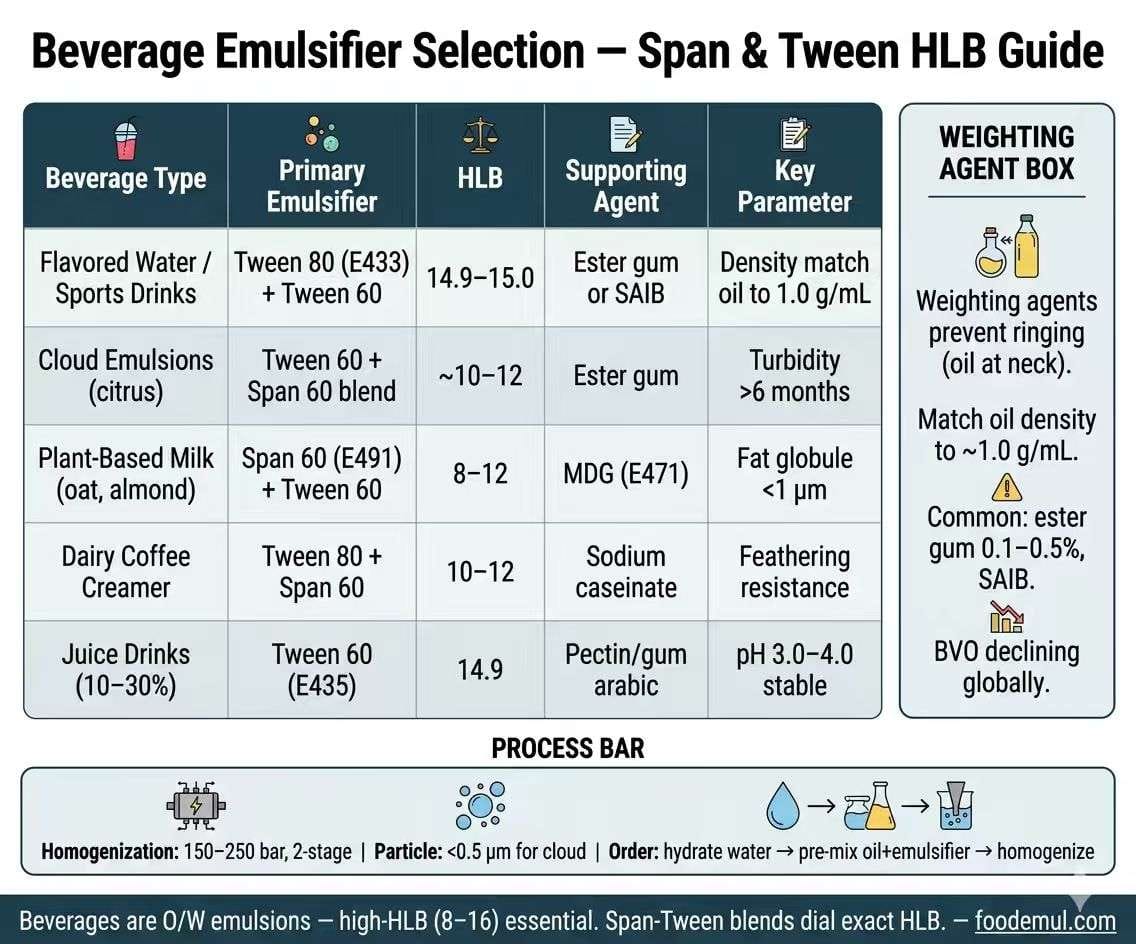
HLB Matching by Beverage Type
| Beverage Type | Target HLB | Recommended Emulsifier | Typical Dosage |
|---|---|---|---|
| Flavored water (clear) | 12–14 | PS80 | 10–50 ppm |
| Cloudy sports drink | 10–14 | Span 60 + polysorbate 60 blend | 50–200 ppm |
| Juice drink (5–25% juice) | 11–14 | PS80 or polysorbate 60 | 20–100 ppm |
| Coffee creamer (liquid) | 10–11 | Span 60 + polysorbate 60 (1:2) | 0.3–0.5% |
| Plant-based milk | 9–11 | polysorbate 60 ± Span 60 | 0.02–0.15% |
| RTD protein shake | 11–13 | polysorbate 60 | 0.05–0.15% |
| Dairy-based drink | 9–10 | Span 60 + polysorbate 60 (1:1) | 0.05–0.15% |
For HLB calculation methodology, see our Span & polysorbate Formulators Guide.
Dosage by Drink Type
| Drink Type | PS80 (ppm) | polysorbate 60 (ppm) | Span 60 (ppm) | Weighting Agent |
|---|---|---|---|---|
| Clear flavored water | 10–50 | — | — | None |
| Cloudy lemon-lime soda | — | 50–100 | 10–20 | SAIB 100–300 ppm |
| Sports drink | 50–200 | — | — | SAIB or GEWR |
| Orange juice drink | 20–100 | — | — | Optional: GEWR 50–150 ppm |
| Coffee creamer (liquid) | — | 600–1,000 | 600–1,000 | None (high fat phase self-weights) |
| Oat/almond milk | — | 500–1,500 | 0–300 | None |
| RTD protein shake | — | 500–1,500 | 200–500 | None |
Process Integration
Flavor Emulsion Process
- Pre-emulsion: Dissolve PS80 or polysorbate 60 in the flavor oil phase at 25–40°C. PS80 is liquid — no heating needed. polysorbate 60 needs warming to ~30°C for easy pouring.
- Homogenization: Add the oil phase (with emulsifier) to the water phase. Two-stage: 200–300 bar first stage, 30–50 bar second stage. Target droplet size: 0.2–0.5 μm.
- Weighting agent addition: If using SAIB, dissolve it in the flavor oil phase before emulsification. SAIB is a viscous liquid — pre-warming to 40–50°C helps handling.
- Dilution into finished beverage: The concentrated emulsion (typically 10–20% oil) is metered into the finished drink at 0.1–0.5% of the final volume. Final emulsifier concentration: 10–100 ppm.
Cloud Emulsion Process
- Dissolve Span 60 and polysorbate 60 in the oil phase (typically vegetable oil or terpene-based) at 60–65°C — Span 60 needs to melt.
- Add SAIB at 10–15% of oil phase weight. Mix until homogenous.
- Pre-emulsify with water phase at 55–60°C under high-shear.
- Homogenize: 250–350 bar. Target droplet size: 0.3–1.0 μm. Larger than flavor emulsions — cloud opacity depends on light scattering, which peaks at ~0.5–1.0 μm.
- Pasteurize at 85–95°C for 15–30 seconds. Cool rapidly to ambient.
Troubleshooting
| Problem | Likely Cause | Solution |
|---|---|---|
| Ringing (oily neck ring) | Droplets too large; insufficient emulsifier | Increase homogenization pressure; check emulsifier dosage |
| Gradual clearing | Ostwald ripening — broad droplet size distribution | Narrow particle size distribution; increase emulsifier for smaller, more uniform droplets |
| Flavor loss during shelf life | Flavor oil oxidation at large droplet surface area | Use polysorbate 60 instead of PS80; tighter interfacial packing reduces oxygen penetration |
| Cloud collapse (sediment) | Density mismatch without weighting agent | Add SAIB at 10–15% of oil phase; verify oil phase density ≈ 1.02 g/mL |
| Oil layer on surface | Coalescence — emulsion has broken | Increase Span 60 proportion; add Span 60 if not present |
| Off-flavor development | PS80 auto-oxidation at unsaturated oleic chain | Switch to polysorbate 60 (saturated stearic chain); add antioxidant (tocopherols) |
| Precipitate in UHT drink | Protein denaturation + emulsifier interaction | Reduce emulsifier; add emulsifier after protein hydration step |
| Foaming during filling | Excess high-HLB emulsifier | Reduce polysorbate proportion; add antifoam if process-critical |
The Bottom Line
Beverages are the application where Span/polysorbate emulsifiers show their full range — from flavored waters to coffee creamers. For a deep dive on coffee whiteners and whipped toppings specifically, our coffee whitener emulsifier guide covers HLB targets, SSL for acid buffering, and freeze-thaw recovery. — from 10 ppm of PS80 in a flavored water to 0.5% Span 60 + polysorbate 60 in a coffee creamer. The key decisions:
- Match the emulsifier to your process temperature. PS80 for cold-process — it’s a liquid, no heating needed. polysorbate 60 for hot-fill and UHT — its stearic chain stands up to heat better.
- Match the HLB to your oil phase. Clear flavored waters (HLB 12–14) need PS80 alone. Cloud emulsions (HLB 10–14) need a Span 60/polysorbate 60 blend. Higher-fat systems need more Span 60.
- Don’t skip the weighting agent for cloud emulsions. Emulsifiers stop coalescence. Weighting agents stop creaming. You need both for 12-month cloud stability.
- Homogenization pressure is your primary process lever. 200–300 bar for flavor emulsions, 250–350 bar for cloud emulsions. The pressure determines droplet size; droplet size determines everything else.
For PS80 technical data and regulatory limits, see our PS80 Comprehensive Guide. For polysorbate 60 application data, see the Polysorbate 60 Food Application Guide. For HLB methodology, refer to our Span & polysorbate Formulators Guide.
This guide draws on published industry research, formulation practice, and the food emulsifier science reference work by Hu et al. (2011). For specific beverage formulation advice for your product and process, consult your emulsifier supplier’s technical service team.
The choice between ionic and non-ionic emulsifiers matters in beverage formulations. Our non-ionic surfactants guide covers the full classification, HLB ranges, and selection framework for food-grade applications.