

Estimated reading time: 12 minutes
Ice cream is four things at once — a foam, an emulsion, a suspension of ice crystals, and a freeze-concentrated liquid. All of them have to hold together from the factory freezer at -18°C to the moment it melts in your mouth. Without the right emulsifiers, that structure falls apart.
At FoodEmul, we’ve seen what happens when you get the PS80-to-Span 60 ratio wrong: weak body, fast melting, collapsed air cells. And we’ve seen what happens when you get it right: firm scoop, clean melt, and overrun you can control with precision.
This guide is about those two emulsifiers — PS80 and Span 60 — and how the ratio between them is the single most powerful tuning knob in your ice cream line.
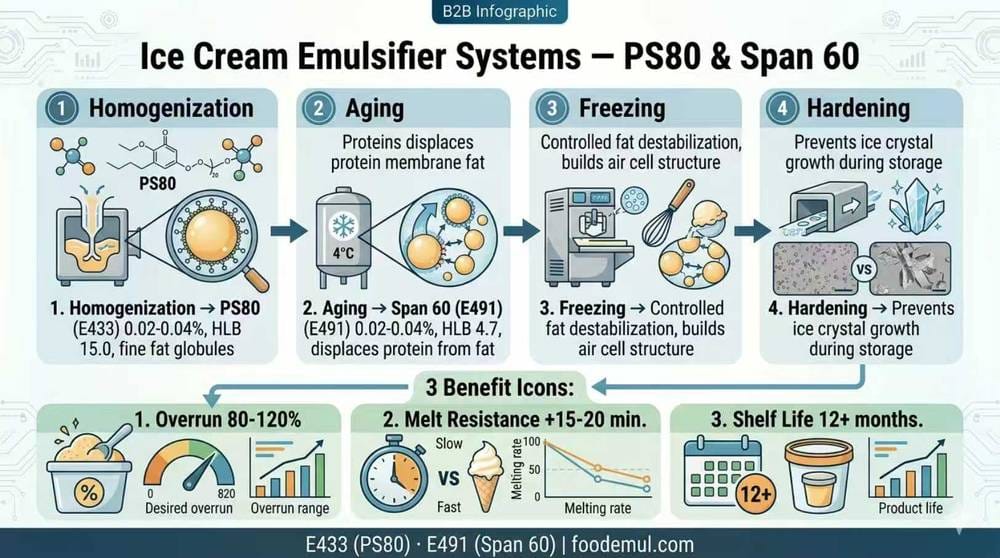
Why Ice Cream Needs Emulsifiers
Ice cream is one of the most structurally complex foods made at scale. It’s a foam (air cells), an emulsion (fat droplets), a sol (ice crystals), and a viscous liquid (freeze-concentrated serum) — all at once, from -18°C storage to the moment it hits your tongue.
Without emulsifiers, this structure collapses. Milk proteins alone — caseins and whey — form protein membranes around fat globules that are too tough. These membranes block the controlled fat destabilization that builds the internal scaffolding of premium ice cream. The result: weak body, fast melt, poor shape retention.
Emulsifiers fix this by displacing proteins from the fat globule surface, allowing partial coalescence — fat globules sharing crystalline fat to link into a 3D network that stabilizes air cells and delivers body.
The two most important emulsifiers for ice cream are PS80 (polysorbate 80, E433) and Span 60 (Sorbitan Monostearate, E491). Together they give you dual control: PS80 drives fat destabilization, Span 60 reinforces the resulting fat network.
The Science: How PS80 and Span 60 Build Ice Cream Structure
Partial Coalescence — The Goal
During freezing, semi-crystalline fat globules collide under shear in the scraped-surface freezer. Three things can happen:
| Outcome | What Happens | Result |
|---|---|---|
| No coalescence | Protein membrane intact, globules repel | Weak body, rapid melt, poor overrun |
| Partial coalescence (optimal) | Fat globules share crystalline fat, form 3D network | Firm body, stable air cells, good melt resistance |
| Full coalescence (churning) | Globules merge completely into oil pools | Buttery texture, collapsed foam, ruined product |
PS80 and Span 60 control this from opposite directions. PS80 drives the protein displacement that makes partial coalescence possible. Span 60 stabilizes the resulting fat network so it doesn’t tip over into full coalescence.
PS80 — The Destabilizer
PS80 (HLB 15.0) is the strongest single emulsifier for triggering partial coalescence in ice cream. It drops interfacial tension aggressively — from ~15 mN/m (protein-stabilized) to ~5–8 mN/m — driving rapid protein displacement from the fat globule surface. The thinner interfacial film that forms is mechanically weaker and responds to shear, enabling the partial coalescence step.
Among polysorbate variants tested in ice cream, polysorbate 80 (oleic acid chain, C18:1) produces the most fat agglomeration and product “dryness” at extrusion. polysorbate 60 (stearic acid chain, C18:0) gives the best balance of high overrun with good dryness (Hu et al., 2011). See our PS80 in Ice Cream Guide for application data.
Span 60 — The Fat Network Reinforcer
Span 60 (HLB 4.7) co-crystallizes with milk fat at the globule interface. While PS80 opens the door for fat globule interaction, Span 60 makes sure the resulting fat network is strong and heat-resistant:
- It builds a structured fat crystal shell around each partially coalesced globule cluster
- This shell physically resists the serum drainage that would collapse the foam during melting
- It stops partial coalescence from sliding into full coalescence (churning)
Span 60 paired with a high-HLB emulsifier at combined HLB 8–10 can cut total emulsifier usage by 20–40% while improving foaming and expansion rate (Hu et al., 2011). For full specs, see our Sorbitan Monostearate (E491) Technical Guide.
The PS80/Span 60 Ratio — Your Primary Tuning Knob
| PS80 : Span 60 Ratio | Combined HLB | Result |
|---|---|---|
| 1 : 1 | ~10 | Maximum fat network strength, best melt resistance |
| 2 : 1 | ~12 | Balanced partial coalescence and overrun |
| 3 : 1 | ~13 | Faster destabilization, higher overrun, lighter body |
| PS80 alone | 15.0 | Maximum destabilization — use with caution (churn risk) |
Practical starting point for standard dairy ice cream (10–12% butterfat): PS80 : Span 60 = 2:1, paired with GMS at 0.2–0.3% for bulk fat structuring. Adjust from there based on fat content and desired body.
The power of this pair: two independent control levers. PS80 controls how much destabilization happens. Span 60 controls how strong the resulting structure is. (The same dual-emulsifier approach applies to pure milk — our pure milk stability guide shows a GMS/Span 60/polysorbate 80 blend targeting HLB 9.0 for long-term dairy stability.)
For blending methodology, see our Span & polysorbate Formulators Guide and PS80 HLB Synergy Guide.
Supporting Emulsifiers
PS80 and Span 60 form the functional core, but other emulsifiers handle specific jobs:
| Emulsifier | Role in Ice Cream | When to Add |
|---|---|---|
| GMS / DMG (E471) | Bulk fat structuring and anti-staling; provides the primary fat network substrate | Standard in all dairy ice cream; 0.1–0.5% |
| PGMS (E477) | Extra aeration and overrun; stabilizes air cells during hardening | Low-fat and soft-serve formulations |
| Lecithin (E322) | Clean-label fat dispersion; phospholipid source | Vegan, organic, and clean-label products |
In most industrial ice cream, PS80, Span 60, and GMS work together. A common compound blend: GMS 80 : PS80 15 : Span 60 5 — GMS provides bulk, PS80 drives destabilization, Span 60 reinforces the network.
How PS80 and Span 60 Help Control Ice Crystals
Ice crystals grow through recrystallization — small crystals shrink while large ones grow — especially during temperature fluctuations in distribution. While stabilizers (guar gum, locust bean gum, carrageenan) are the primary ice crystal control tools, emulsifiers contribute indirectly:
- Fat network as physical barrier. The partial coalescence fat network that PS80 and Span 60 build physically separates ice crystal domains, limiting crystal-to-crystal contact that drives recrystallization.
- Water immobilization. Span 60’s crystal-templating effect incorporates some water into structured interfacial layers, reducing free water available for ice crystal growth.
Dosage by Ice Cream Type
| Ice Cream Type | Fat Content | PS80 (%) | Span 60 (%) | Ratio | Total Emulsifier |
|---|---|---|---|---|---|
| Premium dairy (super-premium) | 14–18% | 0.10–0.15 | 0.05–0.10 | 2:1 to 3:2 | 0.15–0.25% |
| Standard dairy | 10–12% | 0.08–0.12 | 0.04–0.06 | 2:1 | 0.12–0.18% |
| Economy / low-fat | 5–8% | 0.05–0.08 | 0.03–0.05 | 3:2 to 2:1 | 0.08–0.13% |
| Vegan (coconut-based) | 10–15% | 0.10–0.15 | 0.08–0.12 | 3:2 | 0.18–0.27% |
| Soft-serve | 5–6% | 0.08–0.12 | 0.02–0.04 | 3:1 | 0.10–0.16% |
| Gelato | 4–8% | 0.03–0.06 | 0.02–0.04 | 3:2 | 0.05–0.10% |
Key principle: Higher fat content = more Span 60 needed to reinforce the larger fat network. Lower fat content = more PS80 relative to Span 60 to drive sufficient destabilization from limited fat globules.
Process Integration
- Mix preparation: Add PS80 and Span 60 to the fat phase (butter, cream, vegetable fat) at 60–65°C. Span 60 melts at ~56°C. PS80 is liquid — no pre-melting needed. Blend until fully dissolved.
- Pasteurization: HTST at 80–85°C for 15–30 seconds or batch at 69–72°C for 30 minutes. Both emulsifiers are thermally stable at these temperatures.
- Homogenization: Two-stage: 140–180 bar first stage, 30–40 bar second stage. Temperature: 70–75°C. This disperses fat to 0.5–1.5 μm and builds the initial interfacial layer.
- Aging: Cool to 2–4°C and hold for 4–24 hours. This is critical — milk fat crystallizes during aging, and Span 60 co-crystallizes with it. Without this step, partial coalescence during freezing is uncontrolled.
- Freezing: Scraped-surface freezer at -5 to -7°C draw temperature. Air incorporation (overrun) during freezing: 25–50% for premium, 50–100% for standard, 30–40% for gelato. The shear during freezing triggers PS80-mediated partial coalescence.
- Hardening: Rapid freeze to -25 to -30°C core temperature. The fat network set during freezing is locked in place. Hardening time: 4–12 hours depending on package size.
Troubleshooting
| Problem | Likely Cause | Solution |
|---|---|---|
| Weak body / rapid melt | Insufficient partial coalescence | Increase PS80 proportion; verify aging time (min 4 hr) |
| Buttery / greasy texture | Excessive coalescence (churning) | Increase Span 60 proportion; reduce PS80 |
| Low overrun | Poor air incorporation; weak foam stabilization | Increase total emulsifier; add PGMS for extra aeration |
| Shrinkage during storage | Air cell collapse; weak fat network | Increase Span 60; verify hardening rate |
| Icy / coarse texture | Ice crystal growth during distribution | Add stabilizer (guar, LBG); verify storage temperature stability |
| Whey separation (wheying-off) | Protein instability; insufficient fat network | Increase Span 60; check homogenization pressure |
| Vegan ice cream too soft | Coconut oil has lower solids at freezer temp | Increase Span 60 proportion; consider harder fat fraction |
The Bottom Line
PS80 and Span 60 are the two emulsifiers that give ice cream formulators independent control over the most critical quality parameter — partial coalescence. (The same principle drives whipped topping stability. Our whipped topping emulsifier guide covers LACTEM, PGMS, and PGFE for foam structure and freeze-thaw recovery.) — partial coalescence:
- PS80 drives destabilization by displacing proteins from the fat globule surface, enabling fat globules to interact and share crystalline fat. More PS80 = faster destabilization, higher overrun, lighter body — but more churn risk.
- Span 60 reinforces the fat network by co-crystallizing with milk fat and building structured crystal shells around fat globule clusters. More Span 60 = stronger structure, better melt resistance, slower melt — but potentially weaker body if overdone.
- The ratio between them is your primary tuning knob. Start at 2:1 (PS80:Span 60) for standard ice cream. Adjust toward 1:1 for premium melt resistance, toward 3:1 for high overrun economy products.
For PS80 technical data and ice cream-specific application limits, see our PS80 in Ice Cream Guide. For Span 60 specifications, see the Sorbitan Monostearate Technical Guide. For HLB blending methodology, refer to our Span & polysorbate Formulators Guide.
This guide draws on published industry research, formulation practice, and the food emulsifier science reference work by Hu et al. (2011). For specific ice cream formulation advice for your product and process, consult your emulsifier supplier’s technical service team.