

If you’ve ever tried to dissolve peppermint oil into a water-based drink, you already know the problem. The oil floats to the top. It forms a ring. The first sip burns with flavor and the last sip tastes like nothing. This is the daily reality for anyone formulating beverages, oral care products, or water-based fragrances—and it all comes down to one thing: oil and water don’t mix.
At Foodemul, we supply emulsifiers to flavor houses and beverage manufacturers around the world, and the question we hear most often is: which polysorbate should I use to solubilize my essential oil, and how much? This article answers that question with real data—not theory, not marketing claims. We pulled solubilization numbers from the most comprehensive reference on food emulsifiers, tested across seven common essential oils, and built a practical guide you can take straight to the bench.
By the end, you’ll know exactly when to reach for Polysorbate 20 versus Polysorbate 80, how to calculate the right ratio, and what to do when things go wrong.
Why oil-soluble flavors need a solubilizer
Polysorbates 20 and 80 are non-ionic surfactants. For a full breakdown of surfactant types — including ionic vs. non-ionic comparisons, HLB theory, and chemical class classification — read our non-ionic surfactants 101 guide.
Essential oils, oleoresins, and most aroma chemicals are hydrophobic. They don’t dissolve in water. When you add them directly to a water-based product (see our beverage emulsifier guide)—a soft drink, a mouthwash, a room spray—they separate into droplets. Over hours or days, those droplets coalesce. You get an oil slick on the surface, uneven flavor delivery, and a product that looks unprofessional on the shelf.
A solubilizer fixes this by wrapping each oil droplet in a molecular jacket that makes it compatible with water. Instead of floating free, the oil gets tucked inside microscopic spheres called micelles. The result is a crystal-clear, single-phase liquid that stays stable for months.
Two solubilizers stand out for flavor and fragrance work: Polysorbate 20 (E432) and Polysorbate 80 (E433). They’re non-ionic, food-grade, and work across a wide range of essential oils. Here’s how.
Micelles, CMC, and how polysorbates actually work
Every polysorbate molecule has two ends: a water-loving head made of 20 ethylene oxide units, and an oil-loving tail made of a fatty acid. Polysorbate 20 uses lauric acid (C12). Polysorbate 80 uses oleic acid (C18:1).
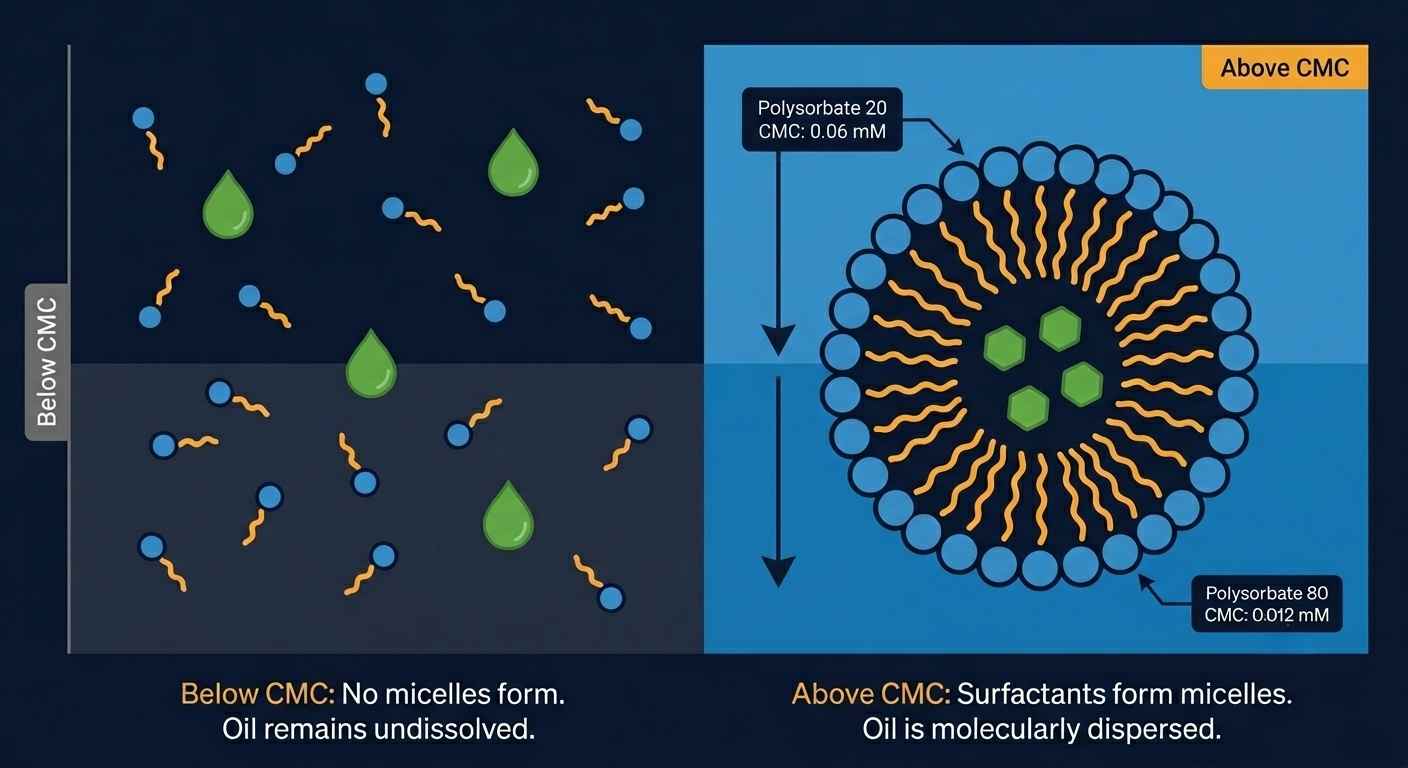
When you dissolve enough polysorbate in water—past a threshold called the Critical Micelle Concentration, or CMC—the molecules self-organize. The fatty tails huddle together in the center, creating an oil-friendly pocket. The water-loving heads face outward. An essential oil molecule slips into that pocket and stays there, dispersed at the molecular level, invisible to the eye.
Below the CMC, nothing happens. The surfactant molecules float around as lone monomers, unable to form micelles. Above the CMC, every extra surfactant molecule adds solubilization capacity. For Polysorbate 20, the CMC is roughly 0.06 mM in water at 25°C—about 0.007% by weight. For Polysorbate 80, it’s lower: roughly 0.012 mM, or 0.0015%. These numbers shift a bit when you add ethanol or propylene glycol, which is common in flavor formulations, but the principle holds: stay above CMC and your oil stays dissolved.
For a deeper understanding of how non-ionic surfactants work at the molecular level — including micelle formation, CMC values, and the full ionic vs nonionic comparison — see our complete guide to non-ionic surfactants.
Polysorbate 20 vs Polysorbate 80: which one for which oil?
We have a detailed side-by-side comparison if you need more: Polysorbate 20 vs. Polysorbate 80: Key Differences and Uses.
The short answer: it depends on the oil. Lighter, more polar oils work better with Polysorbate 20. Heavier, less polar oils prefer Polysorbate 80. Here are the key numbers:
| Property | Polysorbate 20 | Polysorbate 80 |
|---|---|---|
| Chemical name | Polyoxyethylene (20) sorbitan monolaurate | Polyoxyethylene (20) sorbitan monooleate |
| INS number | E432 | E433 |
| CAS number | 9005-64-5 | 9005-65-6 |
| HLB value | 16.9 | 15.0 |
| Fatty acid tail | Lauric acid (C12, saturated) | Oleic acid (C18:1, unsaturated) |
| Appearance | Lemon to amber oily liquid | Amber oily liquid |
Polysorbate 20, with its HLB of 16.9, is the more hydrophilic of the two. Its shorter lauric acid tail creates smaller micelle cores—perfect for lighter molecules like citrus oils (limonene, citral), fruit esters (ethyl butyrate, isoamyl acetate), and menthol-based cooling agents. You’ll typically need less of it to reach clarity.
Polysorbate 80, at HLB 15.0, has a longer unsaturated tail. That means bigger micelle cores with more room for heavy molecules—cinnamon oil, clove oil, vetiver, black pepper oleoresin, ginger extract. If your flavor system has a lot of sesquiterpenes or resinous components, Polysorbate 80 is usually the better choice.
And here’s a trick formulators use all the time: blend the two. Since HLB is additive by weight, you can mix Polysorbate 20 and Polysorbate 80 to hit any intermediate HLB your oil phase needs. A 50/50 blend gives you roughly HLB 16. A 25/75 blend favors the heavier side at about HLB 15.5. This is how you dial in a solubilization system that fits a complex flavor profile perfectly.
Essential oil solubilization data: the numbers that matter
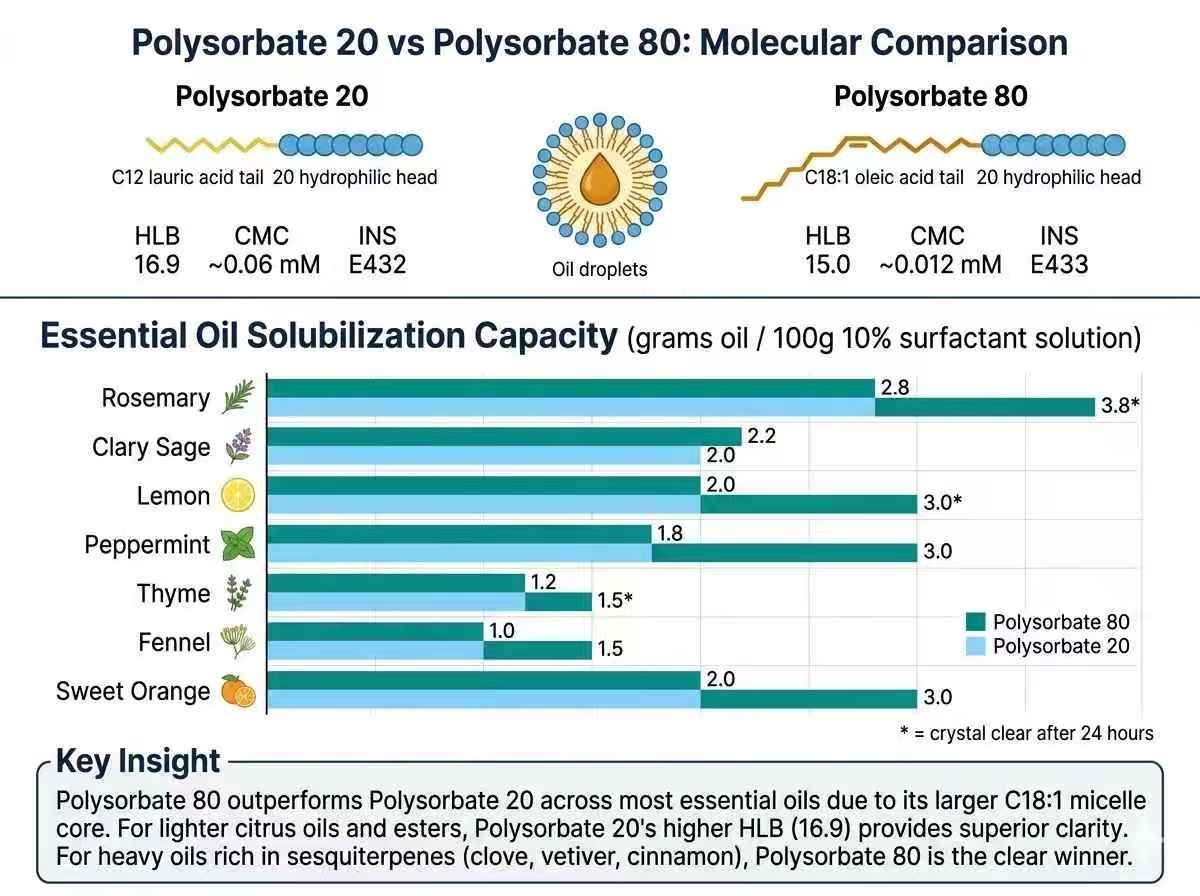
The table below comes from experimentally measured solubilization capacities (for more on usage ratios, see our Polysorbate 20 Usage Guide)—not theoretical estimates. Each number represents grams of essential oil that dissolve completely in 100 grams of a 10% surfactant solution:
| Essential oil | Polysorbate 20 (HLB 16.9) grams oil / 100g 10% solution |
Polysorbate 80 (HLB 15.0) grams oil / 100g 10% solution |
|---|---|---|
| Lemon oil | 2.0 | 3.0* |
| Sweet lemon oil | 2.0 | 3.0 |
| Peppermint oil | 1.8 | 3.0 |
| Clary sage oil | 2.2 | 2.0 |
| Rosemary oil | 2.8 | 3.8* |
| Fennel oil | 1.0 | 1.5 |
| Thyme oil | 1.2 | 1.5* |
A few patterns jump out. Polysorbate 80 beats Polysorbate 20 across almost every oil, sometimes by a factor of two or more—that bigger micelle core really does matter. Rosemary oil, rich in the relatively polar compound 1,8-cineole, shows the highest capacity with both surfactants. Fennel oil, dominated by the less polar trans-anethole, is the hardest to solubilize—you’ll need nearly twice as much surfactant per gram of oil. And those asterisks? They’re the difference between a formulation that looks good at the bench and one that stays clear on a store shelf for six months.
How to calculate the right polysorbate-to-oil ratio
Let’s walk through a real example. Say you’re making a peppermint-flavored beverage at 0.1% oil loading in a 1,000 kg batch. That’s 1.0 kg of peppermint oil.
From the table, Polysorbate 80 solubilizes 3.0 grams of peppermint oil per 10 grams of surfactant (in a 10% solution). That’s a surfactant-to-oil ratio of about 3.3:1—meaning you need roughly 3.3 kg of Polysorbate 80 for your 1.0 kg of oil.
But those numbers came from a lab, not a production line. Temperature fluctuations, mixing efficiency, and batch-to-batch variation in the essential oil all eat into performance. Standard practice is to add a 20–50% safety margin—so you’d actually use 4.0 to 5.0 kg.
Final rule: always run a benchtop trial with your actual production lot of essential oil. Terpene profiles vary between harvests and suppliers, and what works on paper needs to work in your tank.
The mixing sequence that actually works
The order in which you combine ingredients matters more than most people realize. Get the sequence wrong and you’ll fight foam, haze, or incomplete solubilization. Here’s the protocol we recommend:
- Pre-mix the polysorbate with the oil first. Combine your full amount of Polysorbate 20 or 80 with the essential oil. Stir gently at 25–40°C until you get a clear, uniform mixture. This step gets the surfactant tails into direct contact with the oil molecules before water enters the picture.
- Add water slowly, in stages. Keep agitation moderate — high shear whips in air and creates foam. The mixture will turn thick and may look milky. That’s normal. It means you’re forming a liquid crystalline phase, which is exactly what should happen.
- Watch for the inversion point. As you keep adding water, the system flips from a water-in-oil microemulsion to an oil-in-water micellar solution. You’ll see it — the mixture suddenly clears. Keep adding the remaining water.
- Polish, don’t pulverize. Once fully diluted, drop the mixer to low speed and let it turn for 10–15 minutes. Prolonged high-shear at this stage generates heat and can pop your freshly formed micelles.
- Add co-solvents at the end. Ethanol, propylene glycol, glycerin — these go in after dilution. They expand the micelle cores and can boost both capacity and clarity.
Temperature matters too: 30–40°C is the sweet spot for solubilization. Don’t let it climb past 50°C for long, or you risk oxidizing unsaturated oils. And when you cool down, do it gradually. A rapid temperature drop can shock the micelles and create a temporary haze that takes hours to clear.
Flavor emulsions and fragrance solubilization are not the same thing
Same chemistry, different rules. Here’s how the two applications compare:
| Parameter | Flavor emulsions (beverages) | Fragrance solubilization |
|---|---|---|
| Clarity target | Crystal clear (turbidity under 5 NTU) | Clear to slightly hazy is fine |
| Polysorbate loading | 0.05–0.3% of finished beverage | 0.5–3% of finished product |
| Co-solvents | Limited by label restrictions | Ethanol, DPG freely used |
| pH range | 2.5–4.0 (carbonated soft drinks) | 4.5–7.0 (personal care) |
| Shelf life target | 6–12 months | 12–24 months |
| Weighting agents needed? | Often — ester gum, SAIB | Rarely |
| Preferred polysorbate | Polysorbate 80 (handles weighting agents) | Polysorbate 20 (lower viscosity, cold-process friendly) |
The weighting agent point deserves emphasis. In beverages, the oil phase is usually lighter than water — so it rises. Weighting agents like ester gum or sucrose acetate isobutyrate (SAIB) increase the oil phase density to match the water phase. That prevents the dreaded ring at the bottle neck. Polysorbate 80’s larger micelle core can accommodate these bulky hydrophobic molecules. Polysorbate 20’s smaller core struggles with them. If you’re making a beverage emulsion with weighting agents, the choice is clear.
When things go wrong: troubleshooting solubilization problems
| Symptom | What’s probably happening | What to do about it |
|---|---|---|
| Persistent haze | Polysorbate loading below CMC, or surfactant-to-oil ratio too low | Increase polysorbate by 20–50%. Check the polarity of your specific oil batch — it can vary. |
| Oil ring at the surface | Free oil not fully encapsulated. Could be density mismatch. | Bump up the polysorbate. If it’s a beverage, add a weighting agent. Re-check your pre-mix step — oil and polysorbate need to combine before water enters. |
| Starts clear, hazes over days | Ostwald ripening: small micelles dissolve, large ones grow | Push the polysorbate level above the thermodynamic minimum. Add a co-solvent like ethanol or PG to stabilize. |
| Excessive foaming | Too much shear, or air getting pulled in. Polysorbate 20 foams more than Polysorbate 80. | Slow down the mixer. Consider switching partially to Polysorbate 80. A tiny dose of simethicone antifoam helps if your formula allows it. |
| Sudden viscosity spike when adding water | Normal liquid crystalline phase — just means water is going in too fast | Slow your water addition rate. Warming to about 35°C helps it pass faster. |
| Flavor fades over shelf life | Oxidation of unsaturated oil components. Could also be peroxide carryover from old surfactant. | Use a fresh lot of Polysorbate 80 with a low peroxide value. Add an antioxidant to the oil phase — tocopherol or rosemary extract work well. |
Quality standards: what food-grade actually means
Both Polysorbate 20 and Polysorbate 80 are approved food additives in every major market. In the United States, Polysorbate 80 falls under FDA 21 CFR 172.840 (for a complete regulatory overview, see our Polysorbate 80 safety and compliance guide); Polysorbate 20 under 21 CFR 172.515. In the European Union, polysorbates E432 through E436 are authorized under Regulation (EC) 1333/2008, with an EFSA-established ADI of 25 mg per kilogram of body weight per day. The Joint FAO/WHO Expert Committee (JECFA) sets a more conservative ADI of 0–5 mg/kg.
For flavor-grade applications, the Food Chemicals Codex (FCC) is the benchmark. It specifies an acid value no higher than 2.0, water content under 3%, heavy metals below 10 mg/kg, and arsenic below 3 mg/kg.
Three things to check on every Certificate of Analysis: peroxide value, 1,4-dioxane, and residual ethylene oxide. Peroxide value matters especially for Polysorbate 80—the unsaturated oleic acid tail can oxidize over time, and even slight rancidity will interfere with delicate flavor profiles. A peroxide value under 5 meq/kg is what you want for flavor work. 1,4-dioxane and ethylene oxide are process impurities from ethoxylation. Both have regulatory limits and should be confirmed on every lot.
What to look for in a polysorbate supplier
When you’ve spent weeks optimizing a flavor formulation, the last thing you want is a surfactant lot that performs differently from the last one. Batch-to-batch consistency isn’t a nice-to-have—it’s the whole game. Here’s what matters:
- FCC compliance. Non-negotiable minimum. If it doesn’t meet the Food Chemicals Codex monograph, it doesn’t belong in a flavor or fragrance formula.
- HLB stability. The effective HLB shouldn’t drift more than half a point between lots. Even a one-point shift changes solubilization performance measurably.
- Low peroxide value. Under 5 meq/kg for Polysorbate 80 destined for flavor applications. Higher than that and you’re introducing off-notes you can’t mask.
- Traceable documentation. COA, SDS, and technical data sheet for every lot. No exceptions.
- Supply chain visibility. You should know the ethoxylation source and the fatty acid origin — palm, coconut, or tallow-based — because it affects both performance and regulatory compliance in certain markets.
Foodemul supplies Polysorbate 20 and Polysorbate 80 in bulk quantities to FCC specifications, with lot-level documentation and consistent HLB values. If you have a target oil profile and an application in mind, browse our Polysorbate 80 product page or Polysorbate 20 specifications—we’ll help you pick the right grade and ratio for your formula.
