

Polysorbate 80 is the most versatile emulsifier in the food-grade Polysorbate family. HLB 15.0, oleic acid backbone, liquid at room temperature — it handles ice cream, beverages, sauces, and flavor emulsions with the same molecule. At FoodEmul, it is our highest-volume Polysorbate for a reason: it just works across more applications than any other single emulsifier. This guide covers the full picture: chemistry, specifications, applications, and formulation data.
Core Functions — Why Two Industries Use the Same Molecule
Polysorbate 80 does three things in any formulation:
| Function | Mechanism | Why It Matters |
|---|---|---|
| Emulsification | Positions at the oil-water interface, lowers interfacial tension, forms a steric barrier around droplets | Prevents phase separation during shelf life |
| Solubilization | Forms micelles that encapsulate hydrophobic compounds inside, with hydrophilic exterfaces facing the aqueous phase | Gets oil-soluble actives (vitamins, flavors, fragrance oils) into water-based systems |
| Wetting & dispersion | Reduces surface tension to improve spreading and particle de-agglomeration | Uniform distribution of pigments, powders, and poorly soluble ingredients |
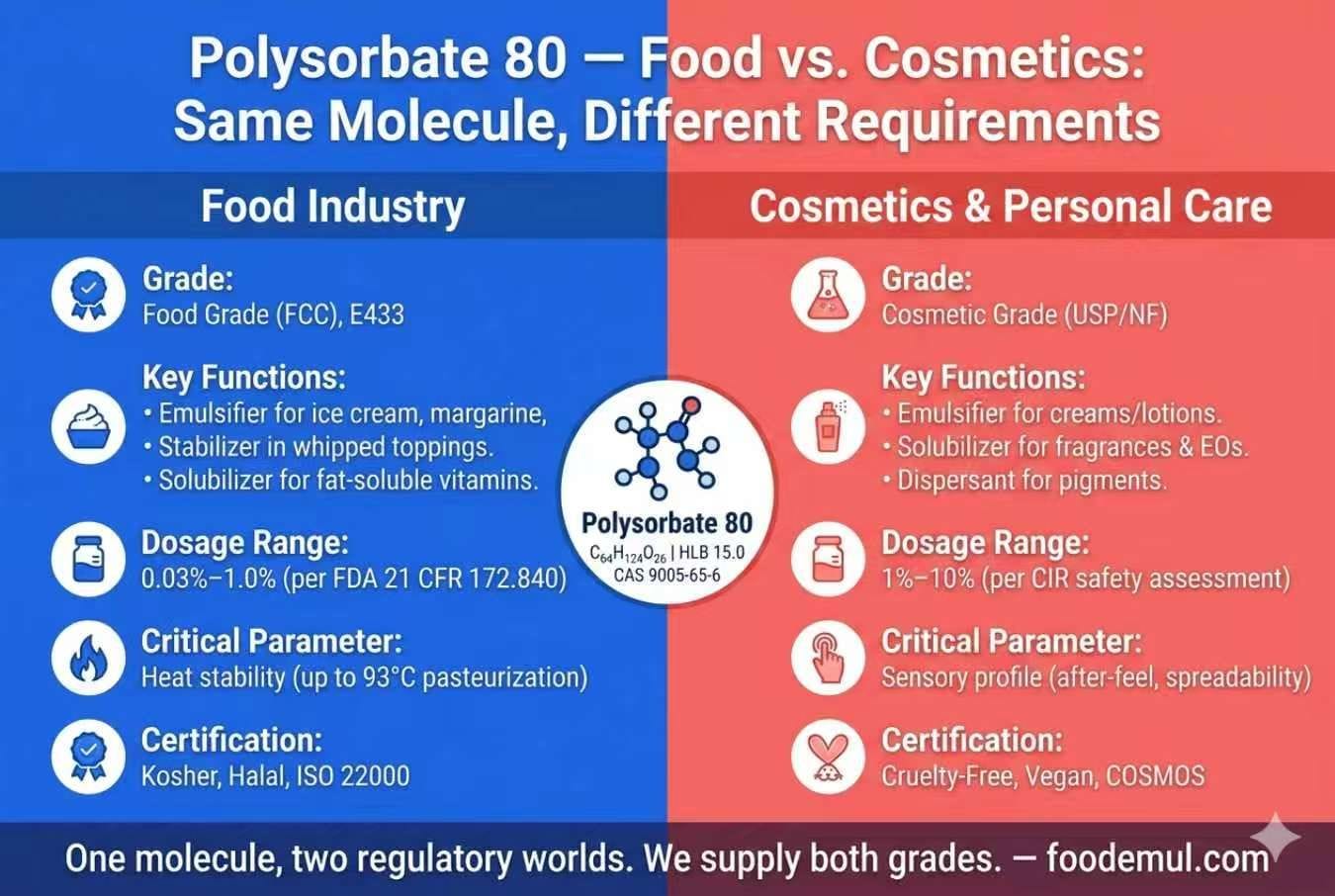
These three mechanisms are universal. What changes is which one matters most, which grade is required, and what happens if it fails.
Food Industry — Texture, Stability, and Compliance
In food manufacturing, Polysorbate 80 (E433) is primarily about consumer-perceptible quality: melt-down rate, creaminess, and visual uniformity. The key failure modes are phase separation (dressings), ice crystal growth (frozen desserts), and flavor oil stratification (pickles, sauces).
| Food Application | Primary Function | Typical Challenge Without Polysorbate 80 |
|---|---|---|
| Ice cream & frozen desserts | Emulsifier, fat destabilizer | Rapid melting, coarse ice crystals |
| Whipped toppings | Foam stabilizer | Structural collapse during storage |
| Sauces & dressings | Emulsifier | Oil-water separation on shelf |
| Pickles & brined products | Solubilizer for spice oils | Uneven flavor distribution |
| Chocolate & cocoa drinks | Dispersant for cocoa butter | Sedimentation, gritty mouthfeel |
| Baked goods | Dough conditioner | Reduced volume, faster staling |
| Chewing gum | Plasticizer | Texture hardening, flavor loss |
For product-by-product FDA limits (21 CFR 172.840), permitted concentrations, and exact dosage guidance, see the B2B Applications & Regulatory Guide — which covers all 14 regulated food categories with ppm/percentage limits.
Food-grade Polysorbate 80 must meet FCC/USP specifications with acid value ≤ 2.0 mg KOH/g and peroxide value ≤ 5 meq/kg. The oleic acid component is susceptible to oxidation — rancidity in the emulsifier translates directly to off-flavors in the finished product.
Cosmetics & Personal Care — Sensory Properties and Formulation Flexibility
Cosmetic applications prioritize sensory experience: how a product feels during application, how it spreads, and whether it leaves a residue. Polysorbate 80 serves both functional and aesthetic roles here.
| Product Type | Polysorbate 80 Role | Consumer-Perceptible Effect |
|---|---|---|
| Facial cleansers & makeup removers | Solubilizer, surfactant | Lifts oil and waterproof makeup without heavy rubbing |
| Creams & lotions (O/W) | Emulsifier | Smooth, non-greasy application; better spreadability |
| Serums | Solubilizer for active ingredients | Clear, uniform appearance; even active distribution |
| Shampoos & conditioners | Surfactant, dispersant | Even distribution of conditioning agents |
| Body washes | Surfactant, viscosity modifier | Rich lather, stable foam |
| Perfumes & body sprays | Solubilizer for fragrance oils | Clear, non-cloudy solution at low temperatures |
Solubilizing Fragrance Oils
One of the most common cosmetic uses is solubilizing fragrance and essential oils into water-based products. Without Polysorbate 80 (or a similar solubilizer), fragrance oils would float as a separate phase or create a cloudy haze. The typical ratio is 3:1 to 5:1 (Polysorbate 80 to oil), though this varies with the oil’s polarity. Testing at the intended storage temperature is essential — a formula that’s clear at 25°C can cloud at 5°C if the solubilization is marginal.
Cosmetic Grade Requirements
Cosmetic-grade Polysorbate 80 must meet standards for skin-contact safety. Key concerns: residual ethylene oxide and 1,4-dioxane levels, which are regulated in most jurisdictions. EU cosmetics regulation (EC 1223/2009) requires that 1,4-dioxane be “technically unavoidable” at trace levels only.
Grade Selection — Matching Purity to Purpose
Choosing the wrong grade is the most common preventable problem in Polysorbate 80 sourcing:
| Grade | Typical Standard | Use | Do NOT Use For |
|---|---|---|---|
| Food Grade | FCC, USP | Food, dietary supplements | — |
| Cosmetic Grade | Industry standard, EU Cosmetics Reg. | Skincare, haircare, makeup | Food, any ingestible product |
| Industrial Grade | No pharmacopeia standard | Paints, cleaners, agrochemicals | Any human or animal consumption |
Always verify the Certificate of Analysis (COA) against your product’s requirements. Key parameters to check: acid value, peroxide value, water content, and residual solvents (1,4-dioxane, ethylene oxide).
Safety Snapshot
Polysorbate 80 is approved by the FDA (21 CFR 172.840), EFSA (E433), and JECFA, with an ADI of 0–25 mg/kg body weight. It is metabolized by lipases into sorbitol and oleic acid — both normal dietary components.
Agricultural & Industrial Use: Beyond food and cosmetics, polysorbate 80 serves as an emulsifier in pesticide formulations, helping disperse active ingredients evenly in spray solutions. See Technical Manufacturing Guide.
For consumer-facing safety topics (including the gut health question, vegan/kosher/halal/gluten-free status, and ingredient label identification), see our Complete Consumer Guide to Polysorbate 80.
Contact FoodEmul.com for food-grade or cosmetic-grade Polysorbate 80 (E433 / Polysorbate 80), including Certificate of Analysis and Technical Data Sheet.
Need Polysorbate 80? We manufacture it alongside Span 60 and the full sorbitan ester range — reach out for specifications or to request a sample.
