

A supplier sends three PDFs for a food emulsifier: a Technical Data Sheet, a Certificate of Analysis, and a Safety Data Sheet. The product name appears on all three, and several technical values may look similar. That does not make the documents interchangeable.
After two decades of working with chemical export documents, I have seen reviews go wrong when one file is asked to do the work of all three. A typical value on a TDS gets treated as a batch result. An SDS saying “not classified as hazardous” gets treated as proof of food-grade status. A COA with a final “Pass” is accepted without checking the lot number or individual results.
Each document answers a different question:
- TDS: What product or grade is the supplier offering?
- COA: What results were reported for this batch?
- SDS: What hazards and handling measures apply to this product?
Procurement and quality teams need all three, together with the approved specification and applicable regulatory evidence, to make a sound purchasing or release decision.
Quick rule: Use the TDS to understand the grade, the COA to review the batch, and the SDS to manage workplace safety. Do not use one as a substitute for another.
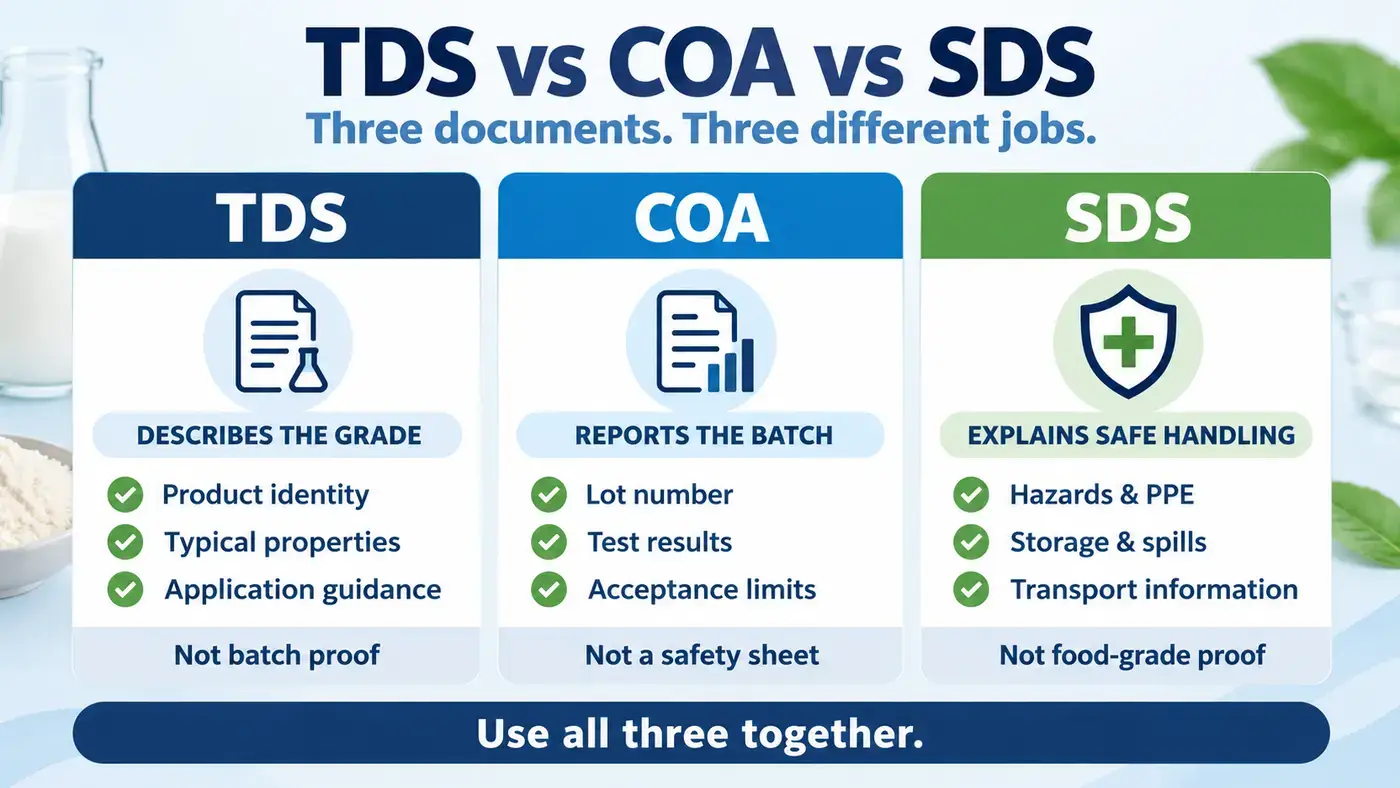
TDS vs COA vs SDS at a Glance
| Document | Primary job | Usual scope | Strongest evidence it provides | What it does not prove by itself |
|---|---|---|---|---|
| Technical Data Sheet (TDS) | Describes a product or commercial grade | Product- or grade-level | Identity, intended function, typical properties, specification information, application and storage guidance | Actual quality of a particular production lot |
| Certificate of Analysis (COA) | Reports test information for a stated batch or sample | Batch-, lot-, or sample-specific | Batch identity, reported tests, acceptance limits, actual results, methods and release decision | Complete safety, universal regulatory acceptance, or absence of every untested impurity |
| Safety Data Sheet (SDS) | Communicates hazards and safe handling information | Substance, mixture or product-level | Hazard classification, first aid, firefighting, handling, storage, exposure controls, disposal and transport information | Food-grade status, batch conformity or suitability for a particular formulation |
The word “usual” matters. TDS and COA formats are not identical across manufacturers, products or markets. A reviewer should judge the contents and scope of the document, not rely on the file name alone.
What a Food Emulsifier TDS Can Prove
A Technical Data Sheet describes the product the supplier intends to sell. It is normally the first document a formulator or buyer reads when comparing grades.
For a polysorbate or sorbitan fatty acid ester, a useful TDS may include:
- the standardized chemical name and commercial grade;
- a CAS number, INS number or E-number where applicable;
- appearance and physical form;
- functional description and suggested applications;
- typical or specified values such as acid value, saponification value, hydroxyl value, water content or HLB;
- solubility or dispersibility information;
- recommended storage conditions and shelf life;
- packaging information; and
- a revision date or document version.
This information helps answer practical questions. Is the material a liquid, paste, waxy solid or powder under the stated conditions? Is the grade intended for oil-in-water emulsification, dispersion or another function? Does the supplier’s standard range appear compatible with the buyer’s approved specification?
Typical Values and Specification Limits Are Different
A TDS may mix descriptive data, typical values and guaranteed limits. They should not be read as the same thing.
- A typical value describes a representative result or general product characteristic. It is not automatically a release limit for every batch.
- A specification limit defines an acceptance requirement, such as a maximum, minimum or range.
- A test result is the value reported for a stated sample or batch.
For example, a TDS might show a typical water content of 1.0%, while the approved specification sets a maximum of 3.0%. The batch COA should report the actual result used for release. Copying the 1.0% typical value into a COA would not demonstrate that the batch was tested.
What a TDS Cannot Establish
A TDS does not normally identify the production lot being shipped. It therefore cannot show that a current batch was tested or met the agreed limits. It also cannot establish that a product is legally permitted for every food application and destination market.
Treat broad wording such as “international standard,” “food grade” or “complies with major regulations” as a prompt for more specific evidence. Ask which standard, which revision, which product grade, which manufacturer and which market the statement covers.
What a Food Emulsifier COA Can Prove
A Certificate of Analysis should connect analytical information to a stated lot, batch or sample. It is the central document for pre-shipment review and incoming batch release.
A useful COA normally identifies:
- the manufacturer, laboratory or issuing entity;
- the exact product and grade;
- the batch or lot number;
- production, inspection or issue dates;
- the applicable specification or standard;
- each reported test and its unit;
- the acceptance limit or range;
- the actual numerical or qualitative result;
- the test method, where stated; and
- the reviewer, approver or release conclusion.
The COA can therefore show that the issuer reported a specific result against a specific limit for a specific batch. That is much stronger batch evidence than a product-level TDS.
It is still evidence that must be reviewed. The U.S. FDA’s Foreign Supplier Verification Programs guidance explains that supplier testing and a COA may support verification, while also stressing representative sampling, scientifically valid methods and suitable method sensitivity. The receiving company remains responsible for deciding whether the evidence is appropriate for its product, hazard and supply chain.
What a COA Cannot Establish
A COA covers the stated sample and reported tests. It does not prove that:
- every possible contaminant or process impurity was tested;
- every package in the shipment is identical;
- the product is approved for every food category or country;
- the supplier holds every certificate mentioned in its marketing material;
- the emulsifier will perform correctly in the buyer’s formulation; or
- the document is authentic merely because it carries a stamp or signature.
The final word “Pass” cannot override the rows above it. Review every actual result against the applicable limit, check the unit and method, and confirm that the COA belongs to the physical lot being purchased.
For a field-by-field review, use our Food Emulsifier COA Checklist: 12 Fields to Verify Before Approving a Batch.
What a Food Emulsifier SDS Can Prove
A Safety Data Sheet is a hazard-communication document. It helps workers, warehouse teams, emergency responders and downstream users handle a chemical product safely.
An SDS generally covers:
- identification;
- hazard identification;
- composition or information on ingredients;
- first-aid measures;
- firefighting measures;
- accidental release measures;
- handling and storage;
- exposure controls and personal protection;
- physical and chemical properties;
- stability and reactivity;
- toxicological information;
- ecological information;
- disposal considerations;
- transport information;
- regulatory information; and
- other information, including the preparation or revision date.
The exact legal requirements depend on the market. In the United States, for example, OSHA Appendix D specifies the SDS section headings and minimum information. Other jurisdictions apply their own hazard-communication rules.
For a food emulsifier, the SDS can help a buyer check the product identifier, physical form, recommended storage, incompatible materials, spill response, personal protective equipment and transport classification. It should match the chemical identity and grade being offered.
“Not Hazardous” Does Not Mean “Approved for Food Use”
Hazard classification and food authorization answer different questions. A substance that is not classified as hazardous for workplace communication does not become food grade on that basis. Food suitability depends on chemical identity, manufacturing controls, applicable compositional requirements, permitted uses, destination-market rules and supporting documentation.
The reverse distinction also matters. A substance used in food may still need an SDS for occupational handling, especially when workers manage bulk quantities, heated material, spills or dust. Food use does not remove workplace risk-management duties.
SDS and MSDS
Many older supplier files still use “MSDS,” meaning Material Safety Data Sheet. Current harmonized systems generally use “SDS” and a standardized 16-section structure. An older MSDS should not be rejected because of its title alone, but its issue date, format, product identity and current regulatory suitability need review.
How the Three Documents Should Agree
Put the TDS, COA and SDS side by side. They do not need to repeat the same information, but the shared facts should tell one consistent product story.
| Checkpoint | TDS | COA | SDS | Review question |
|---|---|---|---|---|
| Product identity and grade | ✓ | ✓ | ✓ | Do all three refer to the same chemical identity and commercial grade? |
| Manufacturer or responsible entity | ✓ | ✓ | ✓ | Are the manufacturing, testing, exporting and SDS-responsible entities clear? |
| Physical appearance | ✓ | ✓ | ✓ | Are descriptions reasonably consistent at the stated temperature? |
| Specification limits | ✓ | ✓ | Sometimes | Does the COA use the correct approved limits rather than copying typical values? |
| Actual batch results | No | ✓ | No | Are real results reported for the lot being purchased? |
| Hazards and safe handling | Limited | No | ✓ | Does the SDS cover the product and current handling conditions? |
| Storage information | ✓ | Sometimes | ✓ | Are temperature, moisture and container instructions compatible? |
| Revision or issue date | ✓ | ✓ | ✓ | Are the documents current enough for the intended decision? |
A difference does not always mean the product is wrong. Physical form can change with temperature, and legal entity names can differ when a manufacturer works through an exporter. The difference still needs a documented explanation before approval.
Which Document Should You Use at Each Buying Stage?
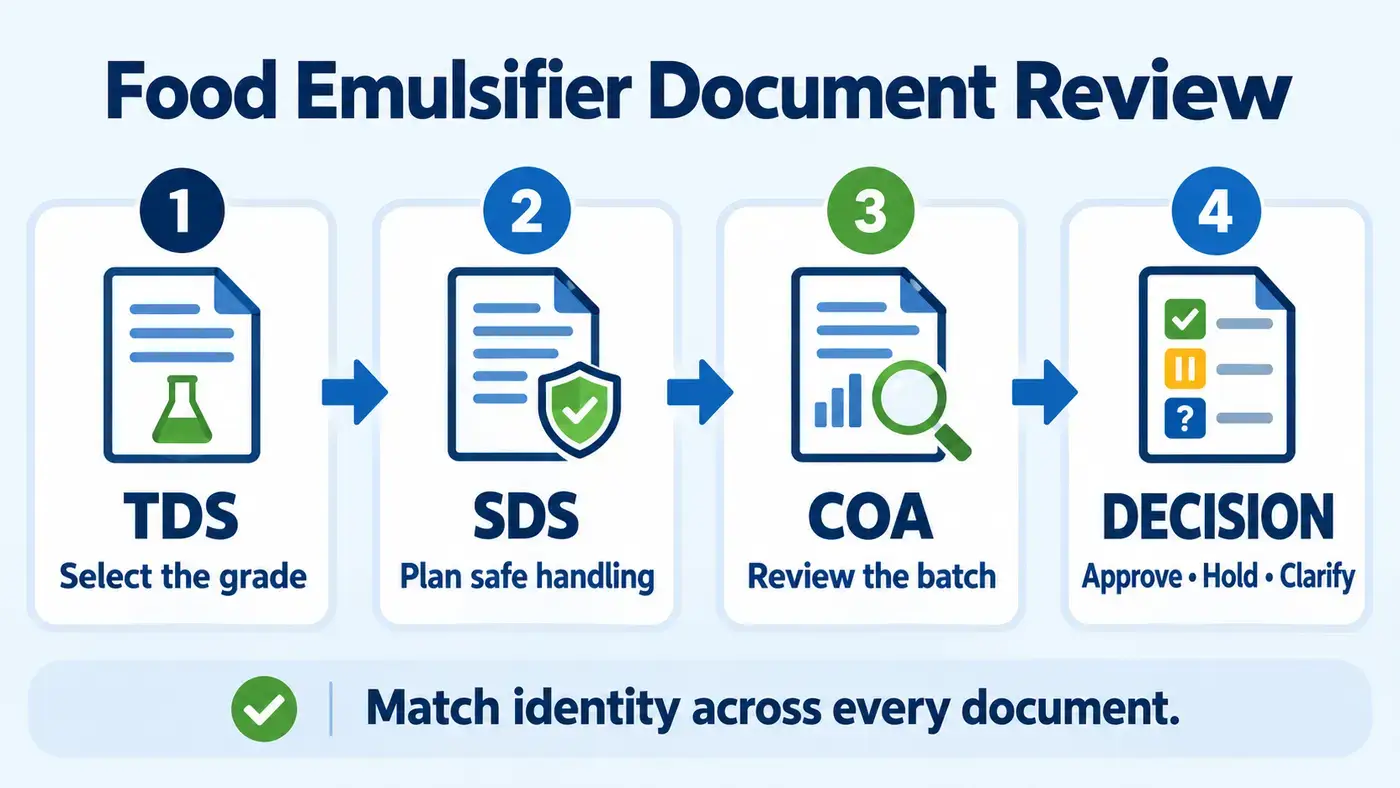
1. Product and Grade Selection
Start with the TDS. Compare the standardized chemical identity, physical form, functional characteristics and stated specification with the formulation requirement. Ask for an application discussion or sample when performance must be confirmed.
2. Supplier Qualification
Review all three documents, then add the approved specification, relevant food-safety or quality certificates, manufacturing information and traceability evidence. Confirm which entity manufactures the product, which entity issues the documents and which entity will appear on the quotation and export paperwork.
3. Sample Review
Request a sample COA tied to the sample lot. Check whether the TDS, label and COA identify the same grade. Use the SDS to plan handling and storage during trials.
4. Pre-Shipment Approval
Request the COA for the actual commercial batch when available. Compare it with the purchase specification and contract requirements. Confirm the batch number, production date, package labels and shipment quantity before release.
5. Incoming Inspection
Match the received labels and lot numbers to the approved COA and packing list. Inspect packaging condition and retain the documents under the buyer’s traceability procedure. If a critical result, identity or date is inconsistent, hold the material under the buyer’s nonconformance process.
Seven Document Mistakes That Delay Approval
1. Treating a Typical TDS Value as a Guaranteed Batch Result
Ask whether each value is typical, specified or tested. The labels matter.
2. Using an SDS as Proof of Food-Grade Status
An SDS supports hazard communication. Request the applicable food specification and regulatory or certification evidence separately.
3. Using an Old Sample COA for a New Shipment
A historical COA can show the supplier’s usual format and test panel. It cannot approve a future production lot.
4. Accepting a COA That Reports Only “Pass”
Where numerical testing is expected, request the actual result, unit, acceptance limit and method. A conclusion without supporting data is difficult to evaluate.
5. Ignoring Different Product Names or Grades
A family name may cover several fatty acid compositions, degrees of ethoxylation or intended grades. Confirm the standardized chemical identity and the exact commercial code.
6. Overlooking Document Dates and Revisions
A current COA does not correct an obsolete SDS, and a recently revised TDS does not validate an old batch report. Review each document on its own timeline.
7. Assuming One Country’s Specification Equals Another
Chinese national food-safety standards, FCC monographs, JECFA specifications, European Union specifications and customer requirements may share parameters without being legally interchangeable. Record the exact standard and revision used for the purchase and release decision.
A Practical Document Request Checklist
Before approving a new food emulsifier source, request:
- the current TDS for the exact product and grade;
- the current SDS matching the same chemical identity;
- a representative COA for initial supplier review;
- the batch-specific COA for the sample or commercial lot;
- the supplier’s or buyer’s approved product specification;
- the applicable national, compendial or customer standard;
- required certificates with holder, site, product scope and validity dates;
- package label and traceability information; and
- clarification of the manufacturer, laboratory, document issuer, exporter and contracting entity.
Keep the approved set together. A later reviewer should be able to reconstruct why the product, supplier and batch were accepted.
Frequently Asked Questions
Is a TDS the same as a product specification?
Not necessarily. A TDS may contain specification limits, but it can also include typical values, descriptive information and application guidance. Ask the supplier to identify which values are guaranteed release requirements and obtain the approved specification when it is a separate document.
Can a TDS replace a COA?
No. A TDS normally describes a product or grade. A COA reports information for a stated batch, lot or sample. Use the TDS to select the grade and the COA to review the batch.
Can an SDS prove that a food emulsifier is food grade?
No. An SDS communicates hazards and handling measures. Food-grade suitability requires product-specific compositional, manufacturing and regulatory evidence for the intended market and use.
Why do the TDS and COA sometimes show different values?
The TDS may show a typical value or an allowed specification range, while the COA shows the actual reported result for one batch. The values can differ and still be consistent if the batch result meets the applicable limit.
Does every shipment need a new COA?
Commercial practice and buyer requirements vary, but batch approval should rely on evidence tied to the lot being supplied. If several batches are shipped, determine whether each requires its own COA or clear multi-lot documentation.
What should I do when the documents conflict?
Place the material or approval decision on hold. Record the exact inconsistency and ask the responsible issuer for a corrected document or written technical explanation. Do not resolve identity, batch or specification conflicts by assumption.
Build One Consistent Evidence Set
The TDS, COA and SDS serve different readers and different decisions. Used together, they help procurement identify the right grade, QA review the current batch, and operations handle the material safely.
Before accepting a food emulsifier, confirm that the TDS, batch COA, SDS, approved specification, package label and purchasing documents describe the same product and supply chain. When a field is unclear, ask for the missing evidence before quotation approval, sampling or shipment.
For a FoodEmul document review, send the standardized product name, grade, intended application, destination market, required specification and expected quantity. We can help identify which technical, batch, safety and certification documents should be requested from the manufacturing source.
