

The quotation names one company. The Certificate of Analysis names another. A food-safety or product certificate may belong to a third entity, while the commercial invoice and bank beneficiary identify a fourth.
That structure can be legitimate in international trade. The buyer still needs to connect the offered product to its manufacturer, manufacturing site, testing laboratory, and certificate holder. The same record should identify the seller, exporter, and payment recipient. A complete set of PDFs does not close the review when those roles do not tell one consistent story.
After two decades in chemical export, I treat supplier qualification as a product-and-site decision. A company may be suitable for one food emulsifier grade, one manufacturing location, and one destination specification while another item in its catalogue still needs separate review.
This guide gives procurement, QA, regulatory, and supply-chain teams a practical method for qualifying a food emulsifier supplier before sample approval, contract placement, or commercial shipment.
Quick qualification rule: Identify the manufacturer, production site, testing and release functions, certificate holders, seller, and exporter. Then connect every document and package label to that role map.
Supplier Approval Must Be Product, Site, and Market Specific
The phrase “approved supplier” can hide several different approvals. A buyer may approve:
- a legal seller for commercial transactions;
- a manufacturing company and named production site;
- one food emulsifier and grade;
- a specification for a particular destination market;
- a packaging and labeling configuration;
- a testing and release programme; and
- an exporter or distributor that manages the order.
These decisions overlap, but they are not identical. A quality-system certificate for one site does not automatically cover another factory. A representative COA for polyoxyethylene (20) sorbitan monooleate does not qualify sorbitan monostearate. A seller approved for commercial coordination may still need to disclose and document the manufacturing source.
For U.S. importers covered by the Foreign Supplier Verification Programs rule, the FDA’s FSVP guidance describes a documented, risk-based supplier approval process. It covers the food, the entity controlling identified hazards, supplier performance, verification activities, and written procedures. Other markets and company systems use different legal or contractual frameworks. The practical principle is similar: define what is being approved and retain the evidence supporting that decision.
Map the Supply Chain Before Reviewing Certificates
Start with names and roles. Ask the supplier to complete a role map for the offered product.
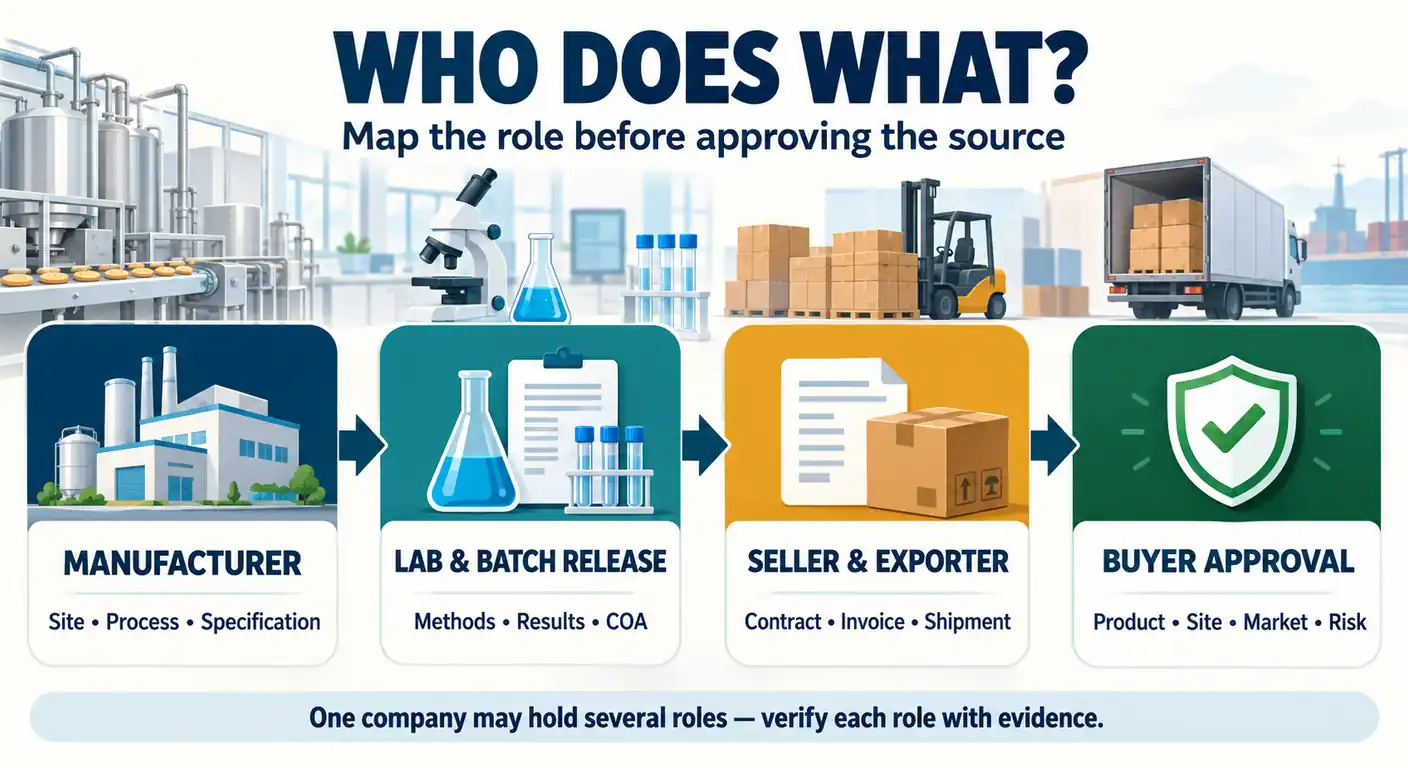
| Role | What the buyer needs to identify | Evidence to request |
|---|---|---|
| Manufacturer | Legal entity responsible for production | Company registration, controlled manufacturer statement, TDS, product specification |
| Manufacturing site | Physical address where the offered grade is made | Site address, audit or certification scope, site-specific statement |
| Testing laboratory | Entity that performs or reports release tests | COA issuer, laboratory name, test-method references, third-party report where required |
| Batch releaser | Quality function authorising the lot for sale | Approved COA, release signature or controlled electronic approval |
| Certificate holder | Entity and site named on Halal, Kosher, food-safety, or other certificates | Complete current certificate, scope, annexes, validity dates |
| Sales supplier or distributor | Company handling the inquiry, quotation, and order | Quotation, distribution or supply relationship statement, authorised contact details |
| Exporter | Entity shown on export and shipping documents | Commercial invoice, packing list, export documentation, contract terms |
| Legal seller and payment recipient | Contracting party and bank beneficiary | Sales contract, pro forma invoice, verified bank details and company identity |
One company may perform several roles. Record that explicitly. When several companies are involved, obtain enough evidence to connect them.
For example, an exporter may issue the quotation while the manufacturer issues the TDS and COA. The product certificate may name the manufacturing site. The sales contract should then identify the seller and offered product clearly, while the supplier-approval file records the manufacturer-exporter relationship. The buyer should not have to infer that chain from similar logos or email signatures.
1. Define the Approval Basis Before Collecting Documents
Supplier qualification begins with the buyer’s requirement, not with the supplier’s brochure.
Record:
- standardized chemical name;
- INS or E-number where applicable;
- required food grade and physical form;
- intended food application and function;
- destination country or market;
- applicable regulatory, compendial, or customer specification;
- additional impurity, microbiological, allergen, origin, or process requirements;
- packaging and labeling needs;
- expected trial and commercial quantity; and
- mandatory certificates and minimum validity requirements.
“Food-grade emulsifier” is too broad for qualification. Polyoxyethylene (20) sorbitan monooleate, INS 433 / E433, and sorbitan monostearate, INS 491 / E491, have different identities, specifications, production routes, and test panels.
The Food Emulsifier RFQ Checklist provides a structured way to define the product, documents, packing, quantity, and destination before requesting a firm offer.
2. Verify the Legal Entities and Their Authority
Confirm that each company exists under the name and address shown in the transaction. Depending on the country and the buyer’s risk policy, checks may include:
- official company registration;
- registered address and business scope;
- corporate website and domain-based email;
- tax, export, or food-business registration where relevant;
- authorised contact person;
- bank beneficiary name and account details; and
- written explanation for any third-party seller, exporter, or payment arrangement.
A bank account in an unrelated name, an invoice from an unexplained company, or a sudden change in payment instructions needs independent verification through a known contact channel. Commercial verification does not replace product qualification, but both must be complete before payment.
If the sales supplier is not the manufacturer, ask what it controls. Relevant questions include:
- Can it obtain current documents from the manufacturing site?
- Can it arrange samples from the same source proposed for commercial supply?
- Will the manufacturer remain fixed after approval?
- Who handles deviations, complaints, corrective actions, and recalls?
- Who can authenticate the COA and certificates?
- Will the manufacturer and batch appear on labels and shipment records?
The answers should fit the buyer’s supplier policy. Some buyers approve distributors. Others require direct site approval. The policy decides what is acceptable; the supplier evidence shows whether the requirement is met.
3. Confirm the Manufacturing Site and Product Capability
A factory photograph or company presentation shows very little by itself. The qualification file should connect the named site to the offered emulsifier and grade.
Request information proportionate to the risk and order stage, such as:
- site name and full address;
- product families made at that location;
- production process summary;
- relevant production lines and separation controls;
- raw-material approval and traceability controls;
- in-process and finished-product testing capability;
- change-control procedure;
- nonconformance and corrective-action process;
- complaint and recall contacts; and
- available audit or assessment reports.
An on-site audit is not automatically required for every initial inquiry. The buyer should determine the verification activity from the product risk, intended use, regulatory obligations, supplier history, order value, and evidence already available. Document review, remote assessment, sample testing, third-party audit, and on-site audit are different tools. They should be selected for a stated reason.
Production capacity, plant area, number of lines, and annual output belong in the approval file only when the supplier can document them. Capacity claims should also be distinguished from the capacity available to the buyer during the required shipment window.
4. Read Each Document for the Question It Can Answer
Supplier qualification often fails because a valid document is used for the wrong decision.
| Evidence | What it can support | What it does not establish by itself |
|---|---|---|
| Company registration | Legal identity and registered business information | Manufacturing capability or food-grade product conformity |
| Site or quality-system certificate | A certified management or food-safety system within the stated scope and validity | Compliance of every product or batch with the buyer’s specification |
| Technical Data Sheet | Offered product identity, grade, typical properties, specification information, application and storage guidance | Actual results for the lot being shipped |
| Representative COA | Typical document format, reported test panel, limits, and example results | Quality or release status of a future commercial batch |
| Batch-specific COA | Reported tests and release decision for the identified lot | Untested characteristics or automatic compliance with every destination market |
| Safety Data Sheet | Hazard communication, handling, storage, exposure, spill, and transport information | Food-grade status, batch conformity, or authorization for a food use |
| Product certificate | Certification status for the stated holder, site, products, and validity period | Coverage outside the certificate scope or after expiry |
| Third-party laboratory report | Results for the identified sample and methods stated in the report | Routine control of every production lot unless the programme says so |
| Package label and packing list | Product, batch, quantity, package count, and shipment link | Laboratory results or full regulatory suitability |
| Quotation and contract | Commercial identity, product, quantity, packing, price, Incoterm, and agreed obligations | Technical conformity unless the specification and evidence are incorporated clearly |
The guide TDS vs COA vs SDS explains how the three core technical documents work together. Review the revision date, issuer, product identity, grade, site, standard, and language across the complete set. A product code that changes between files needs an explanation.
5. Compare the Specification Before Comparing Prices
Two offers with the same common product name may follow different release specifications. Put the buyer requirement and supplier specification side by side.
Check:
- parameter name;
- acceptance limit or range;
- unit and reporting basis;
- test method;
- testing frequency;
- whether the result appears on each batch COA;
- whether periodic or third-party tests are used; and
- how changes to the specification are controlled and communicated.
Chinese national standards, FCC monographs, JECFA specifications, European Union specifications, and customer specifications are separate sources. Similar parameter names do not establish automatic equivalence. The supplier should identify the release basis used for the offered grade and state any difference from the buyer’s requirement.
If a required test is absent from the normal COA, clarify whether it can be added to the release panel, provided periodically, or commissioned from an external laboratory. Record the cost, timing, method, and acceptance rule before the order.
6. Review More Than One Batch When Consistency Matters
A representative COA is useful during early qualification. It shows how the supplier identifies the product, reports limits, presents results, and authorises release. It does not show the variation between production lots.
Where the risk and purchase stage justify it, compare two or more recent COAs from the same product, grade, and manufacturing site. Look for:
- stable product and specification codes;
- sequential and credible batch identifiers;
- dates that follow a sensible order;
- the same required test panel;
- actual results rather than copied conformity statements;
- units and methods that remain consistent;
- variation that is technically plausible; and
- controlled changes to the template or specification.
Identical values across several COAs are not proof of fabrication. They may result from rounding, reporting conventions, or stable production. Ask for the reporting precision and method when the pattern matters to approval.
Use the Food Emulsifier COA Checklist for the detailed review of identity, lot, dates, specification, results, units, methods, and authorisation.
7. Run a Batch Traceability Challenge
Traceability should work in both directions. Choose a realistic lot and ask the supplier to show how the records connect.
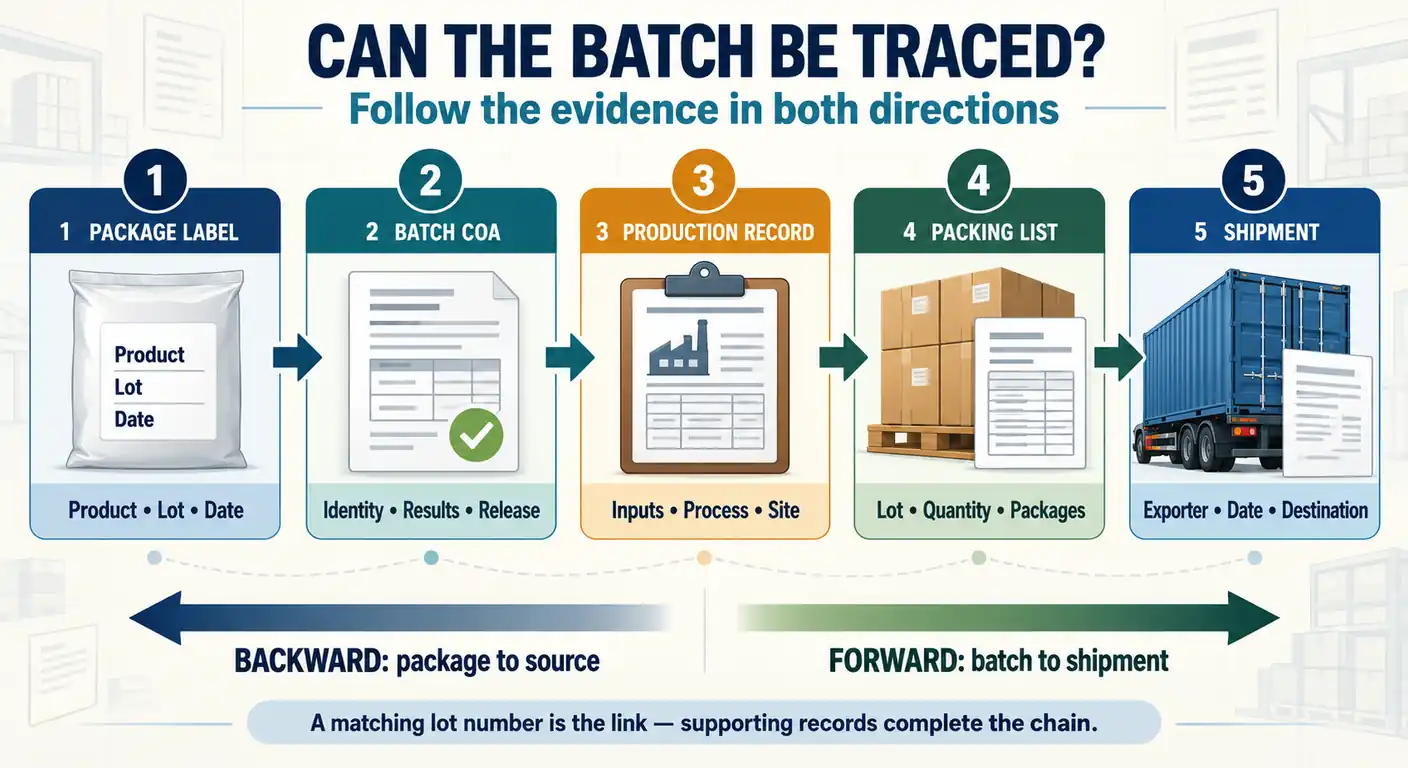
Trace backward from a package
Start with one drum, pail, carton, or bag label. The supplier should be able to connect it to:
- the finished-product batch or lot;
- the batch-specific COA and release record;
- the production date and manufacturing site;
- the relevant production and inspection records;
- the packing record and package count;
- the shipment, packing list, and customer order; and
- the retained sample or complaint record, where applicable.
The depth of raw-material traceability available to the buyer depends on the audit scope and confidentiality controls. The manufacturer should still maintain its own link from finished batch to the relevant incoming materials and process records.
Trace forward from a batch
Select a finished batch number and ask which packages and shipments received material from it. This checks whether the supplier can identify affected customers and quantities if a withdrawal, complaint, or investigation becomes necessary.
For the European Union, Article 18 of Regulation (EC) No 178/2002 requires traceability at all stages of production, processing, and distribution. Food businesses need systems that identify suppliers and the businesses supplied. A buyer’s internal programme may require more detailed lot and package records than this general legal framework.
Compare five identifiers
The following records should agree:
| Record | Identifier to compare |
|---|---|
| Package label | Product, grade, batch, production date, net weight |
| COA | Product, grade, batch, dates, specification |
| Packing list | Product, batch, package count, net and gross weight |
| Commercial invoice | Product description, quantity, seller, buyer |
| Purchase order or contract | Approved product, manufacturer or source, specification, packing, quantity |
A traceability test is stronger than asking whether the supplier “has traceability.” It produces a record that can be checked.
8. Check Certificate Holder, Site, Scope, and Expiry
Read certificates from the first page through every annex. Record:
- certificate issuer;
- certificate number;
- legal holder;
- manufacturing site or sites;
- product names or product categories;
- applicable standard or scheme;
- issue, expiry, and surveillance dates;
- exclusions or conditions; and
- verification channel with the issuer where available.
A certificate title is not enough. A food-safety certificate may cover a manufacturing system but omit the offered product. A Halal or Kosher certificate may list a product family, a site, or specific trade names. A general company certificate may belong to a different location.
When the supplier translates a certificate or product list, retain the original and identify who prepared the translation. Resolve spelling differences and product-code differences before approval.
9. Use a Sample to Verify the Proposed Supply Chain
The qualification sample should represent the product and manufacturing source proposed for commercial supply. Record:
- manufacturer and site;
- product name, grade, and code;
- sample batch number;
- sample production or packing date;
- sample quantity;
- documents provided with the sample;
- courier and seal condition;
- buyer test or trial plan; and
- acceptance decision.
A successful formulation trial confirms performance under the tested conditions. It does not approve a different grade, site, or later batch automatically. The commercial order should preserve the approved identity and source, or trigger a controlled change review.
If the buyer needs a pre-shipment sample from the actual commercial batch, state that requirement in the purchase order together with the test, approval timeline, and shipment-release condition.
10. Close the Commercial and Quality Chain Together
Before placing the first commercial order, compare the supplier-approval record with the quotation or contract.
Confirm:
- approved manufacturer and site;
- exact product, grade, and specification;
- seller, exporter, and payment recipient;
- order quantity and permitted batch structure;
- packaging and label fields;
- required COA, SDS, certificates, and shipping documents;
- sample or pre-shipment approval conditions;
- Incoterm with named place and rule year;
- change-notification requirement;
- complaint and corrective-action contacts; and
- handling of nonconforming material.
A quotation from the correct company can still describe the wrong grade. A technically acceptable sample can still be disconnected from the commercial manufacturer. Quality and commercial records need the same product identity and source.
Red Flags That Require Clarification
| Red flag | Required action |
|---|---|
| The quotation, COA, and certificate name different companies with no role explanation | Obtain a written role map and supporting relationship evidence. |
| The manufacturing site is missing or changes between documents | Identify the proposed site and restart site-specific checks where needed. |
| The certificate holder or site does not match the offered product | Obtain the correct certificate or record the requirement as unmet. |
| The TDS, specification, and COA use different product codes | Request a controlled cross-reference or corrected document set. |
| The sample source differs from the commercial source | Repeat the relevant document review and trial for the proposed source. |
| Package labels do not show a usable batch number | Define the lot-identification and traceability requirement before shipment. |
| The supplier refuses to provide evidence required by the buyer’s policy | Keep the supplier on hold or select another source. |
| Payment details change without verified company explanation | Stop payment and verify through an established independent contact channel. |
| Corrective actions remain open from a previous complaint or audit | Review closure evidence and residual risk before approval. |
One inconsistency does not always mean fraud or poor manufacturing. It does mean the approval record is incomplete until the inconsistency is resolved.
Approve, Conditionally Approve, Hold, or Do Not Approve
| Decision | Practical basis |
|---|---|
| Approve | The product, site, roles, specification, documents, traceability, sample or test evidence, and commercial chain meet the buyer’s defined requirements. |
| Conditionally approve | A documented, time-limited condition remains, and the buyer has defined the verification or control required before use or shipment. |
| Hold for clarification | An entity, site, document, certificate scope, batch link, or commercial detail is missing or inconsistent but may be resolved. |
| Do not approve | A critical requirement is unmet, the wrong source or product is offered, required evidence cannot be authenticated, or the supplier fails the buyer’s risk controls. |
Do not average a critical failure into an acceptable score. A supplier scorecard may help compare response quality and capability, but the wrong product identity, failed specification, undisclosed manufacturing site, or broken batch traceability should remain a gating issue.
Copyable Food Emulsifier Supplier Qualification Checklist
| Review item | Status | Evidence or open question |
|---|---|---|
| Buyer requirement and approval scope defined | ☐ | |
| Standardized product identity and grade confirmed | ☐ | |
| Manufacturer and manufacturing site identified | ☐ | |
| Seller, distributor, exporter, and payment roles mapped | ☐ | |
| Company identities and authorised contacts verified | ☐ | |
| Product capability linked to the named site | ☐ | |
| Quality or food-safety certificate scope reviewed | ☐ | |
| TDS, specification, COA, and SDS are consistent | ☐ | |
| Representative COAs reviewed for the same product and site | ☐ | |
| Required tests, limits, units, methods, and frequency agreed | ☐ | |
| Certificate holder, product scope, site, and expiry confirmed | ☐ | |
| Package-to-COA-to-shipment traceability demonstrated | ☐ | |
| Sample source matches the proposed commercial source | ☐ | |
| Trial or buyer testing completed where required | ☐ | |
| Quotation and contract preserve the approved identity and source | ☐ | |
| Change notification, complaint, and corrective-action contacts agreed | ☐ | |
| Approval decision, reviewer, date, conditions, and next review recorded | ☐ |
Retain the documents reviewed, their revision dates, correspondence used to close gaps, and the final approval decision. A folder full of current files is useful. A controlled record of what was checked and why is more useful during a complaint, audit, or supplier change.
Frequently Asked Questions
Is the manufacturer always the supplier?
No. A distributor, exporter, or trading company may be the contractual supplier while another company manufactures and releases the product. Qualification should identify each role and connect the seller to the approved manufacturer, site, product, and batch documents.
Can an exporter or distributor be an approved supplier?
Yes, if the buyer’s policy allows it and the distributor can provide the required manufacturer, site, product, certificate, batch, and traceability evidence. The approval record should state whether the distributor, manufacturer, or both are approved.
Does a food-safety certificate prove that the emulsifier meets my specification?
No. A certificate supports the management system or product scope stated on the document. Product conformity still requires an agreed specification and suitable batch evidence.
Is one representative COA enough to qualify a supplier?
One COA can support an initial document review. The number of lots needed for a consistency assessment depends on the product risk, buyer policy, supplier history, and stage of approval. The commercial batch still needs its own release evidence.
Is a factory audit always required?
No universal rule applies to every buyer and ingredient. Select document review, remote assessment, testing, third-party audit, or on-site audit according to the applicable regulation, identified hazards, product risk, supplier performance, and company procedure.
How often should a food emulsifier supplier be requalified?
Use a risk-based schedule and trigger an earlier review when the manufacturer, site, process, specification, ownership, certificate status, test method, packaging, regulatory requirement, or performance record changes. Complaints, deviations, failed tests, late corrective actions, or traceability problems also justify reassessment.
What if the supplier will not disclose the manufacturing site?
Commercial confidentiality may affect how information is shared. The buyer still needs enough evidence to meet its own approval and regulatory obligations. If site-specific approval, certificate scope, or traceability cannot be established, keep the review open or choose a source that can satisfy the requirement.
Build an Approval File That Can Survive a Problem
The real test of supplier qualification comes after a deviation, complaint, regulatory question, or urgent traceability request. The file should show who made the product, which site and batch were involved, what specification applied, which evidence supported approval, who sold and exported the material, and how the affected packages can be identified.
For a FoodEmul supplier-document review, use the contact page to send the standardized product name, grade, application, destination market, specification, planned quantity, and proposed source. Attach the available TDS, COA, SDS, and certificates. We can identify missing links in the document chain before a sample request, quotation, or shipment review.
