

“Please send your best price for food emulsifier.”
That message starts a conversation, but it does not give a supplier enough information to prepare a reliable quotation. Which emulsifier? Which food grade and specification? How much material is required? Where will it be delivered? Which documents must travel with the order?
After two decades in chemical export, I read a request for quotation as both a technical brief and a commercial brief. The product identity determines what can be offered. Quantity, packing, destination and trade terms determine the quotation basis. Missing one of those inputs can change the price, lead time or suitability of the offer.
This food emulsifier RFQ checklist helps importers, distributors, food manufacturers and procurement teams request a quotation that can be checked by purchasing, R&D, QA and logistics.
Quick RFQ rule: State the exact product and grade, intended application, required specification, quantity, packaging, destination, Incoterm and mandatory documents. Ask the supplier to identify any point it cannot meet before issuing the quotation.
Why “Best Price” Needs a Defined Basis
A price per kilogram has little meaning until both parties agree on the basis behind it. Two quotations may appear to cover the same food emulsifier while differing in:
- chemical identity or fatty acid composition;
- food grade versus another commercial grade;
- supplier specification or customer specification;
- order quantity and production batch size;
- net weight and packaging type;
- included testing, certificates and document handling;
- freight, insurance and port charges;
- delivery location and Incoterm; or
- payment and shipment schedule.
Procurement teams should make these differences visible before comparing offers. The lowest number on an incomplete quotation may become the more expensive option once re-packing, extra testing, documentation or freight is added.
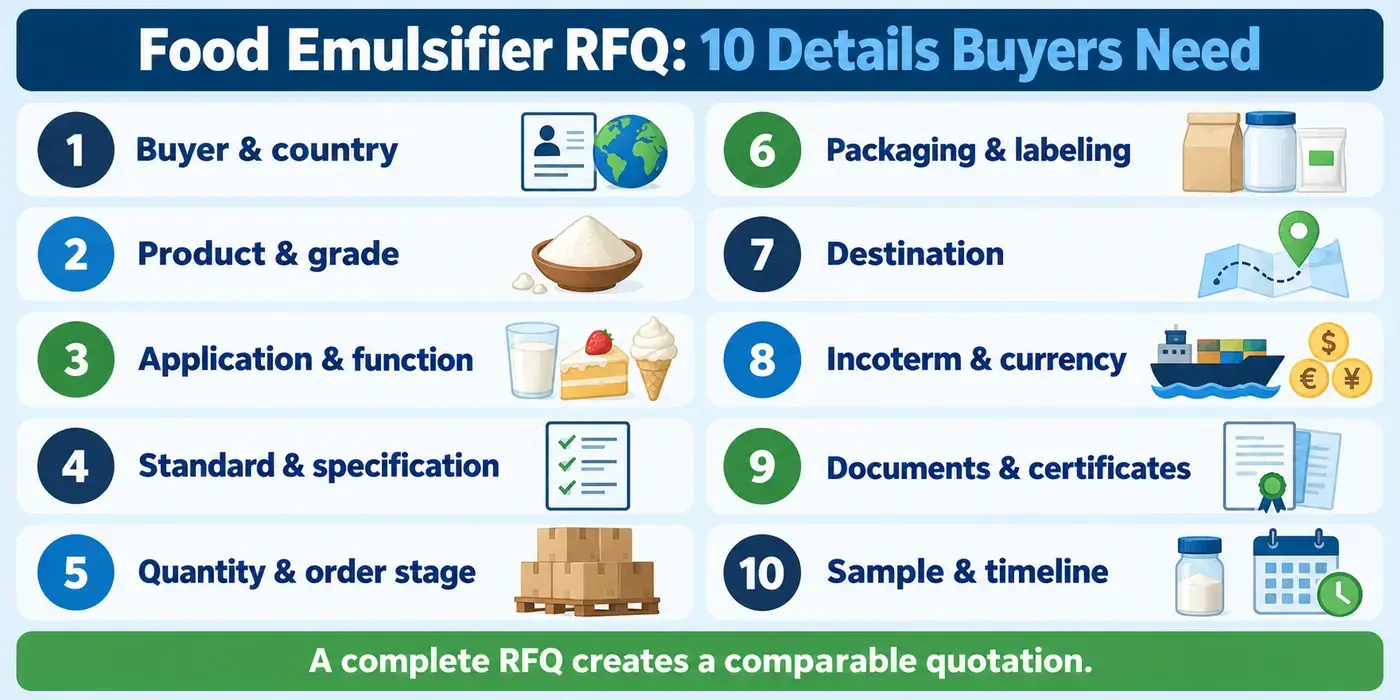
The 10 Fields in a Quotable Food Emulsifier RFQ
1. Buyer, Company, and Country
Identify the company requesting the quotation and the country where the material will be imported or used. Include:
- company name;
- business type, such as food manufacturer, ingredient distributor or importer;
- contact person and business email;
- country of import; and
- company website or other business reference when available.
This information helps the supplier understand the transaction, screen the request as B2B, and identify early questions about documentation, import requirements and the contracting party.
If the buying company, importer of record and final user are different entities, state their roles. A certificate issued to one company or a label prepared for one market may not fit another supply chain.
2. Exact Chemical Identity and Grade
Use the standardized chemical name, not only a family name or trademark. Useful identifiers may include:
- standardized chemical name;
- INS or E-number where applicable;
- CAS number when relevant to the buyer’s system;
- supplier or customer product code; and
- required grade, such as food grade under a stated specification.
For example, “polyoxyethylene sorbitan ester” is too broad for a firm quotation. Polyoxyethylene (20) sorbitan monooleate, INS 433 / E433, food grade identifies a much narrower requirement. Sorbitan monostearate, INS 491 / E491, food grade describes a different emulsifier with a different specification and physical form.
An INS or E-number helps identify a food additive, but it does not replace the full product name, grade and specification. Similar names can conceal differences in fatty acid composition, ethoxylation, physical form or permitted use.
3. Intended Food Application and Function
Tell the supplier where and why the emulsifier will be used. Examples include:
- bakery and yeast protection;
- dairy or dairy-style beverages;
- whipped toppings and coffee whiteners;
- fats, oils and shortenings;
- confectionery;
- flavor or color dispersion; and
- another named food system.
Add the function the buyer expects, such as emulsification, stabilization, solubilization, aeration support or dispersion. When relevant, share the formulation type, oil phase, processing temperature, pH range or other condition that could affect product selection.
Application information supports grade selection. It does not guarantee performance in the final recipe. The buyer should confirm suitability through formulation review and a controlled trial.
4. Required Standard and Technical Specification
Name the specification the quotation must meet. This may be:
- the applicable Chinese national food-safety standard;
- an FCC monograph;
- a JECFA specification;
- a European Union food-additive specification;
- another destination-market requirement; or
- a buyer-approved internal specification.
Attach the required limits when they affect acceptance. Do not rely on a statement such as “international standard.” Chinese GB standards, FCC, JECFA, European Union specifications and customer requirements may use similar parameters without being automatically equivalent.
If the buyer requires an additional process-related impurity, elemental impurity, microbiological test or analytical method, list it by name. Ask whether it is tested per batch, tested periodically, or supplied through a separate laboratory report.
5. Quantity and Order Stage
State the quantity with its unit. Separate the immediate order from the estimated annual demand.
Useful descriptions include:
- laboratory sample quantity;
- pilot-trial quantity;
- first commercial order;
- regular order quantity per shipment; and
- estimated annual volume.
“One container” is not precise enough because payload depends on product form, packaging, pallet use, carrier limits and route. State the required net quantity in kilograms or metric tonnes, then ask the supplier to confirm the practical loading quantity.
The order stage also matters. A sample request needs courier and sample-handling information. A commercial RFQ needs production, packing and shipping details. Annual demand can support supply planning, but it should not be presented as a confirmed order unless the buyer has made that commitment.
6. Packaging and Labeling Requirements
Ask for the packaging format required by the receiving plant and supply chain. Include:
- preferred container type;
- net weight per package;
- palletized or non-palletized shipment;
- pallet material or treatment requirement;
- liner, seal or tamper-evidence requirement;
- label language and mandatory label fields; and
- any restrictions on mixed batches or mixed production dates.
Available packaging depends on the emulsifier’s physical form and the manufacturing source. A liquid, paste and waxy solid may require different filling and handling arrangements. The supplier should confirm what can be offered rather than treating the requested package as automatically available.
Packaging affects unit price, loading quantity, warehouse handling and freight. A quotation should state the actual packing basis used in the calculation.
7. Destination Country, Port, or Delivery Place
Provide the destination country and the precise port or delivery place. “Africa,” “Europe,” or “Middle East” cannot support a freight quotation.
For sea freight, state the named port and whether the shipment is expected to move as full-container load or less-than-container load. For air freight or courier samples, provide the city, postal code and airport or courier-account information where relevant.
Also identify any known route constraints, import permits, temperature concerns, transshipment restrictions or required arrival window. Freight and routing remain subject to carrier availability and quotation validity, but a clear destination allows the supplier to obtain the correct basis.
8. Incoterm, Named Place, Currency, and Price Format
Write the requested trade term together with the named port, place or point and the rule year. A usable request might say CFR [named destination port], Incoterms 2020 rather than only “CFR price.”
The International Chamber of Commerce explains that Incoterms 2020 allocate seller and buyer obligations, costs and transfer of risk. The named place or port is a critical part of the chosen rule.
FOB, CFR and CIF are rules for sea and inland waterway transport. FCA, CPT or CIP may be considered for containerized or multimodal movements, depending on the actual delivery arrangement. The buyer and supplier should select the term that matches the route and contract.
An Incoterm does not define the product specification, payment terms, transfer of title, applicable law or remedies for non-performance. Record those items separately in the quotation, purchase order or sales contract.
Specify the requested currency and price unit as well:
- USD, EUR or another agreed currency;
- price per kilogram, metric tonne or package;
- net or gross weight basis; and
- whether taxes, duties, pallets, special tests or document charges should be shown separately.
9. Required Documents and Certificates
List every mandatory document before the supplier calculates the offer. A normal document request may include:
- current Technical Data Sheet;
- representative Certificate of Analysis for evaluation;
- batch-specific COA before shipment;
- current Safety Data Sheet;
- product specification;
- ingredient, allergen or origin statement when required;
- Halal or Kosher certificate;
- food-safety or quality-system certificate;
- third-party laboratory report; and
- export or destination-specific documents.
For each certificate, specify the required issuer, product scope, manufacturing site and minimum remaining validity where these points matter. A general company certificate may not cover the offered product or factory.
The three core technical documents have different jobs. Our guide to TDS vs COA vs SDS explains the evidence provided by each one. When a commercial batch is ready, use the Food Emulsifier COA Checklist to review the lot, dates, specification, results, units, methods and approval.
10. Sample, Testing, and Required Timeline
If a sample is needed, state:
- sample quantity;
- delivery address;
- courier account or requested freight arrangement;
- documentation required with the sample;
- target trial date; and
- acceptance tests planned by the buyer.
For commercial orders, provide the requested shipment window and any pre-shipment testing, inspection, retained-sample or document-approval condition. The supplier can then confirm feasibility and state its lead-time basis.
Avoid asking for a guaranteed arrival date before the product, quantity, packing, route and terms are confirmed. Production lead time, document preparation, vessel schedules, customs and inland transport affect different parts of the timeline.
How Each RFQ Field Can Change the Quotation
| RFQ field | Why it affects the offer |
|---|---|
| Product and grade | Determines chemical identity, specification, production route and product availability |
| Application | Helps screen whether the proposed grade fits the intended function and trial plan |
| Required specification | Defines the limits, methods and any additional testing needed for acceptance |
| Quantity | Affects production planning, packaging count, loading and unit-cost basis |
| Packaging | Changes filling, materials, pallet use, net payload and handling costs |
| Destination | Determines freight route, transit options and destination charges included in the quote |
| Incoterm | Defines which transport responsibilities and costs are included in the seller’s price |
| Certificates and documents | May require scope checks, originals, legalization, additional testing or lead time |
| Shipment window | Affects production scheduling, freight validity and available transport options |
An Incomplete RFQ and a Quotable RFQ
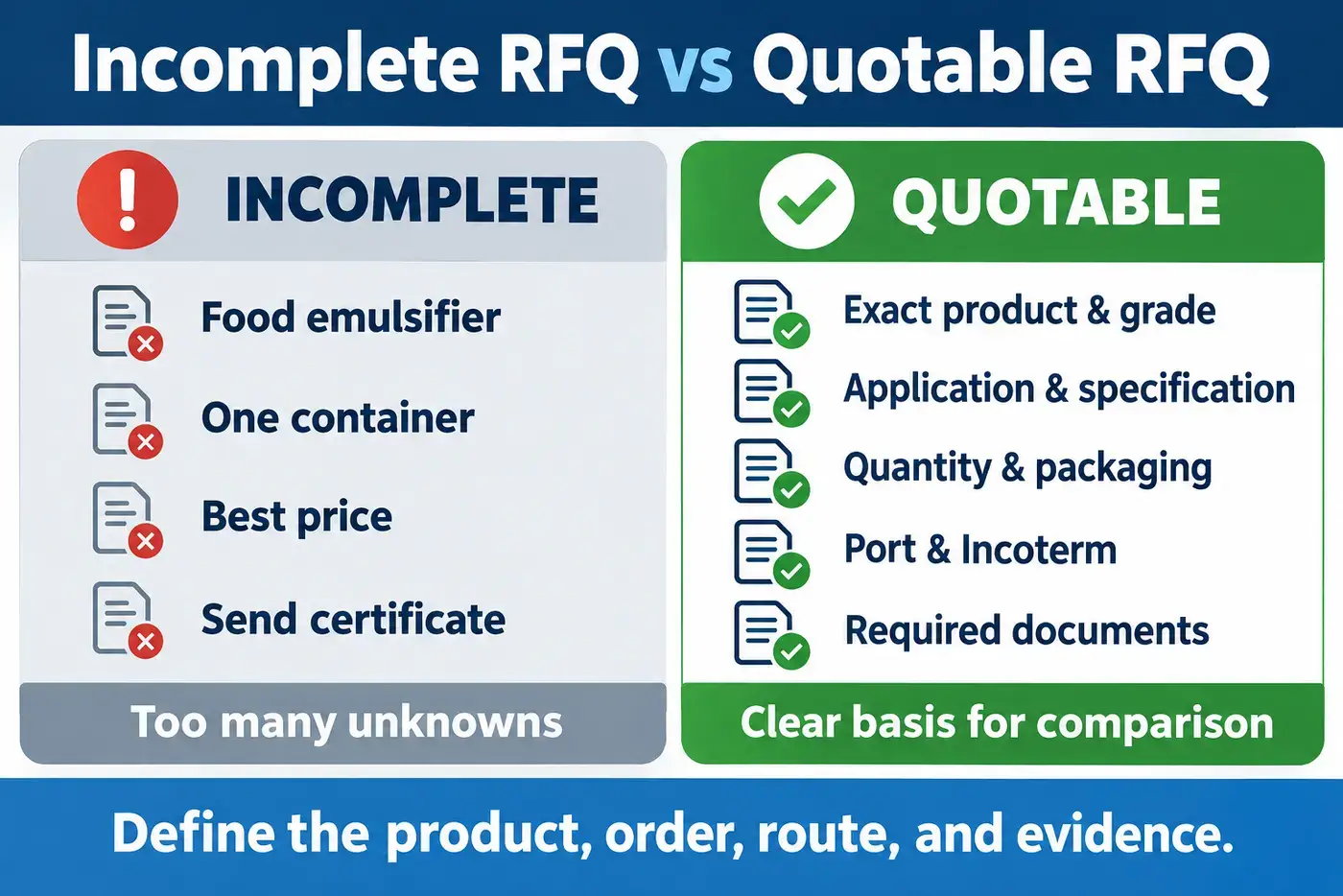
Incomplete
Please quote your best price for food emulsifier, one container CIF. Send COA and certificate.
The supplier still has to ask which emulsifier, grade, application, specification, container payload, package, destination port and certificates are required.
Quotable
Please quote polyoxyethylene (20) sorbitan monooleate, INS 433 / E433, food grade, for use in an oil-in-water beverage system. Required specification is attached. Initial commercial quantity: 20 metric tonnes. Please state the available packaging and confirmed loading quantity. Destination: Mombasa, Kenya. Quote CFR Mombasa, Incoterms 2020, in USD per metric tonne. Required for supplier review: current TDS, representative COA, SDS, applicable food-safety certificate, and available Halal and Kosher certificates with product scope and validity. Please state sample availability, production lead time, quotation validity, payment terms, and any point that does not match the attached requirement.
This version gives technical, commercial and logistics teams a shared basis for review. The supplier can answer with clear exceptions instead of guessing what “standard quality” or “one container” means.
Copy-and-Paste Food Emulsifier RFQ Template
Subject: RFQ – [Standardized product name] – [Quantity] – [Incoterm and named place]
Buyer information
Company name:
Country:
Business type:
Contact person:
Business email:
Company website:
Product requirement
Standardized chemical name:
INS / E-number:
CAS number, if required:
Food grade or other specified grade:
Supplier or buyer product code:
Intended food application:
Required function:
Applicable standard or attached specification:
Additional test items or methods:
Commercial requirement
Sample, trial or commercial order:
Immediate quantity:
Estimated annual demand:
Required packaging:
Pallet and label requirements:
Requested currency and price unit:
Payment-term request:
Logistics requirement
Destination country:
Named port or delivery place:
Transport mode:
Requested Incoterm and year:
Requested shipment window:
Documents and certificates
TDS: Required / Not required
Representative COA: Required / Not required
Batch COA before shipment: Required / Not required
SDS: Required / Not required
Halal: Required / Not required
Kosher: Required / Not required
Other certificates or statements:
Third-party testing or inspection:
Sample requirement
Sample quantity:
Delivery address:
Courier account or freight arrangement:
Target trial date:
Supplier response requested
Please state the offered manufacturer and grade, specification, packing, loading quantity, price basis, lead time, quotation validity, payment terms, available documents, and every deviation from this RFQ.
What a Complete Supplier Quotation Should Show
When the reply arrives, check that the quotation records:
- seller and buyer identities;
- exact product and grade;
- specification or standard;
- quantity and packing;
- unit price, currency and total basis;
- Incoterm with named place and rule year;
- production or shipment lead-time basis;
- quotation validity;
- payment terms;
- included documents and certificates;
- sample or pre-shipment approval conditions; and
- stated exclusions or deviations.
A quotation should not leave the buyer to infer which cost, document or grade was included. Ask for a revised offer when a material point remains ambiguous.
Frequently Asked Questions
Can I request a quotation with only an E-number?
An E-number or INS number is useful, but add the standardized chemical name, grade, required specification and application. This reduces the risk of receiving an offer for the wrong product form or commercial grade.
Why does the supplier need my application?
Application information helps screen the proposed emulsifier and identify technical questions before sampling. The final formulation still needs a controlled trial under the buyer’s process conditions.
Should I ask for FOB, CFR, or CIF?
Choose the term that fits the transport arrangement and allocation of costs and risk. FOB, CFR and CIF apply to sea and inland waterway transport. Always add the named port and “Incoterms 2020.” Ask the supplier or freight adviser to clarify the suitable term when the cargo moves in containers or through several transport modes.
Do I need a current batch COA before asking for a price?
A representative COA can support initial supplier and specification review. The batch-specific COA becomes relevant when the sample or commercial lot has been produced or allocated. State in the RFQ when the actual batch COA must be available for approval.
Should certificates be requested before or after the quotation?
Identify mandatory certificates in the RFQ because document availability and scope can determine whether the supplier is suitable. Review the certificate holder, site, product scope, standard and validity rather than accepting the certificate title alone.
Can the supplier quote freight without a destination port?
A meaningful freight quotation needs a specific destination and transport basis. Provide the named port, airport, terminal or delivery place, along with the requested Incoterm.
Send an RFQ That Can Be Checked and Quoted
A complete RFQ shortens the path from first inquiry to a technically comparable offer. It gives procurement a price basis, QA a document list, R&D an identified grade and logistics a defined destination and trade term.
For a FoodEmul quotation review, send the standardized product name, INS or E-number, intended application, required specification, quantity, packaging, destination, requested Incoterm and mandatory documents. We will check the request against the available product and document scope, then identify any missing point before a commercial offer is prepared.
