

Span 80 (sorbitan monooleate, E494) at HLB 4.3 is the liquid Span — and that matters. While Span 60 is a solid at room temperature, Span 80 stays fluid, making it the go-to low-HLB emulsifier for soft margarine, liquid shortenings, and cold-process formulations. At FoodEmul, we manufacture Span 80 alongside Span 60 and the full sorbitan ester range. This guide covers the technical data, applications, and formulation strategy for sorbitan monooleate.
Global Regulatory Approvals
Span 80 is one of the most widely approved emulsifiers globally, with established safety assessments across all major regulatory jurisdictions. Below is a summary of its regulatory status.
| Jurisdiction | Status | Code / Reference |
|---|---|---|
| FDA (United States) | GRAS — Generally Recognized as Safe | 21 CFR 172.842 |
| EFSA (European Union) | Permitted food additive | E494, ADI 5 mg/kg bw/day |
| GB 2760 (China) | Approved food emulsifier | CNS 10.005, INS 494 |
| JECFA (FAO/WHO) | Acceptable | ADI 0–25 mg/kg bw (combined) |
| FCC | Monograph published | Food Chemicals Codex |
FDA (United States): Under 21 CFR 172.842, Sorbitan Monooleate is affirmed as GRAS for use in food. Permitted applications include whipped toppings, cake icings and fillings, confectionery coatings, non-standardized dressings, solid-state edible vegetable fat-water emulsions used as milk or cream substitutes, and as a crystallization inhibitor in oils. Maximum usage levels range from 0.4% to 1.0% by weight, depending on the food category.
European Union (EFSA): Span 80 is approved as food additive E494. The EFSA ANS Panel re-evaluation (2017) established an Acceptable Daily Intake (ADI) of 5 mg per kg of body weight per day for sorbitan esters (E491–E495) individually, and a combined ADI of 25 mg/kg bw/day for the sorbitan esters as a group when used together.
China (GB 2760): Sorbitan Monooleate is listed under CNS number 10.005 (INS 494) and permitted in a wide range of food categories including dairy products, frozen drinks, cocoa and chocolate products, candies, baked goods, fats and oils, and condiments. The quality standard is GB 25552-2010, which aligns closely with the FCC monograph.
Cosmetic Use: The CIR (Cosmetic Ingredient Review) Expert Panel has evaluated Sorbitan Monooleate as safe for use in cosmetic formulations. It is listed in the EU CosIng database and widely used in creams, lotions, and makeup products.
For current pricing and batch-specific COA documentation, see our Span 80 product page.
Technical Specifications and Quality Standards
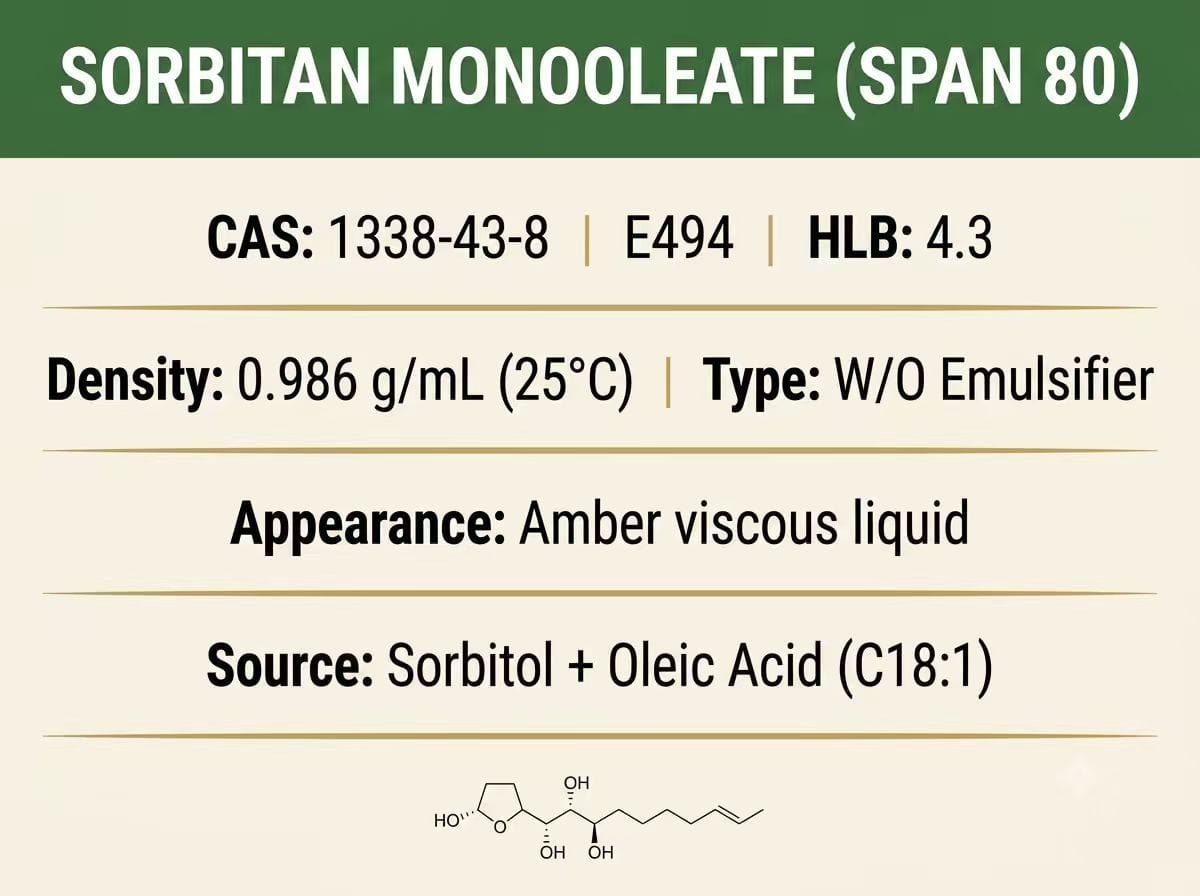
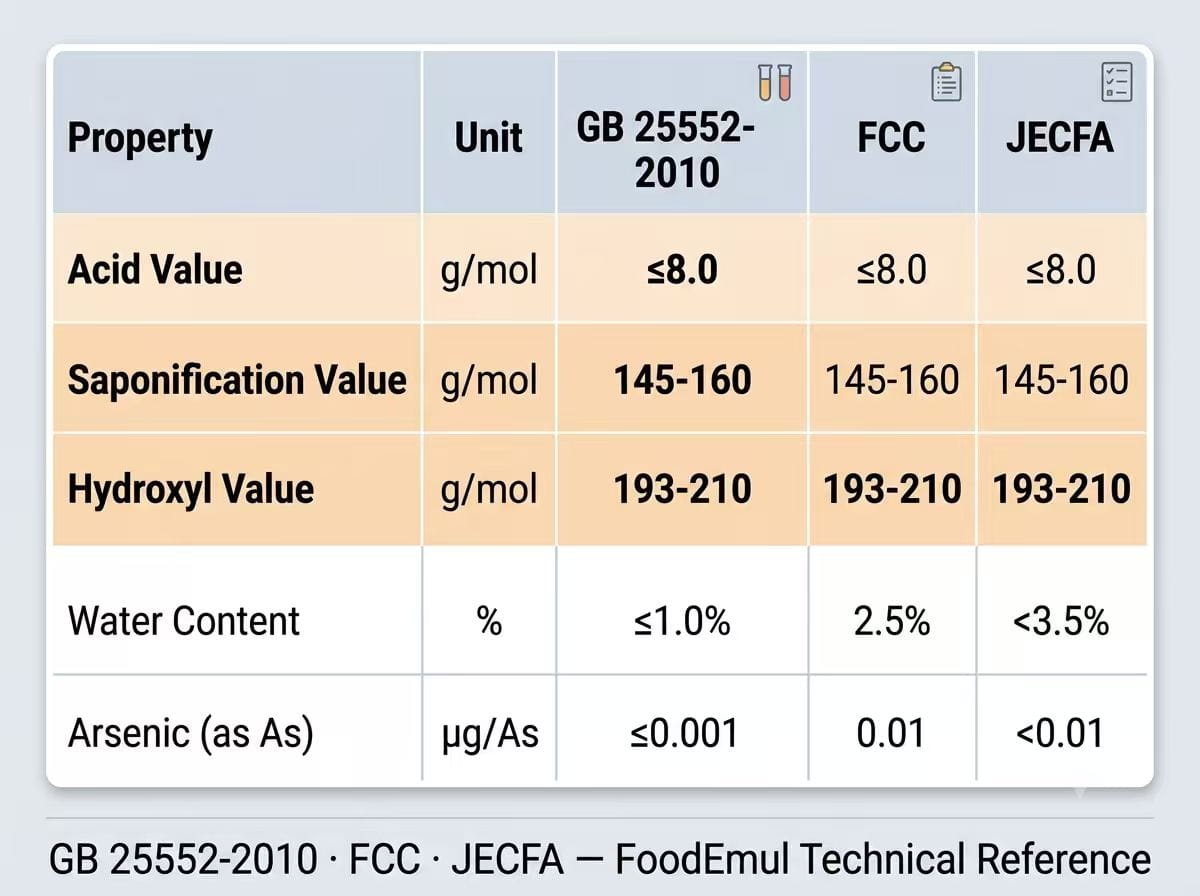
Food-grade Span 80 must meet strict quality specifications to ensure safety and performance. The following table summarizes the key parameters as defined by China’s GB 25552-2010 standard, the Food Chemicals Codex (FCC), and the Joint FAO/WHO Expert Committee on Food Additives (JECFA). These values are drawn from the authoritative Chinese food emulsifier textbook.
| Parameter | GB 25552-2010 | FCC / FAO-WHO | Test Method |
|---|---|---|---|
| Fatty Acid Content | 65–75% | 67–73% | GC |
| Polyol Content | 27–34% | 27–32% | — |
| Acid Value | ≤8.0 mg KOH/g | ≤8.0 mg KOH/g | GB/T 5530 |
| Saponification Value | 145–160 mg KOH/g | 145–160 mg KOH/g | GB/T 5534 |
| Hydroxyl Value | 193–210 mg KOH/g | 190–215 mg KOH/g | GB/T 12008.3 |
| Water Content | ≤2.0% | ≤2.0% | GB/T 6283 (Karl Fischer) |
| Residue on Ignition | ≤0.5% | ≤0.5% | GB/T 9741 |
| Arsenic (As) | ≤3 mg/kg | ≤3 mg/kg | AAS |
| Lead (Pb) | ≤2 mg/kg | ≤2 mg/kg | AAS |
| Heavy Metals (as Pb) | ≤10 mg/kg | ≤10 mg/kg | GB/T 5009.74 |
Appearance and Physical Properties: Span 80 is an amber to brownish-yellow, viscous oily liquid at room temperature. It has a characteristic mild odor. Its density is approximately 0.99–1.05 g/cm³ at 25°C, and it is dispersible in water but readily soluble in most organic solvents (ethanol, isopropanol, mineral oils) and vegetable oils — a solubility profile that directly reflects its low HLB of 4.3 and lipophilic character.
What is Sorbitan Monooleate (Span 80)?
Chemical Structure and Production of Span 80
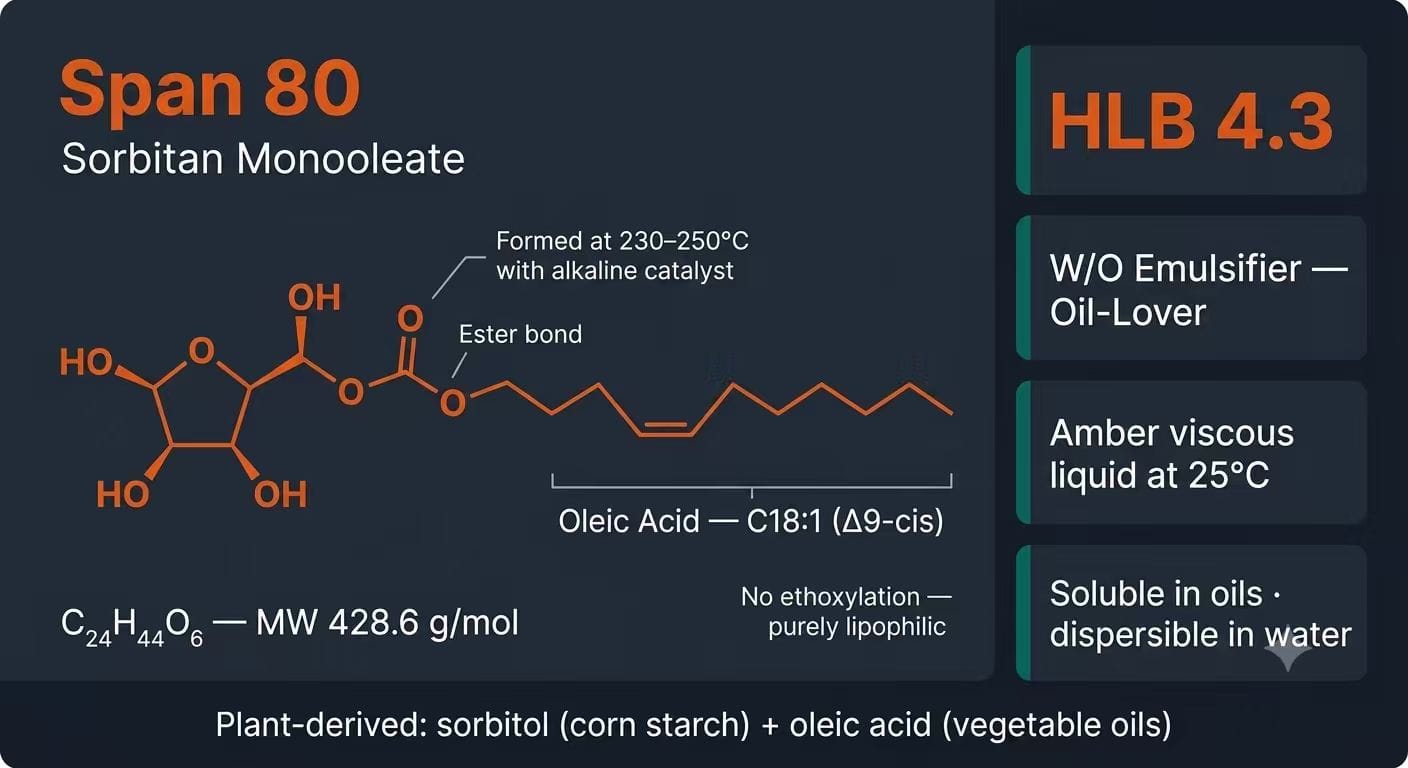
Span 80, chemically known as Sorbitan Monooleate, has the molecular formula C₂₄H₄₄O₆ and a molecular weight of approximately 428.6 g/mol. Its structure consists of a sorbitan ring (derived from sorbitol dehydration) esterified with a single oleic acid molecule. The long C18 hydrocarbon chain from the oleic acid dominates the molecule’s non-polar character, giving Span 80 its characteristic HLB of ~4.3 and lipophilic nature.
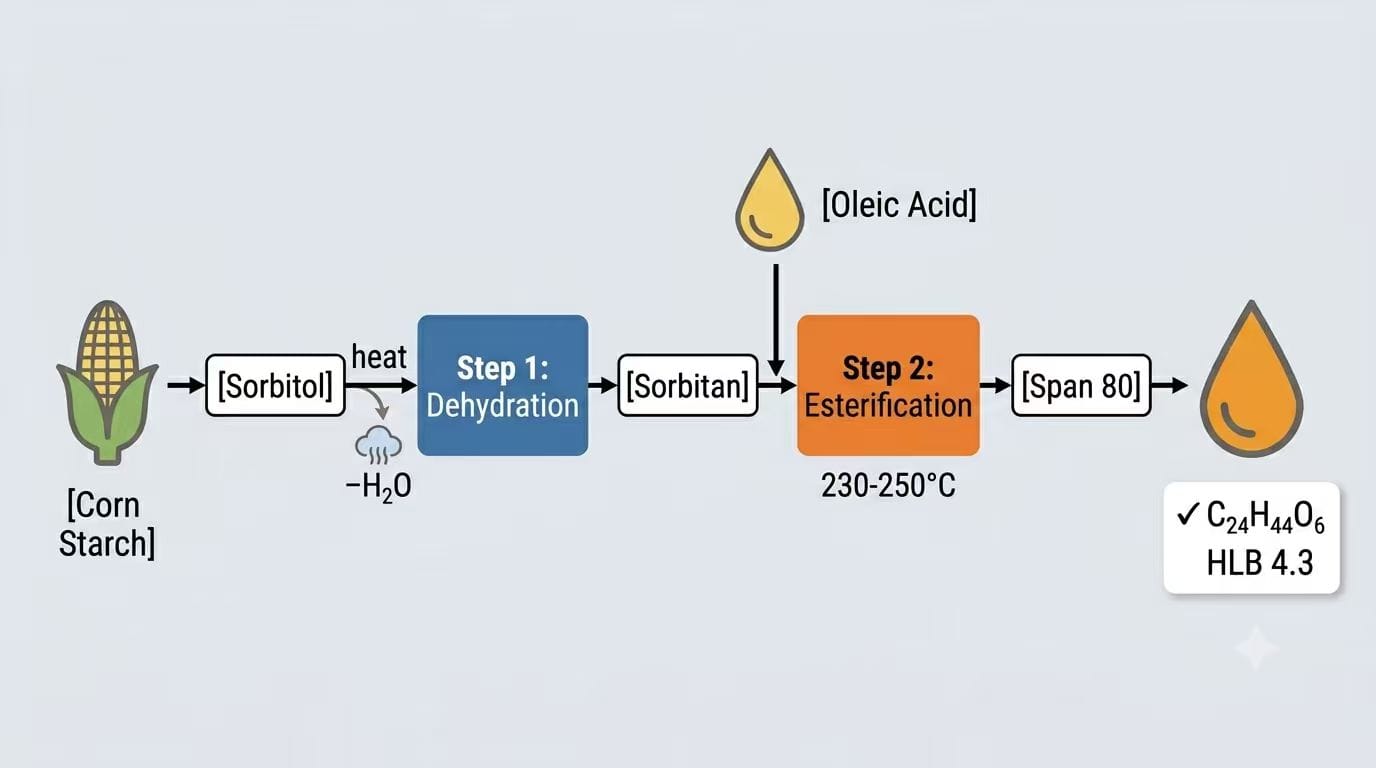
Production Process: Span 80 is manufactured through a two-step process:
- Step 1 — Sorbitan Formation: Sorbitol, a sugar alcohol typically sourced from corn or cassava starch, is heated under vacuum to remove one molecule of water, forming sorbitan (a cyclic ether). Partial dehydration continues to produce the mono- and dianhydride mixture known as sorbitans.
- Step 2 — Esterification: The sorbitan mixture is reacted with food-grade oleic acid (derived from vegetable oils such as sunflower, olive, or palm) at elevated temperatures (230–250°C) in the presence of an alkaline catalyst under nitrogen protection. This esterification attaches the oleic acid to the sorbitan ring, producing Sorbitan Monooleate — Span 80.
The reaction yields a mixture of partial esters (mono-, di-, and tri-esters), which is why Span 80 is not a single pure compound but a complex mixture — a characteristic shared by all sorbitan ester emulsifiers. This mixture composition is reflected in the quality specifications that follow.
The raw materials — sorbitol and oleic acid — are both plant-derived, making Span 80 a botanical-origin emulsifier at the feedstock level, though the chemical esterification process places it outside “natural” organic certification schemes. For applications requiring certified natural emulsifiers, see our guide to natural Polysorbate 80 substitutes.
Sorbitan Monooleate is a non-ionic surfactant characterized by its amber, viscous liquid appearance at room temperature. Chemically, it is a mixture of the partial esters of sorbitol and its mono- and dianhydrides with edible oleic acid. Due to the presence of the long-chain unsaturated oleic acid tail, Span 80 exhibits distinct lipophilic (oil-loving) properties compared to its saturated counterparts like Span 20 (Laurate) or Span 60 (Stearate).
Chemical Properties and HLB Value
The efficacy of a surfactant is largely dictated by its HLB value. Sorbitan Monooleate possesses a low HLB value of approximately 4.3. This places it firmly in the category of lipophilic surfactants, making it highly soluble in oils and organic solvents, but dispersible in water.
| Parameter | Technical Specification (Span 80) |
|---|---|
| Chemical Name | Sorbitan Monooleate |
| CAS Number | 1338-43-8 |
| Density (25°C) | 0.986 g/mL Per manufacturer COA; literature value 0.99 g/mL at 20°C |
| Appearance | Amber to yellow viscous oily liquid |
| HLB Value | 4.3 (± 1.0) |
| Acid Value | ≤ 8.0 mg KOH/g |
| Saponification Value | 145–160 mg KOH/g |
Functionality as a Water-in-Oil Emulsifier
Due to its low HLB, Span 80 serves primarily as a potent water in oil emulsifier (W/O). In these systems, the surfactant lowers the interfacial tension between the water droplets and the continuous oil phase, preventing coalescence and ensuring long-term stability. The unsaturated nature of the oleic acid chain allows for greater fluidity at lower temperatures compared to stearate-based surfactants, which is advantageous for formulations requiring pourability or cold-process manufacturing.
📚 Need the Big Picture?
You are reading a detailed chapter on a specific topic. To understand the complete chemistry, manufacturing process, and full application range of the Span Series, check out our central guide.
Read the Ultimate Guide to Sorbitan Esters →
Major Applications of Span 80
The utility of Sorbitan Monooleate spans multiple industries, driven by its safety profile and emulsifying efficiency. Below, we explore the specific formulation contexts for foodemul.com’s primary sectors.
Cosmetic Emulsifier Span 80: Formulating Creams and Lotions
In the personal care industry, cosmetic emulsifier Span 80 is indispensable for creating rich, emollient textures. It is frequently used in:
- Night Creams and Heavy Lotions: As a W/O emulsifier, it helps create a protective barrier on the skin, reducing transepidermal water loss (TEWL).
- Makeup Removers: Its affinity for oils allows it to solubilize sebum and waterproof makeup effectively without stripping the skin of natural lipids.
- Sunscreens: Span 80 aids in the dispersion of inorganic UV filters (like Zinc Oxide) within oil-based formulations.
Food Grade Span 80: E-Numbers and Stabilizing Uses
Regulatory compliance is paramount in food production. Food grade Span 80 is designated in the European Union as E494. It is generally recognized as safe (GRAS) by the FDA when used in accordance with Good Manufacturing Practices.
Regulatory Highlight: Food Grade Span 80 (E494) must meet strict purity criteria regarding heavy metals and free fatty acids. It is distinct from Span 60 (E491) and Span 65 (E492), primarily serving as an anti-foaming agent and emulsifier in yeast production and bakery applications.
Key food applications include:
- Bakery Products: Improving the aeration and volume of cakes and sponges.
- Yeast Manufacturing: protecting active yeast cells and preventing excess foaming during fermentation.
- Chocolate Production: Modifying viscosity to prevent bloom.
Industrial Lubricants and Agrochemicals
Beyond human consumption and application, Span 80 is a workhorse in industrial formulations. In agrochemicals, it acts as a dispersant in pesticides and herbicides, ensuring the active ingredients adhere to plant surfaces (leaves) rather than washing off. Additionally, in the petroleum industry, it is used in drilling muds and as a corrosion inhibitor in lubricant additives, leveraging its oil solubility to protect metal surfaces.
Comparative Technical Analysis
Selecting the right surfactant often involves comparing structurally similar molecules or understanding synergistic pairings.
Span Series HLB Quick Reference
For context, here are the standard HLB values across the Span (Sorbitan Ester) family:
| Product | Chemical Name | HLB | Type |
|---|---|---|---|
| Span 20 | Sorbitan Monolaurate | 8.6 | W/O |
| Span 40 | Sorbitan Monopalmitate | 6.7 | W/O |
| Span 60 | Sorbitan Monostearate | 4.7 | W/O |
| Span 65 | Sorbitan Tristearate | 2.1 | W/O |
| Span 80 | Sorbitan Monooleate | 4.3 | W/O |
| Span 85 | Sorbitan Trioleate | 1.8 | W/O |
Source: GB 25552-2010 / Food Emulsifier Textbook, Chapter 3. Span 65 and 85 are tri-esters with lower HLB values suitable for highly lipophilic systems.
Sorbitan Monooleate vs. Sorbitan Sesquioleate
Formulators often choose between Sorbitan Monooleate and Sorbitan Sesquioleate. While both are based on oleic acid, their esterification degrees differ.
| Feature | Sorbitan Monooleate (Span 80) | Sorbitan Sesquioleate |
|---|---|---|
| HLB Value | ~4.3 | ~3.7 |
| Structure | Mono-ester | Mixture of mono- and di-esters (1.5 ratio) |
| Primary Use | General W/O Emulsifier, Wetting Agent | Heavy Cosmetic Creams, Pigment Dispersion |
| Solubility | Soluble in most oils | Highly soluble in oils, greater water resistance |
Sorbitan Sesquioleate creates slightly more occlusive films and is often preferred for pigmented cosmetics (like foundations) due to superior pigment wetting capabilities. However, for general W/O emulsions and food applications, Span 80 remains the standard choice.
The Span 80 and Polysorbate 80 Synergistic Balance
Perhaps the most famous relationship in surfactant chemistry is the pairing of Span 80 with Polysorbate 80 (Polysorbate 80). While Span 80 is lipophilic (HLB 4.3), Polysorbate 80 is hydrophilic (HLB 15.0).
By combining these two, formulators can achieve a precise “Target HLB” to stabilize Oil-in-Water (O/W) emulsions. This synergy creates a more robust interfacial film around droplets than either surfactant could achieve alone. For example, a mixture of roughly 30% Span 80 and 70% Polysorbate 80 creates an HLB of approximately 11-12, ideal for fluid O/W lotions.
Safety, Handling, and Storage Protocols
Proper handling of Sorbitan Esters ensures ingredient integrity and personnel safety. Span 80 is generally considered non-toxic and non-irritating, but standard industrial hygiene should be observed.
- Storage Conditions: Store in tightly closed containers in a cool, dry, and well-ventilated area. Avoid direct sunlight and extreme heat, which can accelerate oxidation of the unsaturated oleic chains.
- Shelf Life: Typically 12 to 24 months when stored correctly.
- Handling: Use personal protective equipment (gloves, goggles) to prevent prolonged skin contact, which may cause mild irritation in sensitive individuals.
Compliance Note: Always consult the specific Material Safety Data Sheet (MSDS) or Safety Data Sheet (SDS) provided by foodemul.com for the most current hazard communication and transport regulations.
Frequently Asked Questions
Is Span 80 soluble in water?
No, Span 80 is not soluble in water. It is dispersible in water but soluble in most mineral and vegetable oils. This solubility profile is what defines it as a lipophilic water in oil emulsifier.
What is the difference between Span 80 and Polysorbate 80?
The primary difference lies in their chemical structure and HLB values. Span 80 is Sorbitan Monooleate (HLB 4.3, Oil-Soluble), while Polysorbate 80 is Ethoxylated Sorbitan Monooleate (HLB 15, Water-Soluble). Span is used for W/O emulsions, while Polysorbate is used for O/W emulsions or as a solubilizer.
Can food grade Span 80 be used in cosmetics?
Yes, food grade Span 80 generally meets and exceeds the purity requirements for cosmetic applications. However, cosmetic grade Span 80 may not always meet food safety standards regarding specific by-products. Always check the grade certification.
Why is Span 80 liquid while Span 60 is solid?
This is due to the fatty acid composition. Span 60 is derived from Stearic Acid (saturated fat), which is solid at room temperature. Span 80 is derived from Oleic Acid (unsaturated fat), which remains liquid at room temperature, offering different textural properties in formulation.
For HLB pairing with Polysorbate 80, see the Span & Polysorbate Formulators Guide. For food-specific application limits, refer to the Sorbitan Esters Food Grade Guide.
Related Reading
- Span 80 vs Polysorbate 80: Key Differences and When to Blend
- The Definitive Guide to Span and Polysorbate in Formulations
- Span 80 Product Specifications & COA (commercial)
Need Span 80 (sorbitan monooleate)? We manufacture it alongside Span 60 and the full sorbitan ester range — Kosher and MUI Halal certified — reach out for specifications or samples.
