

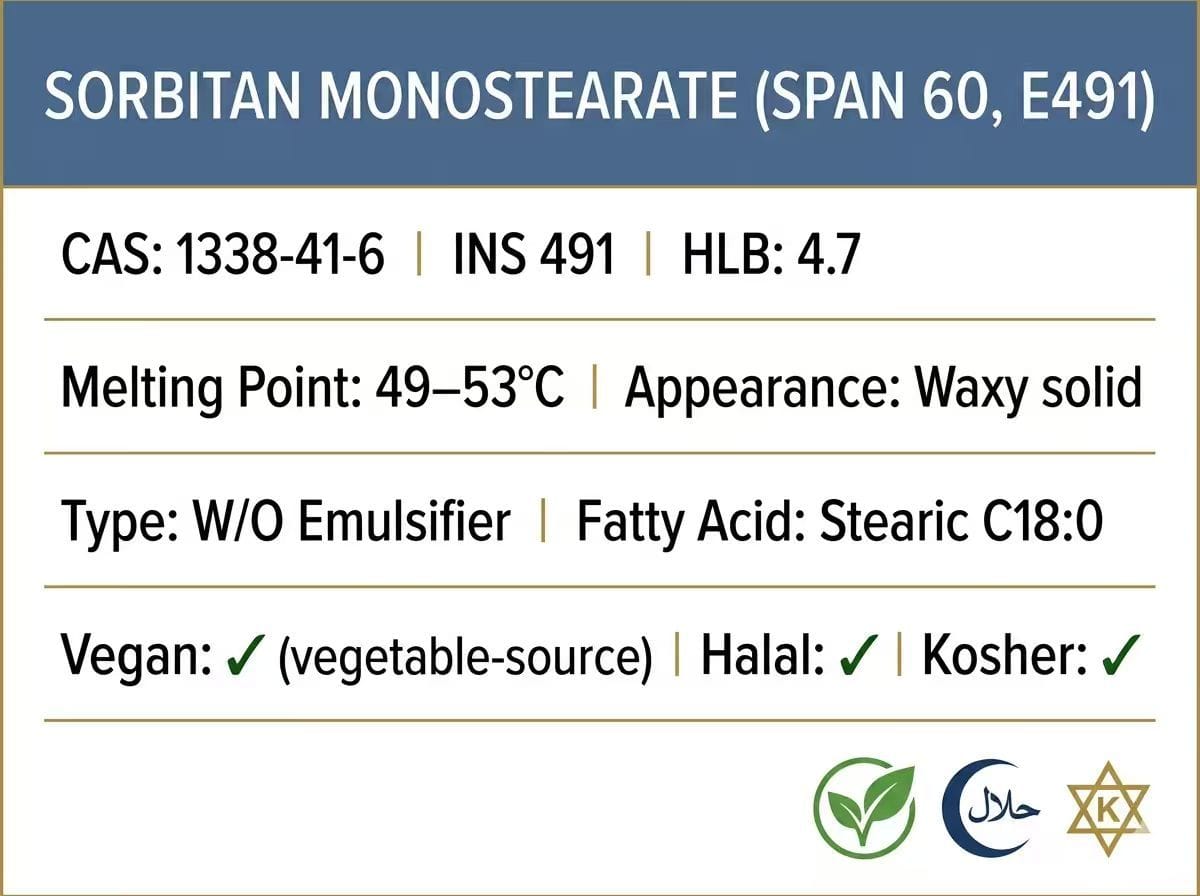
Sorbitan monostearate — Span 60, E491, CAS 1338-41-6, HLB 4.7 — is the most widely used low-HLB emulsifier in the food industry. It anchors W/O emulsions in margarine, co-crystallizes with solid fat in shortening, and stabilizes foam in cake gel systems. At FoodEmul, Span 60 is our flagship sorbitan ester, manufactured to food-grade specifications with Kosher and MUI Halal certification. This technical guide covers the full specification: chemistry, properties, regulatory status, and industrial applications.
Chemical Identity and Molecular Structure
Sorbitan Monostearate (Span 60, E491, CAS 1338-41-6, INS 491) is one of the most widely used non-ionic emulsifiers in industrial food production. With an HLB of 4.7 and a melting point of 49–53°C, it is the go-to lipophilic emulsifier for water-in-oil systems, fat crystallization control, and α-crystal stabilization in margarines, shortenings, and bakery fats.
| Property | Value |
|---|---|
| CAS Number | 1338-41-6 |
| E-number / INS | E491 / INS 491 |
| Molecular Formula | C₂₄H₄₆O₆ |
| Molecular Weight | 430.62 g/mol |
| HLB Value | 4.70 |
| Physical Form (25°C) | Cream to light brown waxy solid or beads |
| Melting Point | 49–53°C |
| Solubility | Dispersible in hot oils, ethanol, toluene; insoluble in water |
| pH Stability | Stable across pH 3–11 |
The sorbitan core is critical to function: it is a cyclic ether, not an aromatic ring. Common misrepresentations in online diagrams show a six-membered benzene-like ring — this is incorrect. The correct structure features a five-membered tetrahydrofuran ring with one ester-linked stearate chain (C17H35COO–) and three free hydroxyl (–OH) groups. The limited hydrophilicity from these three OH groups is what gives Span 60 its low HLB of 4.70.
Manufacturing Pathways and Quality Standards
Two industrial routes produce food-grade sorbitan monostearate, as documented in Chapter 3 of Food Emulsifiers (Science Press):
Route A: Direct Esterification
Sorbitol (1 mol) and stearic acid (1 mol) are reacted with sodium hydroxide catalyst (approx. 2 g NaOH) under nitrogen protection at elevated temperature. The dehydration-esterification produces sorbitan monostearate with water as a byproduct. This one-pot process is the most common industrial method.
Route B: Two-Step via Sorbitan Intermediate
Sorbitol first undergoes vacuum dehydration in the presence of an acid catalyst to form sorbitan (the cyclic ether intermediate). After decolorization and purification, the sorbitan is then esterified with stearic acid. This route offers better control over the sorbitan-to-isosorbide ratio and produces a more consistent product.
Quality Specifications
Food-grade sorbitan monostearate must meet strict specifications. The following table compares the three major standards:
| Parameter | GB 25552-2010 (China) | FCC-IV (US) | FAO/WHO (JECFA) |
|---|---|---|---|
| Fatty Acid Content | 71–75% | 71–75% | ≈95% |
| Polyol Content | 29.5–33.5% | 29.5–33.5% | — |
| Acid Value | ≤ 8 mg KOH/g | ≤ 8 mg KOH/g | ≤ 4.5–7.5 mg KOH/g |
| Saponification Value | 147–156 mg KOH/g | 147–156 mg KOH/g | 140–150 mg KOH/g |
| Hydroxyl Value | 235–260 mg KOH/g | 235–260 mg KOH/g | 270–305 mg KOH/g |
| Moisture | ≤ 1.5% | ≤ 1.5% | ≤ 1.5% |
| Residue on Ignition | ≤ 0.5% | — | — |
| Arsenic (As) | ≤ 3 mg/kg | ≤ 3 mg/kg | ≤ 3 mg/kg |
| Lead (Pb) | ≤ 2 mg/kg | ≤ 10 mg/kg | ≤ 10 mg/kg |
α-Crystalline Stabilization — Why Span 60 Is Essential in Fats
Span 60’s most valuable industrial property is its ability to promote and stabilize the α-crystalline form of triglycerides. In fat-based products (shortenings, margarines, chocolate coatings), triglycerides naturally crystallize into the stable β-form over time — causing graininess, bloom, and textural defects. Span 60 interferes with this transition.
The mechanism: Span 60 molecules, with their stearic acid chain (C18:0), co-crystallize with triglycerides during cooling. The bulky sorbitan head group creates steric hindrance that physically blocks the tight packing required for α → β transition. The result is a fine, stable α-crystal network that gives:
- Smooth texture in margarine and shortenings (no graininess)
- Fat bloom resistance in chocolate and confectionery coatings
- Improved aeration in whipped toppings (α-crystals stabilize air cells)
- Reduced oil separation in peanut butter and spreads
This property makes Span 60 particularly effective when blended with α-tending emulsifiers like propylene glycol monostearate (PGMS). The textbook Food Emulsifiers documents that Span 60 alone in膏状 (paste) form is an excellent whipping agent — and when combined with polysorbates in whipped toppings, the synergistic effect on foam stability is pronounced.
Synergy Chemistry: Span 60 + Polysorbates
Span 60 (HLB 4.70) and Polysorbate 60 (HLB 14.9) share the same stearic acid chain (C18:0) but differ dramatically in hydrophilicity due to the 20-unit polyoxyethylene chain on the polysorbate. This matched fatty acid + different HLB combination is one of the most reliable synergistic pairs in food emulsifier science.
The synergy works because the identical C18 chains ensure both molecules pack compatibly at the oil-water interface, while the HLB differential (4.70 vs. 14.90) allows precise tuning. By blending Span 60 and Polysorbate 60 at varying ratios, formulators can achieve any target HLB between 4.70 and 14.90:
| Target HLB | Span 60 (HLB 4.70) | PS60 (HLB 14.9) | Typical Application |
|---|---|---|---|
| 6 | 87% | 13% | W/O emulsions, margarine |
| 8 | 68% | 32% | Cakes, shortenings |
| 10 | 48% | 52% | Whipped toppings, ice cream |
| 12 | 29% | 71% | O/W dressings, sauces |
Processing Requirements
Span 60 is a waxy solid at room temperature (melting point 49–53°C) and must be handled accordingly:
- Pre-melting: Heat to 55–60°C before use. Direct addition of solid Span 60 to cold mixtures will result in incomplete dispersion and wasted material.
- Oil-phase incorporation: Always dissolve pre-melted Span 60 in the oil/fat phase before combining with aqueous ingredients. Its HLB of 4.70 means it has minimal water dispersibility.
- Homogenization: For fine W/O emulsions, use high-shear mixing (3,000–5,000 rpm) after combining phases. The Span 60 will migrate to the interface during shear.
- Cooling rate: For α-crystalline stabilization, control the cooling rate. Rapid cooling (≥ 5°C/min) favors α-crystal formation; slow cooling allows β-transition and reduces Span 60’s effectiveness.
- Storage: Store in sealed containers below 30°C. Prolonged exposure to > 40°C may cause discoloration and acid value drift.
Sorbitan Ester Family — How Span 60 Compares
Sorbitan monostearate is one member of the Span series. Understanding the full family helps formulators choose the right ester for their fat phase:
| Ester | E-number | Fatty Acid | HLB | Physical Form | Best For |
|---|---|---|---|---|---|
| Span 20 | — | Lauric (C12:0) | 8.6 | Oily liquid | Low-viscosity O/W, solubilization |
| Span 40 | — | Palmitic (C16:0) | 6.7 | Waxy solid | Intermediate HLB applications |
| Span 60 | E491 | Stearic (C18:0) | 4.70 | Waxy solid | W/O emulsions, α-crystal control, aeration |
| Span 65 | E492 | Tristearate (3×C18) | 2.10 | Hard waxy solid | Strong W/O, fat bloom prevention |
| Span 80 | E494 | Oleic (C18:1) | 4.30 | Viscous liquid | W/O emulsions, easier handling (liquid) |
| Span 85 | — | Trioleate (3×C18:1) | 1.80 | Viscous liquid | Very strong W/O, low-HLB blends |
Dietary Status: Vegan, Halal & Kosher Compliance
Is Sorbitan Monostearate vegan? It depends on the source of stearic acid. Sorbitol is always plant-derived (corn or tapioca starch). Stearic acid can be sourced from vegetable oils (palm, coconut) — making the final product vegan — or from animal fats (tallow) — making it non-vegan. Most food-grade SMS on the market uses vegetable-source stearic acid and is suitable for vegetarians and vegans. Always request a vegetable-source declaration from your supplier.
Halal and Kosher certification: When manufactured from vegetable-derived stearic acid under certified protocols, Sorbitan Monostearate (E491) can be certified Halal (MUI, Indonesia) and Kosher. Foodemul holds both certifications for its Span 60 product line. For procurement, always verify that the certificate matches the batch number and manufacturing date.
E-number labeling: In the EU, Sorbitan Monostearate is labeled E491. In the international Codex system, it is INS 491. Both refer to the same substance meeting JECFA and EFSA purity specifications.
Frequently Asked Questions
Q: What is the difference between E491 and Span 60?
They are the same substance. E491 is the EU food additive code; Span 60 is the Croda/ICI trade name. Both refer to sorbitan monostearate meeting food-grade specifications.
Q: Is sorbitan monostearate halal and kosher?
Yes. When produced from plant-based stearic acid (palm or coconut derived), sorbitan monostearate is suitable for halal and kosher certification. Verify with your supplier that no animal-derived stearic acid is used.
Q: Can Span 60 replace mono- and diglycerides (E471)?
Partially. Span 60 provides stronger α-crystalline stabilization and better aeration than E471, but it cannot fully replace MDG in all applications because it lacks the broad emulsification range of mono-diglycerides. The two are often used together: Span 60 for crystal control, E471 for general emulsification.
Q: What is the regulatory status in the US?
Sorbitan monostearate is GRAS (Generally Recognized as Safe) under FDA 21 CFR 172.842. It may be used in food at levels not exceeding GMP (Good Manufacturing Practice). The EFSA re-evaluation (2017) confirmed the ADI of 25 mg/kg bw/day as safe for the general population.
Related Reading
- Comparison: Sorbitan Monostearate vs Tristearate — Span 60 vs Span 65
- Formulation: Sorbitan Monooleate (Span 80) — Complete Technical Guide
- Cluster guide: Sorbitan Esters (Span Series) — Food-Grade Overview
- Product: Food-Grade Sorbitan Monostearate (E491 / Span 60)
Need Span 60 (sorbitan monostearate, E491)? We manufacture it alongside Polysorbate 80 and the full sorbitan ester range — reach out for specifications or samples.
