
Estimated reading time: 11 minutes
Hi, I’m Joe. Here at FoodEmul, we’ve been supplying Span and Polysorbate emulsifiers to dairy manufacturers for years. Milk already has natural emulsifiers — casein and whey proteins do a decent job on their own. But modern dairy processing pushes those proteins way past what they were built for.
Homogenization. UHT sterilization. Six-month shelf life. Temperature swings during shipping. At each step, milk’s natural proteins lose more ground. That’s where Span 60 and polysorbate 60 come in — not to replace the proteins, but to back them up at the points where they fail.
This guide covers the specific dairy applications where Span/polysorbate earn their place, the dosages, and why Polysorbate 60 is the better choice than PS80 for most dairy systems.
Why Dairy Needs Emulsifiers — and Where Span/polysorbate Fit
Milk already has natural emulsifiers: casein micelles and whey proteins form membranes around milk fat globules, keeping them stable. But modern dairy processing pushes these natural systems past their limits:
- Homogenization creates massive new fat surface area — the natural proteins can’t cover it all
- UHT sterilization (135–145°C) denatures whey proteins, cutting their emulsifying ability
- Extended shelf life (6–12 months) demands stability that protein-only interfaces can’t deliver
- Recombined dairy products (butter oil + skim milk powder) have no native fat globule membrane at all
- Whipped and aerated products need foam stabilization beyond what milk proteins can provide
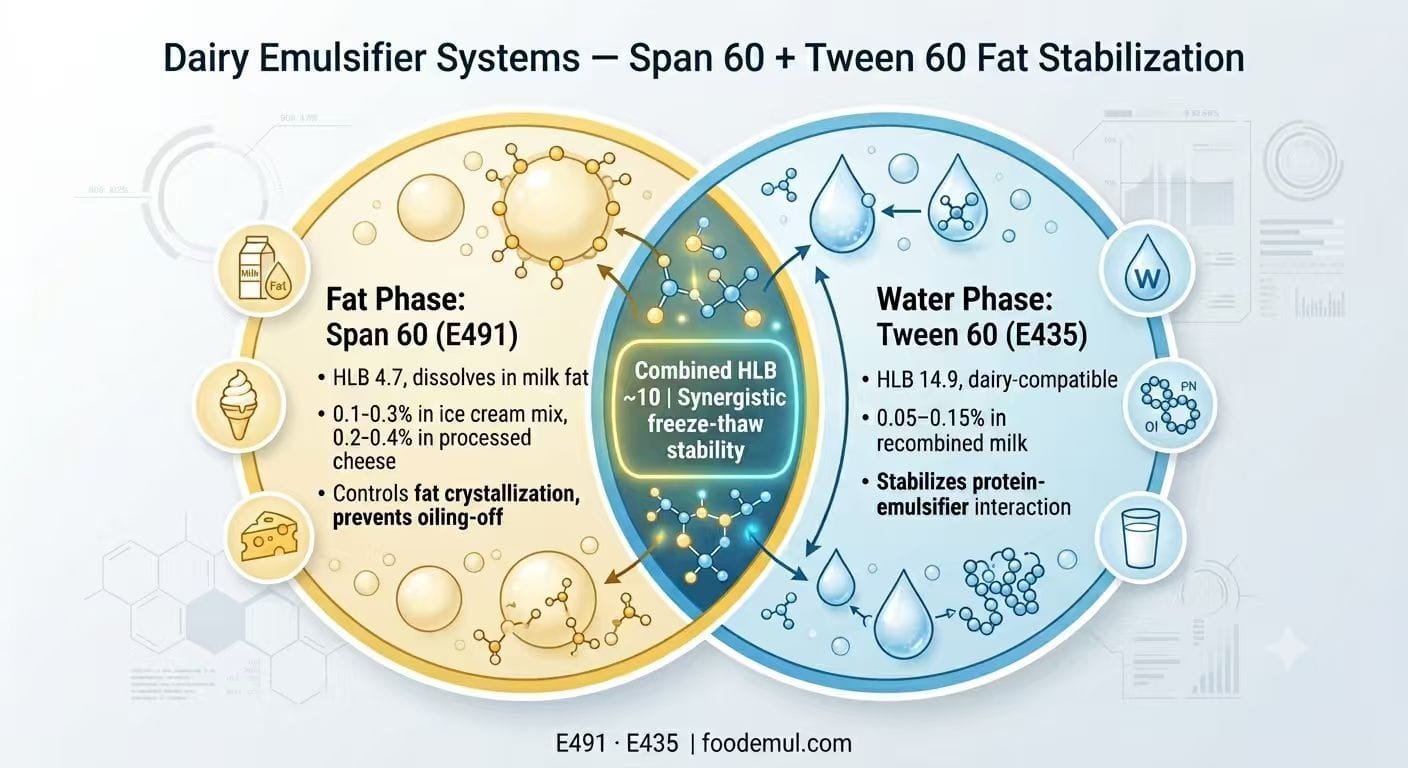
Span 60 (Sorbitan Monostearate, E491, HLB 4.7) and polysorbate 60 (Polysorbate 60, E435, HLB 14.9) fill these gaps as a pair:
- Span 60 stabilizes the fat phase — anchoring at the fat-water interface, co-crystallizing with milk fat, and preventing fat globule coalescence during storage and temperature swings. For a deeper look at how pure milk systems specifically hit the HLB 9.0 sweet spot, see our guide to dairy emulsifier stability at HLB 9.0
- polysorbate 60 provides the high-HLB balance — improving fat dispersion during homogenization, stabilizing foam in whipped products, and matching butterfat’s stearic acid profile (C18:0)
The research confirms it: Span 60 and polysorbate 60 together “create stable emulsions for dairy beverages, coffee creamers, and whipped toppings” — and for a complete formulation walkthrough covering neutral cocoa milk and acidic yogurt drinks, see our dairy beverage stabilizer guide — and Span emulsifiers “improve air incorporation and fat agglomeration, resulting in a rich, smooth, creamy texture” with “better overrun and slower melting in frozen desserts” (Hu et al., 2011).
Span 60 (E491) — The Fat-Phase Anchor in Dairy
How Span 60 Works in Dairy Systems
Span 60’s low HLB (4.7) and stearic acid chain (C18:0) make it a natural fit for dairy fat:
Fat globule membrane reinforcement. After homogenization, milk fat globules shrink from 3–5 μm to 0.5–1.0 μm. The native protein membrane gets stretched thin. Span 60 inserts into this membrane — stearic acid tail aligned with milk fat triglycerides (about 70% saturated, mostly C16:0 and C18:0), sorbitan head hydrogen-bonding with interfacial water. The reinforced membrane resists coalescence far better than protein alone.
Fat-crystal stabilization. In refrigerated dairy, part of the milk fat crystallizes. Those crystals can pierce neighboring fat globule membranes, causing partial coalescence. Span 60 co-crystallizes with milk fat, building a more elastic crystal network that handles temperature-induced phase changes without membrane rupture.
Temperature cycling resistance. Dairy products bounce between temperatures during distribution — refrigerated trucks, loading docks, back to refrigeration. Each cycle partially melts and re-crystallizes milk fat. Span 60’s crystal-templating keeps fat globules intact through these swings, preventing the gradual oiling-off that shows up in protein-only dairy emulsions.
Where Span 60 Adds the Most Value
| Application | Why Span 60 Helps |
|---|---|
| UHT milk / flavored milk | Prevents fat separation during 6–12 month ambient storage; reinforces membranes weakened by UHT protein denaturation |
| Coffee creamers (liquid) | Part of the standard 60:20:20 GMS:Span 60:polysorbate 60 creamer blend; prevents oiling-off in hot acidic coffee |
| Whipped cream / toppings | Stabilizes the fat network supporting foam structure; improves overrun and cuts serum drainage |
| Cheese / processed cheese | Helps fat dispersion for uniform melt; prevents free oil release during heating |
| Recombined dairy | Replaces the native fat globule membrane missing in butter-oil-based recombined products |
For full specs, see our Sorbitan Monostearate (E491) Technical Guide.
polysorbate 60 (E435) — The Dairy-Compatible High-HLB Partner
Why polysorbate 60 for Dairy, Not PS80
Both polysorbate 60 (HLB 14.9) and PS80 (HLB 15.0) are high-HLB emulsifiers — but polysorbate 60 wins in dairy for one reason: fatty acid matching.
Milk fat is mostly saturated: about 70% of milk fatty acids are C16:0 (palmitic) and C18:0 (stearic). polysorbate 60’s stearic acid chain (C18:0) matches this profile. When polysorbate 60 adsorbs alongside Span 60 at the fat-water interface, both emulsifiers share the same fatty acid tail — giving you tighter molecular packing, a stronger interfacial film, and better long-term emulsion stability.
PS80’s oleic acid chain (C18:1, unsaturated) doesn’t pack as tightly with milk fat’s saturated triglycerides. For dairy, polysorbate 60 is the better choice. PS80 is for cold-process and non-dairy applications where its liquid form at room temperature is convenient.
What polysorbate 60 Does in Dairy
- Fat dispersion during homogenization — polysorbate 60’s high HLB drives rapid migration to newly created fat surfaces during homogenization, ensuring complete coverage of the expanded surface area
- Foam stabilization — in whipped toppings, ice cream, and aerated dairy desserts, polysorbate 60 stabilizes the air-water interface alongside milk proteins, improving overrun and foam persistence
- HLB balance with Span 60 — dairy systems typically need HLB 8–11 for O/W emulsions; polysorbate 60 paired with Span 60 at calculated ratios hits this window precisely
For full polysorbate 60 data, see our Polysorbate 60 Food Application Guide.
HLB Matching by Dairy Product Type
Different dairy products need different HLB values. The Span 60 : polysorbate 60 ratio is how you hit the target:
| Dairy Product | Target HLB | Span 60 : polysorbate 60 | Total Emulsifier |
|---|---|---|---|
| UHT milk / flavored milk | 9–10 | 1:1 to 2:3 | 0.05–0.15% |
| Coffee creamers (liquid) | 10–11 | 1:2 (standard 60:20:20 GMS:Span:polysorbate) | 0.3–0.5% |
| Whipped topping | 8–9 | 1:1 | 0.3–0.5% |
| Ice cream | 8–10 | 1:1 to 1:2 | 0.1–0.3% |
| Processed cheese | — | Span 60 alone | 0.1–0.3% |
| Recombined dairy | 9–11 | 1:1 to 1:2 | 0.1–0.3% |
For HLB calculation methodology, see our Span & polysorbate Formulators Guide.
Key Dairy Applications
UHT Milk and Flavored Milk
The problem: UHT processing denatures whey proteins, leaving fat globules with partial membrane coverage. Over 6–12 months of ambient storage, fat rises and forms a cream plug that won’t re-disperse.
The fix: Span 60 : polysorbate 60 = 1:1 at 0.05–0.15%. Add to the milk before homogenization. Homogenize at 200–250 bar at 65–70°C. The Span/polysorbate pair supplements the damaged protein membrane, keeping fat dispersed through the full shelf life.
Coffee Creamers (Liquid)
The problem: Liquid coffee creamers face one of the toughest stability tests in food — they’re poured into hot (85–95°C), acidic (pH 4.8–5.2) coffee. Protein-only emulsions instantly curdle and oil-off.
The fix: The textbook creamer emulsifier blend: GMS 60% : Span 60 20% : polysorbate 60 20% at 0.3–0.5% of the creamer. GMS provides bulk fat structuring. Span 60 reinforces the W/O interface. polysorbate 60 ensures rapid O/W re-dispersion when the creamer hits the coffee. Result: a stable white emulsion with no visible oil droplets.
Whipped Toppings
The problem: Whipped dairy toppings need stable foam that won’t collapse, firm peaks that hold through serving, and minimal serum drainage (weeping) in the container.
The fix: Span 60 : polysorbate 60 = 1:1 at 0.3–0.5%. Span 60 stabilizes the fat network that physically supports the foam structure (partial coalescence of fat globules around air cells). polysorbate 60 stabilizes the air-water interface. Together, they improve overrun by 20–30% over protein-only formulations and reduce serum drainage during a 24-hour refrigerated hold.
Ice Cream
The problem: Ice cream needs controlled partial fat coalescence to build the internal fat network that supports air cells and gives the product its creamy body. Too little coalescence = icy texture. Too much = buttery, greasy mouthfeel.
The fix: Span 60 : polysorbate 60 = 1:2 at 0.1–0.3%. Span 60 provides the controlled partial coalescence through its crystal-templating effect. polysorbate 60 stabilizes the O/W emulsion before freezing and helps the emulsifier blend disperse in the cold mix.
Processed Cheese
The problem: Processed cheese must melt uniformly without free oil release. Fat pools on the surface of melted cheese are a quality defect — and a sign of insufficient fat dispersion.
The fix: Span 60 alone at 0.1–0.3%. The low-HLB emulsifier disperses fat throughout the cheese matrix during cooking (80–95°C), producing uniform melt and no free oil on the surface. polysorbate 60 is not used — processed cheese is a low-moisture, high-fat system where high-HLB emulsifiers add nothing.
Dosage Quick Reference
| Dairy Product | Span 60 (%) | polysorbate 60 (%) | Ratio | Addition Point |
|---|---|---|---|---|
| UHT milk | 0.025–0.075 | 0.025–0.075 | 1:1 | Before homogenization |
| Coffee creamer (liquid) | 0.06–0.10 | 0.06–0.10 | 1:1* | Fat phase before emulsification |
| Whipped topping | 0.15–0.25 | 0.15–0.25 | 1:1 | Fat phase; homogenize before whipping |
| Ice cream | 0.03–0.10 | 0.07–0.20 | 1:2 | Fat phase before pasteurization |
| Processed cheese | 0.1–0.3 | — | Span alone | With emulsifying salts during cooking |
| Recombined milk | 0.05–0.10 | 0.05–0.10 | 1:1 to 1:2 | Fat phase before recombination |
* Standard coffee creamer formula uses GMS 60% : Span 60 20% : polysorbate 60 20% at 0.3–0.5% total.
Process Integration
General Dairy Process with Span 60 + polysorbate 60
- Fat phase preparation: Melt butter oil, milk fat, or vegetable fat at 60–65°C. Add Span 60 — it dissolves completely above ~56°C. Add polysorbate 60 — it disperses best in the fat phase at temperature.
- Water phase preparation: Reconstitute skim milk powder in water at 45–50°C. Hydrate for 30 minutes. Add sugar, stabilizers (carrageenan, guar gum) if used.
- Pre-emulsion: Add the fat phase (with Span/polysorbate) to the water phase under high-shear mixing at 60–65°C. A coarse O/W pre-emulsion forms.
- Homogenization: Two-stage: 200–250 bar first stage, 40–50 bar second stage. Temperature: 65–70°C. This is where Span/polysorbate migrate to the fat globule surface and build the reinforced interfacial membrane.
- Heat treatment: UHT (135–145°C, 2–8 seconds) or HTST pasteurization (72–75°C, 15–20 seconds). polysorbate 60 is stable at UHT temperatures.
- Cooling and filling: Cool to filling temperature (20–25°C for UHT, 4–8°C for pasteurized). Aseptic filling for UHT products.
- Aging (ice cream): Age the mix at 2–4°C for 4–24 hours before freezing. This lets milk fat crystallize and Span 60 co-crystallize with it — a critical step for proper fat destabilization during freezing.
Troubleshooting
| Problem | Likely Cause | Span/polysorbate Solution |
|---|---|---|
| Cream plug in UHT milk | Insufficient fat globule membrane reinforcement | Increase Span 60 to 0.075%; check homogenization pressure (≥200 bar) |
| Oiling-off in coffee | Creamer emulsion instability at high temp + low pH | Verify GMS:Span:polysorbate = 60:20:20; increase total to 0.5% |
| Whipped topping collapse | Weak fat network; insufficient partial coalescence | Increase Span 60 proportion to 1:1; verify aging time |
| Serum drainage (weeping) | Poor water-holding; insufficient foam stability | Increase polysorbate 60; add stabilizer (carrageenan, guar) |
| Icy ice cream texture | Insufficient fat destabilization | Increase Span 60; verify aging time (minimum 4 hours at 2–4°C) |
| Free oil in processed cheese | Poor fat dispersion; insufficient emulsifier | Increase Span 60 to 0.2–0.3%; check cooking temperature and time |
| Fat separation after temperature cycling | Crystal-mediated membrane rupture | Increase Span 60 to 0.1%; Span 60 co-crystallizes and reinforces crystal network |
For a deeper look at how homogenization and the HLB 9.0 rule work together in pure milk, see our guide on milk emulsification stability.
The Bottom Line
Span 60 and polysorbate 60 form the most versatile emulsifier pair for dairy — not replacing milk’s natural proteins, but backing them up at the points where modern processing pushes them past their limits:
- Span 60 is the fat-phase anchor — it reinforces the fat globule membrane after homogenization, co-crystallizes with milk fat to prevent crystal-mediated coalescence, and maintains stability through temperature cycling. Most valuable in UHT milk, coffee creamers, whipped toppings, and recombined dairy.
- polysorbate 60 is the dairy-compatible high-HLB partner — its stearic acid chain matches milk fat’s saturated profile, giving tighter interfacial packing than PS80. It drives fat dispersion during homogenization and stabilizes foam in whipped products.
- The Span:polysorbate ratio tunes HLB for each product — from Span 60 alone in processed cheese to 1:2 in ice cream to 1:1 in most dairy beverages. This is the same tuning principle used across all food categories — dairy just happens to be where fatty acid matching makes the biggest difference.
For Span 60 specs, see the Sorbitan Monostearate Technical Guide. For polysorbate 60 application limits, see the Polysorbate 60 Food Application Guide. For HLB methodology, refer to our Span & polysorbate Formulators Guide.
This guide draws on published industry research, formulation practice, and the food emulsifier science reference work by Hu et al. (2011). For specific dairy formulation advice for your product and process, consult your emulsifier supplier’s technical service team.