

Polysorbate 80 shelf life and storage conditions must be checked against the documents for the actual grade, manufacturer, package and batch. A product name alone does not establish an expiry date, an acceptable temperature range or an open-container use period.
For procurement and quality teams, the practical question is: Will the material still meet the agreed requirements when it arrives and when we plan to use it? Answer it with the current technical data sheet (TDS), the batch certificate of analysis (COA), the package label and, where needed, a written clarification from the supplier.
What Is Polysorbate 80?
Polysorbate 80 is also described as polyoxyethylene (20) sorbitan monooleate; its CAS number is 9005-65-6. The FDA food-substance listing identifies these names and technical functions. Product identity alone does not establish that a particular grade is suitable or permitted for every food or market. Confirm the grade, intended use and applicable requirements with your regulatory team.
How Long Is Polysorbate 80’s Shelf Life?
There is no single shelf life to apply to every polysorbate 80 supply. Ask for the manufacturer’s stated period, its starting date, the specified storage conditions and whether it applies to the original unopened packaging.
For example, one food-grade lot certificate from Lab Alley lists manufacture and expiration dates approximately three years apart and specifies a cool, dry, well-ventilated environment. Those dates apply to that identified lot and supplier’s documentation. They are not a guarantee for another manufacturer, grade or shipment.
If the TDS gives a period but the batch label gives an expiry date, check that they are consistent. Ask the supplier to resolve any mismatch before release. A shelf-life statement is conditional on the supplier’s defined storage and packaging assumptions; it does not prove that every container experienced those conditions in transit.
Which Document Answers Which Question?
| Source | What to look for | What it cannot establish on its own |
|---|---|---|
| Current TDS or product specification | Grade, general storage instructions, packaging and any stated shelf-life conditions | The actual age or test results of the delivered batch |
| Batch COA | Product and lot identity, test results, issue date and manufacture or expiry dates if provided | Continuous storage history or an open-container use period |
| Container label | Product, grade, lot, dates and handling instructions applicable to the package | Full test results or a substitute for the agreed specification |
| SDS | Safe handling, storage and incompatibility information for the specified product | A food-grade certificate or a batch expiry date |
| Written manufacturer clarification | Specific temperature range, open-pack guidance, transport excursions or retest policy, when available | Evidence of actual conditions unless supported by shipment or warehouse records |
Compare document versions and issuer names. A representative COA can help assess a proposed product, but it cannot confirm the identity or results of an unshipped batch. For the distinction between documents, see TDS vs COA vs SDS.
How Should Polysorbate 80 Be Stored?
Use the current instructions for the grade and packaging supplied. FoodEmul’s public January 2026 Polysorbate 80 TDS describes a cool, dry, well-ventilated area away from direct sunlight and heat. It does not specify a numeric temperature range or a shelf-life period. Request current, source-specific instructions before treating that document as the basis for an order.
For warehouse planning, confirm the following in writing:
- The permitted temperature range and any limits on short transport excursions.
- Protection from light, heat and moisture, where specified.
- Whether the shelf life assumes a sealed, original container and any approved alternative packaging.
- How to protect the material from contamination during sampling and dispensing.
- Handling instructions, incompatible materials and any site safety requirements in the current SDS.
- Whether temperature records are required for the route or storage location under the supplier’s instructions or buyer’s quality system.
“Cool” and “ambient” may be interpreted differently across warehouses and seasons. If an exact range matters to the buyer’s acceptance decision, obtain a numerical range from the manufacturer rather than assigning one yourself.
Inspect the Packaging on Receipt
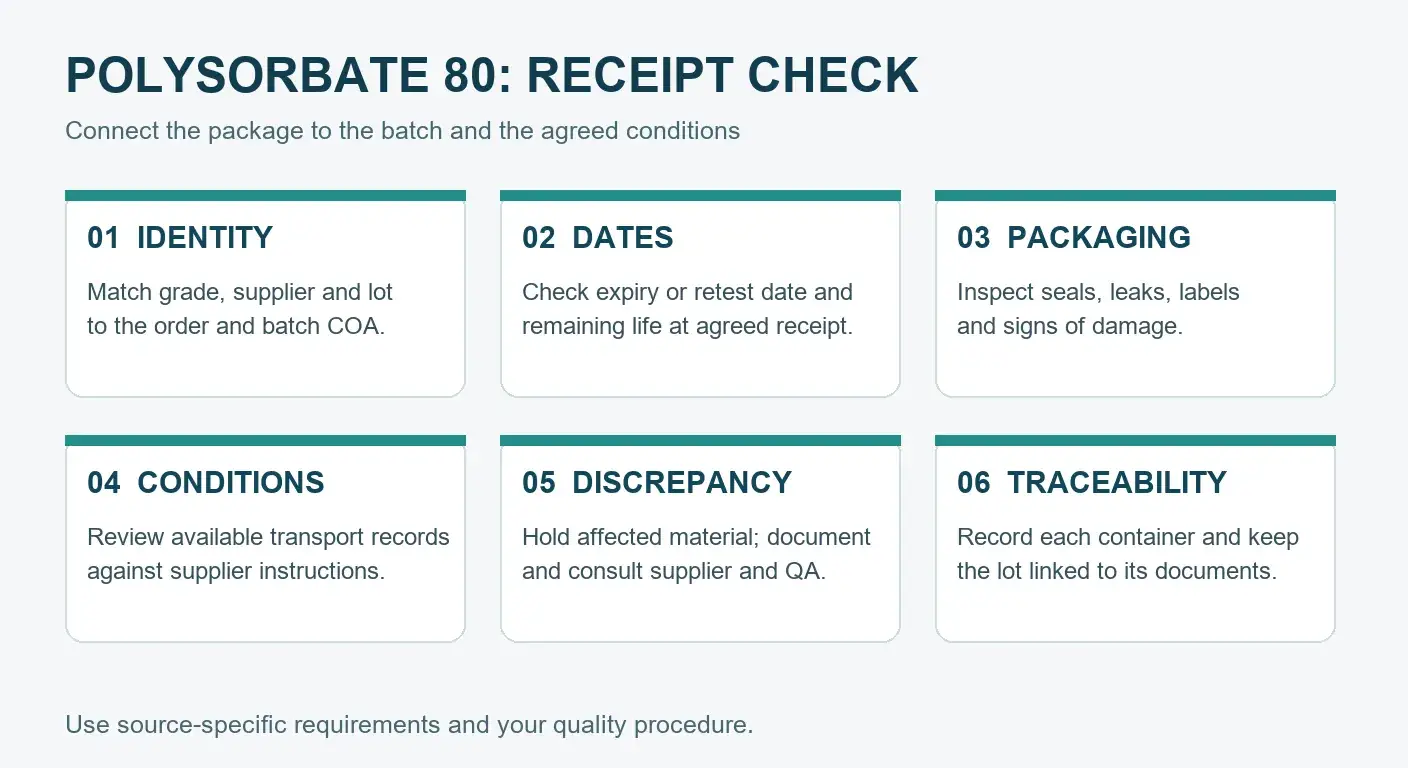
Before accepting the material into stock, compare each container and the shipping documents with the approved purchase order:
- Match the product name, grade, manufacturer or source, package size and lot number to the order and batch COA.
- Check manufacture and expiry or retest dates, where shown, and calculate remaining life from the agreed receipt or delivery date.
- Inspect for damaged seals, leaks, contamination, damaged labels or evidence of unsuitable handling. Record photographs and affected package numbers when appropriate.
- Compare any available temperature or incident records with the agreed transport conditions.
- Place material with an unresolved identity, date, packaging or transport discrepancy on hold under the buyer’s procedure. Obtain supplier guidance and a documented quality decision before use.
A package can look intact after an unrecorded temperature excursion. Conversely, a damaged outer package does not by itself prove that the ingredient failed. Investigate the specific event and evidence.
Expiry Date, Retest Date and Remaining Shelf Life
Expiry date is the date stated for use within the supplier’s defined conditions and contractual or regulatory context. Follow the supplier’s instructions and your quality system; do not assume an expired lot can be used simply because it looks normal.
Retest date, when the supplier assigns one, is a date for reassessment under the applicable procedure. It is not automatically an expiry date or permission to extend use. Any extension requires an authorised decision, appropriate test evidence and applicable legal and contractual review.
Remaining shelf life is the time between the agreed reference date and the labelled expiry date. For example, if a batch expires on 30 September 2028 and the agreed receipt date is 30 September 2027, it has approximately 12 months remaining at receipt. The dates are illustrative, not an offer or specification. State whether acceptance is calculated at dispatch, arrival at port or receipt at the buyer’s warehouse, and define the minimum in the purchase order.
When the planned use date is later than expiry, ask for a later-dated batch or revise the order plan. Do not infer a new expiry from the COA issue date.
What Changes After Opening a Drum or IBC?
The original unopened shelf-life statement may not cover a container after opening, repeated sampling or transfer. Ask the manufacturer for written open-container guidance for the actual package. If none is available, the buyer’s QA team should establish a controlled procedure based on risk assessment, supplier input, storage history and any appropriate testing.
Record the first-opened date and lot number, use clean equipment, close the container according to supplier instructions and protect the contents during each withdrawal. Track transfers to secondary containers so the original identity, relevant dates and traceability remain available. Do not assign a universal post-opening shelf life.
Does Appearance Prove the Material Is Still Suitable?
No. Appearance is useful for detecting an obvious deviation, but it does not measure every relevant quality attribute. Conversely, a change in appearance needs investigation against the product’s specification and supplier guidance before reaching a conclusion.
PubChem’s polysorbate 80 record cites reference material describing oxidation sensitivity and possible peroxide formation during prolonged storage. This is a reason to discuss relevant stability indicators with the manufacturer, not evidence that a particular lot has deteriorated. Select any testing and acceptance limits against the agreed specification, validated methods, the event being investigated and the buyer’s quality procedure. Do not assume that a standard COA includes a particular test.
If material has been exposed to conditions outside the stated range, isolate the affected lot, document the duration and conditions where known, and consult the supplier and QA. A retest is useful only when the selected tests and decision criteria address the concern; passing a limited panel does not recreate the original storage history.
Storage and Shelf-Life Checklist for Your RFQ
| Ask or check | Record before approval |
|---|---|
| Identity | Polysorbate 80, grade, product code, manufacturer and site |
| Documents | Current TDS, SDS, agreed specification and batch COA availability |
| Shelf life | Starting date, total period, expiry or retest policy and applicable package |
| Storage | Temperature range, light and moisture precautions, and approved packaging |
| Shipment | Destination, expected transit and any temperature or excursion requirements |
| Receipt | Minimum remaining life and the exact date at which it is measured |
| Packaging | Container type, size, seal, label information and batch identification |
| After opening | Supplier guidance, sampling and dispensing controls, and traceability |
| Exceptions | Who assesses excursions, discrepancies, retesting and release |
Include the expected quantity, destination and requested delivery date so the supplier can check whether an available batch meets the requirement. The food emulsifier RFQ checklist provides the wider purchasing details, and the COA checklist explains batch-document review.
Frequently Asked Questions
Does polysorbate 80 need refrigeration?
Do not assume refrigeration or a universal room-temperature range. Follow the manufacturer’s current instructions for the supplied grade and package. Ask about cold exposure and handling if the route or warehouse may fall outside the stated range.
Can I use polysorbate 80 after its expiry date?
Place it on hold and follow the manufacturer’s policy, applicable requirements and your QA procedure. A date extension should not be assumed; it requires an authorised, evidence-based decision where permitted.
Is the COA issue date the manufacturing date?
Not necessarily. The issue date records when the certificate was issued. Obtain the actual manufacture date and expiry or retest date from the supplier or label if they are not shown.
Is a three-year shelf life standard for all food-grade polysorbate 80?
No. A three-year date interval appears on one supplier’s identified lot certificate, but the relevant period and conditions depend on the product and source. Confirm the applicable documentation for the batch you intend to purchase.
Can I rely on the original shelf life after opening?
Only if the manufacturer confirms how its statement applies after opening and the buyer’s procedure accepts it. Otherwise obtain specific guidance and have QA decide how to control and assess the opened material.
Request Storage and Batch Documents
Before requesting a quotation, define the food-grade polysorbate 80 specification, destination, package size, expected delivery date and minimum remaining shelf life at receipt. Use the FoodEmul contact page to share these requirements and ask for the available current TDS, SDS, batch documentation and source-specific storage and shelf-life information.
