

What Are Polysorbates and Why Are They in Your Skincare?
Polysorbates are a family of non-ionic surfactants made by ethoxylating sorbitan esters. If you look at the back of a facial cleanser, micellar water, or leave-in conditioner, there’s a good chance you’ll see Polysorbate 20, Polysorbate 60, or Polysorbate 80 on the ingredient list.
They’re there for one reason: they make oil and water play nice. A toner with a drop of essential oil stays clear because a polysorbate has wrapped that oil in a micelle. A cream cleanser rinses off without leaving a film because the polysorbate emulsified the oils into the water phase. That lightweight, non-greasy texture people like in modern skincare? Polysorbates are doing a lot of the heavy lifting.
The three you’ll actually see in formulations are PS20, PS60, and PS80. They share the same sorbitan backbone but differ in the fatty acid attached and the length of the polyethylene oxide chains grafted on. Those differences map directly to what each one can do in a formula — and picking the wrong one is the most common mistake I see DIY formulators make.
Polysorbate 20 in Skin Care — The Solubilizer
Polysorbate 20 (polysorbate 20, E432) has an HLB of 16.7 and a lauric acid backbone. That high HLB makes it the most water-soluble of the three, and in skincare that means one thing: solubilization. PS20 is what you reach for when you want to dissolve a small amount of oil into a water-based product without cloudiness.
The Cosmetic Ingredient Review (CIR) Expert Panel assessed Polysorbate 20 in 2015 and found it safe as used in cosmetics at concentrations up to 5-10% in rinse-off products and 1-3% in leave-on products. It’s classified as a low-hazard ingredient in the EWG Skin Deep database, with a score of 3 (on a 1-10 scale where lower is safer). The primary concern flagged by CIR was not the polysorbate itself but the potential for 1,4-dioxane contamination from the ethoxylation process — a manufacturing issue, not an inherent property of the molecule. High-purity cosmetic-grade PS20 is vacuum-stripped to remove residual ethylene oxide and 1,4-dioxane.
Where you’ll see it: micellar waters, facial toners with essential oils, water-based serums with fragrance, makeup removers, and any “clear” product that lists an oil or fragrance in the ingredients.
Typical use rate: 0.5-2% for solubilizing fragrance oils, 3-5% in cleansers, up to 10% in rinse-off makeup removers.
One ratio I use as a starting point: 3 parts PS20 to 1 part essential oil. If the mixture hazes after 24 hours at room temperature, bump to 4:1 or switch to a PS20/PS80 blend. Heavier oils (patchouli, sandalwood, myrrh) often need 5:1 or more, or a switch to PS80 which has better compatibility with these oil profiles.
Polysorbate 60 in Skin Care — The Emulsifier
Polysorbate 60 (polysorbate 60, E435) has an HLB of 14.9 and a stearic acid backbone. Stearic acid is a saturated C18 fatty acid — solid at room temperature — and that gives PS60 different handling characteristics from PS20. It’s a waxy solid at 25°C rather than a viscous liquid.
In skincare, PS60 is the go-to emulsifier for oil-in-water creams and lotions where you want a richer, more substantive feel than PS20 provides. The longer fatty acid chain gives it better compatibility with the fatty alcohols and waxes used in cream formulations (cetyl alcohol, stearyl alcohol, glyceryl stearate).
The CIR Expert Panel reviewed Polysorbate 60 alongside the other polysorbates and reached the same safety conclusion: safe as used in cosmetics. FDA lists it as GRAS (Generally Recognized As Safe) under 21 CFR 172.836 for food use, and the cosmetic grade meets the same monograph specifications for purity and heavy metals. In China, the product quality standard is GB 25553.
Where you’ll see it: facial moisturizers, body lotions, sunscreens (O/W type), hair conditioners, and any cream product where you want a stable emulsion with a rich texture.
Typical use rate: 1-4% in O/W creams and lotions, often paired with a low-HLB co-emulsifier like glyceryl stearate or cetearyl alcohol at 1-2%.
PS60 forms the most stable emulsions with medium-chain triglycerides, jojoba oil, and squalane — all common in modern facial oils and serums. If your emulsion is breaking after 48 hours, check your oil phase. If it’s heavy on these medium-polarity oils, PS60 is likely the best fit.
Polysorbate 80 in Skin Care — The Workhorse
Polysorbate 80 (polysorbate 80, E433) has an HLB of 15.0 and an oleic acid backbone — monounsaturated C18, liquid at room temperature. It’s the most widely used polysorbate in skincare because its oleic acid tail gives it excellent compatibility with the broadest range of natural oils.
The CIR safety review for polysorbates covers PS80 under the same umbrella assessment. It’s classified as safe for cosmetic use, with the same ethoxylation-related manufacturing purity considerations as PS20 and PS60. The quality standard in China is GB 25554.
Where you’ll see it: oil cleansers, cleansing balms, emulsifying oil-to-milk products, facial creams with high oil phase (20-30%), body butters, hair oils that rinse clean. It’s also the standard emulsifier in bath oils and bath bombs — it disperses oils evenly through bath water instead of letting them float in a greasy slick.
Typical use rate: 5-10% in oil cleansers and cleansing balms, 2-5% in creams, 1-3% as a co-emulsifier.
In oil cleansers specifically, PS80 at 8-10% gives you the “emulsifies on contact with water” behavior that turns an oil into a milky rinse. Below 5%, the oil won’t rinse clean and you’ll get complaints about residue. Above 12%, the cleanser starts to feel sticky — there’s a fairly narrow sweet spot in that 8-10% range.
Is Polysorbate Safe for Skin? (Evidence vs. Internet Myths)
A few years ago, clean-beauty blogs started claiming polysorbates are “bad for your skin.” The argument was: polysorbates are ethoxylated → ethoxylation produces 1,4-dioxane → 1,4-dioxane is a carcinogen → therefore polysorbates are dangerous. Let’s walk through what the toxicology actually says.
The CIR Expert Panel — an independent group of dermatologists, toxicologists, and pharmacologists — conducted a comprehensive safety assessment of polysorbates 20, 40, 60, 65, 80, and 85 as used in cosmetics. Their 2015 report concluded that polysorbates are safe in the present practices of use and concentration. This is not a manufacturer’s claim. It’s the conclusion of an independent panel whose findings are published in the International Journal of Toxicology.
The 1,4-dioxane concern is a manufacturing-purity issue, not a polysorbate issue. 1,4-dioxane is a potential byproduct of ethoxylation — but cosmetic-grade polysorbates are vacuum-stripped to remove it. The FDA monitors 1,4-dioxane levels in cosmetic ingredients and has not established a concern for polysorbates at the levels found in finished products. A 2018 FDA survey found that 1,4-dioxane levels in cosmetic products have declined by over 90% since the 1980s due to manufacturer improvements in purification.
The EWG Skin Deep database gives Polysorbate 20 a score of 3, Polysorbate 60 a score of 3, and Polysorbate 80 a score of 3 (on their 1-10 scale). For context: water scores a 1, sodium lauryl sulfate scores a 1-2, and parabens score 5-8. A score of 3 puts polysorbates squarely in the low-concern category.
Is there a small subset of people who experience irritation from polysorbates? Yes — as with literally every cosmetic ingredient ever tested, including water and glycerin. The CIR report notes that polysorbates are low in irritation potential, and human repeat-insult patch tests (HRIPT) with 100% polysorbate 20 showed no sensitization. In practice, I’ve seen exactly zero cases of confirmed polysorbate allergy or irritation in years of working with cosmetic formulators — but if someone has extremely sensitive or compromised skin, a patch test is always the right call.
Polysorbates in Hair Care — Shampoos, Conditioners, and Leave-Ins
Hair care uses polysorbates differently from skincare. The surfactant concentration is higher, the contact time is shorter, and the goal shifts from “emulsify and stay” to “disperse and rinse.”
Shampoos: Polysorbate 20 at 2-5% acts as a secondary surfactant and solubilizer. It won’t produce the rich foam of sodium lauryl sulfate or sodium coco-sulfate, but it helps disperse fragrance oils, botanical extracts, and anti-dandruff actives (zinc pyrithione, piroctone olamine) evenly through the formula. In sulfate-free shampoos built on decyl glucoside or coco-glucoside, PS20 improves clarity and prevents fragrance separation on the shelf.
Conditioners: Polysorbate 60 at 0.5-2% helps emulsify the fatty alcohol phase (cetyl alcohol, stearyl alcohol, cetearyl alcohol) that gives conditioners their slip and detangling properties. PS60’s stearic acid backbone blends seamlessly with these fatty alcohols. PS80 is sometimes used instead in conditioners with a higher oil content (argan oil, coconut oil) because the oleic backbone gives better oil compatibility.
Leave-in products: PS20 at 0.5-1% solubilizes fragrance in water-based leave-in sprays and detanglers. The key constraint here is build-up — above 1%, you can feel a slight residue after multiple applications. PS80 at 0.3-0.8% is an alternative for products containing silicone oils (dimethicone, cyclomethicone) which PS20 doesn’t solubilize as effectively.
Hair serums and oils: PS80 at 3-5% in water-based serums, or at 8-10% in rinse-out hair oils that need to emulsify upon contact with water in the shower.
Ionic vs. Non-Ionic Detergents in Personal Care — What’s Actually Different?
The cleanser aisle is split into two worlds: ionic detergents that foam like crazy and strip everything, and non-ionic detergents that clean gently without the drama.
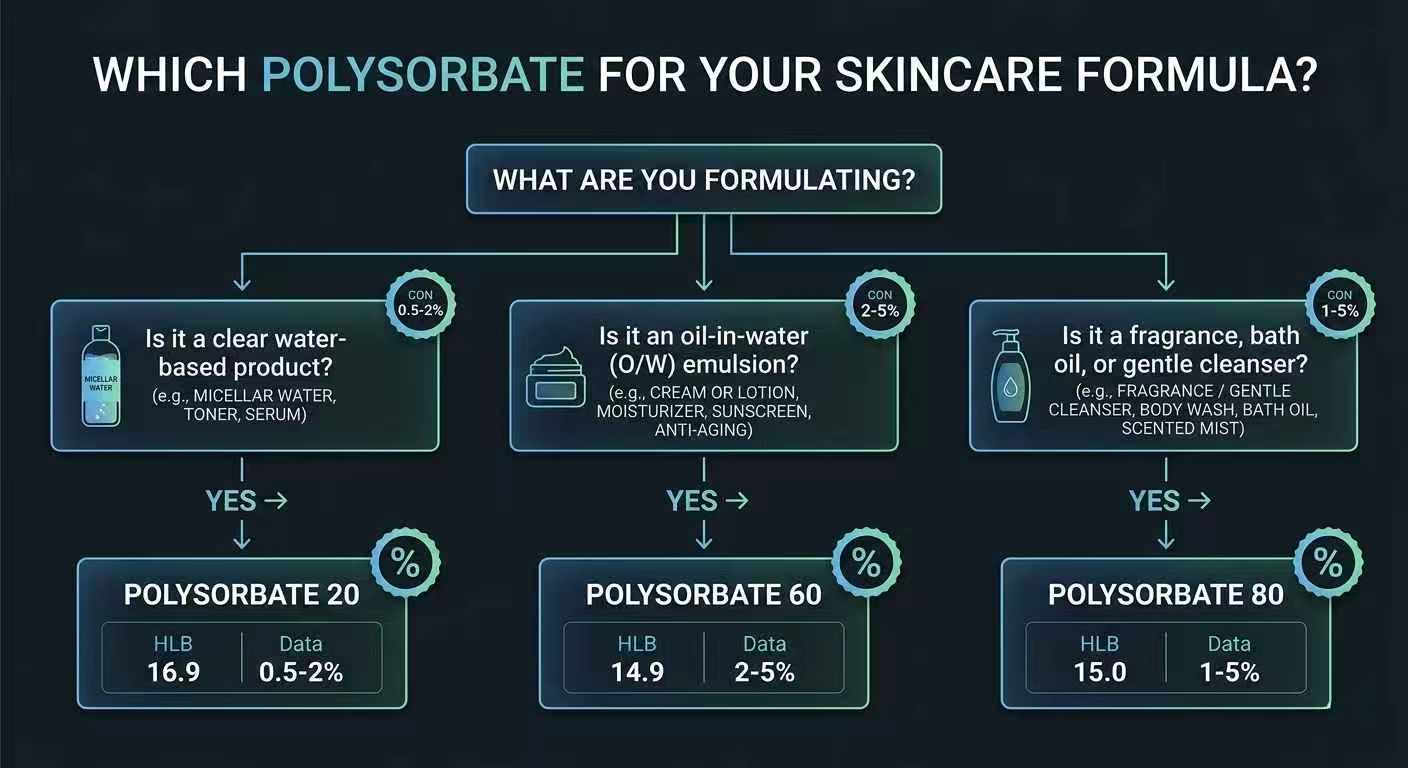
Ionic surfactants — sodium lauryl sulfate, sodium laureth sulfate, cocamidopropyl betaine — carry an electrical charge. That charge makes them excellent at lifting dirt and oil off skin and hair, but it also means they interact with the proteins in your skin barrier and hair cuticle. That’s why sulfate shampoos can leave hair feeling “squeaky clean” (read: stripped) and why they can trigger irritation in sensitive skin types.
Non-ionic detergents — polysorbates, decyl glucoside, coco-glucoside, laureth-4 — carry no charge. They clean by solubilizing oils into micelles rather than by electrostatic attraction. This is gentler because there’s no charge interaction with skin proteins or the hair cuticle. The tradeoff: less foam, and a different “rinse feel” that some consumers mistake for “not clean enough.”
In practice, most modern personal care cleansers use a blend — an anionic primary surfactant for foam and cleansing power, plus a non-ionic like polysorbate 20 for fragrance solubilization and mildness. The ratio matters: 80:20 anionic to non-ionic is a common starting point for a balanced cleanser. For ultra-mild products (baby washes, post-procedure cleansers), the ratio flips — non-ionic surfactants become the primary cleansers, with a small amount of amphoteric surfactant (cocamidopropyl betaine) for viscosity and foam stability.
The polysorbates are not the primary cleansers in any of these systems — at least not at typical use rates. They’re the behind-the-scenes ingredient that keeps the formula stable, clear, and evenly distributed. But without them, that sulfate-free shampoo with six botanical extracts and three fragrance oils would separate into layers within a week.
PS20 vs. PS60 vs. PS80 — A Formulator’s Quick Decision Guide
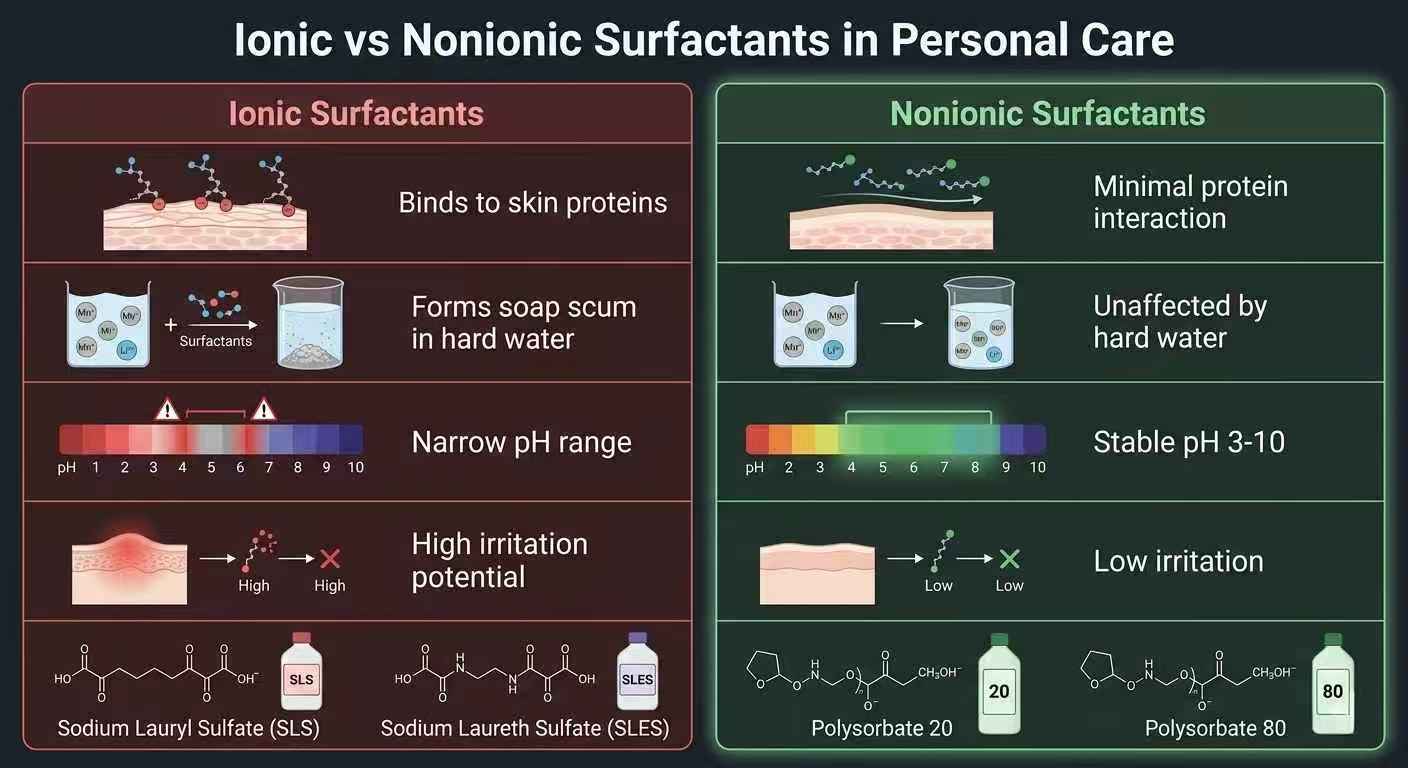
| Property | PS20 | PS60 | PS80 |
|---|---|---|---|
| HLB | 16.7 | 14.9 | 15.0 |
| Fatty acid | Lauric (C12, saturated) | Stearic (C18, saturated) | Oleic (C18, monounsaturated) |
| Physical form | Viscous liquid at 25°C | Waxy solid at 25°C | Viscous liquid at 25°C |
| Best for | Solubilizing fragrance, micellar waters, toners | O/W creams, lotions, hair conditioners | Oil cleansers, makeup removers, bath oils |
| Use rate | 0.5-5% leave-on, 5-10% rinse-off | 1-4% creams, 0.5-2% conditioners | 5-10% oil cleansers, 2-5% creams |
| Oil compatibility | Light oils, essential oils | Medium-chain triglycerides, squalane | Broadest — including heavy oils and silicones |
| Quality standard | GB 29221 (China), FCC, USP/NF | GB 25553 (China), FCC, USP/NF | GB 25554 (China), FCC, USP/NF |
| EWG Skin Deep | 3 (low concern) | 3 (low concern) | 3 (low concern) |
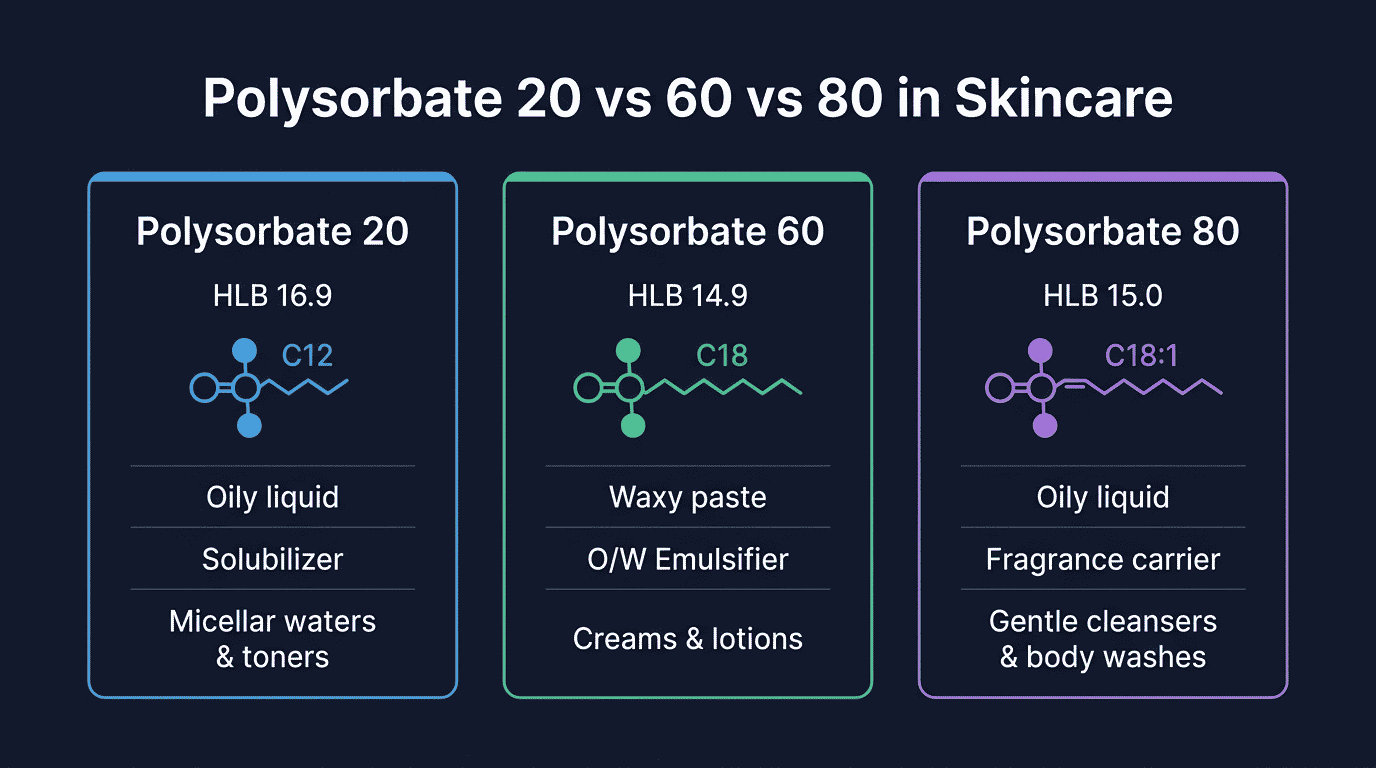
If I had to reduce this to one sentence for someone building their first skincare formula: PS20 for clear water-based products, PS60 for creams and emulsions that need body, PS80 when you’re working with heavy oils or need a product to rinse completely clean.
Frequently Asked Questions
Q: Is polysorbate 20 safe for skin?
Yes. The CIR Expert Panel reviewed all polysorbates and concluded they are safe as used in cosmetics. EWG gives PS20 a low-concern score of 3. The ethoxylation purity concern is a manufacturing issue addressed by vacuum-stripping in cosmetic-grade material — not a property of the polysorbate molecule itself.
Q: What’s the difference between polysorbate 20 and polysorbate 80 in skincare?
PS20 (HLB 16.7, lauric acid) is a solubilizer for light oils and fragrances in water-based products. PS80 (HLB 15.0, oleic acid) handles heavier oils and is the standard choice for oil cleansers and rinse-off products. PS20 gives you a lighter feel; PS80 gives you better heavy-oil compatibility.
Q: Can I use polysorbate 20 in shampoo?
Yes, at 2-5% as a secondary surfactant and fragrance solubilizer. It won’t contribute significant foam but will keep fragrance oils and extracts evenly dispersed through the formula. In sulfate-free systems it’s particularly useful for preventing separation.
Q: Is polysorbate bad for hair?
No. Polysorbates are non-ionic surfactants — they clean without charge-based interaction with the hair cuticle, making them gentler than sulfates. The main thing to watch is build-up: in leave-in products, keep PS20 below 1% to avoid residue accumulation over multiple applications.
Q: Why do some websites say polysorbate is toxic or dangerous?
This traces back to concerns about 1,4-dioxane, a potential ethoxylation byproduct. Cosmetic-grade polysorbates are purified by vacuum-stripping to remove residual 1,4-dioxane and ethylene oxide. The CIR, FDA, and European SCCS have all reviewed this and found polysorbates safe at cosmetic use levels. The “polysorbate is dangerous” narrative is an internet myth perpetuated by clean-beauty marketing — it’s not supported by the toxicology literature or regulatory assessments.
