
Estimated reading time: 9 minutes
Hi, I’m Joe. Here at FoodEmul, we’ve been supplying Span and polysorbate emulsifiers to food manufacturers for years, and biscuit and cookie producers ask us the same question: “Do I even need Span 60 in my dough?”
The honest answer is — it depends on your fat content. If you’re running a lean cracker line, probably not. But if you’re making butter cookies at 30% fat, or dealing with oil migration in sandwich cookies, Span and polysorbate solve problems that standard lecithin and GMS can’t touch.
In this guide, I’ll show you exactly where Span 60 and polysorbate 60 fit in biscuit production — specific applications, specific dosages, and the few places where they actually earn their cost. No filler.
Biscuits Are Different from Bread and Cake — Here’s Why It Matters
Biscuit and cookie dough is nothing like bread dough or cake batter:
| Property | Bread Dough | Cake Batter | Biscuit Dough |
|---|---|---|---|
| Water content | 55–65% | 25–40% | 10–20% |
| Fat content | 2–5% | 10–25% | 15–35% |
| Continuous phase | Water | Water | Fat |
| Gluten development | High | Low | Minimal |
| Key emulsifier function | Dough strengthening | Foam generation | Fat dispersion and control |
Biscuit dough is low-moisture, high-fat — close to a W/O system in some formulas. This decides which emulsifiers actually work. SSL, DATEM, and DMG (the main bread emulsifiers) operate in the water phase and lose effectiveness in low-moisture biscuit dough. The emulsifiers that matter in biscuits are the ones that control the fat phase.
Span 60 and polysorbate 60 fit into biscuit production at three specific points: fat dispersion in the dough, cream filling stability in sandwich cookies, and coating performance on chocolate-enrobed biscuits. They aren’t the primary biscuit emulsifiers — that’s lecithin and GMS in most industrial lines — but they fill gaps those general-purpose emulsifiers leave open.
Span 60 (E491) — Controlling Fat in Biscuit Dough
The Fat Distribution Problem
In biscuit production, you cream fat with sugar first, then add flour and water. The fat coats flour particles, limiting gluten hydration and giving you the tender, short texture of a good biscuit. But the fat has to coat evenly — uneven coating means uneven spread, irregular surface cracking, and inconsistent texture batch to batch.
How Span 60 Helps
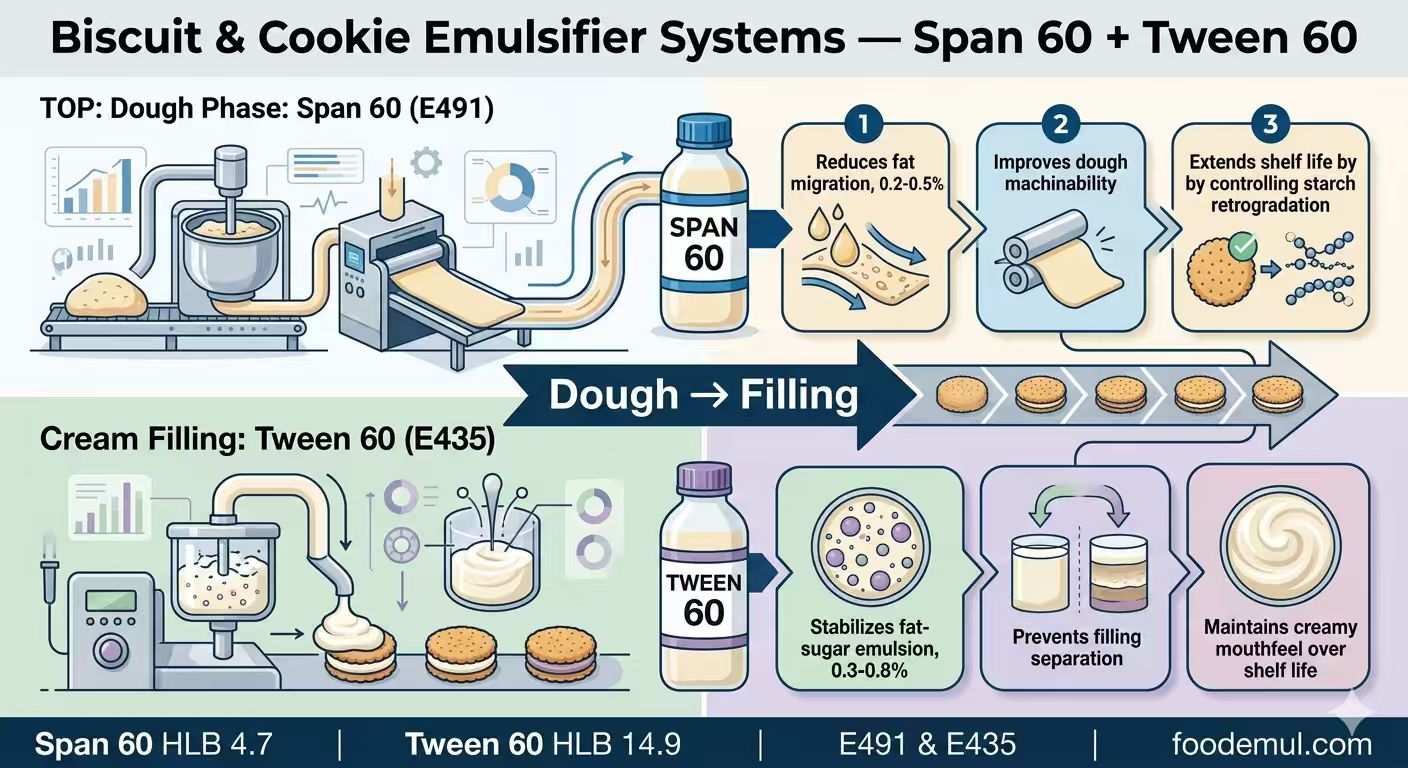
Span 60 at 0.1–0.3% of flour weight improves fat distribution through two mechanisms:
Fat crystal modification. Biscuit fats (butter, palm shortening, margarine) contain mixed crystal forms. Span 60 pushes the β’ (beta-prime) crystal form — the one that gives you finer fat crystals and smoother creaming. This means more even fat dispersion during creaming, which means biscuits with consistent spread and surface cracking.
Dough-phase stabilization. In low-moisture biscuit dough, Span 60’s low HLB (4.7) anchors at the limited water-fat interfaces, stopping fat from pooling into large pockets during mixing and sheeting. The result: dough that sheets more evenly and biscuits that hold their dimensions after baking.
Where Span 60 Adds the Most Value
| Biscuit Type | Why Span 60 Helps |
|---|---|
| Shortbread / butter cookies | High butter content (25–35% fat) — Span 60 controls fat distribution for uniform spread and surface finish |
| Rotary-molded biscuits | Dough must release cleanly from mold cavities — Span 60’s fat-phase control improves mold release |
| Laminated crackers | Alternating fat and dough layers — Span 60 in the roll-in fat maintains layer integrity |
| High-fat filled biscuits | Fat from filling migrates into the biscuit shell causing softening — Span 60 in the shell slows migration |
For full specs, see our Sorbitan Monostearate (E491) Technical Guide.
polysorbate 60 (E435) — Stabilizing Cream Fillings
The Cream Filling Challenge
Sandwich cookie fillings are high-fat, low-moisture pastes (30–40% fat, under 5% water) that need to stay smooth, spreadable, and non-oily through months of shelf life. Without proper emulsification, the filling separates — oil moves into the biscuit shell making it greasy, and the filling turns dry and crumbly.
How polysorbate 60 Stabilizes Fillings
polysorbate 60 at 0.1–0.3% of filling weight:
- Maintains fat-in-sugar dispersion. The filling is mostly fat and powdered sugar. polysorbate 60’s high HLB (14.9) keeps the small amount of water evenly spread through the fat phase, preventing sugar clumping and fat pooling.
- Slows oil migration. A stable filling emulsion means less driving force for oil to move out of the filling into the biscuit shell.
- Improves mouthfeel. Finer fat dispersion in the filling gives you a cleaner, less waxy mouthfeel.
For sandwich cookies with flavored fillings (chocolate, vanilla, fruit), polysorbate 60 also helps distribute flavor evenly through the filling mass.
For full polysorbate 60 technical data and FDA usage limits, see our Polysorbate 60 Food Application Guide.
Polysorbates in Chocolate-Coated Biscuits
Competitor literature flags polysorbates as useful for “biscuits with fillings, coatings, or toppings.” Two distinct jobs here:
Chocolate Enrobing Compound
When you enrobe biscuit in chocolate or compound coating, the coating needs to flow smoothly, coat evenly, and set with good gloss. PS80 or polysorbate 60 at 0.1–0.3% of the coating cuts interfacial tension between the coating and the biscuit surface, giving you a thinner, more uniform coating layer at lower temperature.
Fat Bloom Prevention
Fat bloom — that whitish film on chocolate-coated biscuits — comes from fat migrating out of the biscuit or filling into the chocolate coating. Span 60 in the biscuit dough (0.1–0.2%) slows fat migration by binding fat tighter in the biscuit matrix. polysorbate 60 in the coating improves cocoa butter crystal stability.
It’s a two-direction approach: Span 60 holds fat in the biscuit, polysorbate 60 stabilizes the coating structure. Together they tackle fat bloom from both sides.
Dosage by Biscuit Type
| Biscuit Type | Span 60 (% of flour) | polysorbate 60 (% of flour) | When to Add |
|---|---|---|---|
| Butter cookies / shortbread | 0.1–0.3% | — | Cream with fat and sugar |
| Rotary-molded biscuits | 0.1–0.2% | — | Cream with fat |
| Laminated crackers | 0.2–0.3% (in roll-in fat) | — | Blend into roll-in fat |
| Sandwich cookie filling | — | 0.1–0.3% (of filling) | Blend into filling during mixing |
| Chocolate-coated biscuits | 0.1–0.2% (in dough) | 0.1–0.3% (in coating) | Span in dough; polysorbate in coating |
| Enriched/soft cookies | 0.1–0.2% | 0.05–0.10% | Cream with fat |
Key principle: Span 60 dosage follows fat content. Above 25% fat, Span 60 at 0.2–0.3% gives you measurable improvement in fat distribution and dimensional consistency. Below 20% fat, the benefit drops off — there’s not enough fat phase to justify the cost.
Process Integration
Standard Biscuit Process with Span 60
- Creaming: Blend Span 60 powder with fat (butter, margarine, shortening) and sugar. Cream at medium speed for 2–4 minutes. Span 60’s melting point (~56°C) means it dissolves into the fat phase during creaming if fat temperature is adequate.
- Dough mixing: Add water, flour, leavening agents. Mix as little as possible — overmixing develops gluten and produces tough, distorted biscuits. Span 60, already dissolved in the fat phase, spreads through the dough as fat coats flour particles.
- Sheeting/forming: Sheet dough to target thickness; cut or mold. Span 60’s fat-phase control gives you more even sheeting with less sticking.
- Baking: 160–200°C, 8–15 minutes depending on biscuit type. Span 60’s fat crystal effect holds through baking — it doesn’t evaporate or degrade at biscuit baking temperatures.
Cream Filling Process with polysorbate 60
- Blend polysorbate 60 powder with the fat portion of the filling (usually palm-based shortening) at 35–45°C.
- Add powdered sugar, flavors, colors; mix to a uniform paste.
- Cool to depositing temperature (25–30°C); deposit onto biscuit shells.
- Let sandwich cookies rest 24–48 hours before packaging — this lets the filling set and the emulsion stabilize.
Troubleshooting
| Problem | Likely Cause | Span/polysorbate Solution |
|---|---|---|
| Uneven biscuit spread | Uneven fat distribution in dough | Add Span 60 at 0.1–0.2%; check creaming time and fat temperature |
| Excessive spread | Low-melting fat pools during baking | Span 60 at 0.2–0.3% raises effective fat melting point through co-crystallization |
| Oily/greasy filling | Filling emulsion breakdown | Add polysorbate 60 at 0.2–0.3% of filling; check fat-to-sugar ratio |
| Chocolate coating whitening (bloom) | Fat migration from biscuit to coating | Span 60 in dough (0.1–0.2%); check storage temperature |
| Filling hardening | Sugar recrystallization in filling | polysorbate 60 at 0.1–0.2% keeps water distributed through filling |
| Sticking to molds | Poor mold release in rotary molder | Span 60 at 0.1–0.2% improves fat-phase mold release |
The Bottom Line
Span 60 and polysorbate 60 play specific, targeted roles in biscuit and cookie manufacturing — not as primary dough emulsifiers (lecithin and GMS do that job economically in most lines), but as the fix for three fat-phase problems:
- Span 60 controls fat distribution in high-fat doughs — improving dimensional consistency and surface quality. Most valuable in butter cookies, shortbread, and laminated products where fat exceeds 25%.
- polysorbate 60 stabilizes cream fillings — preventing oil migration and sugar recrystallization. Most valuable in sandwich cookies and filled biscuits.
- Together, they fight fat bloom on chocolate-coated biscuits — Span 60 in the dough holds fat in place, polysorbate 60 in the coating stabilizes the structure.
If you make biscuits and are evaluating Span/polysorbate, focus on these three applications. Don’t treat them as general-purpose biscuit emulsifiers — in the right spot, they solve problems lecithin and GMS can’t fully cover.
For Span 60 technical specs, see the Sorbitan Monostearate Technical Guide. For polysorbate 60 application limits, see the Polysorbate 60 Food Application Guide. For HLB methodology, refer to our Span & polysorbate Formulators Guide. For emulsifier fundamentals, see our Guide to Food Emulsifier Functions.
This guide draws on published industry research, formulation practice, and the food emulsifier science reference work by Hu et al. (2011). For specific biscuit formulation advice, consult your emulsifier supplier’s technical service team.