
Estimated reading time: 11 minutes
Hi, I’m Joe. Here at FoodEmul, we’ve been supplying Span and polysorbate emulsifiers to food manufacturers for years, and one question keeps coming up from plant-based brands: “Are your emulsifiers actually plant-derived?”
The answer is yes — and it’s not a new product line. Span and polysorbate have always been made from plants. The sorbitan backbone comes from corn or cassava glucose. The fatty acids come from vegetable oils. These aren’t “plant-based versions” of something else — they’ve been plant-based from day one.
In this guide, I’ll walk you through exactly which Span and polysorbate grades work in which plant-based applications, what dosages to use, and how plant-derived sourcing simplifies your certifications. No fluff — just what works on a production line.
Span and polysorbate Are Plant-Derived — Always Have Been
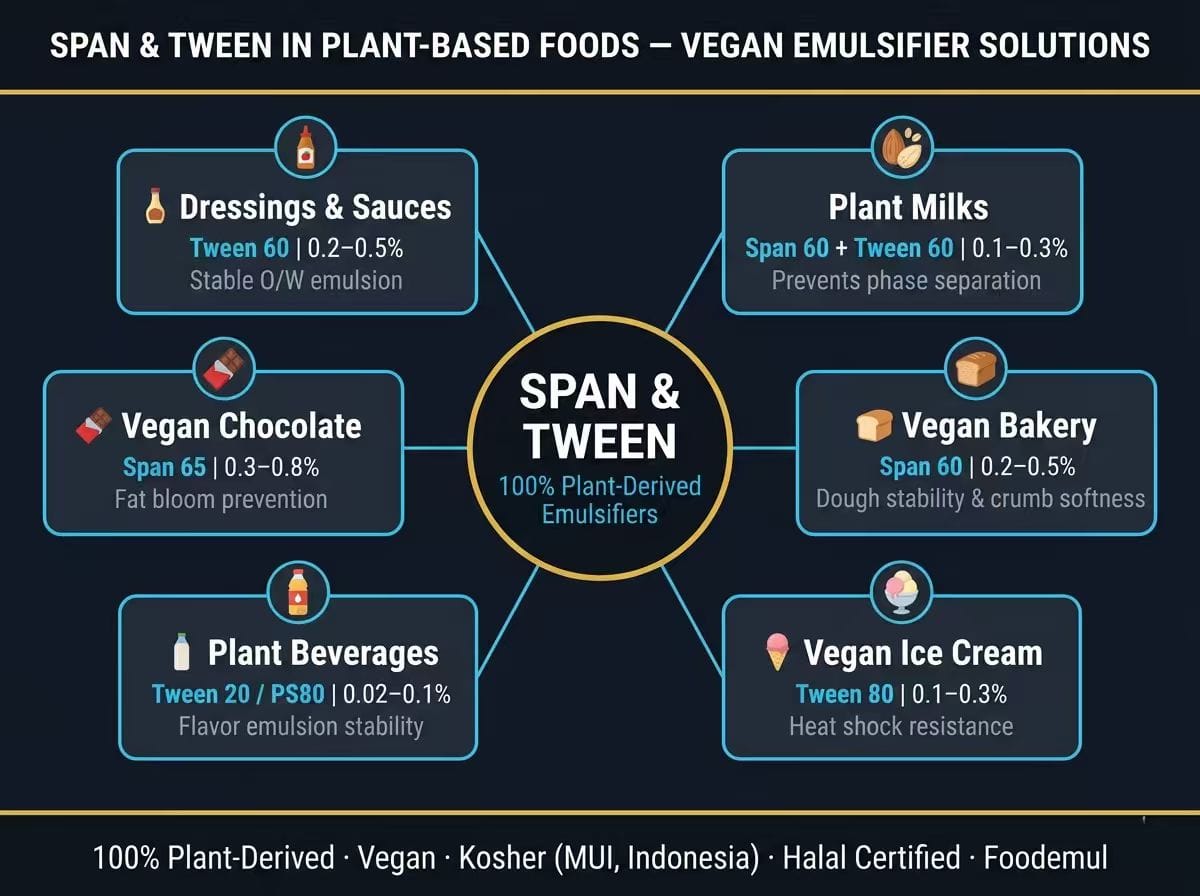
The most basic fact about sorbitan esters (Span) and polysorbates (polysorbate) for plant-based manufacturing: they are plant-derived emulsifiers. Not a new “plant-based version” — this is how they’ve always been made.
Raw Material Origin
| Raw Material | Source | Product |
|---|---|---|
| Sorbitol | Hydrogenated glucose from corn starch, cassava, or wheat | Sorbitan ring structure (both Span and polysorbate) |
| Stearic acid (C18:0) | Palm oil, palm stearin, or shea butter | Span 60, polysorbate 60 |
| Oleic acid (C18:1) | Palm oil, sunflower oil, soybean oil | Span 80, PS80 |
| Lauric acid (C12:0) | Palm kernel oil, coconut oil | Span 20, polysorbate 20 |
| Ethylene oxide | Petroleum-derived (synthetic step) | Polysorbates only |
The sorbitan backbone and the fatty acids are plant-derived. For polysorbates, the ethylene oxide polymerization step is synthetic — but the resulting molecule still counts as plant-based in food regulation because the functional portion (sorbitan ester) and roughly 70% of the molecular weight comes from plant sources.
Competitor literature lists polysorbates (polysorbate series) among plant-based food emulsifiers, alongside vegetable-derived DMG, GMS, SSL, and lecithin. For sourcing details, see our Guide to Food-Grade Span & polysorbate Raw Materials.
Certification Advantages
Plant-derived Span/polysorbate emulsifiers make certification simpler than animal-derived alternatives:
| Certification | Plant-Based Span/polysorbate Status |
|---|---|
| Vegan | Yes — no animal-derived raw materials |
| Vegetarian | Yes |
| Halal | Certifiable — no animal or alcohol components |
| Kosher | Certifiable — pareve (neutral) status achievable |
| Non-GMO | Available — non-GMO sorbitol and fatty acid sources |
This means Span/polysorbate work for products targeting multiple dietary groups at once — a real advantage for brands shipping globally. For the full plant-based compliance picture, see our Plant-Based Emulsifiers Comprehensive Guide.
Plant-Based Dairy Alternatives — Where Span/polysorbate Do the Heavy Lifting
Plant-based dairy alternatives are the biggest category where Span/polysorbate emulsifiers earn their keep. Unlike cow’s milk, plant milks have no native emulsifying proteins — without added emulsifiers, they separate into water, oil, and sediment layers fast. (For cow’s milk dairy beverages — flavored milk and reconstituted products — our dairy beverage formulation guide covers emulsifier dosage and pH-specific strategies.)
Oat Milk
The problem: Oat milk has fine fiber particles that sink over time, plus a small oil layer that rises to the top. No native emulsifying proteins.
The fix: polysorbate 60 at 0.05–0.10% handles fat dispersion and adds the creamy, opaque look consumers expect. Pair with a stabilizer (gellan gum or xanthan gum) for fiber suspension. Span 60 isn’t needed here — the fat content is too low for a low-HLB emulsifier to add value.
Almond Milk
The problem: Almond milk splits into three layers — clear water on top, a thin oil film, and fine almond particles on the bottom. Fat content is low (~2–3%), but visible separation kills shelf appeal.
The fix: polysorbate 60 or PS80 at 0.05–0.15% keeps almond oil evenly spread. Competitor literature specifically recommends Polysorbate 60 for almond-based drinks — it prevents separation in low-fat formulations. Add guar gum for body and mouthfeel.
Coconut Milk and Coconut Yogurt
The problem: Coconut milk packs 15–25% oil that solidifies at fridge temperature (melting point ~24°C). The phase change causes severe separation — liquid oil floats at room temp, solid fat sinks in the fridge.
The fix: This is the plant-based dairy application where Span 60 delivers the most value. Span 60 (HLB 4.7) + polysorbate 60 (HLB 14.9) at a 1:3 to 1:2 ratio, combined HLB ~12, at 0.10–0.25%. Span 60 co-crystallizes with coconut oil’s saturated fats (mostly C12:0 lauric), anchoring the fat phase through the liquid-to-solid transition. polysorbate 60 keeps the system oil-in-water and ensures quick re-dispersion on pouring.
For fermented coconut yogurt (pH 4.0–4.5), use polysorbate 60 at the higher end of the ratio — it handles acidic conditions better than most high-HLB emulsifiers.
Soy Milk
The problem: Soy milk has some natural emulsifying ability from soy proteins, but processing (soaking, grinding, heating) knocks some of that out, and the remaining protein varies batch to batch.
The fix: Low levels of polysorbate 60 (0.02–0.05%) support soy protein’s natural emulsification. Don’t go higher — too much polysorbate 60 competes with soy proteins at the interface and can make things worse. Lecithin is the more common primary emulsifier for soy; polysorbate 60 is a supplement when lecithin alone isn’t enough for your shelf-life target.
Plant-Based Bakery
Egg-Free Cakes
Removing eggs from cake removes both foam generation (egg white proteins) and emulsification (egg yolk phospholipids). Span 60 + polysorbate 60 cake gel systems replace both functions — and since both are plant-derived, the cake is fully vegan.
Recommendation: Span 60 : polysorbate 60 = 1:2 at 3–6% of batter weight (higher than dairy-egg formulations because you’re replacing both foaming and emulsifying). Full details in our Cake Gel Emulsifier Guide.
Vegan Butter and Margarine
Plant-based butter alternatives (coconut oil, shea butter, palm oil blends) are W/O emulsions — same structure as dairy margarine. Span 60 at 0.3–0.5% is the primary W/O stabilizer. polysorbate 60 at a Span:polysorbate = 2:1 to 3:1 ratio gives you spreadability control.
Key difference from dairy margarine: Plant-based fat blends crystallize differently than butterfat. Coconut-oil-based vegan butter goes firm below ~24°C but fully liquid above it — a tighter plastic range than butterfat. Push Span 60 closer to 0.5% to build a stronger crystal network that holds up through that narrow range.
Gluten-Free Baking
Gluten-free doughs lack the elastic protein network that traps gas and provides structure. Emulsifiers help fill the gap: polysorbate 60 at 0.1–0.3% improves gas retention through the interface-modification mechanism covered in our Bread Emulsifier Guide. Span 60 at 0.1–0.2% structures the fat phase in enriched gluten-free doughs.
Plant-Based Beverages
Protein Shakes and Meal Replacements
RTD plant-based protein drinks (pea, soy, rice protein) have two stability challenges at once: fat emulsification and protein suspension. polysorbate 60 at 0.05–0.15% handles the fat phase. Add Span 60 at 0.02–0.05% when the formula includes oils (MCT, flax, canola) above 3%.
polysorbate 60’s higher melting point makes it better than PS80 for UHT-processed protein drinks (135–145°C). PS80 works for cold-process or HTST-pasteurized protein drinks.
Flavored Plant-Based Waters
Lightly flavored plant-based waters need stable flavor oil emulsification at very low oil load (0.02–0.10%). PS80 at 10–50 ppm in the finished drink gives sub-micron flavor oil droplets that stay visually clear. The mechanism is the same as conventional flavored waters — the plant-based positioning comes from the emulsifier source, not a different technique.
Plant-Based Confectionery and Coatings
Vegan Chocolate
Vegan chocolate swaps milk fat for cocoa butter or vegetable fats. Span 60 at 0.1–0.3% improves fat dispersion and contributes to snap and gloss in properly tempered chocolate. polysorbate 60 isn’t used here — chocolate is fat-continuous and low-HLB emulsifiers are the right tool.
Compound Coatings
Compound coatings (vegetable fat + sugar + cocoa powder, no cocoa butter) for ice cream bars, bakery, and confectionery: Span 60 at 0.2–0.5% stabilizes the fat phase and improves coating viscosity for even enrobing. Pair with lecithin for cost-effective flow control.
The Regulatory Advantage: Global Market Access
Plant-derived Span/polysorbate emulsifiers face fewer regulatory hurdles than animal-derived alternatives:
- EU: All Span/polysorbate food emulsifiers are approved additives with E-numbers (E491–E495, E432–E436). Plant-derived origin simplifies novel food and GMO documentation.
- Middle East / Southeast Asia: Halal certification is straightforward — no animal tissues, no alcohol in the finished product.
- North America: Span/polysorbate are GRAS. Plant-derived origin supports “suitable for vegan” and “plant-based” label claims.
- India: FSSAI approves sorbitan esters and polysorbates. Vegetarian mark (green dot) is applicable.
For full regulatory details, see our Global Food Additive Compliance Guide.
Dosage Quick Reference for Plant-Based Applications
| Application | Span 60 | polysorbate 60 / PS80 | Ratio (Span:polysorbate) |
|---|---|---|---|
| Oat milk | — | 0.05–0.10% (polysorbate 60) | N/A |
| Almond milk | — | 0.05–0.15% (polysorbate 60) | N/A |
| Coconut milk | 0.03–0.06% | 0.10–0.20% (polysorbate 60) | 1:3 to 1:2 |
| Soy milk | — | 0.02–0.05% (polysorbate 60) | N/A |
| Vegan cake (egg-free) | 1–2% | 2–4% (polysorbate 60) | 1:2 |
| Vegan butter/margarine | 0.3–0.5% | 0.1–0.2% (polysorbate 60) | 2:1 to 3:1 |
| Plant protein shakes | 0.02–0.05% | 0.05–0.15% (polysorbate 60) | 1:3 |
| Flavored plant water | — | 10–50 ppm (PS80) | N/A |
| Vegan chocolate | 0.1–0.3% | — | Span 60 alone |
| Compound coatings | 0.2–0.5% | — | Span 60 + lecithin |
Process Considerations for Plant-Based Systems
- Pre-hydration of Span 60: Plant-based fat blends often melt differently than dairy fat. Make sure Span 60 is fully melted (>56°C) before adding the water phase. In coconut-oil-based products, pre-melt the entire fat phase to 60–65°C.
- Homogenization pressure: Plant-based milks benefit from higher homogenization pressure (200–300 bar) than dairy milk — plant proteins don’t spread at interfaces as easily as casein. polysorbate 60 helps at the interface.
- pH sensitivity: Fermented plant-based products (yogurt alternatives, pH 4.0–4.5) need pH-tolerant emulsifiers. polysorbate 60 holds up in acidic conditions better than most protein-based emulsifiers. Span 60 is pH-insensitive.
- Heat treatment: UHT processing (135–145°C) of plant-based beverages denatures any native plant proteins, so you’ll rely more on added emulsifiers for stability. Formulate for the post-UHT condition, not how the emulsion looks before heating.
Troubleshooting
| Problem | Likely Cause | Span/polysorbate Solution |
|---|---|---|
| Creaming / oil separation | Insufficient fat phase stabilization | Add Span 60 at 0.02–0.05%; increase polysorbate 60 dosage |
| Sedimentation | Fiber/protein settling; not an emulsifier problem | Add stabilizer (gellan gum, xanthan); emulsifiers don’t suspend solids |
| Coconut milk solidifies as a block | Coconut oil crystallization without emulsifier control | Add Span 60 at 0.05% to modify crystal network; polysorbate 60 at 0.15% |
| Vegan cake collapse | Insufficient foam stability without eggs | Increase Span 60 proportion to 1:1.5 (Span:polysorbate); verify specific gravity |
| Phase separation in vegan yogurt | Acidic pH + heat treatment denatures proteins | polysorbate 60 at 0.10–0.20%; pair with pectin or gellan gum |
| Grainy plant-based butter | Poor fat crystal structure | Increase Span 60 dosage; verify cooling rate in votator |
The Bottom Line
Span and polysorbate emulsifiers are plant-derived — their sorbitan backbone comes from corn or cassava glucose, and their fatty acids come from vegetable oils (palm, coconut, sunflower, soybean). This makes them a natural fit for plant-based manufacturing, with simpler vegan, Halal, and Kosher certification than animal-derived alternatives.
The four key decisions for plant-based food manufacturers:
- polysorbate 60 is your primary emulsifier for plant milks — oat, almond, and soy need the high-HLB fat dispersion that polysorbate 60 provides at 0.02–0.15%
- Add Span 60 when fat content exceeds 3% — coconut milk, vegan butter, and oil-enriched formulas benefit from low-HLB fat-phase anchoring
- Span/polysorbate replace missing egg and dairy proteins — in vegan bakery and plant-based ice cream, they handle both foaming and emulsifying
- Plant-derived origin simplifies compliance — vegan, Halal, Kosher, and global market access are all easier with Span/polysorbate than with animal-derived emulsifiers
For plant-derived sourcing details, see our Food-Grade Span & polysorbate Raw Materials Guide. For the broader plant-based emulsifier picture, see the Plant-Based Emulsifiers Comprehensive Guide. For HLB methodology, refer to our Span & polysorbate Formulators Guide. For PS80 applications, see PS80: What Is It.
This guide draws on published industry research, formulation practice, and the food emulsifier science reference work by Hu et al. (2011). For specific plant-based formulation advice tailored to your product, consult your emulsifier supplier’s technical service team.