
Choosing the right emulsifier is not about picking the one with the best spec sheet. It is about matching molecular structure, HLB, and fatty acid chain to what your product actually needs — pH, fat profile, processing temperature, and shelf life. At FoodEmul, we help formulators make this decision every day. This guide lays out a systematic framework for emulsifier selection, from oil phase characterization to final ratio testing.
The 5-Step Selection Framework
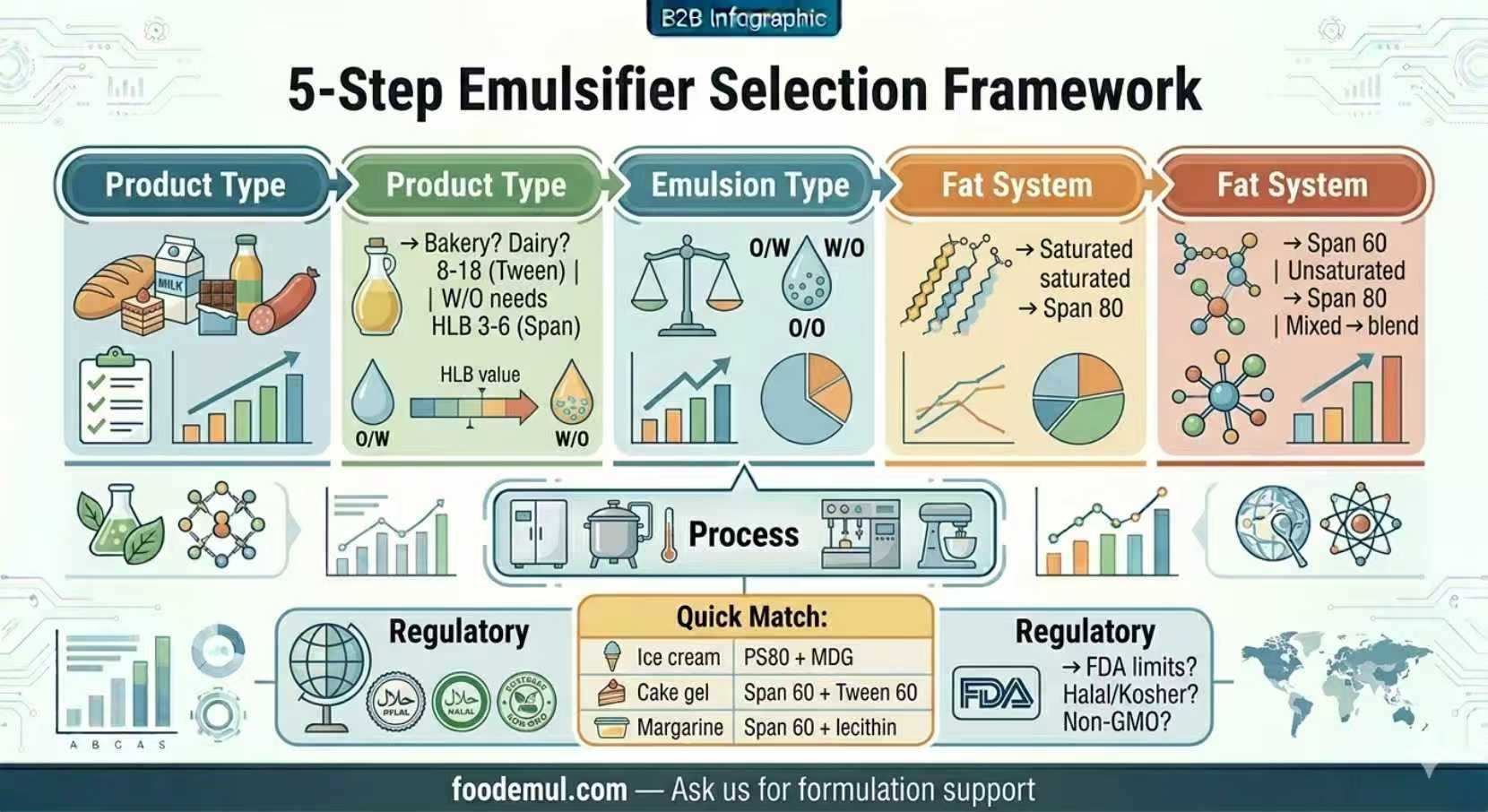
Selecting the right emulsifier is not a single decision — it is a sequence of narrowing filters. The framework below takes you from product type to final emulsifier system:
| Step | Question | Output |
|---|---|---|
| 1. Product Type | What is the food system? | Emulsion type (O/W or W/O), fat content, key structural requirements |
| 2. Primary Function | What must the emulsifier do? | Functional category: dough strength, aeration, fat stabilization, anti-staling, moisture retention |
| 3. Fat System | What is the oil/fat phase? | Required HLB, fatty acid chain type → Span/Polysorbate pair selection |
| 4. Process Conditions | Heat? Shear? pH? Freeze-thaw? | Emulsifier stability requirements and form (powder/liquid) |
| 5. Regulatory & Label | E-number limits? Clean label? Kosher/halal? | Approved emulsifier list, dosage limits |
If you are new to food emulsifier functions, start with our guide to food emulsifier functions and applications.
Step 1: Match Emulsifier to Product Type
| Product Type | Emulsion System | Fat Content | Critical Emulsifier Functions | Primary Emulsifiers |
|---|---|---|---|---|
| Bread / toast | Mostly O/W, partial W/O at fat interface | 2-8% | Dough strengthening, gas retention, anti-staling | DATEM (E472e), SSL (E481), GMS (E471) |
| Cakes (sponge, pound) | O/W with foam | 5-25% | Aeration, foam stability, crumb softening | Span 60 + Polysorbate 60 (cake gel), PGMS, GMS |
| Ice cream | O/W with partial coalescence | 8-18% | Fat destabilization, air cell stabilization | Span 80 + Polysorbate 80, GMS |
| Beverage emulsions | O/W | 0.05-2% | Fine droplet stabilization, density matching | Polysorbate 80/20, sucrose esters, PGMS |
| Margarine / shortening | W/O | 60-85% | Water droplet dispersion, fat crystal stabilization | Span 60, GMS, PGPR |
| Chocolate / confectionery | W/O (fat-continuous) | 28-42% | Viscosity reduction, fat crystal control | PGPR (E476), lecithin, Span 65 |
| Dairy (yogurt, cream) | O/W | 3-40% | Protein-fat interface stabilization | GMS, lecithin |
| Dressings / sauces | O/W | 10-50% | Long-term emulsion stability, mouthfeel | Polysorbate 80, Span 80, GMS |
For detailed product-by-product guidance, see our application guides for bread, cake gel, and ice cream.
Step 2: Select by Primary Function
Emulsifiers have distinct functional strengths. Match the function to the emulsifier, not the other way around.
Dough Strengthening & Gas Retention
These emulsifiers interact with gluten proteins to form a stronger, more elastic dough network that traps fermentation CO₂:
| Emulsifier | Mechanism | Typical Dosage (% of flour) | Best For |
|---|---|---|---|
| DATEM (E472e) | Cross-links gluten via tartaric acid ester groups | 0.2-0.5% | High-speed bread lines, frozen dough |
| SSL (E481) | Ionic binding to gluten, strengthens protein film around gas cells | 0.3-0.5% | Sandwich bread, soft rolls |
| CSL (E482) | Milder gluten interaction than SSL | 0.2-0.5% | Softer texture breads, low-fat formulations |
Span and Polysorbate are NOT primary dough strengtheners — they are nonionic and do not interact directly with gluten proteins. However, Span 60 (0.1-0.3%) can supplement DATEM/SSL systems by improving fat dispersion in dough, which indirectly supports gas retention and crumb softness.
Aeration & Foam Stability
These emulsifiers drive air incorporation and stabilize air cells during mixing and baking:
| Emulsifier | Mechanism | Typical Dosage | Best For |
|---|---|---|---|
| Polysorbate 60 (E435, HLB 14.9) | Rapid surface tension reduction at air-water interface | 0.1-0.5% of batter | Sponge cake, whipped topping |
| PGMS (E477) | Strong aeration, alpha-tending — forms solid film at bubble interface | 3-14% of shortening | Cake mixes, cream fillings |
| SSL (E481) | Secondary aeration booster in cake systems | 0.2-0.5% | High-ratio cakes |
Span 60 (E491, HLB 4.7) is essential as the foam-stability partner to Polysorbate 60. Span 60 co-crystallizes with fat at the bubble surface, creating a heat-resistant film that prevents foam collapse during baking. A Span 60:Polysorbate 60 ratio of 1:2 is the standard starting point for cake gel foam systems. Our HLB System guide explains the ratio calculation.
Fat Stabilization & Crystallization Control
| Emulsifier | Mechanism | Typical Dosage | Best For |
|---|---|---|---|
| Span 60 (E491) | Co-crystallizes with solid fat, forms rigid shell around fat droplets | 0.1-0.5% | Margarine, shortening, cake foam |
| GMS (E471) | Modifies fat crystal size and polymorphic form (promotes β’ form) | 0.2-1.0% | Margarine, spreads |
| PGPR (E476) | Strong W/O emulsifier, reduces fat crystal network strength | 0.2-0.5% | Chocolate viscosity reduction |
Anti-Staling & Crumb Softening
| Emulsifier | Mechanism | Typical Dosage | Best For |
|---|---|---|---|
| GMS / DMG (E471) | Forms insoluble complex with amylose, preventing starch retrogradation | 0.2-0.5% | Bread, cakes, buns |
| SSL (E481) | Starch complexation + gluten interaction | 0.3-0.5% | Packaged bread |
| CSL (E482) | Milder starch complexation, retains crumb moisture | 0.2-0.5% | Sliced bread |
GMS is the most cost-effective anti-staling emulsifier. For maximum shelf life, combine GMS (starch complexation) with SSL (gluten strengthening + moisture retention).
Moisture Retention
| Emulsifier | Mechanism | Typical Dosage | Best For |
|---|---|---|---|
| GMS (E471) | Humectant effect, reduces water activity at crumb surface | 0.3-1.0% | Cakes, muffins |
| SSL (E481) | Water binding in gluten network | 0.2-0.5% | Bread |
| Span 60 (E491) | Reduces moisture migration from crumb to crust | 0.1-0.3% | Packaged cakes |
Step 3: Match the Fat System to the Span/Polysorbate Pair
The fatty acid chain of the emulsifier should match the dominant fatty acid in the food’s fat phase. This is a fundamental principle covered in our Compound Emulsifiers guide.
| Dominant Fat Type | Fatty Acid | Melting Behavior | Best Span/Polysorbate Pair |
|---|---|---|---|
| Bakery shortening (palm stearin, tallow) | Stearic (C18:0), Palmitic (C16:0) | Solid at room temp, melts ~40-55 °C | Span 60 + Polysorbate 60 |
| Dairy fat (butterfat, cream) | Oleic (C18:1), Palmitic (C16:0) | Semi-solid, melts ~30-35 °C | Span 80 + Polysorbate 80 |
| Liquid vegetable oils (soybean, corn, sunflower) | Linoleic (C18:2), Oleic (C18:1) | Liquid at room temp | Span 80 + Polysorbate 80 |
| Coconut / palm kernel oil | Lauric (C12:0) | Solid at cool temp, melts ~24-26 °C | Span 20 + Polysorbate 20 |
| Cocoa butter | Stearic (C18:0), Palmitic (C16:0), Oleic (C18:1) | Solid, sharp melt at 34 °C | PGPR + Span 65 or Span 60 |
Step 4: Process Conditions Filter
Different processing environments demand different emulsifier properties:
| Process Condition | Emulsifier Requirement | Good Choices | Avoid |
|---|---|---|---|
| High-temperature (>100 °C) | Thermal stability, high melting point | Span 60 (MP ~53 °C), DATEM, SSL | Polysorbate 20 (liquid, may degrade) |
| Low pH (<4.0) | Acid stability | Nonionic Span/Polysorbate, PGMS | Lecithin (degrades), some SSL grades |
| High shear (homogenization) | Rapid interfacial adsorption | Polysorbate 80 (fast), Polysorbate 20 (fastest) | Span-only (too slow to cover new interfaces) |
| Freeze-thaw cycling | Cold stability, fat recrystallization tolerance | Span 80/Polysorbate 80, GMS | Span 60 (may crystallize and desorb) |
| Long ambient storage | Resistance to polymorphic transformation | Span 60, PGPR, DMG | Polysorbate 20 (hygroscopic) |
| Dry premix / powder | Powder form, good flowability | Span 60 powder, GMS powder, SSL powder | Liquid Polysorbate, liquid lecithin |
Form selection: Powdered Span 60 and spray-dried GMS are preferred for dry premix systems (cake mixes, bread improvers). Liquid Polysorbate 80 and Polysorbate 20 are preferred for liquid dosing systems in beverage and dairy plants.
Step 5: Regulatory & Labeling Constraints
E-Number Quick Reference
| Emulsifier | E-number | EU Limit (typical) | US Status | Notes |
|---|---|---|---|---|
| Span 60 (Sorbitan Monostearate) | E491 | 10 g/kg (varies by product) | GRAS (21 CFR 172.842) | Powder or flake |
| Span 80 (Sorbitan Monooleate) | E494 | Similar to E491 | GRAS | Liquid/paste |
| Polysorbate 60 (Polysorbate 60) | E435 | 10 g/kg (varies) | GRAS (21 CFR 172.836) | Paste/liquid |
| Polysorbate 80 (Polysorbate 80) (for clean-label alternatives, see our natural substitutes for Polysorbate 80) | E433 | 10 g/kg (varies) | GRAS (21 CFR 172.840) | Liquid |
| GMS / DMG (Mono- and Diglycerides) | E471 | QS (no numerical limit) | GRAS (21 CFR 184.1505) | Most widely accepted |
| SSL (Sodium Stearoyl Lactylate) | E481 | QS in most applications | GRAS (21 CFR 172.846) | Anionic |
| DATEM | E472e | QS | GRAS (21 CFR 184.1101) | Anionic |
| Lecithin | E322 | QS | GRAS (21 CFR 184.1400) | Clean-label friendly |
Clean-Label Considerations
For clean-label or “natural” positioning:
– Lecithin (E322) — the go-to natural emulsifier, recognized by consumers
– GMS / DMG (E471) — widely accepted, derived from vegetable oils
– Mono-diglycerides from organic sources — organic GMS is available
– Span/Polysorbate are NOT generally considered clean-label, though they are all plant-derived (vegetable fatty acids + sorbitol)
Kosher & Halal Certification
Most Span and Polysorbate emulsifiers can be kosher and halal certified when manufactured from vegetable sources. The key factors are:
– Fatty acid source (vegetable vs animal-derived stearic acid)
– Processing aids and catalysts
– Facility segregation
Our existing article on Kosher & Halal Certification for Emulsifiers covers the full certification requirements.
Single Emulsifier vs Compound Blend — Decision Rule
| Situation | Use Single Emulsifier | Use Compound Blend |
|---|---|---|
| Simple system (e.g., bread) | DATEM or SSL alone may suffice at 0.3-0.5% | DATEM + SSL for maximum dough stability + anti-staling |
| Complex multi-interface system (e.g., cake) | Rarely works — cake needs aeration + foam stability + anti-staling | Span 60 + Polysorbate 60 + GMS at 1:2:3 ratio |
| Cost-sensitive | GMS alone for basic anti-staling | Add small DATEM or SSL fraction for premium line |
| Maximum functionality | — | Span/Polysorbate pair + GMS + co-emulsifier (propylene glycol) |
The rule: if your product requires more than one primary function, a compound blend will outperform any single emulsifier. Our Compound Emulsifiers guide covers blend design in depth.
Quick Selection Cheat Sheet
| I need to… | In… | Try This First |
|---|---|---|
| Strengthen dough | Bread, pizza | DATEM 0.3% or SSL 0.3% |
| Extend bread softness | Packaged bread | GMS 0.3% + SSL 0.2% |
| Increase cake volume | Sponge cake | Span 60:Polysorbate 60 = 1:2 at 3% of batter |
| Prevent ice crystals | Ice cream | Span 80:Polysorbate 80 = 1:2 at 0.15% |
| Stabilize beverage flavor oil | RTD drinks | Polysorbate 80 at 0.05-0.2% |
| Reduce chocolate viscosity | Chocolate coating | PGPR 0.2-0.5% or lecithin |
| Keep margarine from leaking | Table margarine | Span 60 0.3% + GMS 0.5% |
| Improve cake shelf moisture | Packaged cake | GMS 0.5% + Span 60 0.1% |
The right emulsifier selection is rarely obvious from the first experiment. Use this framework to narrow the options to 2-3 candidates, then test. For product-specific formulation data, see our application guides. For the science behind each selection factor, see our guides on HLB system, O/W vs W/O emulsions, and Compound Emulsifiers.
Need help narrowing down your emulsifier choice? We manufacture Span 60, Polysorbate 80, and the full range — reach out for technical guidance.