
Formulators reach for Polysorbate 20 for a reason: at HLB 16.7, it is the most hydrophilic emulsifier in the food-grade Polysorbate family, and it handles low-fat systems that Polysorbate 60 and 80 struggle with. At FoodEmul, we manufacture the full Polysorbate range alongside sorbitan esters (Span). This guide covers the chemistry, applications, and practical usage of Polysorbate 20 — from protein beverages to flavor emulsions.
Introduction to Polysorbate 20
Blending oil and water is a constant hurdle in modern product formulation — one that emulsifiers like Polysorbate 20 adeptly overcome. As a non-ionic surfactant derived from natural sources, Polysorbate 20 has carved a niche as an indispensable ingredient across the cosmetic, food, and pharmaceutical sectors.
Its ability to create stable, homogeneous mixtures not only enhances product efficacy but also extends shelf life and improves user experience. From luxurious creams to life-saving medications, this emulsifier is a staple in countless everyday products.
This guide covers the chemical makeup, multifaceted benefits, diverse applications, and safety profile of Polysorbate 20.
What is Polysorbate 20?
Polysorbate 20 is a non-ionic surfactant and emulsifier renowned for its water-soluble properties and effectiveness in stabilizing mixtures. It typically appears as a yellowish, viscous liquid and belongs to the polysorbate family, which includes variants like Polysorbate 40, 60, and 80.
Each family member shares a common foundation but differs in specific fatty acid components, tailoring them for distinct formulation needs. Polysorbate 20 is celebrated for its high hydrophilicity, making it exceptionally suited for oil-in-water emulsions.
Origin and Chemical Profile
Polysorbate 20 is synthesized through the ethoxylation of sorbitan monolaurate. Sorbitol — a sugar alcohol naturally found in fruits — is esterified with lauric acid, a medium-chain fatty acid predominantly sourced from coconut oil. This plant-based origin aligns with the growing demand for natural and sustainable ingredients.
Chemically, it is identified as polyoxyethylene-20 sorbitan monolaurate, with 20 ethylene oxide units that enhance water solubility. The production process involves careful control to ensure purity and consistency.
Historically, polysorbates emerged from mid-20th century advancements in surfactant chemistry, driven by the need for better emulsifiers. Today, Polysorbate 20 is manufactured under strict quality standards, ensuring safety and performance across applications.
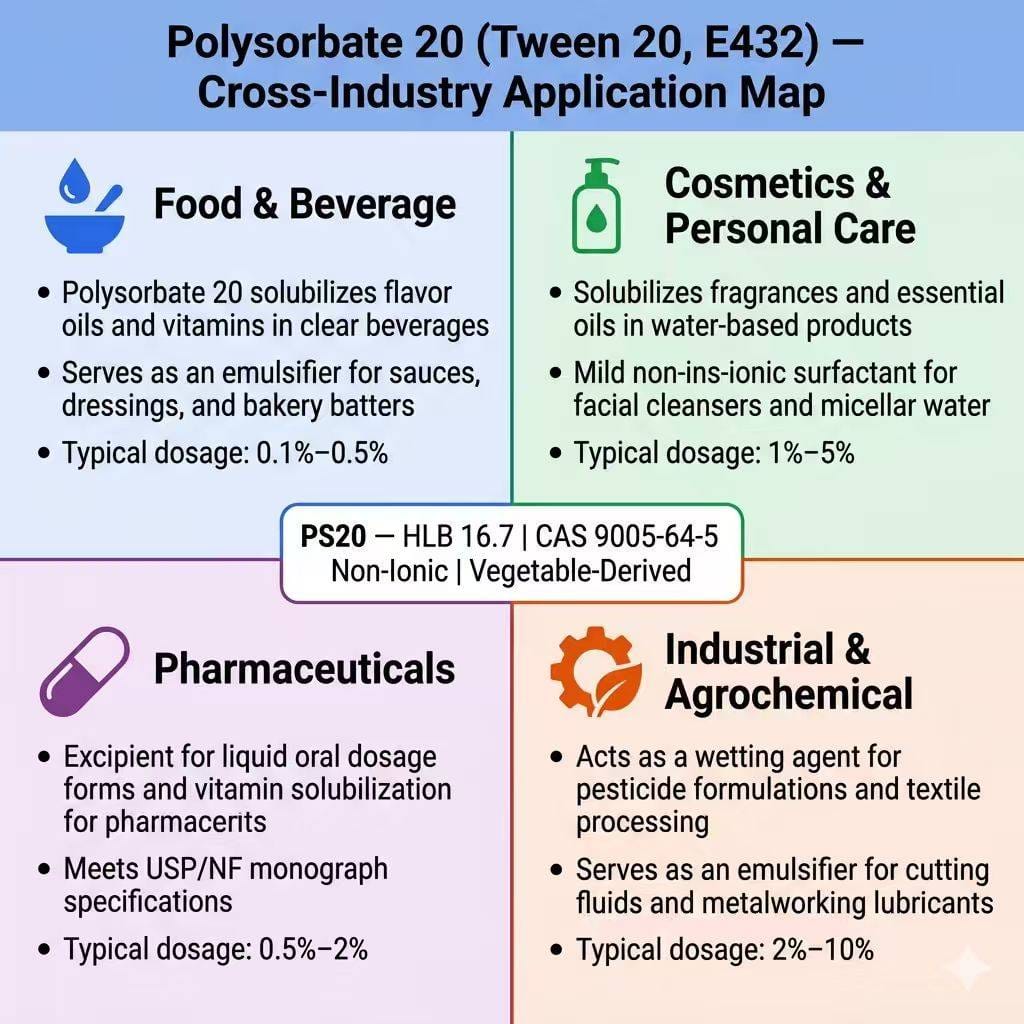
Cosmetics, and Pharmaceuticals image 1″ src=”https://foodemul.com/wp-content/uploads/2025/10/generated_image_1-3.png”>
Key Characteristics: HLB Value and Solubility
A pivotal characteristic of Polysorbate 20 is its Hydrophile-Lipophile Balance (HLB) value, which ranges from 16 to 17. This high HLB places it firmly in the oil-in-water (O/W) emulsifier category, meaning it has a strong affinity for water and can effectively disperse oil phases into aqueous solutions.
In terms of solubility, it is fully miscible with water and alcohols but only partially soluble in oils — reinforcing its role in creating clear, stable emulsions. Its non-ionic nature means it does not dissociate into ions in solution, reducing the risk of interactions with other charged ingredients.
This solubility profile makes it an effective solubilizer for essential oils, fragrances, and other lipophilic substances, enabling their incorporation into water-based products without cloudiness or separation. Understanding these characteristics is crucial for optimizing product stability and performance.
Multifunctional Benefits of Polysorbate 20
Beyond its primary role as an emulsifier, Polysorbate 20 offers a suite of benefits that reduce the need for additional additives and simplify formulations. Its molecular structure allows it to perform multiple tasks simultaneously.
Master Emulsifier and Stabilizer
As an emulsifier, Polysorbate 20 excels at reducing interfacial tension between oil and water. Its hydrophilic heads orient towards water while lipophilic tails anchor in oil, creating a protective barrier that prevents coalescence.
In practical terms, products like lotions, creams, and sauces maintain uniform texture without separating over time. Its stabilizing properties go beyond initial mixing — it helps inhibit phase separation, creaming, or sedimentation throughout the product lifecycle.
Studies show that emulsions stabilized with Polysorbate 20 withstand temperature variations and mechanical stress, making them robust for storage and transport. This dual emulsifier-stabilizer role is particularly valuable in pharmaceuticals where dose uniformity is critical.
Effective Solubilizer for Oils and Fragrances
One of the standout features of Polysorbate 20 is its ability to solubilize oil-soluble ingredients in water-based systems. Through micelle formation, Polysorbate 20 molecules surround oil droplets, allowing them to dissolve in water without precipitating.
In cosmetics, this property powers toners, serums, and perfumes where essential oils and active agents must distribute evenly. In a facial spray, for example, Polysorbate 20 solubilizes soothing essential oils without leaving a greasy residue.
It also aids fragrance retention by slowly releasing scents over time, enhancing the sensory experience. In food, it helps incorporate flavorings and colorings into beverages. Typical use levels of 2-10% provide optimal results without compromising safety or clarity.
Dispersing Agent and Surfactant
Polysorbate 20 ensures that insoluble particles — pigments, powders, and active ingredients — are uniformly distributed throughout a formulation. This prevents clumping, color variations, or reduced efficacy in products like mascaras, foundations, and pharmaceutical suspensions.
Its mild surfactant properties make it suitable for cleansing applications, removing dirt and oil without excessive drying or irritation. In hair care, its anti-static capabilities minimize static electricity that causes frizz.
As a thickener, it can modify viscosity for easier spreadability. In a single product, Polysorbate 20 might emulsify oils, disperse actives, and provide mild cleansing — reducing the need for complex ingredient lists.
Diverse Industrial Applications
The versatility of Polysorbate 20 is reflected in its widespread use across cosmetics, food, and pharmaceuticals — each leveraging its unique properties to meet specific needs.
In Cosmetics and Personal Care
In the cosmetics sector, Polysorbate 20 is a cornerstone ingredient found in creams, lotions, cleansers, and sprays. Its primary function is emulsifying oil and water, creating smooth, stable formulations that deliver active ingredients effectively.
In moisturizers, it ensures oils and humectants blend seamlessly, providing hydration without greasiness. In cleansers, its surfactant properties enable gentle removal of makeup and impurities — ideal for sensitive skin types.
The solubilizing ability is particularly valued in fragrances and essential oil products. In body mists, it allows for a fine, even spray that retains fragrance over time. Typical use levels range from 2% to 10%, and it is often combined with other emulsifiers like sorbitan stearate to optimize performance.
In the Food Industry
As a food additive, Polysorbate 20 improves texture, stability, and sensory attributes. It is approved by the FDA and EFSA, functioning as an emulsifier, stabilizer, and dispersing agent.
In baked goods, it helps create a soft, uniform crumb by evenly distributing fats and liquids. In ice cream, it prevents ice crystal formation and improves melt resistance. In flavor emulsions, it solubilizes oil-based flavors into water-based systems — ensuring consistent taste in beverages and candies.
In mint drops or citrus-flavored drinks, Polysorbate 20 enables a smooth, spreading sensation without oiliness. Its use in food is carefully regulated, and it is GRAS (Generally Recognized as Safe) within specified limits.
In Pharmaceutical Formulations
In pharmaceuticals, Polysorbate 20 enhances the stability, bioavailability, and delivery of active ingredients. In oral medications like syrups or suspensions, it prevents separation of insoluble compounds, allowing for accurate dosing.
In topical preparations, it improves penetration of active agents through the skin. In vaccine adjuvants and injectable formulations, it stabilizes proteins and other sensitive molecules, reducing aggregation and preserving potency.
The pharmaceutical industry relies on its non-ionic nature to minimize interactions with other ingredients. Typical concentrations range from 0.1% to 5%, subject to rigorous pharmacopoeial standards (USP, EP).
Polysorbate 20 in Personal Care and Cosmetic Formulations
Beyond its food and pharmaceutical roles, Polysorbate 20 is a cornerstone solubilizer and emulsifier in personal care products. Its ability to dissolve essential oils, fragrances, and active ingredients into water-based formulations makes it indispensable in modern cosmetic chemistry.
Polysorbate 20 in Hand Sanitizer
In alcohol-based hand sanitizers (60–80% ethanol or isopropanol), Polysorbate 20 serves a critical function: it solubilizes fragrance oils and moisturizing agents that would otherwise separate from the high-alcohol base. Without a solubilizer, essential oils and emollients like glycerin form a separate layer, reducing both product performance and user experience.
Typical usage rate in hand sanitizer: 0.5–2.0% by weight. At this concentration, PS20 creates a clear, homogeneous solution that dispenses evenly and leaves hands feeling conditioned rather than stripped. It is compatible with both ethanol-based and isopropanol-based WHO-recommended formulations.
Formulation tip: Pre-blend the fragrance oil or essential oil blend with Polysorbate 20 at a 1:1 to 1:3 ratio (oil:PS20) before adding to the alcohol-water base. This pre-solubilization step ensures clarity and prevents clouding over the product’s shelf life.
How to Use Polysorbate 20 in Liquid Soap
In liquid soap and body wash formulations, Polysorbate 20 acts as both a co-emulsifier and a foam stabilizer. It helps disperse fragrance oils evenly throughout the surfactant system and can improve the richness and stability of the foam profile when used alongside primary surfactants like sodium laureth sulfate (SLES) or cocamidopropyl betaine (CAPB).
Usage rate in liquid soap: 0.5–3.0% by weight. Higher concentrations (2–3%) are used in fragrance-heavy formulations or when solubilizing thicker essential oils like patchouli or sandalwood.
Step-by-step incorporation:
- Pre-mix fragrance/essential oils with Polysorbate 20 (1:1 to 1:3 ratio) until clear
- Add the pre-mix to your surfactant base (SLES/CAPB/water) under gentle stirring
- Adjust pH to 5.5–6.5 for optimal skin compatibility
- Add preservative, thickener (salt or HEC), and any additional actives
- Allow to rest for 24 hours to check for clarity and stability
Other Personal Care Applications
Polysorbate 20 also finds use in:
- Air freshener sprays: Solubilizes fragrance oils in water-based room sprays at 1–3%
- Facial toners and micellar waters: Gentle cleansing and solubilization at 0.5–2%
- Bath oils and bath bombs: Disperses oils evenly in bath water for a non-greasy experience
- Hair care: Improves spreadability of conditioning agents in leave-in treatments
Safety note for cosmetics: The Cosmetic Ingredient Review (CIR) has confirmed Polysorbate 20 as safe in cosmetic formulations when formulated to be non-irritating. At typical use concentrations (0.5–5%), it is non-sensitizing and non-comedogenic. See our emulsifier safety guide for detailed toxicology data (applies across the polysorbate family).
Polysorbate 20 vs. Polysorbate 80: Choosing the Right Emulsifier
Both Polysorbate 20 and 80 belong to the polysorbate family and share non-ionic, emulsifying properties — but their fatty acid components create significant functional distinctions.
| Property | Polysorbate 20 | Polysorbate 80 |
|---|---|---|
| Chemical Name | Polyoxyethylene (20) sorbitan monolaurate | Polyoxyethylene (20) sorbitan monooleate |
| CAS Number | 9005-64-5 | 9005-65-6 |
| HLB Value | Approximately 16.7 | Approximately 15 |
| Source | Derived from sorbitol and lauric acid | Derived from sorbitol and oleic acid |
| Appearance | Pale yellow to yellow liquid | Amber-colored, viscous liquid |
| Solubility | Soluble in water and ethanol; partially soluble in oils | Soluble in water and ethanol; more soluble in oils |
| Common Applications | Low oil content (<5%): Facial cleansers, serums, mists | Complex oil mixtures: Creams, lotions, ice cream |
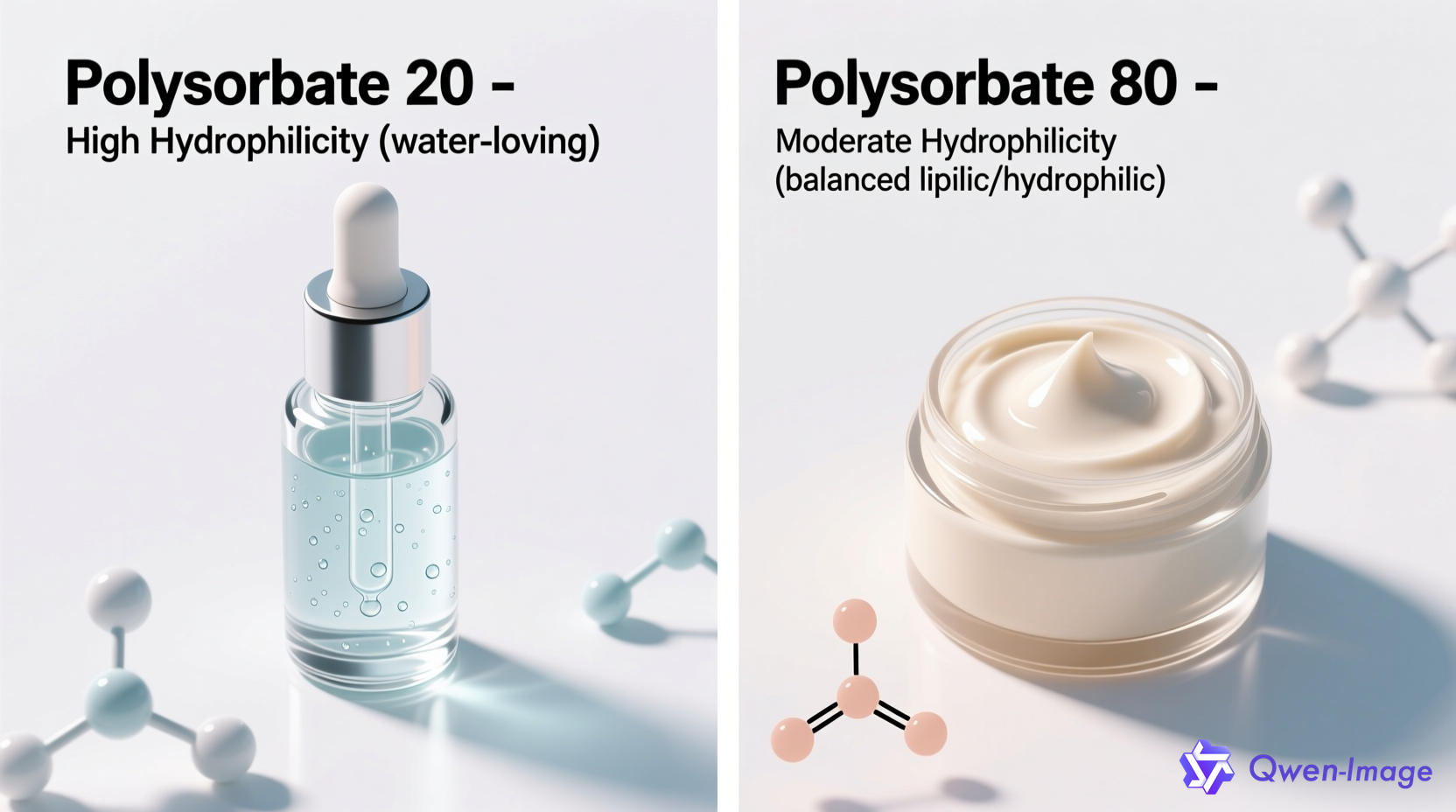
Polysorbate 20, derived from lauric acid, has a higher HLB (~16.7) and excels at solubilizing essential oils and fragrances in light products like serums, sprays, and cleansers. Its superior solubilizing power makes it the go-to for clear, water-based systems.
Polysorbate 80, derived from oleic acid (HLB ~15), handles higher oil content formulations — rich creams, cleansing oils, and complex food emulsions. It offers better resistance to electrolytes and a broader range of compatible oil phases.
The choice depends on oil concentration, desired clarity, and ingredient compatibility. For a fragrance-heavy facial mist, Polysorbate 20 delivers clarity; for a dense body butter, Polysorbate 80 provides stronger emulsification.
For technical data and sourcing, visit the Polysorbate 20 product page and the Polysorbate 20 TDS. For detailed comparison, see Polysorbate 20 vs. 80. For usage ratios, refer to the Polysorbate 20 Usage Ratio Guide. For low-EO monolaurate applications requiring controlled wetting rather than full solubilization, Polysorbate 21 (Polysorbate 21) provides reduced water solubility suited to agrochemical and industrial lubricant systems.
Safety and Usage Guidelines
Extensive research supports Polysorbate 20’s safety in cosmetics, food, and pharmaceuticals. Regulatory agencies including the FDA, EFSA, and Cosmetic Ingredient Review (CIR) panel have evaluated its toxicity profile and deemed it safe at specified concentrations.
In cosmetics, it is recommended for external use at 2-10%, though higher concentrations may apply in products like spray deodorants (up to 4%). While mild and non-irritating for most users, rare allergic reactions — itching or redness — are possible; patch testing is advised for sensitive skin.
In food, it is subject to maximum usage limits. In pharmaceuticals, it adheres to strict purity standards with monitored levels of ethylene oxide and dioxane. Polysorbate 20 is biodegradable under aerobic conditions, minimizing ecological impact.
Conclusion: The Essential Role of Polysorbate 20
Polysorbate 20 transcends simple mixing to enable innovation across food, cosmetics, and pharmaceuticals. Its high HLB value and water solubility allow it to emulsify, solubilize, stabilize, and disperse with remarkable efficiency.
From luxurious creams to consistent medication doses, its applications are both diverse and critical. As industries evolve toward natural and sustainable practices, Polysorbate 20’s plant-based origin positions it as a forward-thinking choice. For high-quality ingredients, FoodEmul.com offers reliable Polysorbate 20 and related products.
Need Polysorbate 20 samples? We manufacture the full Polysorbate range — reach out for specifications or to request a sample.