
Polysorbate 60 (E435) is one of the most thoroughly evaluated food additives on the market. FDA GRAS, EFSA-approved, JECFA-reviewed — the regulatory consensus is consistent across jurisdictions. At FoodEmul, we manufacture Polysorbate 60 to food-grade specifications with Kosher and MUI Halal certification. This guide covers the safety data, regulatory status, and what the science actually says about Polysorbate 60.
What Is Polysorbate 60?
Polysorbate 60 (Polysorbate 60, E435) is a sorbitan-based nonionic emulsifier manufactured by reacting sorbitol with stearic acid and ethylene oxide. It has been used in food, cosmetics, and pharmaceuticals for over 50 years. With an HLB value of 14.9 and an acute oral LD₅₀ exceeding 10 g/kg body weight (rat), it is classified as practically non-toxic and is one of the most extensively safety-tested food emulsifiers on the market.
Is Polysorbate 60 Safe? — Quick Answer
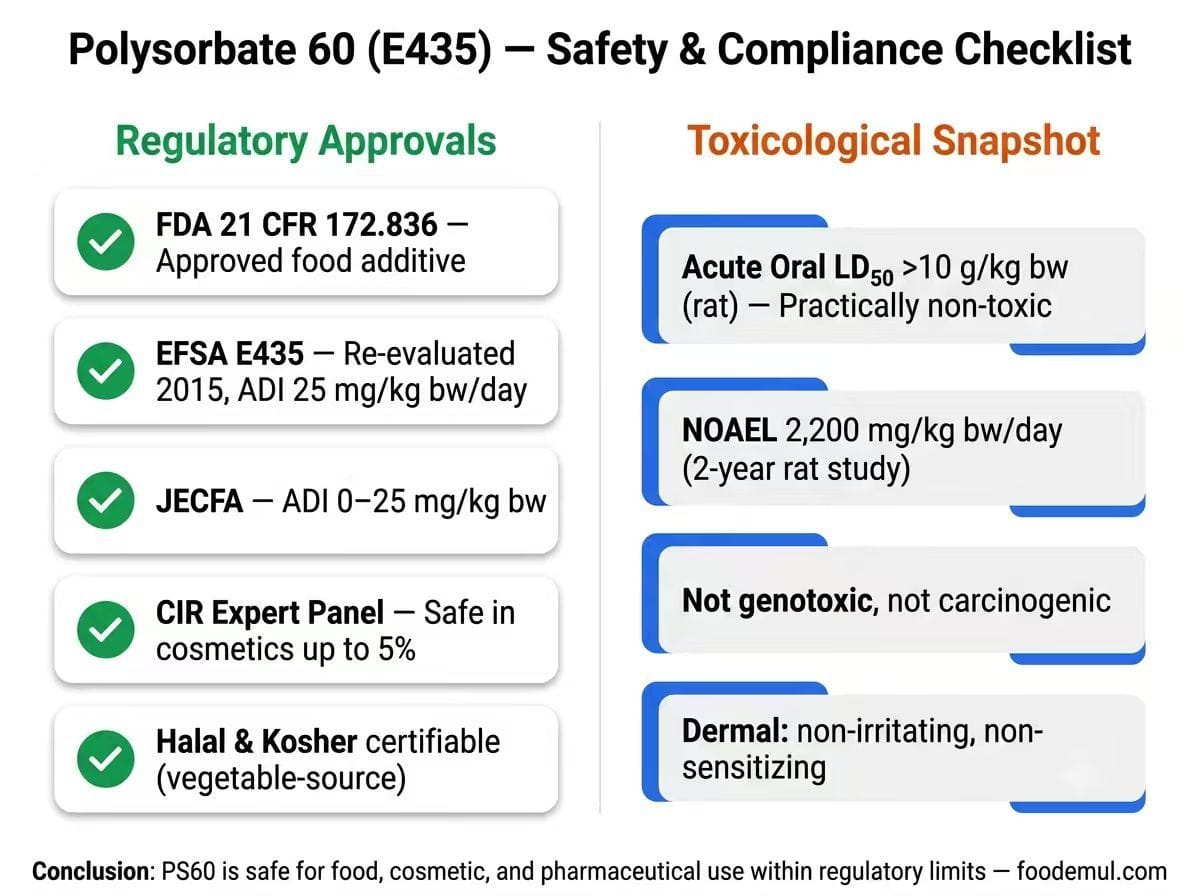
Yes. Polysorbate 60 is safe for use in food, cosmetics, and pharmaceuticals when used within regulatory limits. It has been designated Generally Recognized as Safe (GRAS) by the U.S. FDA, approved as food additive E435 by the European Food Safety Authority (EFSA), and assigned an Acceptable Daily Intake (ADI) of 0–25 mg/kg body weight by JECFA (WHO/FAO). The Cosmetic Ingredient Review (CIR) Expert Panel has also concluded that Polysorbate 60 is safe in cosmetic formulations when formulated to be non-irritating. Below we examine the evidence for each application category in detail.
Global Regulatory Status (FDA & EFSA)
Polysorbate 60 is approved for use in food, cosmetics, and pharmaceuticals by almost every major regulatory body in the world.
- FDA (USA): Classified as GRAS (Generally Recognized as Safe) under 21 CFR 172.836. It is permitted for use in specific food categories within defined limits.
- EFSA (Europe): Assigned the food additive code E435. It has undergone multiple safety re-evaluations, with the most recent confirming its safety for the general population.
- JECFA (Joint FAO/WHO Committee): Established an Acceptable Daily Intake (ADI) of 0–25 mg per kg of body weight.
How Emulsifier Safety Is Evaluated
Internationally, food emulsifier safety follows a structured evaluation framework. According to standard toxicology protocols, emulsifier evaluation includes:
- Chemical characterization: Structure, purity, degradation products, and form in food
- Metabolic pathway: Absorption, distribution, metabolism, and excretion in the body
- Biological effects: Acute toxicity, chronic toxicity, reproductive effects, embryotoxicity, teratogenicity, mutagenicity, carcinogenicity, and allergenicity
Regulatory bodies then classify emulsifiers into three safety tiers:
- Unrestricted use (GRAS): Emulsifiers with established ADI values and FDA GRAS designation — confirmed safe for unlimited use in food. Polysorbate 60 falls in this category.
- Restricted use: Emulsifiers permitted only within specified ADI and usage limits for particular food categories.
- Not permitted in food: Non-digestible or potentially harmful emulsifiers that cannot be used in food at any level.
Polysorbate 60 belongs to the first category — the safest tier — with its ADI of 0–25 mg/kg bw and GRAS status confirmed by decades of toxicological review.
Is Polysorbate 60 Safe to Eat?
Polysorbate 60 is safe for consumption within FDA and EFSA approved limits. In the digestive system, it is broken down by lipase enzymes into its constituent components — sorbitol and stearic acid — both of which are naturally metabolized by the human body. The FDA permits its use in specific food categories under 21 CFR 172.836, including baked goods (up to 0.5% by weight), frozen dairy desserts (0.1%), whipped vegetable oil toppings (0.4%), and confectionery coatings (0.2%).
EFSA’s most recent re-evaluation of E435 (EFSA Journal 2015;13(11):4295) confirmed its safety for the general population at current exposure levels. No evidence of carcinogenicity, genotoxicity, or reproductive toxicity was found in long-term feeding studies. The JECFA ADI of 0–25 mg/kg bw provides a wide safety margin — a 70 kg adult would need to consume over 1.75 g of pure polysorbate 60 daily to approach the ADI, far exceeding realistic dietary exposure from processed foods.
Key toxicology findings:
- Acute oral toxicity: LD₅₀ >10 g/kg bw (rat) — practically non-toxic
- Subchronic studies: No observed adverse effect level (NOAEL) of 5,000 mg/kg bw/day in 90-day rat feeding studies
- Carcinogenicity: No evidence in 2-year rodent bioassays
- Reproductive toxicity: No effects on fertility or fetal development at doses up to 5,000 mg/kg bw/day
Side Effects and Toxicological Profile
In its concentrated form, Polysorbate 60 can be a mild irritant, but in final formulations, it is considered non-toxic.
- Skin Sensitivity: In cosmetics, it is classified as non-irritating and non-sensitizing. It is even used in products for sensitive skin.
- Digestion: In food, it is broken down into sorbitol and stearic acid, both of which are naturally metabolized by the human body.
- Carcinogenicity: Extensive studies have shown no evidence that Polysorbate 60 is carcinogenic or mutagenic.
Ultimate Guide to Polysorbate 60
New to Polysorbate 60? Explore our comprehensive pillar guide covering properties, technical specifications, and global industry applications of E435.
Is Polysorbate 60 Safe for Skin?
Yes, Polysorbate 60 is considered safe for topical use in cosmetics and personal care products. The Cosmetic Ingredient Review (CIR) Expert Panel comprehensively assessed the safety of polysorbates in cosmetic formulations and concluded they are safe when formulated to be non-irritating (CIR Final Report, 2015).
At typical cosmetic use concentrations (0.1–5%), Polysorbate 60 shows low skin irritation potential and is classified as non-sensitizing in standard patch tests. It is routinely used in products formulated for sensitive skin, including facial cleansers, moisturizers, and baby care products. The EWG Skin Deep database rates Polysorbate 60 with a low hazard score of 1–2 out of 10.
However, in its undiluted concentrated form, Polysorbate 60 can be a mild irritant to eyes and mucous membranes. This is standard for virtually all surfactants and emulsifiers in concentrated form — it does not reflect the safety profile of the ingredient in finished formulations. As with any cosmetic ingredient, individuals with known sensitivities should perform a patch test before use.
Safety summary for skin applications:
- Irritation: Low — non-irritating at <5% concentration
- Sensitization: Non-sensitizing in human repeat insult patch tests
- Comedogenicity: Non-comedogenic — does not clog pores
- Phototoxicity: No evidence of phototoxic or photosensitizing effects
Health Risks and Common Concerns
While Polysorbate 60 has a strong safety record, several concerns are frequently raised. Here we address each based on current scientific evidence:
Ethylene Oxide and 1,4-Dioxane
Polysorbate 60 is manufactured using ethylene oxide, which has led to concerns about residual 1,4-dioxane — a potential contaminant. However, pharmaceutical and food-grade polysorbate 60 is subject to strict purification processes that reduce 1,4-dioxane to levels well below regulatory limits. The FDA and European Pharmacopoeia both specify maximum limits for ethylene oxide residues. When sourced from reputable GMP-certified manufacturers, food-grade polysorbate 60 meets these specifications.
Cancer Risk
Extensive toxicological evaluation has found no evidence that Polysorbate 60 is carcinogenic. Two-year rodent feeding studies conducted as part of the FDA GRAS review showed no increase in tumor incidence. Both the IARC (International Agency for Research on Cancer) and the U.S. National Toxicology Program have not classified Polysorbate 60 as a carcinogen. The EFSA 2015 re-evaluation similarly found no genotoxic or carcinogenic potential.
Allergic Reactions
True allergic reactions to Polysorbate 60 are rare but have been documented in isolated case reports. Most reported reactions involve mild contact dermatitis in individuals with pre-existing sensitive skin conditions. Systemic allergic reactions (anaphylaxis) are extremely rare and typically associated with intravenous pharmaceutical formulations rather than dietary or topical exposure.
Gut Microbiome
Recent research has raised questions about whether dietary emulsifiers may affect the gut microbiome. While some animal studies using high doses have suggested potential effects, human evidence remains limited and inconclusive. The doses used in animal studies far exceed typical human dietary exposure. Regulatory agencies continue to monitor emerging research, and to date no regulatory body has revised the safety status of Polysorbate 60 based on microbiome concerns.
Application-Specific Compliance Limits
For per-product FDA permitted maximums across all 14 regulated food categories (bakery, frozen desserts, whipped toppings, confectionery, dressings, and more), see the detailed table in our PS60 Food Application & FDA Compliance Guide . Safety limits from a toxicological perspective (ADI, GRAS) have been established by JECFA and FDA as covered in §1 above — the application limits are about regulatory compliance, not toxicological safety per se.
Is It Vegan and Halal?
- Vegan: Most Polysorbate 60 is derived from vegetable-based stearic acid (like palm oil), making it vegan-friendly. However, some industrial grades can be animal-derived, so always check with your supplier.
- Halal & Kosher: As long as the fatty acid source is plant-based and the facility is certified, Polysorbate 60 is fully compatible with Halal and Kosher requirements.
Conclusion: The Verdict
Yes, Polysorbate 60 is safe for its intended uses in the food and personal care industries. Its long history of use and rigorous testing by international agencies make it a reliable choice for stabilizing complex emulsions.
For more technical details on how to use this ingredient safely in your recipe, visit our Polysorbate 60 Formulation Guide.
Related: For EU REACH microplastics compliance — why polysorbates are exempt from Regulation 2023/2055 — see our Polysorbates & Microplastics Guide.
Need Polysorbate 60 with full safety documentation? We manufacture it to food-grade specs with Kosher and MUI Halal certification — reach out for certificates or samples.