
A usage guide that skips the ratios is not a guide — it is a marketing page. Polysorbate 20 needs specific mixing ratios, temperature ranges, and co-emulsifier pairings to work. At FoodEmul, we manufacture it alongside the full Polysorbate and sorbitan ester range. This guide covers the practical numbers: how much Polysorbate 20 to use, how to mix it, and what to pair it with for protein drinks, flavor emulsions, and solubilization.
For the science behind solubilization ratios — CMC micelle chemistry and essential oil data — see our Polysorbate Flavor & Fragrance Solubilizers Guide.
PS20 Solubilization Ratios by Essential Oil Type
Polysorbate 20 has applications far beyond food. Our skincare and haircare formulation guide covers PS20 in micellar waters, toners, sulfate-free shampoos, and fragrance solubilization — with safety data from the CIR assessment.
Not all essential oils are created equal. Their chemical composition — terpenes, phenols, esters — determines how much PS20 is needed to achieve a clear, stable solution. The following table provides laboratory-validated data showing the exact mass of essential oil (in grams) that can be solubilized in 100 g of a 10% Polysorbate 20 solution:
For the science behind solubilization ratios — CMC micelle chemistry and polysorbate 20 vs polysorbate 80 data — see our .
| Essential Oil | PS20 (HLB 16.7) grams solubilized |
Polysorbate 80 (HLB 15.0) grams solubilized |
PS20 : Oil Practical Ratio |
|---|---|---|---|
| Lemon Oil | 2.0 g | 3.0 g* | 5 : 1 |
| Sweet Lemon Oil | 2.0 g | 3.0 g | 5 : 1 |
| Peppermint Oil | 1.8 g | 3.0 g | 5.5 : 1 |
| Clove Oil | 2.2 g | 2.0 g | 4.5 : 1 |
| Rosemary Oil | 2.8 g | 3.8 g* | 3.6 : 1 |
| Fennel Oil | 1.0 g | 1.5 g | 10 : 1 |
| Thyme Oil | 1.2 g | 1.5 g* | 8.3 : 1 |
How to use this table: If you need to solubilize 2 g of rosemary oil in 100 g of final product, the table says rosemary requires a 3.6 : 1 ratio (PS20 : oil). So you need 2 g × 3.6 = 7.2 g of PS20. Adjust the emulsifier percentage in solution accordingly — the standard starting point is 10% PS20 in the aqueous phase.
How to Calculate the Correct PS20-to-Oil Ratio
The industry rule of thumb is a 1:1 starting ratio (1 g PS20 per 1 g essential oil), but this is just a starting point. The actual ratio depends on three factors:
- Oil density and polarity. Light citrus oils (lemon, grapefruit) with high limonene content are easier to solubilize. Heavy resinous oils (patchouli, vetiver, vanilla oleoresin) require 3 to 5 times more PS20.
- Desired clarity. A hazy product (acceptable for opaque lotions) needs less PS20. Crystal-clear products (room sprays, facial mists) need higher ratios and may require 24-hour settling to verify stability — as the table above shows, some oils reach full clarity only after extended equilibration.
- Co-solvents. Adding 2–5% ethanol or propylene glycol can reduce PS20 usage by 20–30% by lowering the interfacial tension between oil and water.
Quick Calculation Formula
PS20 needed (g) = EO weight (g) × Solubilization Ratio
- Light citrus oils: ratio 3–5 (i.e., 3–5 g PS20 per 1 g oil)
- Medium oils (peppermint, lavender, eucalyptus): ratio 5–7
- Heavy/resinous oils (patchouli, sandalwood, vanilla): ratio 8–15
- Synthetic fragrance oils: ratio 1–3 (pre-solubilized by manufacturer)
Note on PS20 vs Polysorbate 80: If you’re solubilizing carrier oils (jojoba, sweet almond, MCT) rather than essential oils, Polysorbate 80 is the better choice — PS20’s shorter C12 lauric acid chain is optimized for small-molecule essential oils and cannot effectively emulsify triglycerides. For a full comparison of when to choose each, see our Polysorbate 20 vs 80 — Complete Comparison Guide. For food-grade dosage limits, see the Polysorbate 80 Dosage Guide.
Mixing Protocol — The Correct Order of Addition
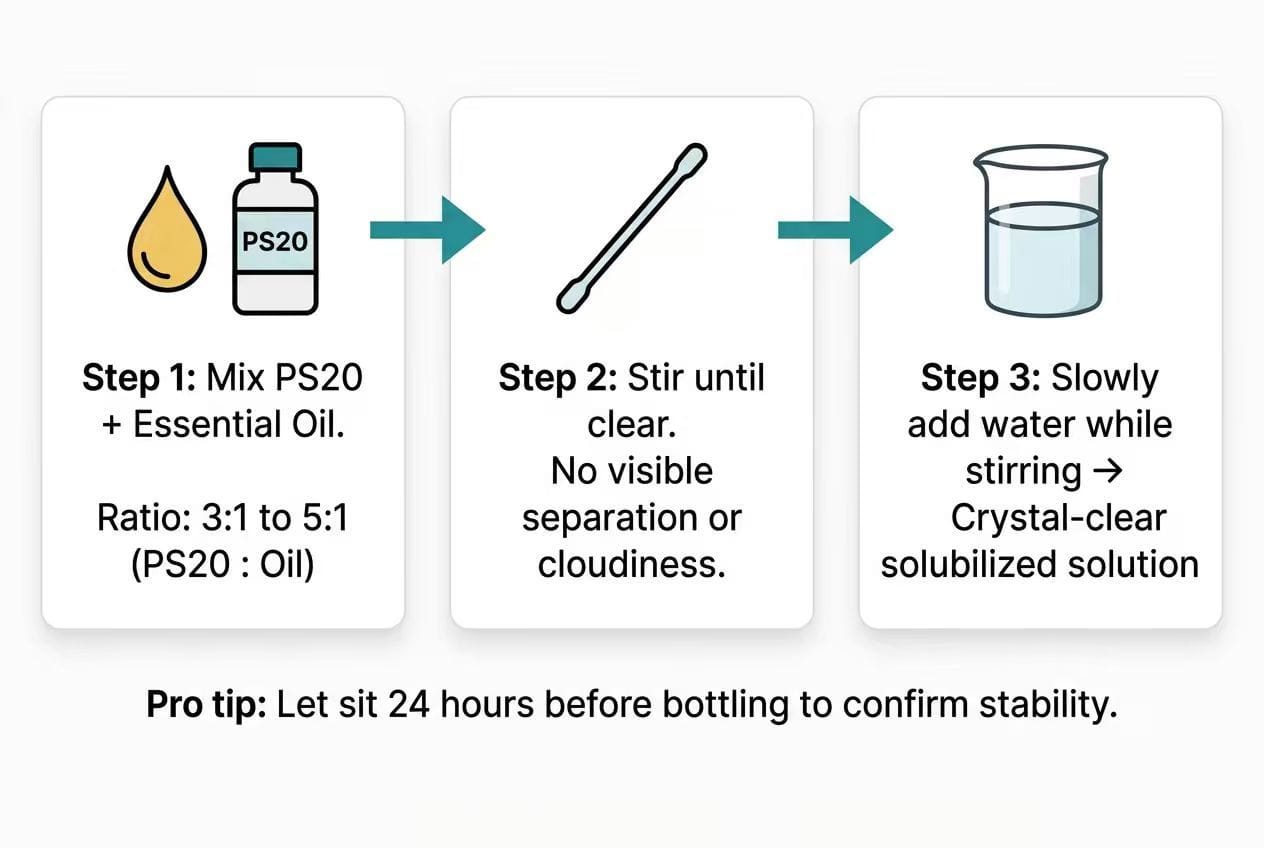
The order of addition is as important as the ratio. PS20 must contact the oil before it contacts water to achieve a true microemulsion. Follow this sequence:
Technical specifications: For the complete PS20 TDS including HLB, CMC, solubility profile, and batch specifications, see our Polysorbate 20 TDS & Specifications.
- Weigh PS20 and essential oil in a clean, dry container. PS20 is a viscous liquid at 25°C — use a syringe or pipette for small batches.
- Pre-blend. Stir or swirl the PS20 + oil mixture until homogenous (30–60 seconds). The mixture will be clear to slightly hazy. Do not add water yet.
- Add water slowly in small increments while stirring continuously. The mixture will become temporarily cloudy at ~30% water — this is the inversion point. Keep adding water; clarity returns as the microemulsion forms.
- Let it rest. After reaching final volume, let the solution stand for 30–60 minutes. Some oils (rosemary, thyme) reach full optical clarity only after 24 hours of equilibration.
- Filter if needed. For commercial products, pass through a 0.45 μm membrane filter to remove any undissolved particulates.
Troubleshooting Common Solubilization Issues
| Symptom | Probable Cause | Fix |
|---|---|---|
| Cloudy/hazy after mixing | PS20:oil ratio too low; water added too fast | Increase PS20 by 20%. Add a co-solvent (2% ethanol). Let rest 24h. |
| Oil droplets floating on surface | PS20 and oil not pre-blended before water addition | Restart: mix PS20 + oil first, THEN add water slowly. |
| Product is sticky or foams excessively | PS20 ratio too high; using PS20 where Polysorbate 80 is better | Reduce PS20. For high oil loads, consider Polysorbate 80 instead (see Table 2). |
| Separation after 1–2 weeks | Insufficient PS20 for oil load; temperature fluctuation | Recalculate ratio. Store product below 35°C. Test with accelerated stability (45°C × 7 days). |
| Product is clear but feels greasy | Microemulsion forming but oil load exceeds sensory threshold | Reduce essential oil to ≤ 1% of final product. Balance with a light ester (IPM) to cut greasiness. |
PS20 in Liquid Soap & Body Sprays
Liquid soap and shower gels: Add PS20 at 1–3% of total batch weight to solubilize fragrances and essential oils into clear surfactant systems. For a 500 g batch of liquid soap with 2% fragrance oil (10 g), use 30–50 g PS20 (3:1 to 5:1 ratio to fragrance). Mix PS20 with the fragrance first, then blend into the surfactant base at room temperature.
Body sprays and facial mists: For a 100 mL body spray with 1 mL essential oil, start at 3–4 mL PS20 (3:1–4:1 ratio). Mix PS20 + oil first until clear, then slowly add water while stirring. Allow to sit 24 hours to confirm no separation before bottling.
Bath oils: For dispersible bath oils, use 1:1 PS20-to-oil to prevent an oil slick on the water surface.
Related Reading
- When to choose Polysorbate 80 instead: Polysorbate 80 Dosage Guide — Ratios & Regulatory Limits
- Deep comparison: Polysorbate 20 vs 80 — Key Differences
- Technical specifications: Polysorbate 20 TDS — Full Technical Data Sheet
- Product & ordering: Food-Grade Polysorbate 20 (Polysorbate 20)
Need Polysorbate 20 with application support? We manufacture the full range with Kosher and MUI Halal certification — reach out for guidance or samples.