
Not all polysorbates are interchangeable. Polysorbate 60 at HLB 14.9 behaves differently from Polysorbate 80 at HLB 15.0 — and both are worlds apart from Polysorbate 20 at HLB 16.7. The fatty acid chain matters as much as the HLB number. At FoodEmul, we manufacture the full range alongside sorbitan esters (Span), so we see the differences play out in real formulations every day. This guide compares the chemistry, applications, and specifications of Polysorbate 20, 40, 60, and 80.
Chemical Identity and Properties
Polysorbate 60 is widely used in creams and lotions as an O/W emulsifier. For the full personal care picture — including PS20 for solubilization and PS80 for fragrance — see our complete guide to polysorbates in skincare and haircare.
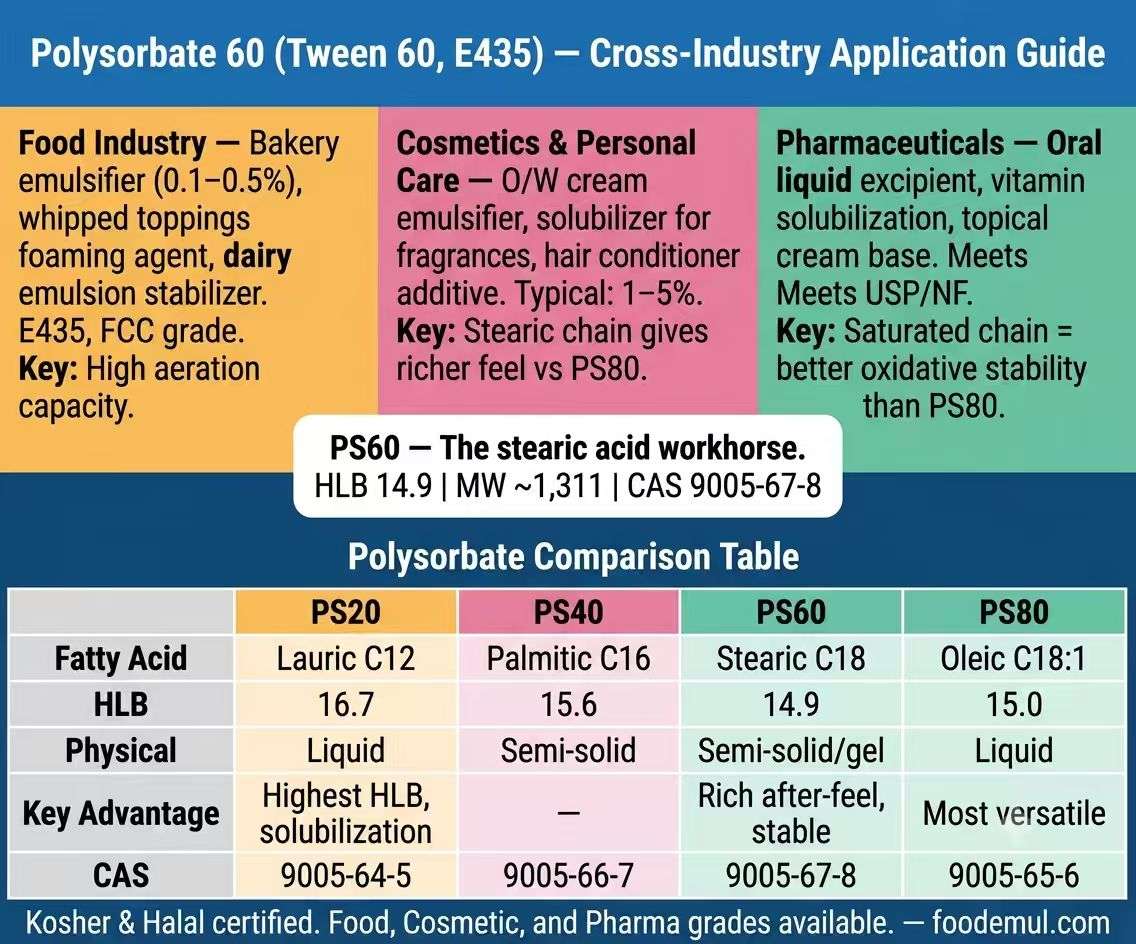
Polysorbate 60 is polyoxyethylene (20) sorbitan monostearate — a sorbitan backbone ethoxylated with ~20 units of ethylene oxide and esterified with stearic acid (C18, saturated). The stearic acid chain is what distinguishes it from other polysorbates:
| Polysorbate | Fatty Acid | Chain | HLB |
|---|---|---|---|
| Polysorbate 20 | Lauric acid | C12, saturated | 16.7 |
| Polysorbate 40 | Palmitic acid | C16, saturated | 15.6 |
| Polysorbate 60 | Stearic acid | C18, saturated | 14.9 |
| Polysorbate 80 | Oleic acid | C18:1, monounsaturated | 15.0 |
Key properties:
| Parameter | Specification |
|---|---|
| CAS Number | 9005-67-8 |
| INS Number | 435 (Codex Alimentarius) |
| GB Standard | 10.015 (China National Food Additive Standard) |
| Molecular Formula | C₆₄H₁₂₆O₂₆ (approximate, 20 EO units) |
| Molecular Weight | ~1,311.65 g/mol |
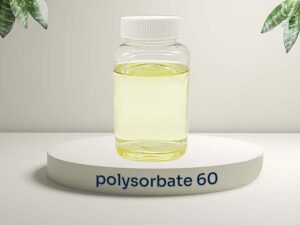
| Physical State | Lemon-to-orange oily liquid or semi-solid gel at 25°C; pourable at 30–35°C |
| Density | 1.10 g/cm³ |
| Viscosity | 0.60 Pa·s |
| Flash Point | >149°C |
| Solubility | Soluble in water, ethanol, isopropanol, ethyl acetate, aniline, toluene. Insoluble in mineral and vegetable oils — a key differentiator from Span-series (oil-soluble) |
| Saponification Value | 45–55 mg KOH/g |
| Hydroxyl Value | 81–96 mg KOH/g |
| Acid Value | ≤2 mg KOH/g (food-grade) |
As a nonionic surfactant, it carries no charge, minimizing interaction with ionic ingredients in complex formulations.
The Polysorbate Series at a Glance
| Product | Chemical Name | Raw Material | HLB | Type |
|---|---|---|---|---|
| Polysorbate 20 | POE(20) sorbitan monolaurate | Span 20 + 20 EO | 16.7 | O/W |
| Polysorbate 40 | POE(20) sorbitan monopalmitate | Span 40 + 20 EO | 15.6 | O/W |
| Polysorbate 60 | POE(20) sorbitan monostearate | Span 60 + 20 EO | 14.9 | O/W |
| Polysorbate 65 | POE(20) sorbitan tristearate | Span 65 + 20 EO | 10.5 | O/W |
| Polysorbate 80 | POE(20) sorbitan monooleate | Span 80 + 20 EO | 15.0 | O/W |
| Polysorbate 85 | POE(20) sorbitan trioleate | Span 85 + 20 EO | 11.0 | O/W |
For sourcing, explore the full range: Polysorbate 40 (Polysorbate 40) for palmitic-based mid-HLB needs, Polysorbate 65 (Polysorbate 65) for tristearate frozen-dessert applications, and Polysorbate 85 (Polysorbate 85) for trioleate high-oil systems.
Polysorbate 60’s stearic acid backbone (C18 saturated) gives it a higher melting point and better aeration properties than Polysorbate 80 (oleic, unsaturated). This makes it the preferred choice for whipped toppings, cake gels, and solid-emulsion systems.
Regulatory Status (E435)
Polysorbate 60 is designated E435 in the EU, holds GRAS status with the FDA (21 CFR 172.836), and has a JECFA ADI of 0–25 mg/kg body weight. Acute oral toxicity: LD₅₀ >10 g/kg bw (rat) — practically non-toxic. For the complete safety profile, see our Is Polysorbate 60 Safe? guide.
Food Industry Applications
In food manufacturing, Polysorbate 60 functions as an emulsifier, dough conditioner, aeration stabilizer, and anti-staling agent. It is used across bakery products (bread, cakes, cake mixes), frozen desserts (ice cream), whipped toppings, coffee whiteners, confectionery coatings, salad dressings, and shortenings.
Its saturated stearic acid chain gives it better oxidative stability than Polysorbate 80 (oleic acid, unsaturated), making it preferable in applications sensitive to rancidity — particularly baked goods and dry mixes with long shelf lives.
For the full list of 14 regulated food categories with per-product FDA limits, permitted concentrations, and co-emulsifier pairing ratios, see the Polysorbate 60 Food Application & FDA Compliance Guide.
Cosmetic and Personal Care Applications
In cosmetics, Polysorbate 60 serves as an O/W emulsifier that blends oil and water-based ingredients while contributing to texture and sensory experience.
- Creams and lotions: Provides emulsion stability and improves spreadability, leaving a non-greasy feel.
- Shampoos and conditioners: Disperses oils and active ingredients evenly, improving cleansing and conditioning performance.
- Makeup (foundations, eyeshadows): Ensures even pigment distribution for uniform color and long wear.
- Fragrance solubilization: Disperses fragrance and essential oils evenly in water-based products.
Its non-irritating profile makes it suitable for sensitive-skin formulations, and it pairs well with fatty alcohols (cetyl, stearyl) to build viscosity and texture in creams.
Pharmaceutical Applications
In pharmaceuticals, Polysorbate 60 functions as a solubilizer and stabilizer for active pharmaceutical ingredients (APIs).
- Oral medications: Solubilizes poorly water-soluble drugs, improving bioavailability and dose uniformity.
- Topical formulations (creams, ointments): Ensures even dispersion of APIs for consistent therapeutic effect.
- Injectable formulations: Stabilizes proteins and prevents API aggregation during storage — critical for vaccines and biologics where potency depends on structural integrity.
Its ability to form micelles that encapsulate hydrophobic drugs makes it valuable in pediatric and geriatric formulations where liquid dosage forms are required.
Formulating with Polysorbate 60
Synergistic Pairing with Low-HLB Emulsifiers
Polysorbate 60 (HLB 14.9) is rarely used alone. The standard practice is to pair it with a low-HLB emulsifier — most commonly Sorbitan Monostearate (Span 60, HLB 4.7) — to achieve a target HLB matched to the oil phase. This “Polysorbate-Span” blend creates more stable emulsions than either emulsifier alone, with better resistance to temperature cycling.
Common pairings and their applications:
| PS60 + Co-Emulsifier | Typical Application | Why It Works |
|---|---|---|
| PS60 + Span 60 (HLB 4.7) | Whipped toppings, cake mixes, confectionery coatings | Stearic acid chains match, creating a tightly packed interfacial film |
| PS60 + Polysorbate 65 | Ice cream, frozen desserts | Balanced fat destabilization for smooth texture |
| PS60 + Monoglycerides | Bread, bakery | Improved dough conditioning and crumb softness |
HLB Additive Principle
Non-ionic emulsifiers follow the HLB additive rule. When blending Polysorbate 60 (HLB 14.9) with a low-HLB co-emulsifier, the resulting HLB is the weighted average:
HLB(blend) = (W₁ × HLB₁) + (W₂ × HLB₂)
For a target HLB of 10 (common for many oil phases), use approximately 70% Polysorbate 60 + 30% Span 60 (HLB 4.7): 0.70 × 14.9 + 0.30 × 4.7 ≈ 10.4. Adjust the ratio based on your specific oil’s required HLB.
Usage and Storage
Typical use levels range from 0.1% to 5.0%, depending on the application. Incorporate into the water phase at 60–70°C with gentle stirring (below 100 rpm to minimize foaming). Store in sealed containers below 25°C, away from direct sunlight. The flash point is >149°C, but prolonged heat accelerates oxidation. For COA verification, check acid value (≤2 mg KOH/g), moisture content (≤3%), and 1,4-dioxane levels. Always verify Kosher, Halal, and ISO 22000 certifications when sourcing.
For step-by-step bench protocols — temperature control, blending sequences, and troubleshooting — see our PS60 Formulation Guide . For alternatives and clean-label replacements, see our Top 5 Polysorbate 60 Substitutes . For industrial applications requiring lower water solubility, Polysorbate 61 (Polysorbate 61) — a low-EO stearate emulsifier — provides an alternative with controlled wetting properties for W/O emulsions and lubricant systems.
Contact FoodEmul.com for food-grade Polysorbate 60 (E435), Certificate of Analysis, and formulation support.
Food applications & FDA limits: For the complete product-by-product compliance reference with processing guidance, see our PS60 Food Application & FDA Compliance Guide — covering all 14 regulated food categories under 21 CFR 172.836.
Span + Polysorbate system overview: For the complete chemistry, HLB pairing guide, and product line comparison across all Span and Polysorbate surfactants, see our Span & Polysorbate Formulators Guide.
Family overview: For the full four-way polysorbate comparison (20 vs 40 vs 60 vs 80) with decision framework, see our Polysorbate Emulsifiers Complete Guide.
Related: PS60 Food Application & FDA Guide · PS60 vs. Polysorbate 80 Comparison · PS60 Formulation Guide · Span & Polysorbate Hub
🔗 Related Pages
- Is Polysorbate 60 Safe?
- Polysorbate 60 Food Application & FDA Compliance Guide
- PS60 Formulation Guide
- Top 5 Polysorbate 60 Substitutes
- Polysorbate 40 (Polysorbate 40)
- Polysorbate 61 (Polysorbate 61)
- Polysorbate 65 (Polysorbate 65)
- Polysorbate 85 (Polysorbate 85)
- Polysorbate 60 in Cake Gel Systems
Need Polysorbate samples? We manufacture the full range — reach out for technical specifications or to request a sample.