

BLOG
Insights on food emulsifiers—applications, functions, and benefits to improve stability, texture, and quality across industries.
Discover insights into sorbitan esters, polysorbates, and other food emulsifiers. Our blog shares technical knowledge, industry applications, and practical guidance to help food manufacturers and formulators understand ingredient functions and optimize product performance. From bakery and dairy to beverages and sauces, explore how emulsifiers improve stability, texture, and shelf life. Stay updated with trends, case studies, and expert perspectives from the food additive industry.
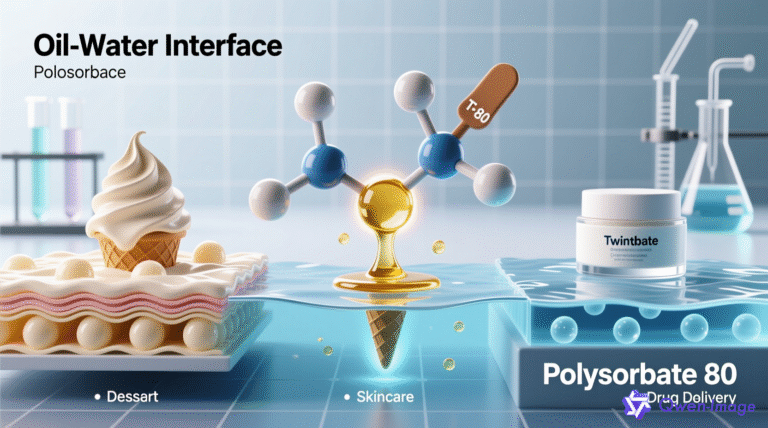
How Polysorbate 80 functions across food and cosmetic formulations — emulsification, solubilization, and stabilization mechanisms in each industry.
Discover Polysorbate 20’s properties, benefits, and applications as a key emulsifier and solubilizer in various industries, including safety insights.
Polysorbate 60 (Tween 60, E435): a high-HLB emulsifier for oil-in-water systems across food, cosmetics, and pharmaceuticals. Properties, applications, and formulation best practices.
Discover the uses, benefits, and safety of polysorbate emulsifiers Tween 20, 40, 60, and 80 in food, cosmetics, and pharmaceuticals. Learn how they enhance product stability and performance.
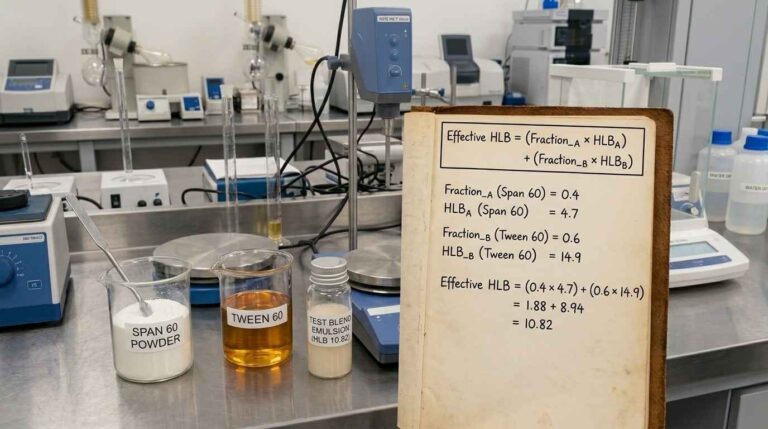
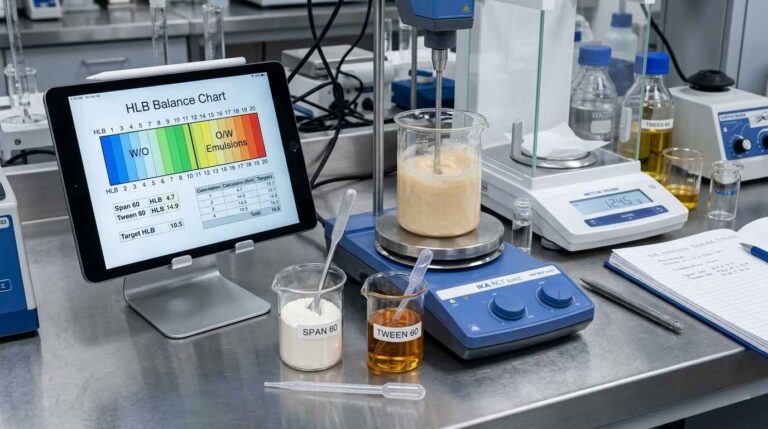
How to use the Hydrophilic-Lipophilic Balance (HLB) system to select and blend Span and Tween emulsifiers. Covers HLB calculation, required HLB for oil phases, ratio formulation, and practical limitations.
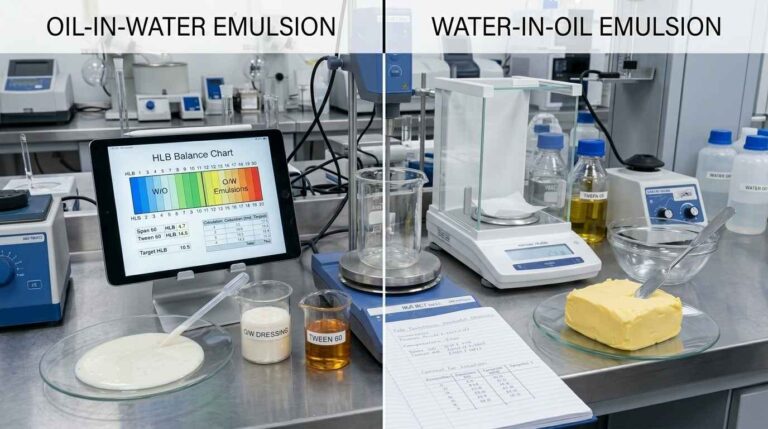
How to formulate oil-in-water (O/W) and water-in-oil (W/O) food emulsions using Span and Tween emulsifiers. Covers HLB selection, emulsion type determination, stability mechanisms, and practical formulation strategies.
How to design compound emulsifier blends using Span 60/Tween 60 and Span 80/Tween 80 pairs. Covers HLB balancing, molecular similarity, ionic complementarity, co-emulsifiers, and formulation methodology for food manufacturing.
Food emulsifiers are compounds that help mix two or more immiscible components—such as oil and water—into a stable emulsion. They play an essential role in maintaining the physical stability of food, enhancing texture and flavor, simplifying food processing, and extending shelf life.
