
The HLB system is the closest thing to a cheat sheet in emulsifier selection. Instead of testing twenty emulsifiers and hoping one works, you calculate the number your oil phase needs — then pick the Span/Polysorbate ratio that hits it. It is not perfect, and it will not replace bench testing, but it cuts the search from weeks to hours. At FoodEmul, we live by HLB calculations daily. This guide walks through the system from first principles: how HLB works, how to calculate blend ratios, and what the numbers actually mean for cake batter, ice cream, margarine, and beverages.
What the HLB System Is — and Why It Works
The HLB system guides emulsifier selection across all industries. For personal care specifically — which polysorbate to use in a cream vs. a micellar water vs. a body wash — our polysorbates in skincare guide maps HLB to real-world formulations.
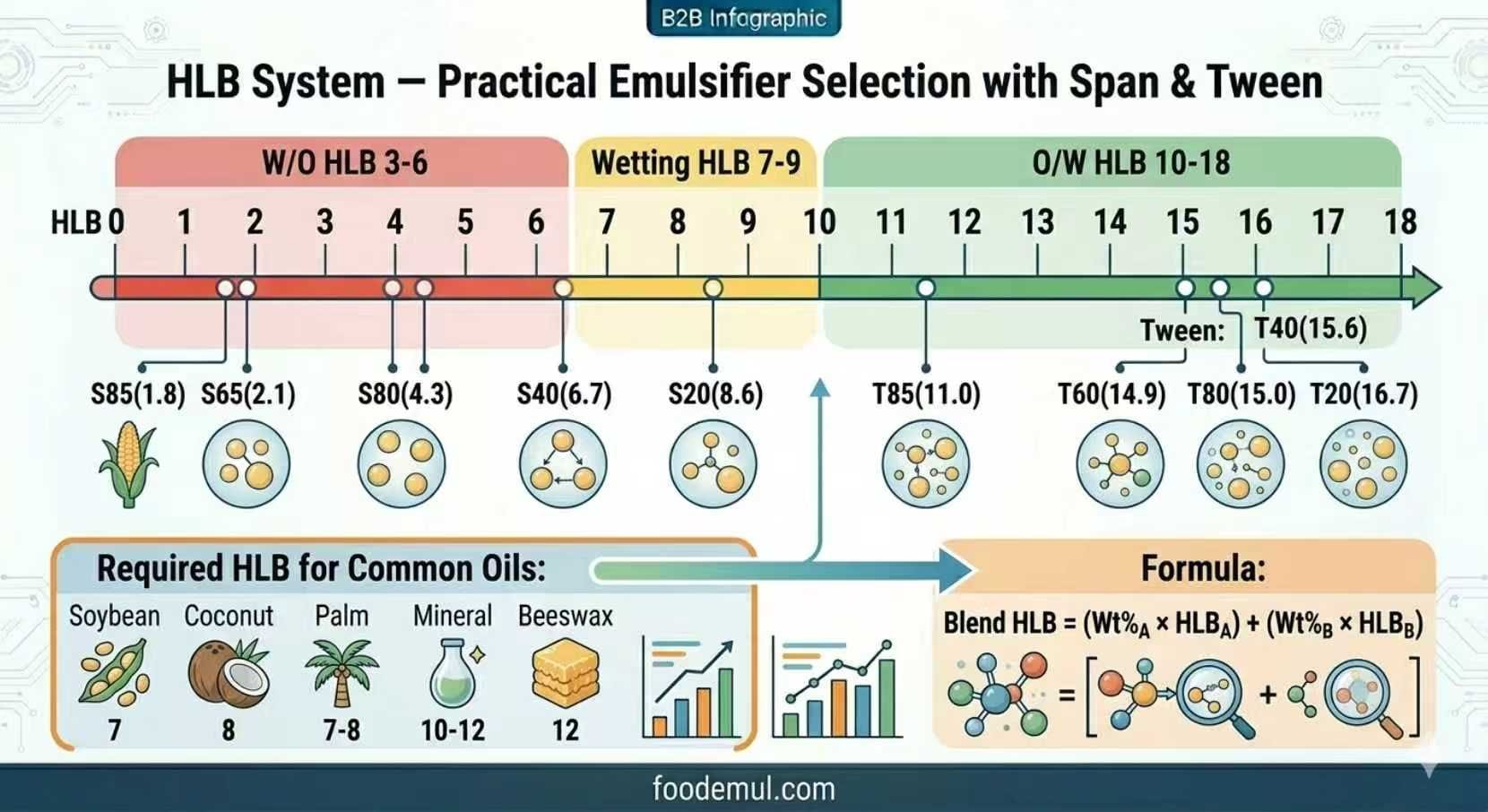
The Hydrophilic-Lipophilic Balance (HLB) system, developed by William C. Griffin for nonionic surfactants, assigns every emulsifier a number from 0 to 20 based on the molecular weight ratio of the hydrophilic portion to the total molecule. An HLB of 0 represents a fully lipophilic (oil-soluble) molecule; 20 represents a fully hydrophilic (water-soluble) molecule (Hu et al., 2011).
The HLB number directly predicts emulsifier behavior:
| HLB Range | Behavior | Emulsion Type | Span/Polysorbate Examples |
|---|---|---|---|
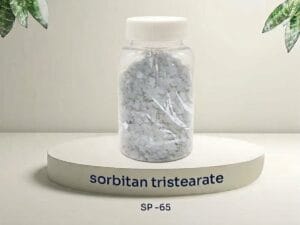
| 0-3 | Strongly lipophilic | Antifoaming agents | Span 65 (2.1) |
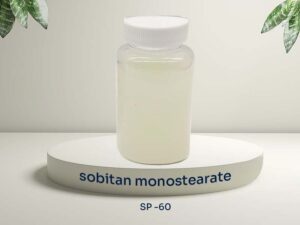
| 3-6 | Lipophilic | W/O emulsions (margarine, shortening) | Span 60 (4.7), Span 80 (4.3) |
| 6-9 | Balanced | Transitional — fat crystal structure matters more than HLB | Span 20 (8.6), Lecithin (4-7) |
| 9-12 | Moderately hydrophilic | General O/W emulsions (dressings, creams) | Balanced Span/Polysorbate blends |
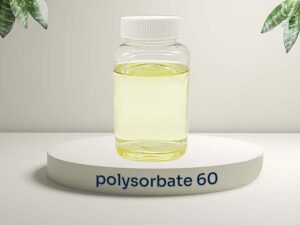
| 12-15 | Hydrophilic | Strong O/W emulsions (beverages, ice cream) | Polysorbate 60 (14.9), Polysorbate 80 (15.0) |
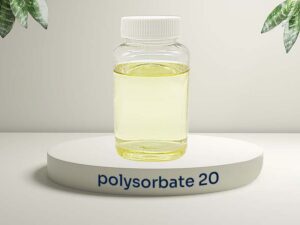
| 15-18 | Strongly hydrophilic | Fine O/W, flavor emulsions, clear beverages | Polysorbate 20 (16.7) |
| 18-20 | Near-fully hydrophilic | Solubilization, detergents | Not typical for food |
The HLB system’s practical value is simple: instead of guessing which emulsifier to use, you calculate the HLB your oil phase needs and match it. If you are new to food emulsifiers, start with our guide to food emulsifier functions and applications.
The Span/Polysorbate HLB Spectrum
The Span (sorbitan esters) and Polysorbate (polysorbates) families together cover the full practical HLB range for food applications — from Span 65 at 2.1 to Polysorbate 20 at 16.7. This makes them a uniquely complete emulsifier toolkit.
| Emulsifier | Chemical Name | HLB | E-number | Primary Use |
|---|---|---|---|---|
| Span 65 | Sorbitan Tristearate | 2.1 | E492 | Ultra-low HLB: chocolate, high-fat systems |
| Span 80 | Sorbitan Monooleate | 4.3 | E494 | W/O: spreads, sauces, confectionery |
| Span 60 | Sorbitan Monostearate | 4.7 | E491 | W/O: margarine, shortening, cake gel |
| Span 40 | Sorbitan Monopalmitate | 6.7 | E495 | Transitional: emulsifier blends |
| Span 20 | Sorbitan Monolaurate | 8.6 | E493 | Low O/W: dressings, sauces |
| Polysorbate 80 | Polysorbate 80 | 15.0 | E433 | O/W: beverages, ice cream, general |
| Polysorbate 60 | Polysorbate 60 | 14.9 | E435 | O/W: cakes, whipped toppings, creams |
| Polysorbate 40 | Polysorbate 40 | 15.6 | E434 | O/W: protein drinks, low-fat systems |
| Polysorbate 20 | Polysorbate 20 | 16.7 | E432 | O/W: flavor emulsions, solubilization |
For detailed Span specifications, see our Sorbitan Esters formulation guide. For Polysorbate specifications, see our Polysorbate comprehensive guide.
The HLB Additive Principle — How Blending Works
The single most useful property of the HLB system is that HLB values are additive by weight. When you blend two emulsifiers, the effective HLB of the blend is the weighted average of the individual HLB values:
HLB_effective = (Fraction_A × HLB_A) + (Fraction_B × HLB_B)
Worked Example: Targeting HLB 10 for a Cake Batter
You need an effective HLB of 10 for a sponge cake oil phase (shortening + egg fat). You’ll use Span 60 (HLB 4.7) and Polysorbate 60 (HLB 14.9).
Let X = fraction of Polysorbate 60, then (1 – X) = fraction of Span 60.
HLB_target = X × 14.9 + (1 – X) × 4.7 = 10
X × 14.9 + 4.7 – X × 4.7 = 10
X × 10.2 = 5.3
X = 0.52
Result: 52% Polysorbate 60 + 48% Span 60 → effective HLB 10.0. Practical ratio: Span 60 : Polysorbate 60 ≈ 1 : 1.1.
A ternary blend including GMS (HLB ~4) would require recalculating with a three-term equation. Our Compound Emulsifiers guide covers ternary blend design in detail.
Required HLB Values for Common Food Oils
Each oil phase has a specific required HLB — the HLB value at which an emulsifier system produces the most stable emulsion. These values were determined experimentally and serve as starting points for formulation:
| Oil / Fat Phase | Required HLB (O/W Emulsion) | Required HLB (W/O Emulsion) |
|---|---|---|
| Butterfat | 9-10 | 4-5 |
| Soybean oil | 7 | 5-6 |
| Corn oil | 8-10 | 4-6 |
| Cottonseed oil | 10 | 5 |
| Palm oil | 7-8 | 4-5 |
| Cocoa butter | 6-7 | 3-4 |
| Coconut oil | 8-10 | 5-6 |
| Lard | 5-6 | 4 |
| Mineral oil (paraffin) | 10-12 | 4-6 |
| Essential oils (flavor) | 12-15 | — |
| Oleic acid | 14-16 | — |
For mixed oil phases — which most food products contain — calculate the required HLB by the same weighted average method. If your fat phase is 60% palm oil (required HLB 7.5) and 40% butterfat (required HLB 9.5), the blend required HLB = 0.6 × 7.5 + 0.4 × 9.5 = 8.3.
Step-by-Step HLB-Based Emulsifier Selection
Step 1: Characterize the Oil Phase
List every fat and oil in the product, their weight percentages, and individual required HLB values. Calculate the weighted average.
Step 2: Select a Span/Polysorbate Pair
Match the fatty acid chain of the emulsifier to the dominant fat in the system:
– Stearic (C18:0) fats (shortening, palm stearin) → Span 60 / Polysorbate 60
– Oleic (C18:1) fats (liquid oils, butterfat, lard) → Span 80 / Polysorbate 80
– Lauric (C12:0) fats (coconut, palm kernel) → Span 20 / Polysorbate 20
Step 3: Calculate the Ratio
Use the HLB additive equation to find the Span:Polysorbate ratio that hits the target.
Step 4: Test 3 Variants
Prepare emulsions at the calculated ratio, 10% more Span, and 10% more Polysorbate. Evaluate by centrifugation (3,000 rpm, 15 min) and visual inspection after 24 hours.
Step 5: Optimize with Co-emulsifiers
Add 5-10% propylene glycol or glycerol to the emulsifier phase. Test ternary blends with GMS (3-5% of emulsifier weight) for starch complexation in baked goods.
Our Span & Polysorbate formulators guide includes full formulation methodology.
Practical Formulation Examples
| Product | Oil Phase | Required HLB | Span/Polysorbate System | Effective HLB | Span:Polysorbate Ratio |
|---|---|---|---|---|---|
| Cake batter | Shortening + egg fat | 9-10 | Span 60 + Polysorbate 60 | 10.0 | ~1:1.1 |
| Ice cream mix | Butterfat | 9-12 | Span 80 + Polysorbate 80 | 10.5 | 1:2 |
| Bread dough | Shortening (solid fat) | 4-6 (W/O dominant) | Span 60 + Polysorbate 60 | 5.5 | 2.5:1 |
| Beverage flavor emulsion | Essential oils | 14-16 | Span 20 + Polysorbate 20 | 15.0 | 1:6 |
| Margarine | Hydrogenated vegetable oil | 3-6 (W/O) | Span 60 + Polysorbate 60 | 4.8 | 6:1 |
| Salad dressing | Soybean oil | 8-10 | Span 80 + Polysorbate 80 | 9.0 | 1:1.5 |
| Whipped topping | Hydrogenated palm kernel | 8-12 | Span 60 + Polysorbate 60 | 10.0 | 1:2 |
What the HLB System Does NOT Tell You
The HLB system is a starting point, not a complete formulation solution. It has known limitations that formulators should understand:
Molecular Compatibility Is Not Captured by HLB
Two emulsifiers with similar HLB values but different molecular structures (e.g., Span 60 at HLB 4.7 and GMS at HLB 4.0) produce different mixed interfacial films. HLB tells you how hydrophilic an emulsifier is; it does not tell you how well two emulsifier molecules pack together at the interface. This is why “similar molecular structure” is a separate formulation principle — covered in our Compound Emulsifiers guide.
HLB Ignores Processing Conditions
An HLB calculation assumes static equilibrium at room temperature. Real food processing introduces heat, shear, pH shifts, and ionic strength changes that shift the effective behavior of emulsifiers. DATEM (E472e), for example, behaves differently at 4 °C vs 40 °C, and HLB cannot capture this.
The Griffin Scale Was Designed for Nonionic Emulsifiers
Ionic emulsifiers (SSL, CSL, DATEM) have HLB values assigned by analogy to nonionic emulsifiers, but their charge-based stabilization mechanisms operate differently from the steric stabilization that the HLB system was built to predict. Ionic emulsifiers often require experimental optimization beyond what HLB calculations suggest.
Required HLB Values Are Approximate
The required HLB values for oil phases (section 4) are experimentally determined averages — not physical constants. Different sources report different values. The true required HLB for your specific oil depends on the oil’s fatty acid profile, degree of unsaturation, and the presence of minor components like free fatty acids and mono-diglycerides.
For a real-world worked example, see our milk emulsification guide blending GMS, Span 60, and Polysorbate 60 to hit HLB 9.0.
Key Takeaways
- The HLB system is the fastest way to get to a working formulation. It reduces the search space from “try every emulsifier” to “try 3 ratios around the calculated value. For a worked example — pure milk at HLB 9.0 with GMS, Span 60, and polysorbate 80 — see our milk emulsifier formulation walkthrough.”
- The Span/Polysorbate family covers HLB 2.1 to 16.7 — a single supplier portfolio that services everything from high-fat W/O margarine to clear O/W beverage emulsions.
- HLB values are additive by weight. The effective HLB of a blend is the weighted average. This means one Span and one Polysorbate can produce any HLB between their individual values.
- Match the fatty acid chain, not just the HLB number. Span 60/Polysorbate 60 (stearic, C18:0) for bakery fats; Span 80/Polysorbate 80 (oleic, C18:1) for dairy and liquid oils.
- HLB gets you close. Testing gets you there. Always run 3 ratio variants around the calculated value.
- HLB is a starting tool, not a guarantee of stability. Molecular compatibility, processing conditions, and co-emulsifier effects all contribute to the final result.
For detailed formulation guidance combining HLB with the broader principles of emulsifier design, see our guides on Compound Emulsifiers and O/W vs W/O Emulsions.
Need help with your HLB calculations? We manufacture Span 60, Polysorbate 80, and the full sorbitan ester range — reach out for technical support or samples.