

Single emulsifiers do one thing well. The problem is, real food products need three or four things at the same time — aeration, foam stability, crumb softening, and freeze-thaw survival — and no single emulsifier delivers all of them. That’s why compound emulsifiers exist: blends of two or more emulsifiers in specific ratios, designed to cover every interface in the product from mixing bowl to shelf. At FoodEmul, we manufacture the most studied compound emulsifier pair in the industry: sorbitan esters (Span) and polysorbates (polysorbate). This guide covers the six formulation principles that govern how they work together, plus practical ratios for cake gel, ice cream, bread, and beverages.
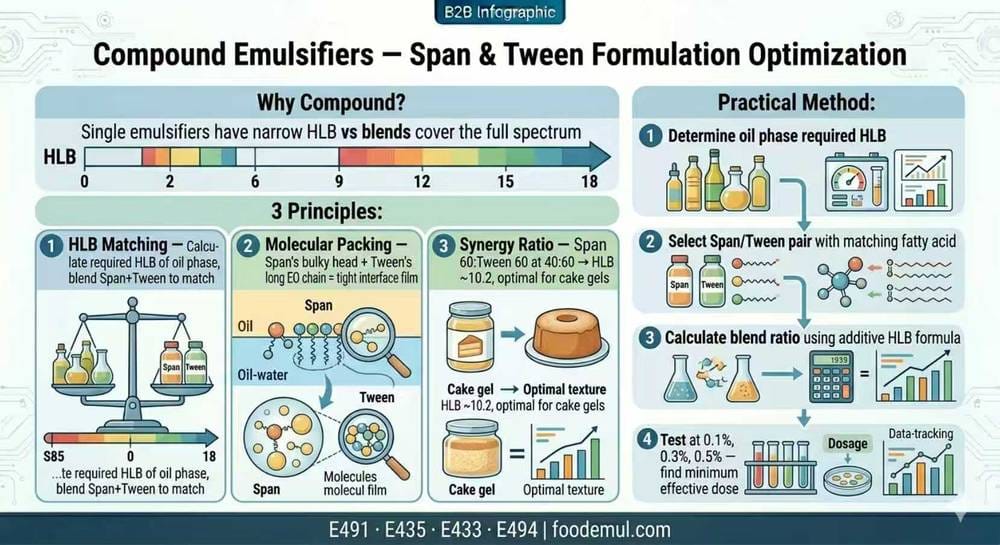
Why Compound? The Limits of Single Emulsifiers
A single emulsifier has one HLB value, one molecular geometry, and one dominant function. Real food systems are more demanding. A cake batter needs both rapid aeration (high HLB) and foam stability during baking (low HLB). An ice cream mix needs fat destabilization (low-mid HLB) plus air cell stabilization (mid-high HLB). No single emulsifier delivers both.
Compound emulsifiers — blends of two or more emulsifiers in specific ratios — solve this by combining complementary functionalities into one system. The evidence is consistent: emulsifier blends outperform single emulsifiers in emulsion stability, interfacial film strength, and product quality across baking, dairy, confectionery, and beverage applications (Hu et al., 2011).
The most extensively studied pair is Span (sorbitan esters) + Polysorbate (polysorbate). They share the same fatty acid backbone — Span 60 and Polysorbate 60 both derive from stearic acid — which means their molecular structures are naturally compatible. Their HLB values span nearly the full practical range (4.7 to 14.9), giving formulators precise control. If you are new to these emulsifiers, start with our guide to food emulsifier functions.
| Advantage of Compound Blends | What It Means in Practice |
|---|---|
| Stronger interfacial film | Low-HLB and high-HLB emulsifiers pack more densely at the interface than either alone |
| Wider HLB coverage | A single blend can stabilize both fat-in-water and air-in-water interfaces |
| Synergistic effects | Span/Polysorbate pairs show measurable synergy — the blend outperforms the sum of its parts |
| Lower total dosage | More efficient emulsification means less emulsifier needed overall |
| Finer droplet/air cell distribution | Tighter packing at the interface produces smaller, more uniform dispersed-phase particles |
| Better process tolerance | Blends resist pH, temperature, and shear fluctuations better than single emulsifiers |
The Span/Polysorbate Pair: A Foundation for Compound Blends
Why Span and Polysorbate Work Together
Span emulsifiers (sorbitan esters) and Polysorbate emulsifiers are the most logical starting point for compound emulsifier design because they satisfy the two strongest predictors of blend synergy:
Molecular similarity. Span 60 (sorbitan monostearate) and Polysorbate 60 share an identical fatty acid chain — stearic acid, C18:0. When these molecules co-adsorb at an interface, they pack more densely than dissimilar molecules, forming a mixed film of greater mechanical strength. Our Span & Polysorbate formulators guide covers the full range of combinations.
Complementary HLB. Span 60 has an HLB of 4.7 (strongly lipophilic). Polysorbate 60 has an HLB of 14.9 (strongly hydrophilic). By blending them at different ratios, a formulator can achieve any effective HLB between these extremes — far more precisely than choosing a single emulsifier with an approximate target HLB.
Span/Polysorbate Compound Pairs at a Glance
| Span Emulsifier | HLB | Polysorbate Partner | HLB | Shared Fatty Acid | Best Applications |
|---|---|---|---|---|---|
| Span 60 (Sorbitan Monostearate, E491) | 4.7 | Polysorbate 60 (E435) | 14.9 | Stearic (C18:0) | Cake gel, bread, margarine, whipped toppings |
| Span 80 (Sorbitan Monooleate, E494) | 4.3 | Polysorbate 80 (E433) | 15.0 | Oleic (C18:1) | Ice cream, beverages, sauces, dressings |
| Span 20 (Sorbitan Monolaurate, E493) | 8.6 | Polysorbate 20 (E432) | 16.7 | Lauric (C12:0) | Low-fat systems, protein drinks, flavor emulsions |
| Span 65 (Sorbitan Tristearate, E492) | 2.1 | Polysorbate 60 (E435) | 14.9 | Stearic (C18:0) | High-fat systems, chocolate, shortening |
The Span 60/Polysorbate 60 pair is the most widely used in baking because stearic acid (C18:0) matches the fatty acid profile of common bakery shortenings. See our Polysorbate 60 comprehensive guide and Sorbitan Esters formulation guide for detailed specifications.
Six Formulation Principles for Compound Emulsifiers
HLB Balancing — The Primary Tuning Knob
The Hydrophilic-Lipophilic Balance (HLB) system assigns a number to every emulsifier based on the ratio of hydrophilic to lipophilic groups. For compound blends, the effective HLB is the weighted average:
Effective HLB = (Fraction_A × HLB_A) + (Fraction_B × HLB_B)
For example, a blend of 40% Span 60 (HLB 4.7) and 60% Polysorbate 60 (HLB 14.9) produces an effective HLB of approximately 10.8 — ideal for O/W emulsions requiring strong interfacial film stability.
The art of compound emulsifier design starts with matching the effective HLB to the oil phase:
| Food System | Oil Phase | Required HLB | Recommended Span/Polysorbate Ratio |
|---|---|---|---|
| Cake batter (sponge) | Shortening + egg fat | 8-10 | Span 60:Polysorbate 60 = 1:1.5 to 1:2.5 |
| Ice cream mix (dairy) | Butterfat | 8-12 | Span 80:Polysorbate 80 = 1:1.5 to 1:3 |
| Bread dough | Shortening | 4-6 | Span 60:Polysorbate 60 = 2:1 to 3:1 |
| Beverage flavor emulsion | Essential oils | 12-15 | Polysorbate-dominant (Span:Polysorbate = 1:5+) |
| Margarine (W/O) | Hydrogenated vegetable oil | 3-6 | Span-dominant (Span:Polysorbate = 4:1 to 6:1) |
For a deeper dive into HLB theory, see our Polysorbate 80 formulation guide which covers the HLB additive principle in detail.
Molecular Structure Similarity
Emulsifiers with similar lipophilic groups form stronger mixed interfacial films than dissimilar ones. Span 60 and Polysorbate 60 share the stearic acid chain (C18:0); Span 80 and Polysorbate 80 share the oleic acid chain (C18:1). This structural compatibility means the molecules align more densely at the interface, producing measurably lower interfacial tension than the weighted HLB average alone would predict.
Rule of thumb: Match the fatty acid chain length and saturation to the fat phase in your product. For bakery fats high in stearic and palmitic acids, the Span 60/Polysorbate 60 system performs best. For dairy systems higher in oleic acid, the Span 80/Polysorbate 80 system is often a better match. Our Span 60/65 comparison guide explains how fatty acid chain length affects performance.
Ionic Complementarity
Food emulsifiers fall into three charge categories:
| Category | Examples | Characteristics |
|---|---|---|
| Nonionic | Span, Polysorbate, GMS, PGMS, sucrose esters | pH-stable, broad compatibility, most commonly used |
| Anionic | SSL (E481), CSL (E482), DATEM (E472e) | Strong emulsification, dough conditioning, lower cost |
| Amphoteric | Lecithin (E322) | Natural origin, clean-label, pH-dependent charge |
Nonionic emulsifiers (Span/Polysorbate) form the backbone of most compound blends because of their broad pH compatibility. However, adding a small proportion of an anionic emulsifier (e.g., 10-20% SSL or DATEM) to a Span/Polysorbate-dominant blend can further enhance interfacial film strength and heat stability — particularly in baked goods where dough conditioning is also needed.
Hydrophilic Group Conformational Complementarity
Emulsifiers with differently shaped hydrophilic head groups can pack together more efficiently at the interface than those with identical head groups. Span emulsifiers have a compact cyclic sorbitan head group, while Polysorbate emulsifiers have extended polyoxyethylene chains. This conformational difference is actually an advantage — the bulky Polysorbate chains create steric stabilization between droplets while the compact Span heads allow dense packing at the oil side of the interface.
The same principle applies when adding GMS (glycerol monostearate, a linear molecule) to a Span/Polysorbate blend — the linear glycerol head group occupies interfacial space differently, further densifying the mixed film.
Co-emulsifiers — Amplifying the Blend
Co-emulsifiers are polar organic molecules — typically propylene glycol, glycerol, D-sorbitol, or ethanol — that don’t emulsify on their own but enhance the performance of primary emulsifiers:
- Reduce interfacial tension further than the primary emulsifier alone
- Increase interfacial film fluidity, helping emulsifier molecules migrate to newly formed interfaces faster during mixing
- Adjust the effective HLB of the system without changing the primary emulsifier ratio
- Prolong emulsifier activity by preventing crystallization of the emulsifier at the interface
In cake gel systems, propylene glycol at 5-10% of the compound emulsifier weight is standard — it keeps the Span/Polysorbate blend working through the full baking cycle, from cold batter to hot oven.
Target-Product Tailoring
The final principle is the most practical: design the blend for the product, not the other way around. Each food system imposes constraints:
| Product Constraint | Emulsifier Implication |
|---|---|
| Low pH (e.g., dressings, juice) | Avoid pH-sensitive esters; prefer nonionic Span/Polysorbate |
| High-temperature processing | Select emulsifiers with melting points above process temperature |
| Freeze-thaw distribution | Span-dominant blends maintain W/O stability during freezing |
| High-shear mixing | Polysorbate-rich blends provide faster interfacial coverage |
| Long shelf life (>12 months) | Blend with multiple hydrophilic group conformations for film density |
Practical Formulation Methodology
The HLB-Based Design Workflow
- Characterize the oil phase. Identify all fats and oils, their approximate weight fractions, and their individual required HLB values.
- Calculate the required HLB for the oil blend by weighted average.
- Select a Span/Polysorbate pair whose fatty acid chain matches the dominant fat in the system.
- Calculate the Span:Polysorbate ratio that delivers the target effective HLB.
- Prepare small-scale test blends at 3 ratios (calculated, calculated ±10%) with a co-emulsifier at 5-10%.
- Evaluate emulsion stability by visual inspection, centrifugation, or microscopy.
- Adjust and re-test until optimal stability is achieved.
Dosage Ranges by Product Category
| Product Category | Total Compound Emulsifier (% of formula weight) | Typical Span/Polysorbate Ratio |
|---|---|---|
| Cake gels | 1-5% of batter weight | Span 60:Polysorbate 60 = 1:1.5 to 1:3 |
| Ice cream | 0.1-0.3% of mix weight | Span 80:Polysorbate 80 = 1:1.5 to 1:2.5 |
| Bread | 0.3-1.0% of flour weight | Span 60:Polysorbate 60 = 2:1 to 4:1 |
| Beverage flavor emulsions | 0.05-0.2% | Polysorbate-dominant, Span:Polysorbate = 1:5+ |
| Margarine/shortening | 0.5-2.0% | Span-dominant, Span:Polysorbate = 4:1+ |
| Whipped toppings | 0.3-0.8% | Span 60:Polysorbate 60 = 1:2 to 1:3 |
The GMS Third Component
Many industrial compound emulsifiers are ternary blends. Glycerol Monostearate (GMS) is the most common third component, valued for its anti-staling function via starch complexation. In cake gel systems, a practical starting formula:
Span 60 : Polysorbate 60 : GMS = 1 : 2 : 3 (by weight)
Hydrated in propylene glycol at 20-30% total solids. This ratio produces an effective HLB around 9-10 — ideal for sponge cake — while GMS provides the starch-complexing anti-staling mechanism that Span and Polysorbate alone cannot deliver.
See our Cake Gel Emulsifiers Complete Guide and Ice Cream Emulsifier Systems Guide for product-specific formulations.
Where Span/Polysorbate Compound Blends Excel
Cake Gel Systems
The classic Span 60/Polysorbate 60 compound emulsifier is the foundation of modern cake gel technology. Span 60 (HLB 4.7) anchors at the fat-air bubble interface providing foam stability during baking. Polysorbate 60 (HLB 14.9) drives rapid aeration during whipping. Together at a 1:2 ratio, they cut whipping time by 50-70%, increase cake volume by 30%, and extend shelf softness by 50-100% versus egg-only controls.
Ice Cream
The Span 80/Polysorbate 80 compound system controls fat destabilization — the critical partial-coalescence mechanism that builds ice cream body. Polysorbate 80 displaces milk proteins from fat globule surfaces. Span 80 reinforces the fat crystal network that stabilizes air cells. At 0.15-0.25% total dosage with a Span 80:Polysorbate 80 ratio of 1:2, manufacturers achieve drier texture, slower melt, and improved shape retention.
Bread & Baked Goods
Bread systems require lower HLB blends because the primary function is dough strengthening and crumb softening, not aeration. Span 60-dominant blends (Span 60:Polysorbate 60 = 2:1 to 3:1, effective HLB 7-9) interact with gluten proteins and starch granules, improving gas retention during proofing and crumb softness during storage. See our Bread Emulsifier Systems Guide for full formulation guidance.
Beverage Emulsions
Beverage systems sit at the opposite end of the HLB spectrum. Flavor oils and clouding agents require high-HLB emulsification. Polysorbate 80 or Polysorbate 20 dominates the blend (Span:Polysorbate = 1:5 to 1:10), with the small Span fraction providing interfacial film density to prevent Ostwald ripening. See our Beverage Emulsifier Systems Guide.
Common Formulation Mistakes
| Mistake | Why It Happens | How to Fix It |
|---|---|---|
| Over-reliance on HLB alone | HLB is a starting point, not a complete design system. Molecular similarity and conformation matter as much. | Test blends that share fatty acid chains with your fat phase, not just the right HLB number. |
| Wrong Span/Polysorbate pair for the fat system | C18:0 (Span 60) in a high-oleic dairy system won’t pack optimally. | Match the fatty acid: Span 60/Polysorbate 60 for stearic-rich fats; Span 80/Polysorbate 80 for oleic-rich. |
| Insufficient Span for heat stability | Polysorbate-only systems fail during baking because there is no low-HLB anchor. | Always include at least 20-30% Span in any blend that will see thermal processing. |
| Over-emulsification | Too much compound emulsifier creates a gummy, waxy mouthfeel and can accelerate staleness. | Start at the low end of the dosage range and increase only as needed. |
| Poor incorporation method | Dumping powder emulsifiers into cold liquid prevents proper hydration. | Pre-melt Span above 55 °C or pre-disperse in the oil phase. Polysorbate liquids can be added directly. |
| Neglecting co-emulsifiers | Pure Span/Polysorbate blends can crystallize at the interface over long storage. | Add 5-10% propylene glycol or glycerol to maintain interfacial film fluidity. |
Key Takeaways
- Single emulsifiers handle one interface. Compound blends handle all of them. Most industrial food products use compound emulsifiers for this reason.
- The Span/Polysorbate pair is the most reliable foundation — molecular similarity + full HLB coverage + decades of industrial validation.
- HLB calculation gets you in the right neighborhood. Testing gets you to the right ratio. Always prepare 3-5 ratio variants around the calculated value.
- Match the fatty acid chain to your fat phase. Stearic (C18:0) for bakery fats, oleic (C18:1) for dairy and liquid oil systems.
- A ternary blend (Span + Polysorbate + GMS) covers more bases than a binary one — GMS adds starch complexation that Span/Polysorbate alone cannot deliver.
- Process matters as much as formula. Pre-melt Span, add Polysorbate to the aqueous phase or at the emulsification stage, and use adequate shear for dispersion.
Compound emulsifier formulation is both science and craft. The HLB system provides the framework; molecular similarity, ionic complementarity, and product-specific constraints provide the refinement. For product-specific formulations, see our guides for cake gel, ice cream, bread, and beverage systems.
Need help with your compound emulsifier formulation? We manufacture Span 60, Polysorbate 80, and the full sorbitan ester range — reach out for technical support or samples.
